Paper I — Q8
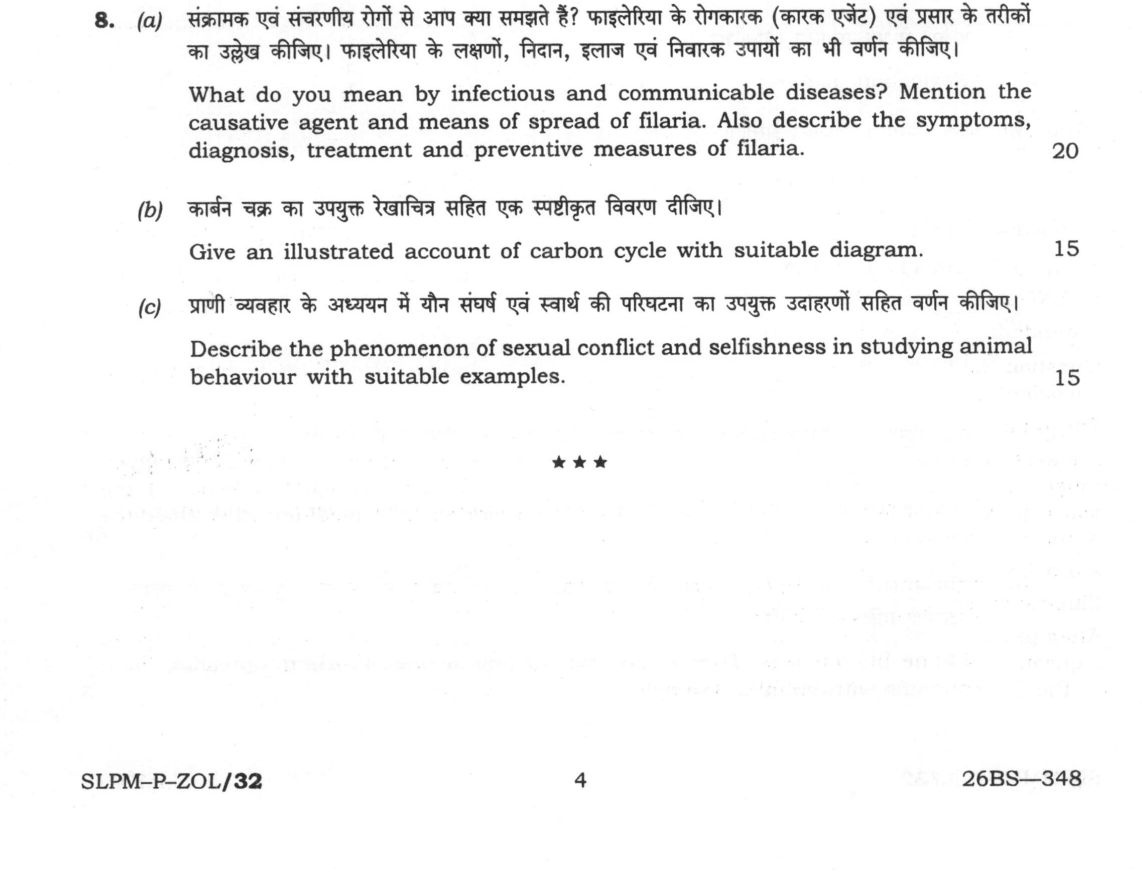
(a) What do you mean by infectious and communicable diseases? Mention the causative agent and means of spread of filaria. Also…
What do you mean by infectious and communicable diseases? Mention the causative agent and means of spread of filaria. Also describe the symptoms, diagnosis, treatment and preventive measures of filaria. 20 marks
Give an illustrated account of carbon cycle with suitable diagram. 15 marks
Describe the phenomenon of sexual conflict and selfishness in studying animal behaviour with suitable examples. 15 marks
हिंदी में प्रश्न पढ़ें
संक्रामक एवं संचारणीय रोगों से आप क्या समझते हैं? फाइलेरिया के रोगकारक (कारक एजेंट) एवं प्रसार के तरीकों का उल्लेख कीजिए। फाइलेरिया के लक्षणों, निदान, इलाज एवं निवारक उपायों का भी वर्णन कीजिए। 20
कार्बन चक्र का उपयुक्त रेखाचित्र सहित एक स्पष्टीकृत विवरण दीजिए। 15
प्राणी व्यवहार के अध्ययन में यौन संघर्ष एवं स्वार्थ की परिघटना का उपयुक्त उदाहरणों सहित वर्णन कीजिए। 15
Model answer
Written by UPSC Answer Check against this question's marking rubric, to the expected length. UPSC does not publish answers for Mains — this is one way to score well, not an official key.
Infectious and Communicable Diseases: Lymphatic Filariasis
An infectious disease is caused by the invasion and multiplication of pathogenic biological agents (bacteria, viruses, fungi, protozoa, or helminths) within a host tissue, regardless of transmission mode (e.g., tetanus). A communicable disease is a sub-class of infectious disease capable of being directly or indirectly transmitted from an infected host or reservoir to a susceptible individual (e.g., filariasis, tuberculosis).
Lymphatic filariasis is caused by thread-like tissue nematodes, predominantly Wuchereria bancrofti (responsible for 90% of global cases), Brugia malayi, and Brugia timori. The parasite is transmitted through the bite of infected female mosquito vectors, chiefly Culex quinquefasciatus in urban/semi-urban regions, Anopheles species in rural zones, and Mansonia species for Brugia. The infective third-stage larvae (L3) enter the human body via the bite puncture and migrate to the lymphatic system, maturing into adult worms.
Clinical manifestation occurs across three stages:
- Asymptomatic microfilaraemia, where individuals harbor microfilariae without outward symptoms but exhibit subclinical lymphatic and renal damage.
- Acute manifestations, including filarial fever, acute adenolymphangitis (ADL), and dermatolymphangioadenitis.
- Chronic pathology, marked by irreversible lymphoedema, hydrocele, chyluria, and severe elephantiasis of limbs or genitalia due to lymphatic obstruction and secondary bacterial infections.
Diagnosis relies on peripheral blood examination by thick blood smear collected at night (10 PM–2 AM) to match nocturnal microfilarial periodicity; Immunochromatographic Card Tests (ICT) and Filariasis Test Strips (FTS) for circulating filarial antigen (CFA); and high-frequency ultrasonography (USG) to visualize live adult worms ("filarial dance sign") in scrotal or breast lymphatics.
Treatment and control utilize anti-helminthics: Diethylcarbamazine (DEC), Albendazole, and Ivermectin (triple-drug therapy, IDA). Preventive measures operate under the National Vector Borne Disease Control Programme (NVBDCP) through Mass Drug Administration (MDA), vector management via indoor residual spraying, integrated drainage sanitation, and adopting a One Health surveillance framework.
Carbon Cycle and Biotic-Abiotic Fluxes
The global carbon cycle operates through interconnected geological, oceanic, atmospheric, and terrestrial pools. Atmospheric carbon dioxide (~870 GtC) is fixed into organic matter via terrestrial and marine photosynthesis (~120 GtC/year terrestrially; ~50 GtC/year marine). Autotrophic and heterotrophic respiration, alongside microbial decomposition of detritus, return CO2 to the atmosphere.
`` [ Atmospheric CO2 Pool (~870 GtC) ] ^ | ^ ^ Respiration | | Photosyn. | Respiration & Combustion | v | | +-------------+-- [Terrestrial]---+ | Marine | [Biomass & Soil] | Biol. Pump | | v [Fossil Fuels] <--------+ [Oceanic Reservoir] (Combustion) (Dissolved CO2, HCO3-, Sedimentary Carbonates) ``
In oceans (~38,000 GtC pool), carbon is regulated by physical solubility and the "biological pump," where phytoplankton sequester carbon that eventually precipitates as carbonate sediments on the seafloor. Anthropogenic perturbations—primarily fossil fuel combustion and land-use changes—release ~10 GtC/year, exceeding natural sink capacities, emphasizing biological carbon sequestration as an imperative for climate mitigation policy.
Sexual Conflict and Selfishness in Animal Behaviour
Sexual conflict arises from evolutionary disagreements between sexes over reproductive investments, optimal mating rates, and parental care. It operates at two levels: intralocus conflict, where the same genetic locus under sexually antagonistic selection pulls traits away from sex-specific optima, and interlocus conflict, involving interactions between different loci expressed in males and females.
Selfish genetic elements exacerbate conflict through segregation distorters and meiotic drive systems (such as the *t*-haplotype in mice or SD locus in Drosophila), which bias transmission in their favour despite imposing host fitness costs.
Interlocus conflict drives chase-away sexual selection and morphological arms races:
- Drosophila melanogaster: Male seminal fluid contains accessory gland proteins (Acps, e.g., sex peptide) that enhance male sperm competitiveness and stimulate female egg laying, but reduce female longevity and remating propensity.
- Gerris (water striders): Males possess grasping abdominal claspers for coercive mating, against which females evolve anti-grasping spines and abdominal modifications to resist energetically costly surplus matings.
- Cimex lectularius (bedbugs): Males bypass the reproductive tract via traumatic insemination through the female abdominal wall; females evolve the spermalege to minimize physiological damage and immune pathogen risk.
- Stalk-eyed flies (Cyrtodiopsis): Male eye-span acts as an indicator of resistance to selfish X-linked meiotic drive genes, driving female preference.
Females resolve male coercive strategies via cryptic female choice and post-copulatory physiological filtering. Understanding sexual conflict is critical in evolutionary biology and conservation breeding, where captive pair-bonding mismatches can trigger severe reproductive depression.
What "Describe" is asking you to do
Give a full, ordered account of the thing named — its parts, stages or mechanism — in the sequence in which it actually exists or occurs. Most describe questions come from the science optionals, where the marks sit in correct technical detail and, where the stem says so, a labelled diagram.
Structure that answers it
One-line identification of the subject → the parts or stages in their real order, each with its defining detail → labelled diagram where the subject is structural → closing line on function or significance
Where marks are lost
Loose general prose where the examiner is ticking named parts, correct terminology and their sequence; and in the General Studies papers, turning to evaluation before the description is finished.
How this answer will be evaluated
Approach
(a) describe: define > structure or process in order > labelled diagram > significance | (b) describe: define > structure or process in order > labelled diagram > significance | (c) describe: define > structure or process in order > labelled diagram > significance Full marks: Precise definitions, named species, labelled diagrams, evolutionary links, and specific examples throughout.
Key points expected
- Define infectious vs communicable diseases
- Identify Wuchereria bancrofti as causative agent
- Explain Culex mosquito vector transmission
- List symptoms, diagnosis, treatment, and prevention
- Draw labelled carbon cycle diagram
- Explain photosynthesis and respiration
- Describe fossil fuel combustion
- Mention oceanic carbon exchange
Evaluation rubric
Each sub-part is marked on its own, against the marks and word limit printed on the paper.
- (a) Define infectious/communicable diseases and detail filaria's agent, spread, symptoms, diagnosis, treatment, and prevention. 20 marks
describe— define → structure or process in order → labelled diagram → significance
Must cover
- Define infectious vs communicable diseases
- Identify Wuchereria bancrofti as causative agent
- Explain Culex mosquito vector transmission
- List symptoms, diagnosis, treatment, and prevention
Loses marks
- Confusing filaria with malaria
- Omitting vector species name
- Vague prevention measures
Earns more
- Mention microfilaria periodicity
- Name specific drugs like DEC
- Describe lymphatic obstruction mechanism
- Mention mass drug administration
Extra mark
- Mention Brugia malayi as secondary agent
- Reference specific WHO elimination targets
- (b) Provide an illustrated account of the carbon cycle with a suitable diagram. 15 marks
describe— define → structure or process in order → labelled diagram → significance
Must cover
- Draw labelled carbon cycle diagram
- Explain photosynthesis and respiration
- Describe fossil fuel combustion
- Mention oceanic carbon exchange
Loses marks
- Diagram without labels
- Omitting key processes
- Confusing carbon with nitrogen cycle
Earns more
- Include decomposition process
- Mention sedimentation and lithification
- Link to greenhouse effect
- Label reservoirs clearly
Extra mark
- Mention specific carbon reservoir sizes
- Reference recent carbon cycle models
- (c) Describe sexual conflict and selfishness in animal behaviour with suitable examples. 15 marks
describe— define → structure or process in order → labelled diagram → significance
Must cover
- Define sexual conflict concept
- Explain selfishness in behaviour
- Provide specific animal examples
- Link to evolutionary theory
Loses marks
- Vague examples without species
- Confusing with general aggression
- Omitting evolutionary context
Earns more
- Mention sperm competition
- Describe mate guarding behaviour
- Reference kin selection
- Include reciprocal altruism
Extra mark
- Cite specific species studies
- Reference recent behavioural research
Practice this exact question
Write your answer and it is marked point by point against the model answer above — what you covered, what you missed, what you got wrong.
Evaluate my answer →More from Zoology 2025 Paper I
- Q5 Write short notes on the following in about 150 words each: 10×5=50 (a) Biodiversity hot…
- Q6 (a) Define air pollution. Explain the types, sources, consequences and control measures o…
- Q7 (a) What is Student's t-test and its significance in biological research? Write the formu…
- Q8 (a) What do you mean by infectious and communicable diseases? Mention the causative agent…