Paper I — Q2
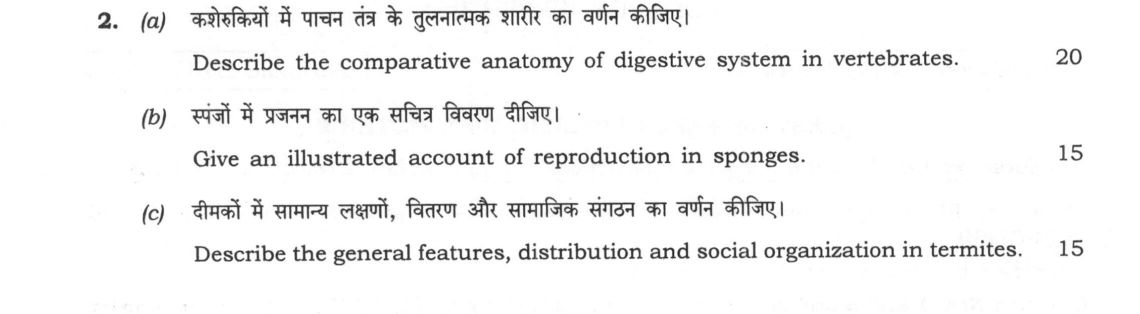
(a) Describe the comparative anatomy of digestive system in vertebrates. 20 (b) Give an illustrated account of reproduction in…
Describe the comparative anatomy of digestive system in vertebrates. 20 marks
Give an illustrated account of reproduction in sponges. 15 marks
Describe the general features, distribution and social organization in termites. 15 marks
हिंदी में प्रश्न पढ़ें
कशेरुकियों में पाचन तंत्र के तुलनात्मक शारीर का वर्णन कीजिए। 20
स्पंजों में प्रजनन का एक सचित्र विवरण दीजिए। 15
दीमकों में सामान्य लक्षणों, वितरण और सामाजिक संगठन का वर्णन कीजिए। 15
Model answer
Written by UPSC Answer Check against this question's marking rubric, to the expected length. UPSC does not publish answers for Mains — this is one way to score well, not an official key.
Comparative anatomy of vertebrate digestion. The vertebrate alimentary canal shows progressive differentiation from a simple tube in agnathans to a highly specialized system in mammals. Cyclostomes have a short gut, an intra-oral tongue and keratinized teeth; many lack a true stomach and a well-developed gall bladder. In gnathostomes the jawed mouth, distinct stomach and accessory glands appear; the alimentary tract becomes more differentiated, and the liver and pancreas become more organized. Chondrichthyes have a spiral valve in the intestine; many teleosts have a J-shaped stomach, but cyprinids such as Labeo rohita are stomachless and have a straight intestine. In bony fishes the gall bladder is common; in Labeo rohita the stomach is absent. Amphibians have a short intestine, a liver and pancreas; the liver is large and the pancreas is small. Reptiles show a more muscular stomach; crocodilians have a complete interventricular septum, while Naja naja has a highly modified gut; the liver is larger and the pancreas is more distinct. Birds possess a crop, gizzard, short intestine and cloaca; the liver is large and the pancreas is small. Mammals have differentiated dentition, a complex stomach in ruminants such as Bos indicus, an elongated intestine and a caecum; a vermiform appendix occurs in some mammals but is absent in ruminants. The liver is lobed, the gall bladder is present in most mammals, and the pancreas is well developed; in ruminants the stomach is divided into rumen, reticulum, omasum and abomasum. Accessory glands are progressively developed: the liver, supplied by the hepatic portal system, secretes bile; the gall bladder stores it; the pancreas has exocrine ducts for enzymes and endocrine islets for insulin and glucagon.
Reproduction in sponges. Sponges reproduce asexually by budding, fragmentation and gemmule formation. External buds arise from the outer surface; internal buds develop within the body. In unfavourable conditions, especially in freshwater sponges such as Ephydatia/Eunapius, thesocytes form gemmules: a mass of archaeocytes enclosed in a resistant spicule coat; after dormancy, a single cell emerges and regenerates a sponge. Sexually, sponges are mostly oviparous, some viviparous. Spermatozoa are released into water and, by water currents, enter other sponges through oscula, where they are carried by choanocytes to ova; fertilization is internal. The zygote develops into an amphiblastula, with flagellated micromeres at one pole and non-flagellated macromeres at the other, or into a parenchymula larva, a free-swimming mass of amoeboid cells. In the amphiblastula, the flagellated micromeres become the inner choanoderm and the non-flagellated macromeres become the outer pinacoderm; in the parenchymula, amoeboid cells differentiate into pinacocytes and choanocytes.
Termites. Termites are soft-bodied, polymorphic, hemimetabolous insects, usually cryptic, living in soil, wood or leaf litter. They are distributed from tropical to temperate regions; in India Coptotermes and Odontotermes occur, causing agricultural and structural damage. Social organization is based on castes. The reproductive caste includes the king and queen, and in some species neotenics that can become supplementary reproductives. Sterile castes include workers, which feed, build and care for brood, and soldiers, which defend the colony; soldiers may be mandibulate or nasute. Caste differentiation is regulated by pheromones, and workers exchange food by trophallaxis; in lower termites this may also transfer symbionts. Digestion is often symbiotic: lower termites harbour hindgut flagellates such as Trichonympha and Holomastigotoides that break down cellulose; higher termites such as Odontotermes lack these flagellates and cultivate fungi. Odontotermes builds mounds with chambers for fungal gardens. Termites are pests but also soil engineers, improving aeration and nutrient cycling.
Across all three, evolution shows increasing specialization: vertebrate digestive systems become more compartmentalized, sponges retain simple cell-level reproduction with regenerative gemmules, and termites achieve complex social and symbiotic adaptations for resource use.
What "Describe" is asking you to do
Give a full, ordered account of the thing named — its parts, stages or mechanism — in the sequence in which it actually exists or occurs. Most describe questions come from the science optionals, where the marks sit in correct technical detail and, where the stem says so, a labelled diagram.
Structure that answers it
One-line identification of the subject → the parts or stages in their real order, each with its defining detail → labelled diagram where the subject is structural → closing line on function or significance
Where marks are lost
Loose general prose where the examiner is ticking named parts, correct terminology and their sequence; and in the General Studies papers, turning to evaluation before the description is finished.
How this answer will be evaluated
Approach
Framework: UPSC Zoology Paper 1. (a) describe: define > structure or process in order > labelled diagram > significance | (b) describe: define > structure or process in order > labelled diagram > significance | (c) describe: define > structure or process in order > labelled diagram > significance Full marks: Comprehensive, comparative, and well-illustrated with precise terminology.
Key points expected
- Morphology of mouthparts and pharynx
- Structure of stomach and intestine
- Accessory glands (liver, pancreas)
- Comparative table or labelled diagram
- Asexual reproduction (budding, fragmentation)
- Sexual reproduction (gametogenesis)
- Internal fertilization and larval development
- Labelled diagrams of life cycle
Evaluation rubric
Each sub-part is marked on its own, against the marks and word limit printed on the paper.
- (a) Comparative anatomical analysis of the vertebrate digestive tract. 20 marks
describe— define → structure or process in order → labelled diagram → significance
Must cover
- Morphology of mouthparts and pharynx
- Structure of stomach and intestine
- Accessory glands (liver, pancreas)
- Comparative table or labelled diagram
Loses marks
- Unlabelled diagrams
- General description without comparison
- Omission of accessory glands
Earns more
- Specific examples (e.g., ruminant vs. carnivore)
- Adaptations to specific diets
- Evolutionary trends in gut length
Extra mark
- Mention of specific species (e.g., *Bos taurus*)
- Reference to specific anatomical landmarks
- (b) Illustrated account of sponge reproductive mechanisms. 15 marks
describe— define → structure or process in order → labelled diagram → significance
Must cover
- Asexual reproduction (budding, fragmentation)
- Sexual reproduction (gametogenesis)
- Internal fertilization and larval development
- Labelled diagrams of life cycle
Loses marks
- Diagrams without labels
- Confusing larval types
- Omission of asexual methods
Earns more
- Description of larval types (parenchymula, amphiblastula)
- Role of archaeocytes in reproduction
- Comparison of asexual vs. sexual timing
Extra mark
- Mention of specific sponge species
- Reference to regeneration capabilities
- (c) General features, distribution, and social organization of termites. 15 marks
describe— define → structure or process in order → labelled diagram → significance
Must cover
- General morphological features
- Global distribution and habitat
- Caste system (workers, soldiers, reproductives)
- Social organization and colony structure
Loses marks
- Confusing termites with ants
- Vague description of castes
- Omission of distribution details
Earns more
- Role of symbiotic gut protozoa
- Nest architecture and construction
- Communication methods (pheromones)
Extra mark
- Mention of specific termite species
- Reference to economic importance or damage
Practice this exact question
Write your answer and it is marked point by point against the model answer above — what you covered, what you missed, what you got wrong.
Evaluate my answer →More from Zoology 2025 Paper I
- Q1 Write short notes on/Answer the following in about 150 words each: 10×5=50 (a) Metagenesi…
- Q2 (a) Describe the comparative anatomy of digestive system in vertebrates. 20 (b) Give an i…
- Q3 (a) Describe the mechanism of parental care in amphibians with suitable examples. 20 (b)…
- Q4 (a) Draw a well-labelled diagram of testis and ovary in mammals, and discuss the function…
- Q5 Write short notes on the following in about 150 words each: 10×5=50 (a) Biodiversity hot…