Paper I — Q5
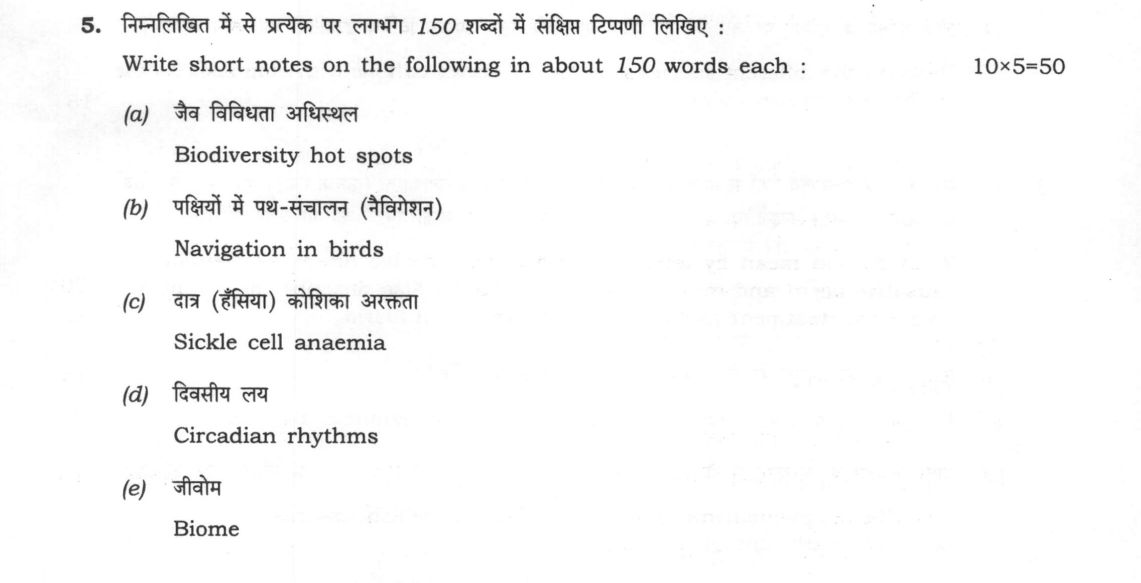
Write short notes on the following in about 150 words each: 10×5=50 (a) Biodiversity hot spots (b) Navigation in birds (c)…
Write short notes on the following in about 150 words each: 10×5=50
Biodiversity hot spots
Navigation in birds
Sickle cell anaemia
Circadian rhythms
Biome
हिंदी में प्रश्न पढ़ें
निम्नलिखित में से प्रत्येक पर लगभग 150 शब्दों में संक्षिप्त टिप्पणी लिखिए : 10×5=50
जैव विविधता अधिदेशल
पक्षियों में पथ-संचालन (नैविगेशन)
दार (हँसिया) कोशिका अरक्तता
दिवसीय लय
जीवोम
Model answer
Written by UPSC Answer Check against this question's marking rubric, to the 150-word length. UPSC does not publish answers for Mains — this is one way to score well, not an official key.
(a) Biodiversity hot spots
Biodiversity hot spots are regions of exceptional endemic richness under severe threat, a concept formalised by Norman Myers in 1988 to prioritise conservation. A region qualifies if it contains at least 1,500 endemic vascular plant species, representing 0.5% of the world’s vascular flora, and has lost at least 70% of its original habitat. India’s Western Ghats and Himalaya are recognised hot spots. The Western Ghats contain endemic amphibians, reptiles, and birds in sholas, grasslands, and evergreen forests; the Himalaya includes alpine meadows, temperate forests, and high-altitude endemics. Their conservation significance is strategic: protecting these small, species-dense areas can avert mass extinction, preserve ecosystem services and resilience, and guide conservation planning under the Biodiversity Act and national park frameworks. They cover a small fraction of land but hold disproportionate plant and vertebrate endemism. This makes them priority targets for in-situ protected-area expansion, ex-situ conservation, community-based management, and ecological restoration in India.
(b) Navigation in birds
Avian navigation is the capacity of birds to orient and travel over long distances using integrated sensory cues. The sun compass uses the position of the sun corrected by an internal clock; the star compass relies on polarised star patterns around the celestial pole. A magnetic compass, mediated by magnetite in the beak and cryptochrome-based radical-pair mechanisms in the retina, provides directional bearing and inclination. Olfactory maps contribute to route finding, especially in homing and foraging contexts. These cues are not used in isolation; birds integrate them, with priority shifting when one cue is manipulated. The Arctic tern exemplifies long-distance migratory navigation, travelling between polar breeding and wintering grounds. In India, controlled experiments with homing pigeons (Columba livia) show that they can return to lofts after displacement using magnetic, visual, and olfactory information, though they are domesticated rock doves rather than long-distance migrants. These studies clarify cue integration in birds.
(c) Sickle cell anaemia
Sickle cell anaemia is an autosomal recessive haemoglobinopathy caused by a single-base substitution in the β-globin gene, replacing glutamic acid by valine at the sixth position of the β-chain. The resulting HbS has a hydrophobic patch that, under low oxygen tension, polymerises into rigid fibres, distorting erythrocytes into sickle shapes. These cells become sticky, obstruct microvasculature, and lyse, producing chronic haemolytic anaemia, vaso-occlusive crises, splenic infarction, and organ damage. The condition illustrates balancing selection. Heterozygotes carrying one HbS allele (HbAS) have reduced susceptibility to severe Plasmodium falciparum malaria because the parasite’s growth and red-cell survival are impaired, giving a fitness advantage in malarious regions. In India, HbS is uncommon but documented in tribal and isolated populations, notably in Saurashtra and the Nilgiris, where historical malaria pressure may have maintained the allele. Diagnosis uses haemoglobin electrophoresis, HPLC, or DNA testing, and management includes hydration, transfusion, hydroxyurea, and supportive care in India.
(d) Circadian rhythms
Circadian rhythms are endogenous, approximately 24-hour oscillations in physiology, behaviour, and gene expression that persist in constant conditions. In mammals, the master oscillator is the suprachiasmatic nucleus (SCN) of the hypothalamus, which receives retinal input via the retinohypothalamic tract and synchronises peripheral clocks in the liver, skin, and immune cells. Environmental zeitgebers, especially light, temperature, and feeding time, entrain the clock to the local day. Molecularly, the core clock involves positive elements CLOCK and BMAL1, which activate Period (Per) and Cryptochrome (Cry) genes; PER/CRY proteins accumulate, inhibit CLOCK/BMAL1, and create a transcriptional feedback loop. In birds and other animals, similar loops regulate melatonin secretion, body temperature, locomotor activity, and hormone release. Chronobiology applies this knowledge to shift-work health in humans, drug timing (chronopharmacology), treatment of jet lag, and management of sleep disorders. In India, agricultural and veterinary practices also benefit from understanding daily activity patterns in livestock and crop pollinators.
(e) Biome
A biome is a major ecological unit defined by its dominant vegetation, climate, and characteristic biota over a broad geographical area. Unlike an ecosystem, which is a local functional unit of interacting organisms and abiotic factors, a biome is a higher-level pattern that groups similar ecosystems across continents. Whittaker’s classification uses mean annual temperature and precipitation to delineate biomes, producing a matrix in which tropical rain forest, savanna, desert, temperate forest, grassland, tundra, and boreal forest occupy distinct climatic zones. Climate-vegetation coupling is central: rainfall and temperature determine plant form, leaf size, phenology, and productivity, which in turn structure animal communities. In India, tropical thorn forests occur in low-rainfall regions such as parts of Rajasthan and Gujarat, while montane forests show altitudinal zonation from subtropical to temperate and alpine belts in the Himalaya and Western Ghats. Biomes are useful for macroecology, conservation planning, and predicting species distributions under climate change.
What "Write short notes" is asking you to do
Five or six self-contained answers, marked separately, typically 10 marks and about 150 words each. Each note must carry its own definition, its two or three defining features and a line on why it matters; a common introduction or conclusion across the notes earns nothing.
Structure that answers it
Per note: one-line definition or identification → two or three features, mechanisms or named examples → one line of significance or Indian application
Where marks are lost
Writing the first two notes at essay length and rationing the rest. Each note is marked on its own, so marks surrendered on a compressed or unattempted note cannot be won back by the long ones.
How this answer will be evaluated
Approach
Framework: Zoology, Paper 1. (a) write short notes: define > 3-4 key features > one example > one-line significance | (b) write short notes: define > 3-4 key features > one example > one-line significance | (c) write short notes: define > 3-4 key features > one example > one-line significance | (d) write short notes: define > 3-4 key features > one example > one-line significance | (e) write short notes: define > 3-4 key features > one example > one-line significance Full marks: Precise definitions, correct mechanisms, named examples, and clear structure.
Key points expected
- Definition: high endemism + high threat
- Criteria: 1000+ endemic vascular plants
- Loss of >70% original habitat
- One named example (e.g., Western Ghats)
- Magnetic compass (magnetite/ cryptochromes)
- Sun compass / star navigation
- Migratory instinct / imprinting
- One named species (e.g., Arctic Tern)
Evaluation rubric
Each sub-part is marked on its own, against the marks and word limit printed on the paper.
- (a) Define biodiversity hotspots and list key features with one example. · 150 words
write short notes— define → 3-4 key features → one example → one-line significance
Must cover
- Definition: high endemism + high threat
- Criteria: 1000+ endemic vascular plants
- Loss of >70% original habitat
- One named example (e.g., Western Ghats)
Loses marks
- Confusing with general biodiversity
- No mention of endemism criteria
Earns more
- Mention of Norman Myers
- Global count (36 hotspots)
- Specific endemic taxa (e.g., Nilgiri Tahr)
Extra mark
- Conservation status of specific hotspot
- (b) Explain mechanisms of bird navigation with one example. · 150 words
write short notes— define → 3-4 key features → one example → one-line significance
Must cover
- Magnetic compass (magnetite/ cryptochromes)
- Sun compass / star navigation
- Migratory instinct / imprinting
- One named species (e.g., Arctic Tern)
Loses marks
- Vague 'instinct' without mechanism
- Confusing with human navigation
Earns more
- Role of olfaction (pigeons)
- Map sense vs compass sense
- Polarized light detection
Extra mark
- Specific study on homing pigeons
- (c) Define sickle cell anaemia and explain its genetic basis. · 150 words
write short notes— define → 3-4 key features → one example → one-line significance
Must cover
- Genetic cause: HbS mutation (Glu to Val)
- Pathology: RBC sickling under low O2
- Heterozygote advantage (Malaria resistance)
- Inheritance pattern (Autosomal recessive)
Loses marks
- Confusing with thalassemia
- No mention of malaria link
Earns more
- Mention of HbA vs HbS
- Symptoms (pain crises, anaemia)
- Geographic distribution (Malaria belt)
Extra mark
- Mention of gene therapy trials
- (d) Define circadian rhythms and describe the biological clock. · 150 words
write short notes— define → 3-4 key features → one example → one-line significance
Must cover
- Definition: ~24-hour endogenous cycle
- Master clock: Suprachiasmatic Nucleus (SCN)
- Entrainment by light (Zones of light)
- One example (e.g., sleep-wake cycle)
Loses marks
- Confusing with circannual rhythms
- No mention of SCN
Earns more
- Mention of melatonin
- Free-running period in constant conditions
- Peripheral clocks (liver, etc.)
Extra mark
- Nobel Prize 2017 (Hall, Rosbash, Young)
- (e) Define biome and list key features with one example. · 150 words
write short notes— define → 3-4 key features → one example → one-line significance
Must cover
- Definition: Large community of plants/animals
- Determined by climate (temp/rainfall)
- Structural features (e.g., canopy, understory)
- One named example (e.g., Tropical Rainforest)
Loses marks
- Confusing with habitat
- No mention of climate factors
Earns more
- Distinction between biome and ecosystem
- Mention of Whittaker's classification
- Specific vegetation type (e.g., Taiga)
Extra mark
- Current threat to specific biome
Practice this exact question
Write your answer and it is marked point by point against the model answer above — what you covered, what you missed, what you got wrong.
Evaluate my answer →More from Zoology 2025 Paper I
- Q2 (a) Describe the comparative anatomy of digestive system in vertebrates. 20 (b) Give an i…
- Q3 (a) Describe the mechanism of parental care in amphibians with suitable examples. 20 (b)…
- Q4 (a) Draw a well-labelled diagram of testis and ovary in mammals, and discuss the function…
- Q5 Write short notes on the following in about 150 words each: 10×5=50 (a) Biodiversity hot…
- Q6 (a) Define air pollution. Explain the types, sources, consequences and control measures o…
- Q7 (a) What is Student's t-test and its significance in biological research? Write the formu…
- Q8 (a) What do you mean by infectious and communicable diseases? Mention the causative agent…