Paper I — Q6
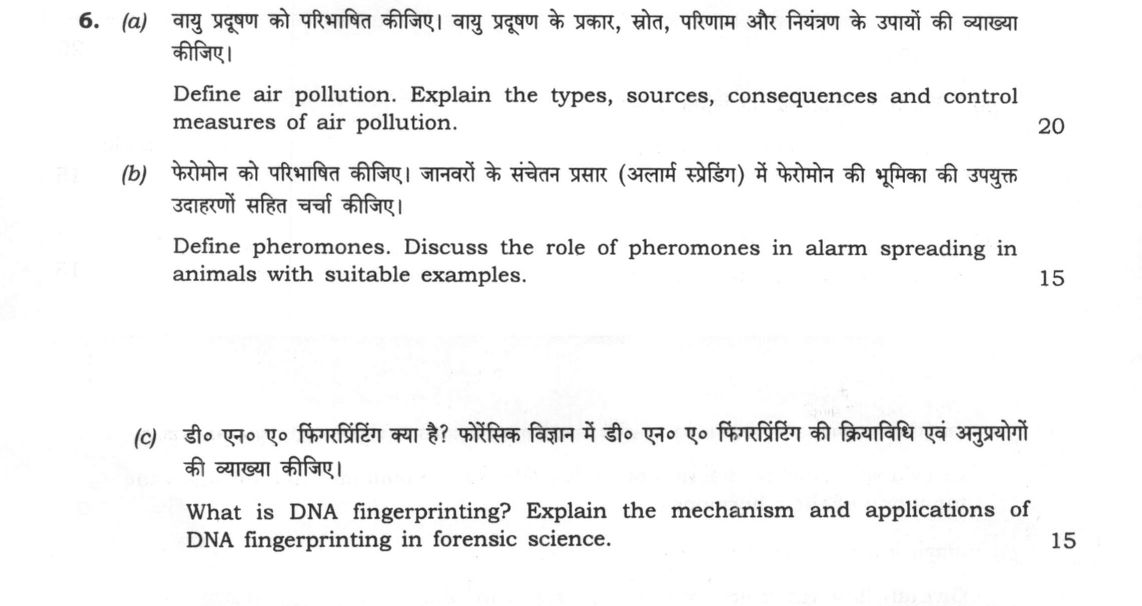
(a) Define air pollution. Explain the types, sources, consequences and control measures of air pollution. 20 (b) Define…
Define air pollution. Explain the types, sources, consequences and control measures of air pollution. 20 marks
Define pheromones. Discuss the role of pheromones in alarm spreading in animals with suitable examples. 15 marks
What is DNA fingerprinting? Explain the mechanism and applications of DNA fingerprinting in forensic science. 15 marks
हिंदी में प्रश्न पढ़ें
वायु प्रदूषण को परिभाषित कीजिए। वायु प्रदूषण के प्रकार, स्रोत, परिणाम और नियंत्रण के उपायों की व्याख्या कीजिए। 20
फेरोमोन को परिभाषित कीजिए। जानवरों के संचेतन प्रसार (अलार्म स्प्रेडिंग) में फेरोमोन की भूमिका की उपयुक्त उदाहरणों सहित चर्चा कीजिए। 15
डी० एन० ए० फिंगरप्रिंटिंग क्या है? फोरेंसिक विज्ञान में डी० एन० ए० फिंगरप्रिंटिंग की क्रियाविधि एवं अनुप्रयोगों की व्याख्या कीजिए। 15
Model answer
Written by UPSC Answer Check against this question's marking rubric, to the expected length. UPSC does not publish answers for Mains — this is one way to score well, not an official key.
Air Pollution: Types, Sources, Consequences, and Control
The World Health Organization defines air pollution as the contamination of indoor or outdoor environments by any chemical, physical, or biological agent that modifies the natural characteristics of the atmosphere. Physically, air pollutants exist as particulate matter (PM₂.5, PM₁₀, soot) or gaseous pollutants (SO₂, NOₓ, CO). By origin, they are classified into primary pollutants, which are directly discharged into the atmosphere (e.g., SO₂, unburnt hydrocarbons), and secondary pollutants, which form through atmospheric chemical interactions (e.g., tropospheric ozone, peroxyacetyl nitrate in photochemical smog).
Sources are twofold. Natural sources comprise volcanic eruptions releasing sulfur compounds, forest fires emitting smoke, and aeolian dust storms. Anthropogenic sources include vehicular combustion emissions, fossil-fuel thermal power stations, metallurgical processing, chemical industries, and biomass burning such as agricultural stubble.
The consequences are systemic. In humans and animals, particulate and gaseous inhalation impairs alveolar gas exchange, leading to chronic obstructive pulmonary disease (COPD), asthma, and cardiovascular stress. Environmentally, the oxidation of atmospheric SO₂ and NOₓ produces sulfuric and nitric acids, precipitating as acid rain. Acid deposition alters freshwater and soil pH, leaches vital cationic nutrients (Ca²⁺, Mg²⁺), mobilizes toxic aluminum ions, and accelerates aquatic eutrophication. Concurrently, greenhouse gases (CO₂, CH₄) enhance radiative forcing, driving global warming and disrupted precipitation regimes.
Control measures require combined approaches:
- Legislative: Implementation of statutory frameworks like the Air (Prevention and Control of Pollution) Act, 1981, and vehicular transition to Bharat Stage VI (BS-VI) emission norms.
- Technological: Industrial installations of electrostatic precipitators (ESPs) and fabric filters to arrest fly ash; wet scrubbers to neutralize acidic gases like SO₂; and vehicular three-way catalytic converters to oxidize CO and hydrocarbons while reducing NOₓ.
- Biological: Establishing green belts around industrial corridors using tolerant plant species (Ficus religiosa, Azadirachta indica) that act as vegetative particulate sinks and bio-filters.
Pheromones and Alarm Spreading in Animals
Karlson and Lüscher (1959) defined pheromones as substances secreted to the outside by an individual and received by a second individual of the same species, in which they release a specific behavioral or developmental response. They differ from interspecific semiochemicals, namely allomones (which favor the emitter) and kairomones (which favor the receiver).
Alarm pheromones coordinate anti-predator defenses through a causal cascade: noxious stimuli or tissue injury induces immediate exocrine secretion; the chemical volatile disperses along a concentration gradient; it binds to chemoreceptors on the antennae or olfactory sensilla of conspecifics; and signal transduction triggers rapid neuro-motor reflex behaviors such as aggression, aggregation, or flight.
- Honeybees (Apis mellifera): Autotomy of the sting apparatus during defense releases isoamyl acetate and 2-heptanone, eliciting defensive flight and targeted recruitment of guard bees toward the intruder.
- Ants (Formica spp.): When alarmed, workers emit formic acid and undecane from their poison and Dufour's glands, triggering frantic running, jaw-gaping, and aggressive biting within the colony.
- Fishes (Superorder Ostariophysi): Mechanical injury to specialized epidermal club cells releases the alarm substance Schreckstoff (containing hypoxanthine-3-N-oxide). Olfactory detection by nearby shoal members induces rapid escape dives, schooling, or freezing at the benthic substrate.
- Aphids: Predation by ladybird beetles triggers the secretion of (E)-β-farnesene from the cornicles, causing surrounding colony members to release their stylets and drop off the host plant.
DNA Fingerprinting and Forensic Applications
Developed by Sir Alec Jeffreys (1984) and pioneered in India by Lalji Singh, DNA fingerprinting (profiling) identifies unique individual genetic configurations based on polymorphic, non-coding, highly variable tandemly repeated DNA sequences.
The standard molecular mechanism follows a definitive sequence:
- Extraction: High-molecular-weight genomic DNA is isolated from biological trace evidence (blood, semen, hair follicles, epithelial buccal swabs).
- Amplification and Cleavage: Extracted DNA is digested using restriction endonucleases targeting Variable Number of Tandem Repeats (VNTRs), or specific Short Tandem Repeats (STRs) are amplified via Multiplex Polymerase Chain Reaction (PCR).
- Separation: The resulting fragments are resolved according to molecular size through polyacrylamide gel or automated capillary electrophoresis.
- Blotting and Hybridization: In classical RFLP-VNTR analysis, fragments are transferred onto nitrocellulose membranes via Southern blotting and hybridized with radioactive or fluorescent locus-specific probes.
- Detection: Autoradiography or laser-induced fluorescence generates a discrete pattern of bands (DNA profile) unique to the individual, except in monozygotic twins.
In forensic science, the technique provides decisive evidence across multiple domains:
- Criminal Identification: Matches biological evidence from crime scenes to suspects in violent crimes, as decisively demonstrated in the Nirbhaya case.
- Paternity and Kinship Disputes: Resolves parentage conflicts based on the Mendelian inheritance of half-maternal and half-paternal STR alleles.
- Exoneration: Secures the release of wrongfully convicted individuals through retrospective DNA testing of preserved evidence.
- Disaster Victim Identification (DVI): Facilitates the identification of severely degraded human remains in plane crashes, natural disasters, or mass casualties by matching STR profiles with reference family databases.
- Wildlife Forensics: Utilized by institutions such as the Wildlife Institute of India (WII) to trace poached tiger skins, elephant ivory, and venison to specific geographical populations, curbing illegal wildlife trafficking.
Integrated chemical ecology and molecular genetics thus provide essential mechanistic frameworks for wildlife conservation, ecological management, and forensic jurisprudence.
What "Explain" is asking you to do
Make the working of something clear — what sets it off, what follows from what, and what it produces. Explain is the Commission's mechanism word: it dominates the technical papers and the “explain why” stems, where the marks sit in the causal chain and not in the label.
Structure that answers it
State what it is → the initiating condition → the chain of cause, step by step → an instance where it plays out → what the chain produces
Where marks are lost
Describing what something looks like instead of why it works that way. Naming the stages without linking them reads as description too.
How this answer will be evaluated
Approach
(a) explain: definition/context > points in order > small example > short close | (b) discuss: intro > 3-4 dimensions > example > balanced close | (c) explain: definition/context > points in order > small example > short close Full marks: Precise definitions, specific examples, clear mechanisms, and strong forensic/conservation links.
Key points expected
- Precise definition of air pollution
- Classification of types (e.g., point vs non-point)
- Specific sources (industrial, vehicular, domestic)
- Consequences (health, environment, climate)
- Definition of pheromones (chemical signals)
- Mechanism of alarm spreading (diffusion, detection)
- Specific example of alarm pheromone (e.g., honeybee)
- Behavioral response to alarm (defense, escape)
Evaluation rubric
Each sub-part is marked on its own, against the marks and word limit printed on the paper.
- (a) Definition of air pollution followed by types, sources, consequences, and control measures. 20 marks
explain— definition/context → points in order → small example → short close
Must cover
- Precise definition of air pollution
- Classification of types (e.g., point vs non-point)
- Specific sources (industrial, vehicular, domestic)
- Consequences (health, environment, climate)
Loses marks
- Vague generalities without specific pollutants
- Missing one of the four required dimensions
- Confusing air pollution with water pollution
Earns more
- Control measures (scrubbers, catalytic converters)
- Specific pollutants (SO2, NOx, PM2.5)
- Link to specific health issues (asthma, cancer)
- Mention of specific legislation (Clean Air Act)
Extra mark
- Reference to specific index (AQI)
- Mention of specific case study (e.g., Bhopal)
- (b) Definition of pheromones and their role in alarm spreading with examples. 15 marks
discuss— intro → 3-4 dimensions → example → balanced close
Must cover
- Definition of pheromones (chemical signals)
- Mechanism of alarm spreading (diffusion, detection)
- Specific example of alarm pheromone (e.g., honeybee)
- Behavioral response to alarm (defense, escape)
Loses marks
- Confusing pheromones with hormones
- Lack of specific animal examples
- Focusing on mating pheromones instead of alarm
Earns more
- Distinction between alarm and other pheromones
- Mention of specific receptor mechanism
- Example of colony defense (bees/wasps)
- Link to evolutionary advantage
Extra mark
- Mention of specific chemical structure (e.g., 2-heptanone)
- Reference to specific study on pheromone decay
- (c) Definition of DNA fingerprinting, its mechanism, and forensic applications. 15 marks
explain— definition/context → points in order → small example → short close
Must cover
- Definition of DNA fingerprinting (RFLP/STR)
- Mechanism (extraction, digestion, electrophoresis)
- Application in paternity testing
- Application in criminal investigation
Loses marks
- Confusing DNA fingerprinting with DNA sequencing
- Vague description of mechanism
- Lack of specific forensic applications
Earns more
- Mention of specific technique (PCR, STR)
- Explanation of banding patterns
- Reference to specific forensic case
- Mention of database (CODIS)
Extra mark
- Mention of specific marker (e.g., D18S51)
- Reference to specific court case (e.g., O.J. Simpson)
Practice this exact question
Write your answer and it is marked point by point against the model answer above — what you covered, what you missed, what you got wrong.
Evaluate my answer →More from Zoology 2025 Paper I
- Q3 (a) Describe the mechanism of parental care in amphibians with suitable examples. 20 (b)…
- Q4 (a) Draw a well-labelled diagram of testis and ovary in mammals, and discuss the function…
- Q5 Write short notes on the following in about 150 words each: 10×5=50 (a) Biodiversity hot…
- Q6 (a) Define air pollution. Explain the types, sources, consequences and control measures o…
- Q7 (a) What is Student's t-test and its significance in biological research? Write the formu…
- Q8 (a) What do you mean by infectious and communicable diseases? Mention the causative agent…