Paper I — Q3
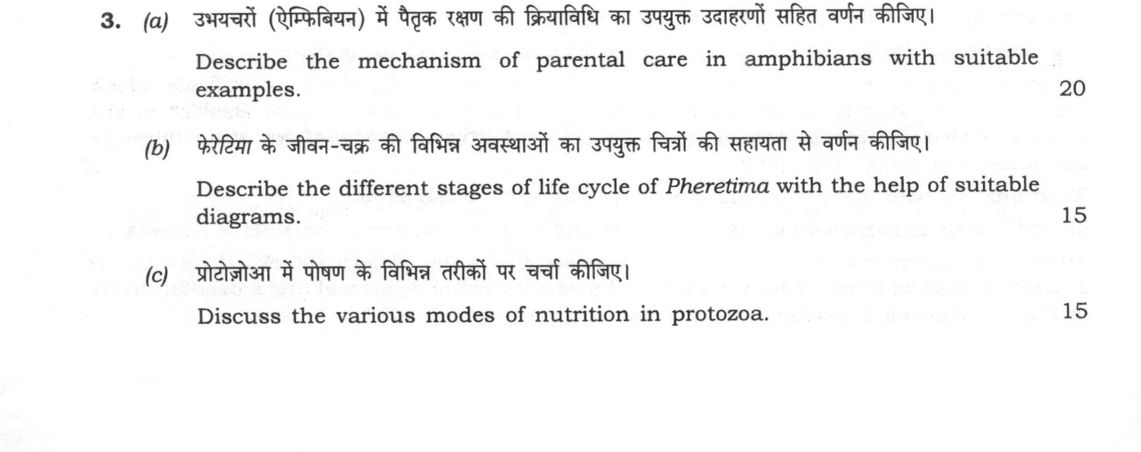
(a) Describe the mechanism of parental care in amphibians with suitable examples. 20 (b) Describe the different stages of life…
Describe the mechanism of parental care in amphibians with suitable examples. 20 marks
Describe the different stages of life cycle of Pheretima with the help of suitable diagrams. 15 marks
Discuss the various modes of nutrition in protozoa. 15 marks
हिंदी में प्रश्न पढ़ें
उभयचरों (एम्फिबियन) में पैतृक रक्षण की क्रियाविधि का उपयुक्त उदाहरणों सहित वर्णन कीजिए। 20
फेरेटिमा के जीवन-चक्र की विभिन्न अवस्थाओं का उपयुक्त चित्रों की सहायता से वर्णन कीजिए। 15
प्रोटोजोआ में पोषण के विभिन्न तरीकों पर चर्चा कीजिए। 15
Model answer
Written by UPSC Answer Check against this question's marking rubric, to the expected length. UPSC does not publish answers for Mains — this is one way to score well, not an official key.
Parental Care in Amphibians
Amphibians exhibit varied behavioral and physiological adaptations to protect their eggs and larvae from predation and desiccation, shifting energy from high fecundity to enhanced juvenile survival.
Nest Guarding and Egg Attendance: Many anurans construct specialized shelters. The Indian bullfrog (Hoplobatrachus tigerinus) guards shallow water scrapes, defending clutches against predators. Tree frogs like Phyllomedusa fold leaves over egg masses above water bodies, while Hyla species construct mud basins.
Egg Transport and Brooding: Parental carrying enhances offspring survival. Male Alytes obstetricans wraps egg strings around its hind limbs. In Rhinoderma darwinii, males exhibit vocal sac brooding (carrying developing young through metamorphosis). Female Pipa pipa carries eggs embedded in vascularized dorsal skin pockets.
Dermatotrophy and Trophic Feeding: Caecilians, such as Ichthyophis glutinosus from the Western Ghats, guard subterranean egg clutches; related caecilians exhibit maternal dermatophagy, where hatchlings peel and consume lipid-rich outer maternal skin. Neotropical poison frogs (Dendrobates) transport tadpoles to bromeliad axils and supply unfertilized trophic eggs (oophagy) for larval nourishment.
Endocrine and Behavioral Mechanisms: Amphibian parental care is regulated neuroendocrinally by prolactin (promoting brooding and hydric egg maintenance) and regulated levels of corticosterone, triggering territorial aggression, hydration behaviors, and parental retrieval responses.
---
**Life Cycle of *Pheretima posthuma***
Pheretima posthuma exhibits direct development without any free-swimming larval stage. Its life cycle proceeds through distinct reproductive and developmental phases:
`` [Copulation/Sperm Exchange] ↓ [Clitellar Secretion → Cocoon Formation (Segments 14–16)] ↓ [Fertilization inside Cocoon (External in albuminous fluid)] ↓ [Cleavage (Holoblastic & Unequal) → Blastula → Gastrula (Invagination)] ↓ [Organogenesis within Cocoon] ↓ [Hatching of Juvenile Worm (approx. 8–10 weeks)] ↓ [Juvenile Growth → Clitellar Development → Adult Earthworm] ``
Cocoon Secretion: The glandular clitellum (segments 14–16) secretes a chitinous, membranous sheath and nutritive albumin. As the worm wriggles backward, the sheath collects ova from female pores (14th segment) and stored sperms from spermathecae (segments 6–9), slipping off the anterior end to form an elastic, lemon-shaped cocoon.
Embryonic Development: Fertilization occurs within the cocoon’s albuminous matrix. Cleavage is holoblastic and unequal, forming a blastula, followed by gastrulation via invagination and epiboly. Mesoderm bands form, giving rise to metameric coelomic cavities and organ systems.
Hatching and Growth: Only one embryo typically completes development per cocoon in Pheretima, consuming the surrounding albumin. It hatches as a fully formed juvenile worm, lacking a clitellum. Through active feeding on organic detritus, the juvenile grows, develops reproductive segments, and attains sexual maturity within a year.
---
Modes of Nutrition in Protozoa
Protozoans exhibit diverse nutritional adaptations suited to their microenvironments:
Holozoic (Heterotrophic): Involves phagocytosis of solid food particles. Amoeba proteus captures prey via pseudopodial circumfluence, while Paramecium caudatum uses ciliary currents along the oral groove to direct food into the cytostome. The ingested food is enclosed in a food vacuole, which fuses with primary lysosomes. Digestion begins in an acidic phase and completes in an alkaline phase as the vacuole undergoes cyclosis. Indigestible residue is expelled via exocytosis or a fixed cytoproct. Osmoregulatory contractile vacuoles actively pump out excess water brought in during endocytosis.
Holophytic (Autotrophic): Photosynthetic protozoans like Euglena viridis utilize chloroplasts containing chlorophyll-a, chlorophyll-b, and carotenoids to synthesize carbohydrates, stored as paramylon bodies.
Saprozoic: Free-living and parasitic flagellates (e.g., Trypanosoma) lack oral structures and absorb dissolved organic matter and amino acids directly across the plasma membrane via active transport and pinocytosis.
Parasitic: Endoparasites like Plasmodium vivax utilize pinocytosis (micropore) to ingest host erythrocyte cytoplasm, while Entamoeba histolytica secretes histolytic enzymes to digest host mucosal epithelial cells and erythrocytes.
Mixotrophic: Certain flagellates, such as Euglena, utilize dual modes: performing photosynthesis in sunlight and switching to saprozoic absorption in prolonged darkness.
These reproductive, developmental, and nutritional specializations reflect evolutionary transitions enabling survival across diverse aquatic, terrestrial, and parasitic niches.
What "Describe" is asking you to do
Give a full, ordered account of the thing named — its parts, stages or mechanism — in the sequence in which it actually exists or occurs. Most describe questions come from the science optionals, where the marks sit in correct technical detail and, where the stem says so, a labelled diagram.
Structure that answers it
One-line identification of the subject → the parts or stages in their real order, each with its defining detail → labelled diagram where the subject is structural → closing line on function or significance
Where marks are lost
Loose general prose where the examiner is ticking named parts, correct terminology and their sequence; and in the General Studies papers, turning to evaluation before the description is finished.
How this answer will be evaluated
Approach
(a) describe: define > structure or process in order > labelled diagram > significance | (b) describe: define > structure or process in order > labelled diagram > significance | (c) discuss: intro > 3-4 dimensions > example > balanced close Full marks: Comprehensive, accurate, and well-structured answers with clear diagrams and named examples.
Key points expected
- Define parental care in amphibians
- Describe specific care mechanisms (e.g., guarding, transport)
- Provide suitable examples with named species
- Explain the biological significance of the care
- Identify *Pheretima* as the taxon
- Describe the stages of the life cycle in order
- Include suitable labelled diagrams of the life cycle
- Explain the role of the clitellum in reproduction
Evaluation rubric
Each sub-part is marked on its own, against the marks and word limit printed on the paper.
- (a) Mechanism of parental care in amphibians with examples. 20 marks
describe— define → structure or process in order → labelled diagram → significance
Must cover
- Define parental care in amphibians
- Describe specific care mechanisms (e.g., guarding, transport)
- Provide suitable examples with named species
- Explain the biological significance of the care
Loses marks
- Using common names without scientific names
- Describing general frog behavior without specific care
- Failing to link mechanism to survival
Earns more
- Mention specific species like *Pipa pipa* or *Xenopus*
- Describe the 'backpack frog' mechanism
- Mention mouth-brooding in *Rana* species
- Link care to larval survival rates
Extra mark
- Mention recent conservation status of a species
- Draw a simple diagram of a care mechanism
- (b) Stages of life cycle of *Pheretima* with diagrams. 15 marks
describe— define → structure or process in order → labelled diagram → significance
Must cover
- Identify *Pheretima* as the taxon
- Describe the stages of the life cycle in order
- Include suitable labelled diagrams of the life cycle
- Explain the role of the clitellum in reproduction
Loses marks
- Diagrams without labels
- Omitting the role of the clitellum
- Describing the life cycle of a different organism
Earns more
- Mention the process of copulation
- Describe the formation of the cocoon
- Label the diagrams clearly
- Mention the number of segments in the clitellum
Extra mark
- Mention the specific species *Pheretima posthuma*
- Draw a detailed diagram of the reproductive system
- (c) Various modes of nutrition in protozoa. 15 marks
discuss— intro → 3-4 dimensions → example → balanced close
Must cover
- Define protozoa and their nutritional modes
- Describe holozoic nutrition with an example
- Describe saprophytic nutrition with an example
- Describe parasitic nutrition with an example
Loses marks
- Failing to distinguish between the modes
- Not providing examples for each mode
- Describing nutrition in other organisms
Earns more
- Mention *Amoeba* for holozoic nutrition
- Mention *Leishmania* for parasitic nutrition
- Describe the process of phagocytosis
- Mention the role of food vacuoles
Extra mark
- Mention a specific protozoan disease
- Draw a diagram of phagocytosis in *Amoeba*
Practice this exact question
Write your answer and it is marked point by point against the model answer above — what you covered, what you missed, what you got wrong.
Evaluate my answer →More from Zoology 2025 Paper I
- Q1 Write short notes on/Answer the following in about 150 words each: 10×5=50 (a) Metagenesi…
- Q2 (a) Describe the comparative anatomy of digestive system in vertebrates. 20 (b) Give an i…
- Q3 (a) Describe the mechanism of parental care in amphibians with suitable examples. 20 (b)…
- Q4 (a) Draw a well-labelled diagram of testis and ovary in mammals, and discuss the function…
- Q5 Write short notes on the following in about 150 words each: 10×5=50 (a) Biodiversity hot…
- Q6 (a) Define air pollution. Explain the types, sources, consequences and control measures o…