Paper I — Q4
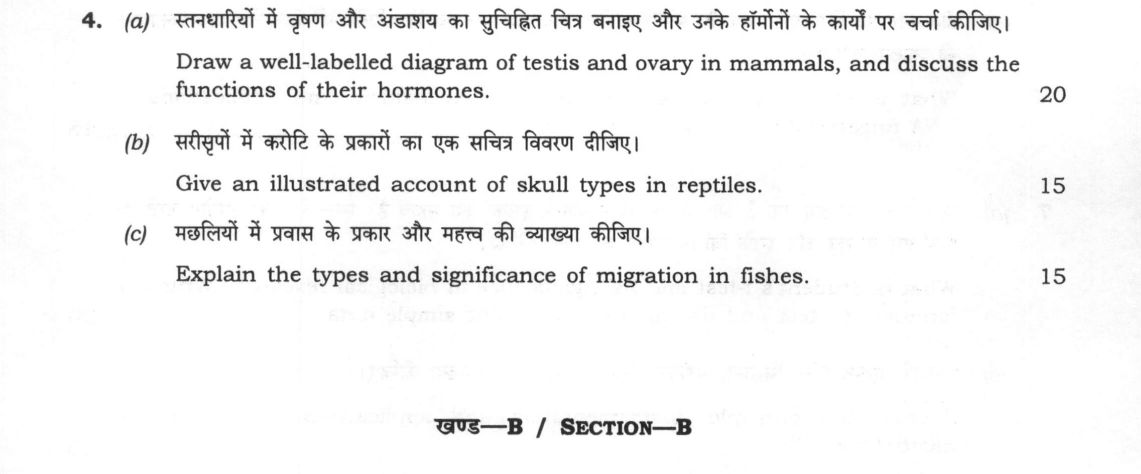
(a) Draw a well-labelled diagram of testis and ovary in mammals, and discuss the functions of their hormones. 20 (b) Give an…
Draw a well-labelled diagram of testis and ovary in mammals, and discuss the functions of their hormones. 20 marks
Give an illustrated account of skull types in reptiles. 15 marks
Explain the types and significance of migration in fishes. 15 marks
हिंदी में प्रश्न पढ़ें
स्तनधारियों में वृषण और अंडाशय का सुचिहित चित्र बनाइए और उनके हार्मोनों के कार्यों पर चर्चा कीजिए। 20
सरीसृपों में कपोटि के प्रकारों का एक सचित्र विवरण दीजिए। 15
मछलियों में प्रवास के प्रकार और महत्व की व्याख्या कीजिए। 15
Model answer
Written by UPSC Answer Check against this question's marking rubric, to the expected length. UPSC does not publish answers for Mains — this is one way to score well, not an official key.
Mammalian gonads and hormones. A labelled diagram of the testis would show a tunica albuginea enclosing coiled seminiferous tubules, where Sertoli cells support spermatogenesis and secrete androgen-binding protein and inhibin, while interstitial Leydig cells between tubules secrete testosterone. The ovary diagram would show primordial, primary, secondary and mature Graafian follicles in the cortex, a corpus luteum after ovulation, and stromal tissue with theca cells. Both are controlled by the hypothalamic–pituitary–gonadal axis: GnRH from the hypothalamus stimulates anterior pituitary FSH and LH. In males, FSH acts on Sertoli cells, LH on Leydig cells; testosterone maintains male secondary sex characters, supports spermatogenesis and libido, and feeds back negatively on the hypothalamus and pituitary, while inhibin specifically suppresses FSH. In females, LH stimulates theca cells to produce androgens, and FSH stimulates granulosa cells to aromatise those androgens into estrogens; after ovulation, the corpus luteum secretes progesterone. Estrogen and progesterone act on the uterus, mammary glands and secondary sex characters, and feed back on the HPG axis; in many species, rising estrogen gives positive feedback to trigger the LH surge. In many mammals, luteolysis by prostaglandin F2α ends the estrous cycle, while menstruation is restricted to primates and a few others. Relaxin, from the corpus luteum/placenta, relaxes the cervix and uterus and supports mammary development. Thus male and female systems are coordinated by the same axis but differ in cyclicity, target organs and luteal fate.
Reptilian skull types. An illustrated account would show three basic patterns of temporal fenestrae, which reduce skull weight and provide attachment areas for jaw muscles. Anapsids, typified by turtles, lack temporal openings, giving a solid skull with strong jaw muscles but limited jaw mobility. Synapsids, the mammal-like reptiles such as pelycosaurs and therapsids, have one lower temporal fenestra, allowing larger jaw muscles and more efficient feeding. Diapsids, including lepidosaurians and archosaurians, have two pairs of fenestrae: an upper temporal bounded by postfrontal, parietal, squamosal and postorbital bones, and a lower temporal bounded by postorbital, jugal, quadratojugal and squamosal. Evolutionarily, the anapsid condition is ancestral, synapsids modified the lower opening, and diapsids retained both openings; crocodilians retain both, while dinosaurs and birds reduce them. Later lineages show secondary modifications: snakes have elongated skulls with modified fenestrae and kinetic jaw elements for swallowing large prey, while birds, derived diapsids, have generally akinetic skulls with reduced fenestrae, a beak and limited exceptions such as rhynchokinesis.
Fish migration. Fish migration is classified by habitat change. Anadromous fishes live in the sea and enter rivers to spawn, e.g., salmon and Hilsa (Tenualosa ilisha) in the Ganga–Brahmaputra and Bay of Bengal. Catadromous fishes spawn in the sea, e.g., eels. Potamodromous fishes remain in freshwater but move within it, e.g., Indian major carps such as catla, rohu and mrigal migrating upstream in the Ganga, Brahmaputra and Godavari for spawning. Oceanodromous fishes migrate within marine waters, e.g., sardines (Sardinella) and mackerel (Rastrelliger) along the Indian coast. Photoperiod, temperature and salinity act as cues; the pituitary–thyroid axis and gonadal hormones regulate readiness, gametogenesis and movement. Navigation uses magnetic fields, olfactory imprints, water temperature, salinity and celestial cues. Ecologically, migration transfers nutrients, connects habitats and maintains population structure; economically, it determines seasonal landings, livelihoods and aquaculture seed collection. Management therefore needs river flow, closed seasons under Marine Fishing Regulation Acts and state laws, bycatch reduction and climate monitoring.
Together, these patterns show vertebrate adaptation: mammalian reproduction integrates structure and endocrine feedback, reptilian skulls illustrate fenestration and kinetic modification, and fish migration links physiology, navigation and fisheries. This integration is essential for understanding vertebrate diversity and sustainable use.
What "Discuss" is asking you to do
Lay the issue out from more than one side — how it arose, what is claimed for it, what is held against it, and where it now stands. UPSC attaches discuss to broad topics with several live dimensions, so coverage of the dimensions earns more than the strength of your opinion.
Structure that answers it
Set the issue up → the case as it is made → the case against → the dimension both sides leave out → where the balance now lies
Where marks are lost
Listing facts with no thread between them, or arguing one side throughout and calling it a discussion.
How this answer will be evaluated
Approach
Framework: Zoology Paper 1: Define > Structure/Mechanism > Diagram > Example. (a) discuss: intro > 3-4 dimensions > example > balanced close | (b) account for: state the phenomenon > the causes in order of weight > conclusion | (c) explain: definition/context > points in order > small example > short close Full marks: Accurate diagrams, precise terminology, clear mechanisms, named examples.
Key points expected
- Well-labelled diagram of mammalian testis
- Well-labelled diagram of mammalian ovary
- Functions of testicular hormones (e.g., testosterone)
- Functions of ovarian hormones (e.g., estrogen, progesterone)
- Definition of skull types (anapsid, diapsid, synapsid)
- Illustrations/diagrams of each skull type
- Examples of reptiles for each type
- Explanation of temporal fenestrae
Evaluation rubric
Each sub-part is marked on its own, against the marks and word limit printed on the paper.
- (a) Labelled diagrams of mammalian testis and ovary with hormonal functions. 20 marks
discuss— intro → 3-4 dimensions → example → balanced close
Must cover
- Well-labelled diagram of mammalian testis
- Well-labelled diagram of mammalian ovary
- Functions of testicular hormones (e.g., testosterone)
- Functions of ovarian hormones (e.g., estrogen, progesterone)
Loses marks
- Diagrams without labels
- Confusing male and female structures
- Omitting hormonal functions
Earns more
- Mention of Leydig cells and Sertoli cells
- Mention of corpus luteum and follicles
- Link to reproductive cycle or spermatogenesis
Extra mark
- Mention of specific mammalian species (e.g., human, cow)
- Mention of HPG axis regulation
- (b) Illustrated account of reptile skull types. 15 marks
account for— state the phenomenon → the causes in order of weight → conclusion
Must cover
- Definition of skull types (anapsid, diapsid, synapsid)
- Illustrations/diagrams of each skull type
- Examples of reptiles for each type
- Explanation of temporal fenestrae
Loses marks
- Missing illustrations
- Confusing skull types
- No examples provided
Earns more
- Mention of specific reptile orders (e.g., Squamata, Crocodylia)
- Comparison of skull structures
- Evolutionary significance of skull types
Extra mark
- Mention of specific species (e.g., Chameleon, Crocodile)
- Mention of fossil evidence
- (c) Types and significance of migration in fishes. 15 marks
explain— definition/context → points in order → small example → short close
Must cover
- Definition of fish migration
- Types of migration (anadromous, catadromous, oceanic)
- Significance of migration (reproduction, feeding)
- Examples of migratory fish species
Loses marks
- Confusing migration types
- No examples provided
- Omitting significance
Earns more
- Mention of specific fish species (e.g., Salmon, Eel)
- Link to fisheries or conservation
- Explanation of migration triggers
Extra mark
- Mention of specific migration routes
- Mention of conservation status of migratory species
Practice this exact question
Write your answer and it is marked point by point against the model answer above — what you covered, what you missed, what you got wrong.
Evaluate my answer →More from Zoology 2025 Paper I
- Q1 Write short notes on/Answer the following in about 150 words each: 10×5=50 (a) Metagenesi…
- Q2 (a) Describe the comparative anatomy of digestive system in vertebrates. 20 (b) Give an i…
- Q3 (a) Describe the mechanism of parental care in amphibians with suitable examples. 20 (b)…
- Q4 (a) Draw a well-labelled diagram of testis and ovary in mammals, and discuss the function…
- Q5 Write short notes on the following in about 150 words each: 10×5=50 (a) Biodiversity hot…
- Q6 (a) Define air pollution. Explain the types, sources, consequences and control measures o…
- Q7 (a) What is Student's t-test and its significance in biological research? Write the formu…