Paper II — Q1
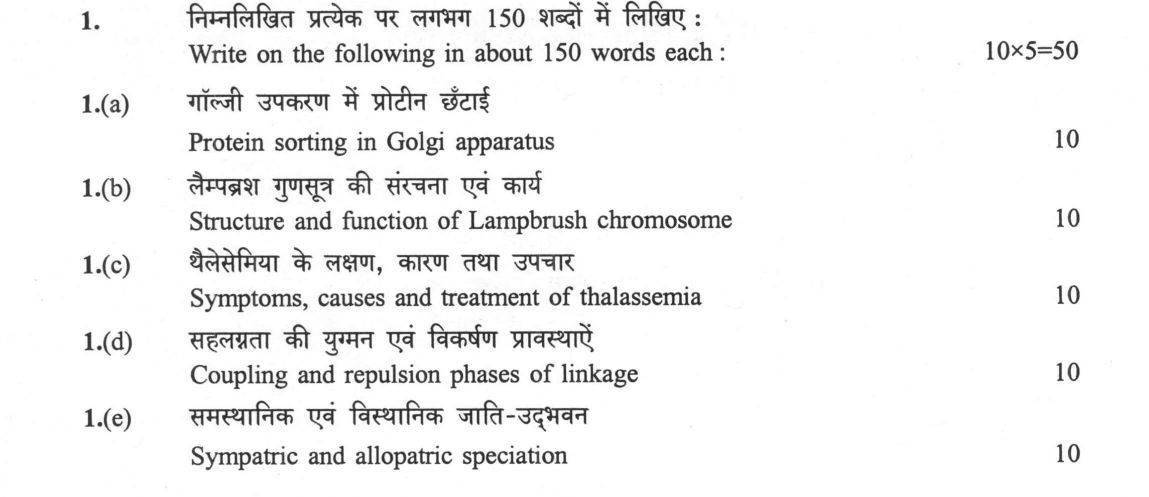
Write on the following in about 150 words each : 10×5=50 (a) Protein sorting in Golgi apparatus (10 marks) (b) Structure and…
Write on the following in about 150 words each : 10×5=50
Protein sorting in Golgi apparatus 10 marks
Structure and function of Lampbrush chromosome 10 marks
Symptoms, causes and treatment of thalassemia 10 marks
Coupling and repulsion phases of linkage 10 marks
Sympatric and allopatric speciation 10 marks
हिंदी में प्रश्न पढ़ें
निम्नलिखित प्रत्येक पर लगभग 150 शब्दों में लिखिए : 10×5=50
गॉल्जी उपकरण में प्रोटीन छँटाई (10 अंक)
लैम्पब्रश गुणसूत्र की संरचना एवं कार्य (10 अंक)
थैलेसीमिया के लक्षण, कारण तथा उपचार (10 अंक)
सहलग्नता की युग्मन एवं विकर्षण प्रावस्थाएँ (10 अंक)
समस्थानिक एवं विस्थानिक जाति-उद्भवन (10 अंक)
Model answer
Written by UPSC Answer Check against this question's marking rubric, to the 150-word length. UPSC does not publish answers for Mains — this is one way to score well, not an official key.
(a) Protein sorting in Golgi apparatus. Protein sorting in the Golgi apparatus is a compartmentalised, receptor-mediated process that directs cargo from the cis-Golgi network through medial and trans cisternae to cellular destinations. The cis, medial, and trans cisternae form sequential sorting compartments. Newly synthesized proteins enter via COPII vesicles from the endoplasmic reticulum, are modified by glycosylation and phosphorylation, and are sorted by cargo receptors. Lysosomal hydrolases acquire mannose-6-phosphate tags in the cis-Golgi; M6P receptors bind them in the trans-Golgi network and are internalised into clathrin-coated vesicles, delivering enzymes to endosomes and lysosomes. Other cargo follows constitutive secretion, continuously delivering membrane and extracellular proteins, or regulated secretion, where hormones and enzymes are stored in secretory granules until a signal triggers exocytosis. Clathrin-coated vesicles, adaptor proteins and SNAREs ensure specificity. This system maintains organelle identity, controls secretion, and prevents mislocalisation, making it central to cell homeostasis.
(b) Structure and function of Lampbrush chromosome. Lampbrush chromosomes are highly extended diplotene bivalents seen in growing oocytes of amphibians, especially Rana and Bufo, where meiosis is arrested for months or years. Each chromosome consists of a central axis with numerous lateral loops projecting from chromomeres; the loops are decondensed chromatin rich in RNA polymerase activity and represent sites of active transcription. The loops transcribe maternal mRNAs and structural RNAs, while proteins are later translated from these transcripts to provision the oocyte. The morphology is highly conserved, allowing loops to be mapped as gene activity markers and used in in situ hybridisation and gene expression studies. They also provide a visible record of transcriptional timing during oogenesis. Their large size makes them a classical model for chromosome structure, transcription, and oocyte development. In Indian zoology, they are important for understanding amphibian reproductive biology and for demonstrating the relationship between chromatin form and RNA synthesis.
(c) Symptoms, causes and treatment of thalassemia. Thalassemia is a group of inherited haemoglobinopathies caused by reduced or absent synthesis of α or β globin chains due to point mutations, deletions, or regulatory mutations. The imbalance causes ineffective erythropoiesis, haemolysis, and microcytic hypochromic anaemia. Symptoms include pallor, fatigue, splenomegaly, bone deformities, and iron overload in severe forms. β-thalassemia trait usually shows elevated HbA2 on haemoglobin electrophoresis, while α-thalassemia trait may be normal or show reduced HbA. Clinical severity ranges from trait to transfusion-dependent disease. Diagnosis includes complete blood count, haemoglobin electrophoresis, HPLC, and DNA testing; prenatal diagnosis by chorionic villus sampling or amniocentesis is important for carrier couples. Treatment includes transfusion, chelation, folic acid, and curative haematopoietic stem cell transplantation. India has high prevalence, especially in Gujarat, Maharashtra, Punjab, and other parts of the Indian subcontinent, making carrier screening and genetic counselling public-health priorities.
(d) Coupling and repulsion phases of linkage. Linkage phase describes how two alleles are arranged on homologous chromosomes. In coupling, or cis, phase a heterozygote has AB/ab, so the dominant alleles are on one chromosome and recessive alleles on the other; parental gametes are AB and ab, while recombinant gametes are Ab and aB. In repulsion, or trans, phase the genotype is Ab/aB; parental gametes are Ab and aB, and recombinant gametes are AB and ab. A test cross with a homozygous recessive parent reveals these gametes directly. If genes are unlinked, the test cross gives a 1:1:1:1 ratio; linkage makes parental classes exceed recombinant classes. Recombination frequency is calculated as recombinant progeny divided by total progeny, multiplied by 100. For short intervals, recombination frequency approximates physical distance, but at longer distances double crossovers reduce observed recombination and underestimate map distance. Thus phase determines which phenotypic classes appear parental or recombinant in mapping experiments.
(e) Sympatric and allopatric speciation. Speciation is the formation of new species. Allopatric speciation occurs when populations are separated by a geographic barrier, such as a mountain range, river, sea, or island, through vicariance or dispersal. Reduced gene flow allows genetic drift, mutation, and natural selection to diverge populations until reproductive isolation evolves. The Nicobar megapode, isolated on the Nicobar Islands, is an Indian example of allopatric divergence. Sympatric speciation occurs without a physical barrier, often within the same habitat, through polyploidy, host-race formation, or disruptive selection. Polyploidy is common in plants and can instantly create reproductive isolation; host races arise when populations specialise on different host plants or resources; disruptive selection favours extreme phenotypes. In both modes, reinforcement can strengthen prezygotic isolation when hybrids have reduced fitness, for example by mate preference, temporal isolation, or behavioural differences. Thus geographic separation and ecological selection are two major routes to biodiversity in Indian biogeography. Collectively, they connect molecular and chromosomal events to disease, inheritance, and species diversity.
What "Write short notes" is asking you to do
Five or six self-contained answers, marked separately, typically 10 marks and about 150 words each. Each note must carry its own definition, its two or three defining features and a line on why it matters; a common introduction or conclusion across the notes earns nothing.
Structure that answers it
Per note: one-line definition or identification → two or three features, mechanisms or named examples → one line of significance or Indian application
Where marks are lost
Writing the first two notes at essay length and rationing the rest. Each note is marked on its own, so marks surrendered on a compressed or unattempted note cannot be won back by the long ones.
How this answer will be evaluated
Approach
Framework: Zoology Paper 2: Define > Structure/Mechanism > Diagram > Example. (a) explain: definition/context > points in order > small example > short close | (b) describe: define > structure or process in order > labelled diagram > significance | (c) analyse: intro > causes > effects > stakeholders/linkages > way forward | (d) explain: definition/context > points in order > small example > short close | (e) compare: paired headings or table > key differences > significance > conclusion Full marks: Precise terminology, labelled diagrams, and specific taxonomic examples for all parts.
Key points expected
- Cis, medial, trans cisternae roles
- COPI and COPII vesicle coats
- KDEL signal for ER retention
- Mannosidase II and Golgi enzymes
- Diplotene stage of meiosis I
- Lateral loops and axial core structure
- High transcriptional activity (RNA synthesis)
- Oogenesis context (e.g., amphibians)
Evaluation rubric
Each sub-part is marked on its own, against the marks and word limit printed on the paper.
- (a) Mechanism of protein sorting and vesicular transport in Golgi. 10 marks · 150 words
explain— definition/context → points in order → small example → short close
Must cover
- Cis, medial, trans cisternae roles
- COPI and COPII vesicle coats
- KDEL signal for ER retention
- Mannosidase II and Golgi enzymes
Loses marks
- Confusing ER and Golgi functions
- No mention of vesicular transport
Earns more
- Labelled diagram of Golgi stack
- Specific cargo examples (e.g., lysosomal enzymes)
Extra mark
- Mention of specific SNARE proteins
- (b) Morphology and functional significance of lampbrush chromosomes. 10 marks · 150 words
describe— define → structure or process in order → labelled diagram → significance
Must cover
- Diplotene stage of meiosis I
- Lateral loops and axial core structure
- High transcriptional activity (RNA synthesis)
- Oogenesis context (e.g., amphibians)
Loses marks
- Confusing with polytene chromosomes
- Ignoring the meiotic stage
Earns more
- Labelled diagram of loop structure
- Mention of 'lampbrush' appearance origin
Extra mark
- Specific taxon example (e.g., Rana tigrina)
- (c) Clinical profile and management of thalassemia. 10 marks · 150 words
analyse— intro → causes → effects → stakeholders/linkages → way forward
Must cover
- Genetic cause (HbA or HbB gene mutation)
- Symptoms (anemia, hepatosplenomegaly)
- Treatment (blood transfusion, chelation)
- Definitive cure (bone marrow transplant)
Loses marks
- Confusing with Sickle Cell Anemia
- Omitting treatment options
Earns more
- Distinction between Alpha and Beta types
- Mention of iron overload complications
Extra mark
- Mention of gene therapy trials
- (d) Genetic configuration and gametic output of linkage phases. 10 marks · 150 words
explain— definition/context → points in order → small example → short close
Must cover
- Coupling phase (AB/ab) definition
- Repulsion phase (Ab/aB) definition
- Parental vs Recombinant gamete ratios
- Linkage map distance calculation
Loses marks
- Confusing phases with dominance
- Incorrect gamete ratios
Earns more
- Punnett square or cross diagram
- Example using Drosophila traits
Extra mark
- Mention of interference or coefficient of coincidence
- (e) Mechanisms and differences between sympatric and allopatric speciation. 10 marks · 150 words
compare— paired headings or table → key differences → significance → conclusion
Must cover
- Allopatric: geographic isolation barrier
- Sympatric: reproductive isolation without geography
- Sympatric mechanisms (polyploidy, habitat)
- Key difference: physical barrier presence
Loses marks
- Defining sympatric as 'same place' only without mechanism
- Ignoring the role of gene flow
Earns more
- Example for each (e.g., Darwin's finches vs Cichlids)
- Mention of post-zygotic barriers
Extra mark
- Mention of peripatric speciation
Practice this exact question
Write your answer and it is marked point by point against the model answer above — what you covered, what you missed, what you got wrong.
Evaluate my answer →More from Zoology 2025 Paper II
- Q1 Write on the following in about 150 words each : 10×5=50 (a) Protein sorting in Golgi app…
- Q2 (a)(i) Describe composition of plasma membrane. (10 marks) (a)(ii) Differentiate between…
- Q3 (a)(i) Describe the synthetic theory of evolution. (10 marks) (a)(ii) Describe common typ…
- Q4 (a) Describe the steps of constructing a recombinant DNA and its cloning. (20 marks) (b)…