Paper II — Q4
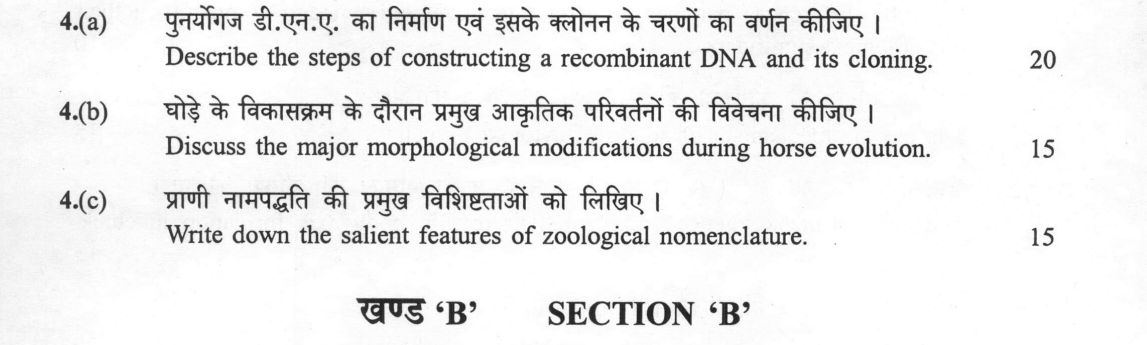
(a) Describe the steps of constructing a recombinant DNA and its cloning. (20 marks) (b) Discuss the major morphological…
Describe the steps of constructing a recombinant DNA and its cloning. 20 marks
Discuss the major morphological modifications during horse evolution. 15 marks
Write down the salient features of zoological nomenclature. 15 marks
हिंदी में प्रश्न पढ़ें
पुनर्योजज डी.एन.ए. का निर्माण एवं इसके क्लोनिंग के चरणों का वर्णन कीजिए । (20 अंक)
घोड़े के विकासक्रम के दौरान प्रमुख आकृतिक परिवर्तनों की विवेचना कीजिए । (15 अंक)
प्राणी नामपद्धति की प्रमुख विशिष्टताओं को लिखिए । (15 अंक)
Model answer
Written by UPSC Answer Check against this question's marking rubric, to the expected length. UPSC does not publish answers for Mains — this is one way to score well, not an official key.
Recombinant DNA Construction and Cloning
Recombinant DNA (rDNA) technology involves combining genetic material from different sources to create novel DNA sequences and multiplying them within host organisms.
The process begins with the isolation of pure target DNA containing the gene of interest and vector DNA, using cell lysis, enzymatic digestion of contaminants (proteases, RNases), and ethanol precipitation. Both target and vector DNAs are treated with specific restriction endonucleases (molecular scissors) that generate compatible cohesive or blunt ends. DNA ligase then catalyzes phosphodiester bond formation between the complementary ends, yielding circular recombinant molecules.
Cloning vectors are tailored to insert size: plasmids (such as pBR322 or pUC19, carrying inserts up to 10 kb), cosmids (30–45 kb), bacterial artificial chromosomes (BACs, 100–300 kb), and yeast artificial chromosomes (YACs, up to 1 Mb). The construct is introduced into competent host cells—predominantly Escherichia coli via heat-shock or electroporation, or Saccharomyces cerevisiae for eukaryotic post-translational expression.
Selection and screening distinguish transformed recombinant cells from non-transformants and non-recombinants. Selectable markers utilize antibiotic resistance genes (e.g., ampicillin, tetracycline resistance). In blue-white screening, insertional inactivation of the lacZ gene prevents functional β-galactosidase synthesis; recombinant colonies remain white on media containing X-gal and IPTG, whereas non-recombinant vectors produce blue colonies.
Morphological Modifications in Horse Evolution
The evolutionary lineage of the horse (Eohippus to Equus) represents an orthogenetic progression driven by climatic shifts from dense, humid Eocene forests to dry, open Miocene grasslands. This transition necessitated adaptations for cursorial locomotion and a tough, fibrous diet.
The sequential morphological modifications include:
- Locomotor System and Digits: Progressive reduction of digits from a four-toed forefoot and three-toed hindfoot in Eohippus (Hyracotherium), through three-toed tridactyl forms (Mesohippus, Merychippus), to the functional monodactyly of modern Equus, where the enlarged third digit bears all weight while the second and fourth digits are reduced to non-functional splint bones. Limbs elongated distally, with fusion of the radius-ulna and tibia-fibula.
- Dentition: Shift from low-crowned, bunodont teeth (adapted for soft forest foliage) to high-crowned, prismatic hypsodont molars with complex enamel folding and cementum infilling, capable of resisting wear from silica-rich grasses. Premolars underwent molarization.
- Cranial and Body Size: Progressive increase in body stature, along with elongation of the facial skull anterior to the eyes to accommodate hypsodont tooth roots and facilitate simultaneous grazing and predator scanning.
Extensive fossil beds in North America trace this phylogeny, while India’s Siwalik deposits yield crucial Neogene fossils like Hipparion theobaldi and Equus sivalensis, demonstrating regional radiation.
Salient Features of Zoological Nomenclature
Zoological nomenclature provides a standardized, universal system for naming animal taxa, governed by the International Commission on Zoological Nomenclature (ICZN) through the International Code of Zoological Nomenclature.
- Binomial Nomenclature: Every species name consists of a Latinized binomen: a capitalized generic name followed by a lowercase specific epithet, both italicized in print (e.g., Panthera tigris).
- Principle of Priority: The valid name of a taxon is the oldest available name published after 1 January 1758 (Linnaeus’ Systema Naturae, 10th edition). Junior synonyms and homonyms are suppressed.
- Type Concept (Typification): Every nominal taxon must be anchored to a physical name-bearing type specimen (holotype, lectotype, or neotype) deposited in a recognized museum, ensuring stability if taxa are split or revised.
- Authorship and Date Citation: The original describer’s surname and publication year follow the binomen without intervening punctuation (e.g., Homo sapiens Linnaeus, 1758); parentheses indicate subsequent generic reassignments.
- Standardized Suffixes: Higher taxonomic ranks require mandated endings, such as -oidea for superfamily, -idae for family (e.g., Felidae), and -inae for subfamily.
These biotechnological, evolutionary, and taxonomic frameworks collectively form the empirical bedrock of modern zoological science, enabling precise identification, evolutionary reconstruction, and genetic manipulation of fauna.
What "Describe" is asking you to do
Give a full, ordered account of the thing named — its parts, stages or mechanism — in the sequence in which it actually exists or occurs. Most describe questions come from the science optionals, where the marks sit in correct technical detail and, where the stem says so, a labelled diagram.
Structure that answers it
One-line identification of the subject → the parts or stages in their real order, each with its defining detail → labelled diagram where the subject is structural → closing line on function or significance
Where marks are lost
Loose general prose where the examiner is ticking named parts, correct terminology and their sequence; and in the General Studies papers, turning to evaluation before the description is finished.
How this answer will be evaluated
Approach
Framework: UPSC Zoology Paper 2. (a) describe: define > structure or process in order > labelled diagram > significance | (b) discuss: intro > 3-4 dimensions > example > balanced close | (c) highlight: name the salient points > one line of substance each > close Full marks: Precise terminology, correct sequence, and specific examples (e.g., EcoRI, Eohippus).
Key points expected
- Isolation of DNA and selection of vector
- Digestion with restriction endonucleases
- Ligation of insert into vector
- Transformation and selection of clones
- Reduction in number of toes (polydactyl to monodactyl)
- Increase in body size and limb length
- Modification of dentition (brachyodont to hypsodont)
- Change in brain size and skull shape
Evaluation rubric
Each sub-part is marked on its own, against the marks and word limit printed on the paper.
- (a) Sequential steps of recombinant DNA construction and cloning. 20 marks
describe— define → structure or process in order → labelled diagram → significance
Must cover
- Isolation of DNA and selection of vector
- Digestion with restriction endonucleases
- Ligation of insert into vector
- Transformation and selection of clones
Loses marks
- Omitting the ligation step
- Confusing restriction enzymes with ligase
- No mention of host cell transformation
Earns more
- Labelled diagram of the cloning process
- Mention of specific enzymes (e.g., EcoRI, DNA ligase)
- Explanation of marker gene selection
- Mention of amplification (PCR) or screening
Extra mark
- Specific example of a recombinant product (e.g., insulin)
- Mention of specific vector types (plasmid, cosmid)
- (b) Major morphological changes in the evolution of the horse. 15 marks
discuss— intro → 3-4 dimensions → example → balanced close
Must cover
- Reduction in number of toes (polydactyl to monodactyl)
- Increase in body size and limb length
- Modification of dentition (brachyodont to hypsodont)
- Change in brain size and skull shape
Loses marks
- Focusing on behavior rather than morphology
- Omitting the change in dentition
- Listing changes without evolutionary context
Earns more
- Mention of specific fossil genera (Eohippus, Mesohippus, Equus)
- Linking changes to environmental shifts (forest to grassland)
- Labelled diagram of the evolutionary series
- Mention of the order Perissodactyla
Extra mark
- Specific dates for fossil appearance
- Mention of the 'Horse Evolution' theory by Cope
- (c) Salient features of zoological nomenclature. 15 marks
highlight— name the salient points → one line of substance each → close
Must cover
- Principle of binomial nomenclature (Genus + species)
- Principle of priority (first valid description)
- Principle of homonymy (identical names for different taxa)
- Principle of typification (holotype/paratype)
Loses marks
- Confusing zoological with botanical nomenclature rules
- Omitting the principle of priority
- Listing only the format without the underlying principles
Earns more
- Mention of the International Code of Zoological Nomenclature (ICZN)
- Rules for author citation and dating
- Principle of tautonymy (identical genus and species names)
- Principle of gender agreement
Extra mark
- Mention of the 'nomen dubium' or 'nomen novum'
- Reference to the 'Principle of Coordination'
Practice this exact question
Write your answer and it is marked point by point against the model answer above — what you covered, what you missed, what you got wrong.
Evaluate my answer →More from Zoology 2025 Paper II
- Q1 Write on the following in about 150 words each : 10×5=50 (a) Protein sorting in Golgi app…
- Q2 (a)(i) Describe composition of plasma membrane. (10 marks) (a)(ii) Differentiate between…
- Q3 (a)(i) Describe the synthetic theory of evolution. (10 marks) (a)(ii) Describe common typ…
- Q4 (a) Describe the steps of constructing a recombinant DNA and its cloning. (20 marks) (b)…
- Q5 Write on the following in about 150 words each : 10×5=50 (a) Block to polyspermy (10 mark…
- Q6 (a)(i) Write down the reactions that produce NADH during Krebs cycle. (10 marks) (a)(ii)…
- Q7 (a)(i) Explain sigmoidal nature of oxygen dissociation curve for hemoglobin. (10 marks) (…