Paper II — Q8
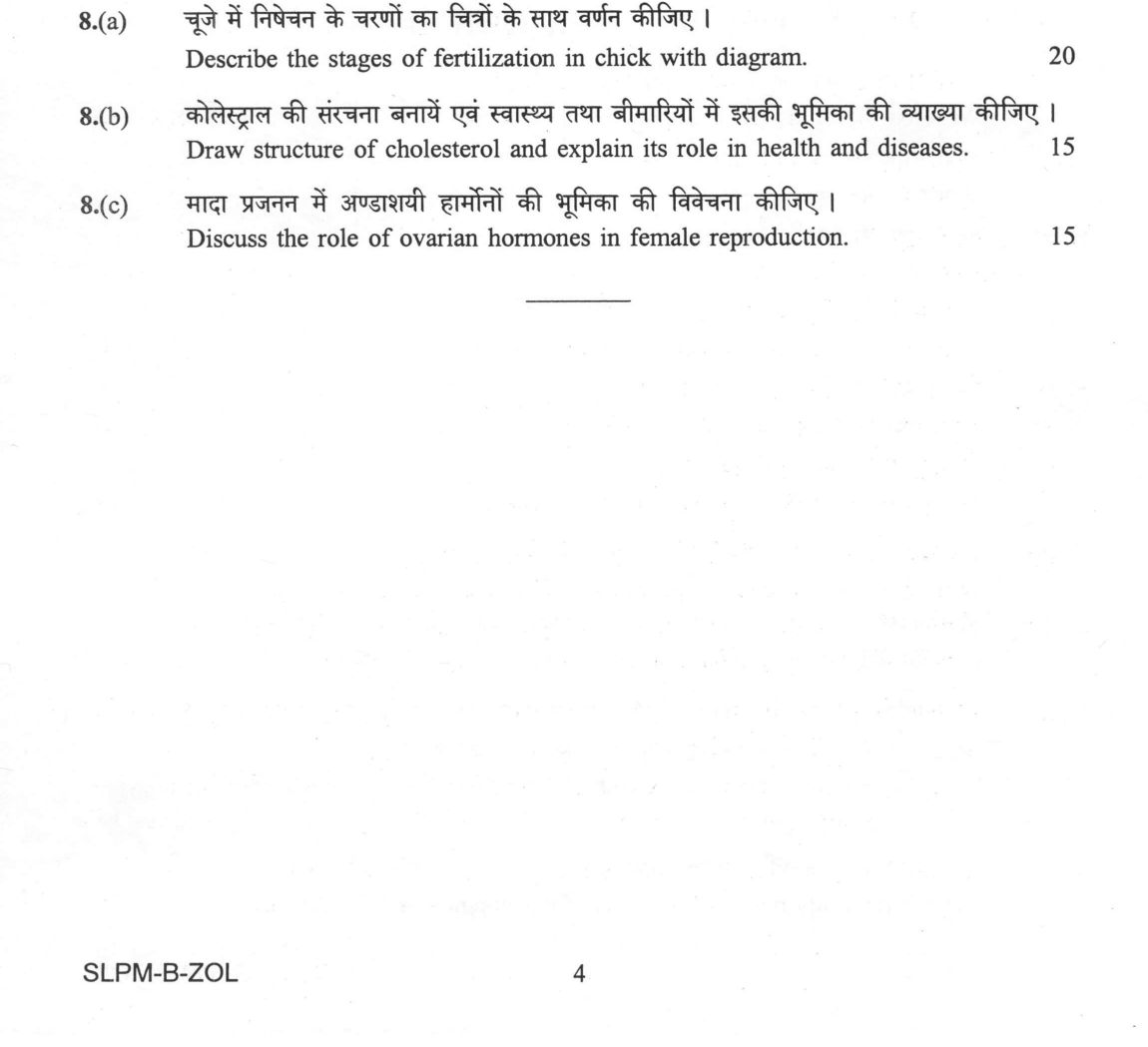
(a) Describe the stages of fertilization in chick with diagram. (20 marks) (b) Draw structure of cholesterol and explain its role…
Describe the stages of fertilization in chick with diagram. 20 marks
Draw structure of cholesterol and explain its role in health and diseases. 15 marks
Discuss the role of ovarian hormones in female reproduction. 15 marks
हिंदी में प्रश्न पढ़ें
चुजे में निषेचन के चरणों का चित्रों के साथ वर्णन कीजिए । (20 अंक)
कोलेस्ट्रॉल की संरचना बनायें एवं स्वास्थ्य तथा बीमारियों में इसकी भूमिका की व्याख्या कीजिए । (15 अंक)
मादा प्रजनन में अंडाशयी हार्मोनों की भूमिका की विवेचना कीजिए । (15 अंक)
Model answer
Written by UPSC Answer Check against this question's marking rubric, to the expected length. UPSC does not publish answers for Mains — this is one way to score well, not an official key.
Chick fertilization Fertilization in the chick is internal and occurs in the infundibulum of the oviduct shortly after ovulation. Sperm deposited during copulation enter the oviduct and may be stored in the oviductal reservoir. When the mature secondary oocyte, bearing the germinal disc, enters the infundibulum, capacitated sperm penetrate the oolemma. In birds physiological polyspermy is common: several sperm may enter and their chromatin may decondense, but only one male pronucleus fuses with the female pronucleus. Before syngamy, the oocyte completes meiosis II, extrudes the second polar body and forms the female pronucleus. The selected male pronucleus decondenses, the two pronuclei approach, and their chromosomes align to form a diploid zygote. Polyspermy is limited by a fast block, a rapid membrane change that limits further sperm activation, and a slow block, in which cortical granule exocytosis modifies the vitelline membrane and prevents further pronuclear fusion. Cleavage then begins in the magnum as the blastoderm forms; because the yolk is large, cleavage is meroblastic and the early blastoderm remains a disc of cells on the animal pole. The diagram would show the oviduct sequence: infundibulum (fertilization), magnum (albumen and cleavage), isthmus (shell membranes), uterus (shell), vagina (laying). The germinal disc at the animal pole is labelled, with sperm entry, pronuclear fusion and first cleavage indicated in the infundibulum/magnum region.
Cholesterol structure and health Cholesterol is a sterol with a tetracyclic steroid nucleus: three six-membered cyclohexane rings (A, B and C) fused to one five-membered cyclopentane ring (D). It has a hydroxyl group at C3, a double bond in the B ring, and an alkyl side chain at C17. This amphipathic structure is central to its health roles. In cell membranes, cholesterol inserts between phospholipids, preventing tight packing at low temperature and restricting excessive phospholipid movement at high temperature, thereby maintaining membrane fluidity and permeability. It is also the precursor of steroid hormones such as cortisol, aldosterone, oestrogen and androgen, and it is converted in the liver into bile acids, which emulsify dietary fats for digestion and absorption. In disease, excess cholesterol, especially carried in low-density lipoproteins, promotes atherosclerosis by depositing in arterial intima and forming plaques that narrow vessels and can cause myocardial infarction or stroke. Familial hypercholesterolaemia, usually due to defective LDL-receptor function, causes very high plasma cholesterol and premature coronary disease. Cholesterol supersaturation in bile can precipitate cholesterol gallstones, causing biliary colic and cholecystitis.
Ovarian hormones Ovarian hormones coordinate the female cycle through follicular and luteal phases. During the follicular phase, developing follicular granulosa and theca cells secrete oestrogen, mainly 17β-estradiol, which thickens the endometrium in mammals, stimulates FSH receptor expression, and, at high mid-cycle levels, gives positive feedback to the hypothalamus and anterior pituitary to produce the LH surge that triggers ovulation. After ovulation, the corpus luteum secretes progesterone, with some oestrogen, in the luteal phase; progesterone makes the endometrium secretory and receptive, supports implantation, and maintains early pregnancy by suppressing uterine contractions and sustaining the endometrium. Ovarian inhibin, secreted by granulosa cells, follows a phase-specific pattern, suppresses FSH and helps select follicles. In the luteal phase, progesterone and oestrogen exert negative feedback on GnRH, FSH and LH; if implantation does not occur, corpus luteum regression lowers these hormones, causing menstruation in eutherians; in other mammals the same fall produces the oestrous cycle. In birds and other non-mammalian oviparous animals, the same hormones regulate reproduction differently: oestrogen stimulates oviduct growth, albumen secretion and reproductive behaviour, while progesterone supports oviduct and shell-gland function; there is no menstruation, and the cycle is tied to ovulation and egg passage. Thus ovarian hormones integrate follicle development, ovulation, implantation and pregnancy maintenance across vertebrates.
What "Describe" is asking you to do
Give a full, ordered account of the thing named — its parts, stages or mechanism — in the sequence in which it actually exists or occurs. Most describe questions come from the science optionals, where the marks sit in correct technical detail and, where the stem says so, a labelled diagram.
Structure that answers it
One-line identification of the subject → the parts or stages in their real order, each with its defining detail → labelled diagram where the subject is structural → closing line on function or significance
Where marks are lost
Loose general prose where the examiner is ticking named parts, correct terminology and their sequence; and in the General Studies papers, turning to evaluation before the description is finished.
How this answer will be evaluated
Approach
Framework: Zoology Paper 2: Define > Structure/Mechanism > Diagram > Example. (a) describe: define > structure or process in order > labelled diagram > significance | (b) explain: definition/context > points in order > small example > short close | (c) discuss: intro > 3-4 dimensions > example > balanced close Full marks: Precise anatomical/chemical details, labelled diagrams, clear mechanistic links, and specific taxon references.
Key points expected
- Copulation and sperm storage tubules (SSTs)
- Sperm release and migration to oviduct
- Fertilization in infundibulum (ampulla)
- Labelled diagram of the process
- Correct chemical structure (steroid nucleus)
- Role in cell membrane fluidity
- Precursor to bile salts and steroid hormones
- Link to atherosclerosis/cardiovascular disease
Evaluation rubric
Each sub-part is marked on its own, against the marks and word limit printed on the paper.
- (a) Sequential stages of chick fertilization with a labelled diagram. 20 marks
describe— define → structure or process in order → labelled diagram → significance
Must cover
- Copulation and sperm storage tubules (SSTs)
- Sperm release and migration to oviduct
- Fertilization in infundibulum (ampulla)
- Labelled diagram of the process
Loses marks
- Diagram without labels
- Confusing mammalian and avian reproductive anatomy
- Omitting the role of SSTs
Earns more
- Mention of Gallus gallus (domestic fowl)
- Role of oviductal fluid in capacitation
- Acrosome reaction details
- Timing of fertilization (24-48h post-ovulation)
Extra mark
- Mention of specific SST location (cloacal bursa)
- Reference to specific oviductal segments
- (b) Chemical structure of cholesterol and its physiological/clinical roles. 15 marks
explain— definition/context → points in order → small example → short close
Must cover
- Correct chemical structure (steroid nucleus)
- Role in cell membrane fluidity
- Precursor to bile salts and steroid hormones
- Link to atherosclerosis/cardiovascular disease
Loses marks
- Incorrect chemical structure
- Failing to link structure to function
- Ignoring the disease aspect
Earns more
- Mention of LDL vs HDL transport
- Role in vitamin D synthesis
- Mention of hypercholesterolemia
- Specific enzyme names (e.g., HMG-CoA reductase)
Extra mark
- Mention of statins as therapeutic agents
- Specific gene names (e.g., LDLR)
- (c) Functions of ovarian hormones (estrogen/progesterone) in the reproductive cycle. 15 marks
discuss— intro → 3-4 dimensions → example → balanced close
Must cover
- Role of estrogen in follicular phase
- Role of progesterone in luteal phase
- Feedback mechanisms (positive/negative)
- Effects on uterus (endometrial changes)
Loses marks
- Confusing ovarian and pituitary hormones
- Omitting the feedback loop
- Failing to link hormones to specific cycle phases
Earns more
- Mention of LH/FSH surge
- Role in parturition/lactation
- Mention of specific receptors
- Comparison of estrogen and progesterone actions
Extra mark
- Mention of relaxin or inhibin
- Reference to specific clinical conditions (e.g., PCOS)
Practice this exact question
Write your answer and it is marked point by point against the model answer above — what you covered, what you missed, what you got wrong.
Evaluate my answer →More from Zoology 2025 Paper II
- Q5 Write on the following in about 150 words each : 10×5=50 (a) Block to polyspermy (10 mark…
- Q6 (a)(i) Write down the reactions that produce NADH during Krebs cycle. (10 marks) (a)(ii)…
- Q7 (a)(i) Explain sigmoidal nature of oxygen dissociation curve for hemoglobin. (10 marks) (…
- Q8 (a) Describe the stages of fertilization in chick with diagram. (20 marks) (b) Draw struc…