Paper II — Q6
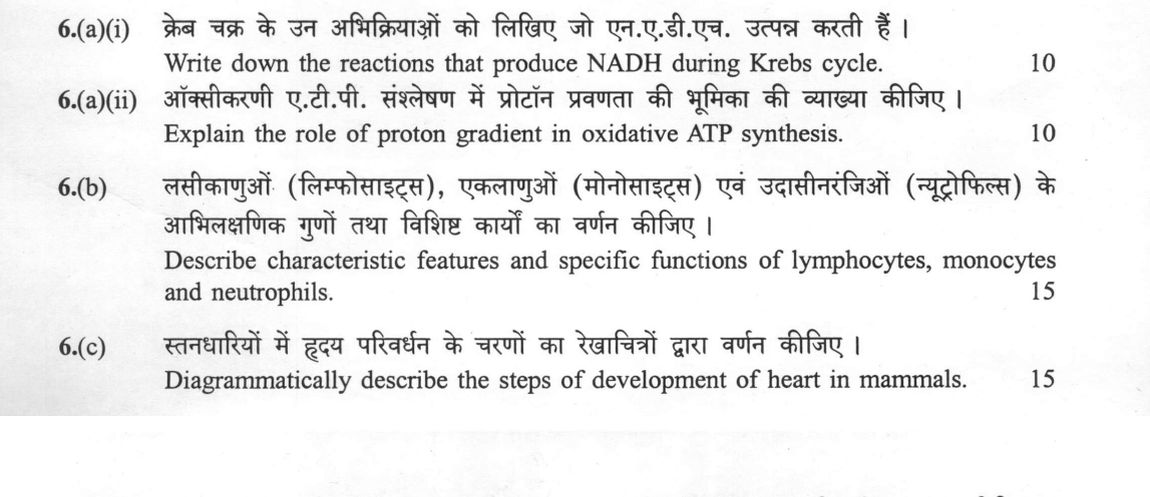
(a)(i) Write down the reactions that produce NADH during Krebs cycle. (10 marks) (a)(ii) Explain the role of proton gradient in…
Write down the reactions that produce NADH during Krebs cycle. 10 marks
Explain the role of proton gradient in oxidative ATP synthesis. 10 marks
Describe characteristic features and specific functions of lymphocytes, monocytes and neutrophils. 15 marks
Diagrammatically describe the steps of development of heart in mammals. 15 marks
हिंदी में प्रश्न पढ़ें
क्रेब चक्र के उन अभिक्रियाओं को लिखिए जो एन.ए.डी.एच. उत्पन्न करती हैं । (10 अंक)
ऑक्सीकरणी ए.टी.पी. संश्लेषण में प्रोटान प्रवणता की भूमिका की व्याख्या कीजिए । (10 अंक)
लसीकाणुओं (लिम्फोसाइड्स), एकलाणुओं (मोनोसाइड्स) एवं उदासीनरंजियों (न्यूट्रोफिल्स) के आभिलक्षणिक गुणों तथा विशिष्ट कार्यों का वर्णन कीजिए । (15 अंक)
स्तनधारियों में हृदय परिवर्धन के चरणों का रेखाचित्रों द्वारा वर्णन कीजिए । (15 अंक)
Model answer
Written by UPSC Answer Check against this question's marking rubric, to the expected length. UPSC does not publish answers for Mains — this is one way to score well, not an official key.
NADH-Producing Reactions in the Krebs Cycle
During the complete oxidation of acetyl-CoA in the mitochondrial matrix, three specific dehydrogenation reactions reduce NAD⁺ to NADH + H⁺:
- Oxidative Decarboxylation of Isocitrate: Isocitrate is converted to α-ketoglutarate by the rate-limiting enzyme isocitrate dehydrogenase. The reaction proceeds through an oxalosuccinate intermediate, releasing the first molecule of CO₂ and generating NADH: Isocitrate + NAD⁺ xrightarrowIsocitrate Dehydrogenase α-Ketoglutarate + CO₂ + NADH + H⁺
- Oxidative Decarboxylation of α-Ketoglutarate: The multienzyme α-ketoglutarate dehydrogenase complex (requiring TPP, lipoate, FAD, NAD⁺, and CoA) converts α-ketoglutarate to succinyl-CoA, releasing the second CO₂ and reducing NAD⁺: α-Ketoglutarate + NAD⁺ + CoA-SH xrightarrowα-Ketoglutarate Dehydrogenase Complex Succinyl-CoA + CO₂ + NADH + H⁺
- Oxidation of L-Malate: In the final step of the cycle, malate dehydrogenase catalyzes the reversible oxidation of L-malate to regenerate oxaloacetate, yielding the third NADH: L-Malate + NAD⁺ xrightarrowMalate Dehydrogenase Oxaloacetate + NADH + H⁺
Proton Gradient in Oxidative ATP Synthesis
According to Peter Mitchell’s chemiosmotic hypothesis, electron transfer along the mitochondrial electron transport chain (Complexes I, III, and IV) is coupled to the active pumping of protons (H⁺) from the matrix into the intermembrane space. This unidirectional extrusion creates an electrochemical proton gradient (proton-motive force, Δ p), comprising an electrical membrane potential (Δ ψ) and a chemical pH gradient (Δ pH).
The dissipation of this proton gradient drives ATP synthesis via the F_oF₁-ATP synthase complex. Protons flow down their electrochemical gradient through the membrane-embedded Fₒ proton channel (c-ring), inducing mechanical rotation of the central stalk (γ/ε subunits). This rotation drives conformational changes within the catalytic β-subunits of the matrix-facing F₁ head through the binding change mechanism (open, loose, and tight states), synthesizing ATP from ADP and inorganic phosphate (Pᵢ). The thermodynamic yield reflects a P/O ratio of approximately 2.5 ATP per NADH and 1.5 ATP per FADH₂.
Characteristics and Functions of Leukocytes
Lymphocytes: Morphologically characterized by a large, darkly staining spherical nucleus with a thin rim of agranular cytoplasm and a lifespan ranging from weeks to several years. T lymphocytes differentiate into CD4⁺ helper cells (orchestrating immune responses via cytokine secretion), CD8⁺ cytotoxic cells (inducing apoptosis in virally infected or neoplastic cells via perforin/granzyme), and regulatory T cells (immune tolerance). B lymphocytes mediate humoral immunity by differentiating into antibody-secreting plasma cells and memory B cells. Natural Killer (NK) cells provide innate cytotoxicity without prior antigen sensitization.
Monocytes: The largest circulating leukocytes (12–20 mum), possessing an indented or kidney-shaped nucleus, abundant agranular cytoplasm, and a circulating lifespan of 1 to 3 days. They migrate into tissues to differentiate into resident macrophages (e.g., Kupffer cells, alveolar macrophages) and dendritic cells. Their functions include receptor-mediated phagocytosis, secretion of pro-inflammatory cytokines, and processing and presentation of exogenous antigens on MHC Class II molecules to activate naive T cells.
Neutrophils: Polymorphonuclear granulocytes featuring 3 to 5 nuclear lobes and a short circulating lifespan (6–10 hours). Their cytoplasm contains primary azurophilic granules (myeloperoxidase, defensins) and secondary specific granules (lactoferrin, lysozyme). They act as first responders to bacterial infection via chemotaxis, phagocytosis, oxidative respiratory burst (generation of reactive oxygen species via NADPH oxidase), and NETosis—extruding neutrophil extracellular traps of chromatin and antimicrobial peptides to immobilize pathogens.
`` Leukocyte Comparison: Lymphocyte: [ Large Spherical Nucleus | Scant Cytoplasm ] -> Adaptive Immunity (T/B/NK) Monocyte: [ Kidney-Shaped Nucleus | Abundant Cytosol ] -> Tissue Macrophages & APCs Neutrophil: [ Multi-lobed Nucleus | Specific Granules] -> Phagocytosis, ROS, NETs ``
Development of the Mammalian Heart
Mammalian cardiogenesis begins at human embryonic day 18–19 (mouse E7.5) with the induction of lateral plate splanchnic mesoderm into the cardiogenic plate, comprising the primary heart field (left ventricle and atria) and secondary heart field (right ventricle and outflow tract).
`` Cardiogenic Field (E18/E7.5) Straight Heart Tube (E21/E8.5) [ Atrial / Ventricular Precursors ] [ Truncus -> Bulbus -> Ventricle -> Atrium -> Sinus ] │ │ ▼ ▼ Dextral Looping (E23-28) Four-Chambered Heart (E50/E14.5) [ D-loop folds Ventricle Ventrally, [ Septum Primum/Secundum, IV Septum, Atrium shifts Dorso-cranially ] Spiral Aorticopulmonary Septum ] ``
Heart Tube Formation and Segmentation: Paired endocardial tubes fuse along the midline by day 21 (mouse E8.5) to form a single continuous heart tube lined by cardiac jelly and myocardium. Craniocaudally, it differentiates into five primitive dilatations: truncus arteriosus, bulbus cordis, primitive ventricle, primitive atrium, and sinus venosus.
Cardiac Looping: Between days 23 and 28, the rapidly elongating tube undergoes dextral looping (D-looping), bending rightward and folding the primitive ventricle ventrocaudally and the primitive atrium and sinus venosus dorsocranially.
Septation and Valve Formation: Atrial septation proceeds via the downward growth of septum primum toward the fused endocardial cushions, leaving the temporary foramen primum, followed by foramen secundum formation and the adjacent growth of the rigid septum secundum, leaving the patent foramen ovale. Ventricular septation occurs through an upward-growing muscular interventricular septum meeting the membranous septum formed by endocardial cushions and conotruncal ridges. Simultaneously, the aorticopulmonary spiral septum divides the truncus arteriosus into the ascending aorta and pulmonary trunk, establishing the integrated, mature four-chambered mammalian circulation.
What "Describe" is asking you to do
Give a full, ordered account of the thing named — its parts, stages or mechanism — in the sequence in which it actually exists or occurs. Most describe questions come from the science optionals, where the marks sit in correct technical detail and, where the stem says so, a labelled diagram.
Structure that answers it
One-line identification of the subject → the parts or stages in their real order, each with its defining detail → labelled diagram where the subject is structural → closing line on function or significance
Where marks are lost
Loose general prose where the examiner is ticking named parts, correct terminology and their sequence; and in the General Studies papers, turning to evaluation before the description is finished.
How this answer will be evaluated
Approach
Framework: UPSC Zoology Paper 2. (a(i)) explain: definition/context > points in order > small example > short close | (a(ii)) explain: definition/context > points in order > small example > short close | (b) describe: define > structure or process in order > labelled diagram > significance | (c) describe: define > structure or process in order > labelled diagram > significance Full marks: Precise biochemical steps and anatomical stages with labelled diagrams.
Key points expected
- Isocitrate to alpha-ketoglutarate (isocitrate dehydrogenase)
- Alpha-ketoglutarate to succinyl-CoA (alpha-ketoglutarate dehydrogenase)
- Malate to oxaloacetate (malate dehydrogenase)
- Mention of 3 NADH produced per acetyl-CoA
- Proton pumping by ETC complexes (I, III, IV)
- Chemiosmotic hypothesis (proton motive force)
- ATP synthase (Complex V) mechanism
- Role of oxygen as final electron acceptor
Evaluation rubric
Each sub-part is marked on its own, against the marks and word limit printed on the paper.
- (a(i)) List the specific Krebs cycle reactions generating NADH. 10 marks
explain— definition/context → points in order → small example → short close
Must cover
- Isocitrate to alpha-ketoglutarate (isocitrate dehydrogenase)
- Alpha-ketoglutarate to succinyl-CoA (alpha-ketoglutarate dehydrogenase)
- Malate to oxaloacetate (malate dehydrogenase)
- Mention of 3 NADH produced per acetyl-CoA
Loses marks
- Omitting the enzyme name for the reaction
- Confusing NADH with FADH2 steps
Earns more
- Mention of FADH2 production (succinate dehydrogenase)
- Mention of GTP/ATP production (succinyl-CoA synthetase)
Extra mark
- Balanced chemical equation for one step
- (a(ii)) Explain the mechanism of oxidative phosphorylation via proton gradient. 10 marks
explain— definition/context → points in order → small example → short close
Must cover
- Proton pumping by ETC complexes (I, III, IV)
- Chemiosmotic hypothesis (proton motive force)
- ATP synthase (Complex V) mechanism
- Role of oxygen as final electron acceptor
Loses marks
- Describing glycolysis instead of ETC
- Failing to link gradient to ATP synthesis
Earns more
- Mention of P/O ratio
- Diagram of inner mitochondrial membrane
Extra mark
- Mention of uncouplers (e.g., DNP)
- (b) Describe features and functions of lymphocytes, monocytes, and neutrophils. 15 marks
describe— define → structure or process in order → labelled diagram → significance
Must cover
- Lymphocytes: T/B cells, adaptive immunity, lymphoid tissue
- Monocytes: Phagocytosis, macrophage differentiation, mononuclear
- Neutrophils: Granulocytes, first responders, polymorphonuclear
- Comparison of specific functions (e.g., antibody vs phagocytosis)
Loses marks
- Confusing monocytes with macrophages (without distinction)
- Omitting specific function for any cell type
Earns more
- Mention of specific granules in neutrophils
- Mention of MHC class II on monocytes
Extra mark
- Mention of specific markers (CD4, CD8)
- (c) Diagrammatically describe the steps of heart development in mammals. 15 marks
describe— define → structure or process in order → labelled diagram → significance
Must cover
- Formation of heart tube from splanchnic mesoderm
- Looping of the heart tube (dextral)
- Septation of atria and ventricles
- Formation of outflow tract (aorticopulmonary septum)
Loses marks
- Diagrams without labels
- Omitting the looping stage
Earns more
- Mention of endocardial cushions
- Mention of neural crest cell contribution
Extra mark
- Mention of specific transcription factors (NKX2.5)
Practice this exact question
Write your answer and it is marked point by point against the model answer above — what you covered, what you missed, what you got wrong.
Evaluate my answer →More from Zoology 2025 Paper II
- Q3 (a)(i) Describe the synthetic theory of evolution. (10 marks) (a)(ii) Describe common typ…
- Q4 (a) Describe the steps of constructing a recombinant DNA and its cloning. (20 marks) (b)…
- Q5 Write on the following in about 150 words each : 10×5=50 (a) Block to polyspermy (10 mark…
- Q6 (a)(i) Write down the reactions that produce NADH during Krebs cycle. (10 marks) (a)(ii)…
- Q7 (a)(i) Explain sigmoidal nature of oxygen dissociation curve for hemoglobin. (10 marks) (…
- Q8 (a) Describe the stages of fertilization in chick with diagram. (20 marks) (b) Draw struc…