Paper II — Q3
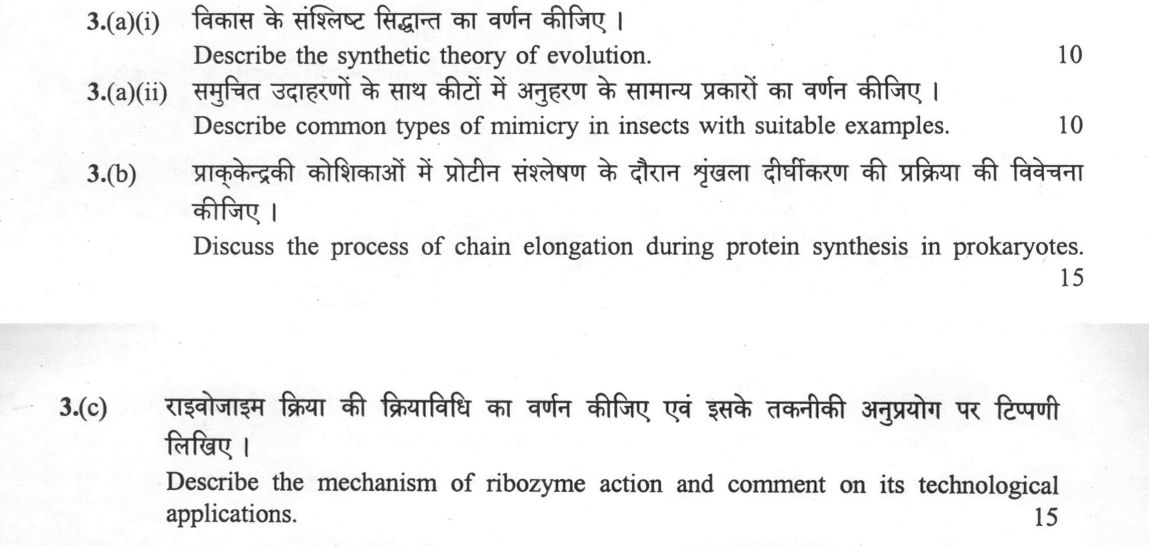
(a)(i) Describe the synthetic theory of evolution. (10 marks) (a)(ii) Describe common types of mimicry in insects with suitable…
Describe the synthetic theory of evolution. 10 marks
Describe common types of mimicry in insects with suitable examples. 10 marks
Discuss the process of chain elongation during protein synthesis in prokaryotes. 15 marks
Describe the mechanism of ribozyme action and comment on its technological applications. 15 marks
हिंदी में प्रश्न पढ़ें
विकास के संश्लिष्ट सिद्धांत का वर्णन कीजिए । (10 अंक)
समुचित उदाहरणों के साथ कीटों में अनुहरण के सामान्य प्रकारों का वर्णन कीजिए । (10 अंक)
प्राक्केंद्रकी कोशिकाओं में प्रोटीन संश्लेषण के दौरान श्रृंखला दीर्घीकरण की प्रक्रिया की विवेचना कीजिए । (15 अंक)
राइबोजाइम क्रिया की क्रियाविधि का वर्णन कीजिए एवं इसके तकनीकी अनुप्रयोग पर टिप्पणी लिखिए । (15 अंक)
Model answer
Written by UPSC Answer Check against this question's marking rubric, to the expected length. UPSC does not publish answers for Mains — this is one way to score well, not an official key.
(a)(i) Synthetic theory. The synthetic theory, or modern synthesis, is the Neo-Darwinian framework uniting Darwinian natural selection with Mendelian inheritance and population genetics. It treats evolution as change in allele frequencies in populations. Hardy–Weinberg equilibrium is the null model: without mutation, migration, selection, drift or non-random mating, allele and genotype frequencies remain constant, so departures reveal evolutionary forces. Dobzhansky linked genetic variation in natural populations to selection; Mayr clarified the biological species concept and reproductive isolation; Simpson integrated fossil sequences with gradual change. Indian scientist P. Maheshwari is not a founder of the synthesis; his work was plant embryology. The synthesis explains adaptation, microevolution and speciation through selection on heritable variation, and remains the central framework for evolutionary biology.
(a)(ii) Mimicry in insects. Mimicry is resemblance to another organism or object that benefits the mimic. Batesian mimicry: a palatable mimic resembles an unpalatable model; female Papilio polytes mimics unpalatable Pachliopta aristolochiae in India. Müllerian mimicry: unpalatable species converge on shared warning signals, strengthening predator learning; Heliconius erato and H. melpomene are classic co-mimics. Aggressive mimicry: a predator or parasite imitates a harmless signal to approach prey; female Photuris fireflies mimic the flash signals of Photinus fireflies to lure and eat them. Automimicry: self-mimicry within the same species, such as eyespots on butterfly wings resembling vertebrate eyes and deflecting attacks from vital parts.
(b) Chain elongation in prokaryotes. In prokaryotes, translation begins when the 30S subunit, initiation factors and formylmethionyl-tRNA bind the 5′ UTR and AUG; the 50S subunit joins to form the 70S initiation complex. Elongation is cyclic. A charged aminoacyl-tRNA matching the codon enters the A site, guided by codon–anticodon pairing and EF-Tu·GTP; GTP hydrolysis releases EF-Tu. The growing peptide is on the P-site tRNA. The 23S rRNA peptidyl-transferase centre catalyses peptide bond formation, transferring the nascent peptide to the A-site amino acid and leaving the P-site tRNA deacylated. EF-G·GTP then binds, and GTP hydrolysis drives translocation: the ribosome moves one codon, the peptidyl-tRNA shifts from A to P, and the deacylated tRNA moves to E and exits. The A site is empty for the next charged tRNA. This ordered cycle ensures codon fidelity and processive chain growth, adding amino acids from N to C terminus. Termination occurs when a stop codon enters the A site; release factors RF2/RF3 promote hydrolysis of the peptide–tRNA bond and release the protein. Prokaryotic 70S ribosomes differ from eukaryotic 80S ribosomes in subunit size, initiation factors, formylmethionine start, and coupling of transcription and translation.
(c) Ribozyme action and applications. Ribozymes are RNA molecules that catalyse reactions, mainly by acid–base catalysis, where conserved nucleobases and metal ions donate/accept protons and stabilise transition states. Group I introns self-splice by a 2′-OH of a conserved internal adenosine attacking the 5′ splice site, followed by exon ligation. Group II introns form a lariat intermediate and catalyse their own excision and splicing. RNase P is an RNA enzyme that processes tRNA 5′ ends; hammerhead ribozymes have a compact pseudoknot with a catalytic core that cleaves a specific phosphodiester bond. Technologically, engineered hammerhead ribozymes can be designed as sequence-specific RNA-cleaving agents for antisense strategies; this is direct catalytic cleavage, not RNA interference. RNAi therapeutics are a separate RNA-based field using small RNAs and RISC. Synthetic biology uses ribozymes as genetic switches, self-cleaving elements and RNA-editing tools. In COVID-19 mRNA vaccines, stability and translation depend on the cap, modified nucleotides, UTRs and poly(A) tail; ribozymes are not the stabilizing feature. Ribozymes support the RNA-world hypothesis, showing RNA can bridge genotype and phenotype by storing information and catalysing chemistry; later molecular novelty may involve gene duplication and neo-functionalization, but that is an extension beyond the original modern synthesis.
What "Describe" is asking you to do
Give a full, ordered account of the thing named — its parts, stages or mechanism — in the sequence in which it actually exists or occurs. Most describe questions come from the science optionals, where the marks sit in correct technical detail and, where the stem says so, a labelled diagram.
Structure that answers it
One-line identification of the subject → the parts or stages in their real order, each with its defining detail → labelled diagram where the subject is structural → closing line on function or significance
Where marks are lost
Loose general prose where the examiner is ticking named parts, correct terminology and their sequence; and in the General Studies papers, turning to evaluation before the description is finished.
How this answer will be evaluated
Approach
Framework: UPSC Zoology Paper 2. (a(i)) describe: define > structure or process in order > labelled diagram > significance | (a(ii)) describe: define > structure or process in order > labelled diagram > significance | (b) discuss: intro > 3-4 dimensions > example > balanced close | (c) describe: define > structure or process in order > labelled diagram > significance Full marks: Precise definitions, named species/factors, clear mechanisms, and labelled diagrams.
Key points expected
- Definition of Modern Synthesis
- Integration of Mendelian genetics
- Role of natural selection
- Mechanisms of speciation
- Batesian mimicry with example
- Mullerian mimicry with example
- Automimicry with example
- Distinction between types
Evaluation rubric
Each sub-part is marked on its own, against the marks and word limit printed on the paper.
- (a(i)) Define and outline the components of the Modern Synthesis. 10 marks
describe— define → structure or process in order → labelled diagram → significance
Must cover
- Definition of Modern Synthesis
- Integration of Mendelian genetics
- Role of natural selection
- Mechanisms of speciation
Loses marks
- Confusing with Lamarckism
- Omitting the role of genetics
Earns more
- Mention of key figures (Dobzhansky, Mayr)
- Distinction from Darwinism
Extra mark
- Reference to specific evolutionary models
- (a(ii)) Classify mimicry types in insects with specific examples. 10 marks
describe— define → structure or process in order → labelled diagram → significance
Must cover
- Batesian mimicry with example
- Mullerian mimicry with example
- Automimicry with example
- Distinction between types
Loses marks
- Confusing Batesian and Mullerian
- Using common names only
Earns more
- Mention of specific species names
- Ecological significance of mimicry
Extra mark
- Reference to specific geographic examples
- (b) Explain the steps of chain elongation in prokaryotes. 15 marks
discuss— intro → 3-4 dimensions → example → balanced close
Must cover
- Aminoacyl-tRNA binding to A site
- Peptide bond formation mechanism
- Translocation of tRNA
- Role of EF-G and GTP
Loses marks
- Omitting translocation step
- Confusing prokaryotic and eukaryotic factors
Earns more
- Labelled diagram of ribosome
- Mention of specific factors (EF-Tu, EF-G)
Extra mark
- Comparison with eukaryotic elongation
- (c) Explain ribozyme mechanism and its applications. 15 marks
describe— define → structure or process in order → labelled diagram → significance
Must cover
- Definition of ribozyme
- Mechanism of catalytic action
- Example of natural ribozyme
- Technological applications
Loses marks
- Confusing ribozymes with ribosomes
- Omitting applications
Earns more
- Mention of specific ribozymes (RNase P, Ribosome)
- Details on biotechnology uses
Extra mark
- Reference to Nobel Prize (Cech, Altman)
Practice this exact question
Write your answer and it is marked point by point against the model answer above — what you covered, what you missed, what you got wrong.
Evaluate my answer →More from Zoology 2025 Paper II
- Q1 Write on the following in about 150 words each : 10×5=50 (a) Protein sorting in Golgi app…
- Q2 (a)(i) Describe composition of plasma membrane. (10 marks) (a)(ii) Differentiate between…
- Q3 (a)(i) Describe the synthetic theory of evolution. (10 marks) (a)(ii) Describe common typ…
- Q4 (a) Describe the steps of constructing a recombinant DNA and its cloning. (20 marks) (b)…
- Q5 Write on the following in about 150 words each : 10×5=50 (a) Block to polyspermy (10 mark…
- Q6 (a)(i) Write down the reactions that produce NADH during Krebs cycle. (10 marks) (a)(ii)…