Paper II — Q2
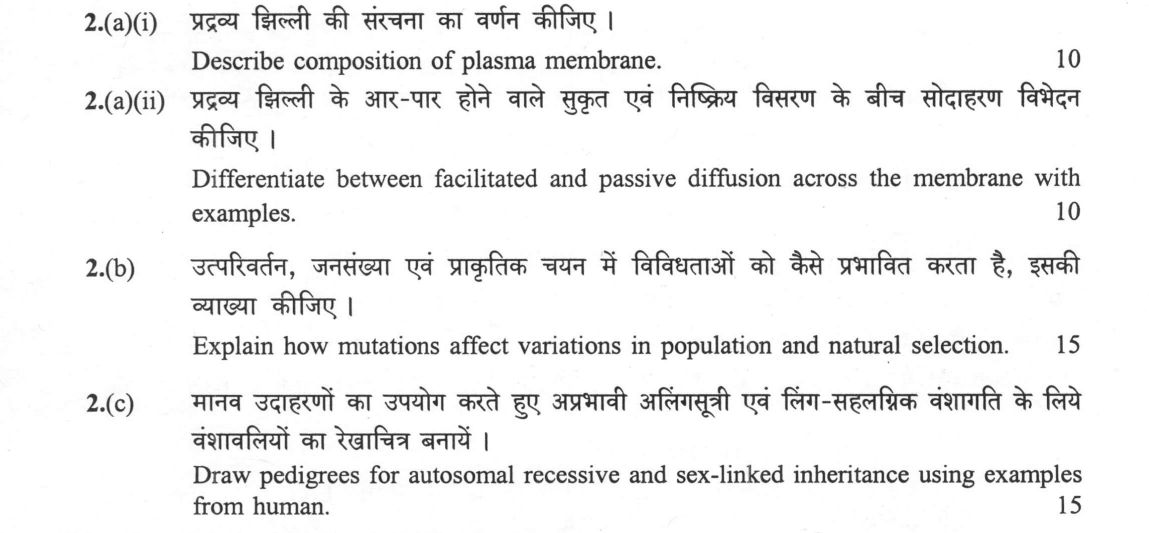
(a)(i) Describe composition of plasma membrane. (10 marks) (a)(ii) Differentiate between facilitated and passive diffusion across…
Describe composition of plasma membrane. 10 marks
Differentiate between facilitated and passive diffusion across the membrane with examples. 10 marks
Explain how mutations affect variations in population and natural selection. 15 marks
Draw pedigrees for autosomal recessive and sex-linked inheritance using examples from human. 15 marks
हिंदी में प्रश्न पढ़ें
प्रद्रव्य झिल्ली की संरचना का वर्णन कीजिए । (10 अंक)
प्रद्रव्य झिल्ली के आर-पार होने वाले सुकृत एवं निष्क्रिय विसरण के बीच सौदाहरण विभेदन कीजिए । (10 अंक)
उत्परिवर्तन, जनसंख्या एवं प्राकृतिक चयन में विविधताओं को कैसे प्रभावित करता है, इसकी व्याख्या कीजिए । (15 अंक)
मानव उदाहरणों का उपयोग करते हुए अप्रभावी अलिंगसूत्री एवं लिंग-सहलग्निक वंशागति के लिए वंशावलियों का रेखाचित्र बनायें । (15 अंक)
Model answer
Written by UPSC Answer Check against this question's marking rubric, to the expected length. UPSC does not publish answers for Mains — this is one way to score well, not an official key.
(a)(i) Plasma membrane composition. The plasma membrane is best described by the Singer–Nicolson fluid mosaic model. It is a phospholipid bilayer in which hydrophilic phosphate heads face the aqueous exterior and interior, while hydrophobic fatty-acid tails form the interior. Integral proteins span or are embedded in the bilayer and form channels, carriers, receptors and enzyme sites; peripheral proteins attach to the surface or to integral proteins. Cholesterol is interspersed in the lipid layer, modulating fluidity and permeability. Carbohydrate chains attached to lipids and proteins form the glycocalyx on the outer surface, aiding cell recognition and protection. The bilayer is selectively permeable: lipid-soluble molecules cross directly, while many polar molecules require protein pathways.
(a)(ii) Passive and facilitated diffusion. Passive or simple diffusion is movement of small, non-polar molecules down their concentration gradient without membrane protein, e.g. O2 and CO2. Its rate depends on gradient, size and membrane permeability. Facilitated diffusion is also passive and down-gradient, but requires specific membrane proteins: channel proteins form aqueous pores for ions or water, while carrier proteins undergo conformational change to move solutes. Examples include GLUT glucose transporters and aquaporins for water. Thus both are energy-independent, but facilitated diffusion is protein-mediated, selective and saturable because transporters are finite.
(b) Mutations, variation and selection. Mutations are permanent changes in DNA and are the primary source of new genetic variation. Gene mutations include point mutations, which are single-base substitutions (transitions or transversions), and frameshift mutations caused by insertions or deletions of bases not in multiples of three. Chromosomal mutations involve deletions, duplications, inversions or translocations; genome mutations involve changes in chromosome number, such as aneuploidy or polyploidy. Mutations arise spontaneously during replication or by DNA damage, and can be induced by radiation or chemical mutagens. Most are neutral or deleterious, but some create alleles that can be advantageous in a particular environment. In a large population, mutation changes allele frequencies, so it violates Hardy–Weinberg equilibrium, where p + q = 1 and p² + 2pq + q² = 1 only when mutation, selection, drift, migration and non-random mating are absent. Natural selection acts on phenotypic variation produced by mutation and recombination: individuals with advantageous alleles survive and reproduce more, increasing those alleles. Examples are antibiotic resistance in bacteria, where resistant mutants persist after drug use, and industrial melanism in Biston betularia, where dark moths increased in soot-covered areas because they were less visible to birds.
(c) Pedigrees. Pedigree symbols are squares for males, circles for females, shaded for affected, half-shaded for carriers, horizontal lines for marriage, vertical lines for offspring, and Roman numerals for generations. For autosomal recessive thalassaemia, common in parts of India, draw three generations: I-1 (half-shaded square) and I-2 (half-shaded circle) are carrier parents; their daughter II-1 (half-shaded circle) marries her carrier cousin II-2 (half-shaded square), the son of I-3 and I-4 (both half-shaded), where I-3 is a sibling of I-1. Their children include III-1 (shaded square) and III-2 (shaded circle), affected males and females, and III-3 (unshaded square), normal. This shows consanguinity, skipped generations, unaffected carrier parents and equal sex ratio. For X-linked recessive haemophilia, draw I-1 (unshaded square) and I-2 (half-shaded circle). Their children are II-1 (shaded square, affected son), II-2 (half-shaded circle, carrier daughter) and II-3 (unshaded square). II-2 marries an unrelated normal male, II-4 (unshaded square); their children are III-1 (shaded square, affected son), III-2 (half-shaded circle, carrier daughter) and III-3 (unshaded square). This shows criss-cross inheritance, more males affected, and no male-to-male transmission. Thus molecular mechanisms link to evolution: membrane proteins regulate selective transport, mutation supplies heritable variation, selection changes allele frequencies, and pedigrees reveal how such variants are transmitted.
What "Explain" is asking you to do
Make the working of something clear — what sets it off, what follows from what, and what it produces. Explain is the Commission's mechanism word: it dominates the technical papers and the “explain why” stems, where the marks sit in the causal chain and not in the label.
Structure that answers it
State what it is → the initiating condition → the chain of cause, step by step → an instance where it plays out → what the chain produces
Where marks are lost
Describing what something looks like instead of why it works that way. Naming the stages without linking them reads as description too.
How this answer will be evaluated
Approach
Framework: Fluid Mosaic Model. (a(i)) describe: define > structure or process in order > labelled diagram > significance | (a(ii)) compare: paired headings or table > key differences > significance > conclusion | (b) explain: definition/context > points in order > small example > short close | (c) map: locate accurately > label > one line on why it matters Full marks: Precise terminology, labelled diagrams, and clear logical flow.
Key points expected
- Phospholipid bilayer structure
- Integral and peripheral proteins
- Cholesterol and glycolipids
- Fluid mosaic model concept
- Definition of passive diffusion
- Definition of facilitated diffusion
- Role of carrier proteins in facilitated
- Specific examples for both types
Evaluation rubric
Each sub-part is marked on its own, against the marks and word limit printed on the paper.
- (a(i)) Composition of plasma membrane components and their arrangement. 10 marks
describe— define → structure or process in order → labelled diagram → significance
Must cover
- Phospholipid bilayer structure
- Integral and peripheral proteins
- Cholesterol and glycolipids
- Fluid mosaic model concept
Loses marks
- Static 'sandwich' model description
- Missing protein classification
Earns more
- Labelled diagram of membrane
- Specific protein types (e.g., channels)
- Asymmetry of membrane layers
Extra mark
- Mention of specific lipid types (e.g., sphingomyelin)
- (a(ii)) Differentiation between facilitated and passive diffusion with examples. 10 marks
compare— paired headings or table → key differences → significance → conclusion
Must cover
- Definition of passive diffusion
- Definition of facilitated diffusion
- Role of carrier proteins in facilitated
- Specific examples for both types
Loses marks
- Confusing with active transport
- Missing examples
Earns more
- Comparison table format
- Mention of saturation kinetics
- Specific molecules (e.g., glucose, O2)
Extra mark
- Graph of transport rate vs concentration
- (b) Mechanism of mutations affecting population variation and selection. 15 marks
explain— definition/context → points in order → small example → short close
Must cover
- Mutation as source of genetic variation
- Types of mutations (point, chromosomal)
- Link to natural selection process
- Impact on population fitness
Loses marks
- Ignoring natural selection link
- Vague description of mutation
Earns more
- Example of adaptive mutation
- Mention of genetic drift
- Hardy-Weinberg equilibrium disruption
Extra mark
- Specific case study (e.g., sickle cell)
- (c) Pedigree charts for autosomal recessive and sex-linked inheritance. 15 marks
map— locate accurately → label → one line on why it matters
Must cover
- Autosomal recessive pedigree
- Sex-linked (X-linked) pedigree
- Correct symbols (squares/circles)
- Human examples (e.g., haemophilia)
Loses marks
- Incorrect pedigree symbols
- Missing genotypes
Earns more
- Genotypes labelled on chart
- Clear distinction between traits
- Multiple generations shown
Extra mark
- Mention of specific disease names
Practice this exact question
Write your answer and it is marked point by point against the model answer above — what you covered, what you missed, what you got wrong.
Evaluate my answer →More from Zoology 2025 Paper II
- Q1 Write on the following in about 150 words each : 10×5=50 (a) Protein sorting in Golgi app…
- Q2 (a)(i) Describe composition of plasma membrane. (10 marks) (a)(ii) Differentiate between…
- Q3 (a)(i) Describe the synthetic theory of evolution. (10 marks) (a)(ii) Describe common typ…
- Q4 (a) Describe the steps of constructing a recombinant DNA and its cloning. (20 marks) (b)…
- Q5 Write on the following in about 150 words each : 10×5=50 (a) Block to polyspermy (10 mark…