Paper I — Q2
(a) Using moment area method, find the slopes and deflection at 'B' for the beam shown in the figure below. Point 'B' is a hinge…
Using moment area method, find the slopes and deflection at 'B' for the beam shown in the figure below. Point 'B' is a hinge. 15 marks
A rectangular reinforced concrete column of size 250 mm × 400 mm is used to support an ultimate axial load of 700 kN. The column has an unsupported length of 3·2 m. The column is effectively held in position at both ends and restrained against rotation at one end. Design suitable reinforcements in the column using M 25 grade of concrete and Fe 415 HYSD bars. Also draw the reinforcement details. Use limit state method. 15 marks
A flow of 100 litres/sec flows down in a rectangular laboratory flume of width 0·60 m and having adjustable bottom slope. If Chezy's constant (C) is 56, determine the bottom slope for uniform flow with a depth of flow 0·30 m. Also find the conveyance and state the flow. 20 marks
हिंदी में प्रश्न पढ़ें
आधृण क्षेत्रफल विधि का उपयोग करके, नीचे चित्र में दर्शाई गई धरन के लिए 'B' पर प्रवणताएँ और विस्थेप ज्ञात कीजिए । बिन्दु 'B' एक हिन्ज है । (15 अंक)
250 mm × 400 mm आमाप के एक आयताकार प्रबलित कंक्रीट स्तम्भ का उपयोग एक 700 kN के चरम अक्षीय भार को आलम्बित करने के लिए किया जाता है । स्तम्भ की अनालम्बित लम्बाई 3·2 m है । स्तम्भ दोनों सिरों पर स्थिति में प्रभावी रूप से आबद्ध है और एक सिरे पर घूर्णन निरोधित है । M 25 ग्रेड के कंक्रीट और Fe 415 एच.वाई.एस.डी. छड़ों का उपयोग करके स्तम्भ में उपयुक्त प्रबलनों की अभिकल्पना कीजिए । प्रबलन विस्तरण भी खींचिए । सीमान्त अवस्था विधि का उपयोग कीजिए । (15 अंक)
100 litres/sec का एक प्रवाह, 0·60 m चौड़ी और समायोज्य तल प्रवणता वाली एक आयताकार प्रयोगशाला अवनालिका (फ्ल्यूम) में प्रवाहित होती है । यदि चेजी नियतांक (C) 56 है, तो 0·30 m की प्रवाह की गहराई के एकसमान प्रवाह के लिए तल प्रवणता का निर्धारण कीजिए । वाहकता (कन्वेयेंस) और प्रवाह की दशा भी ज्ञात कीजिए । (20 अंक)
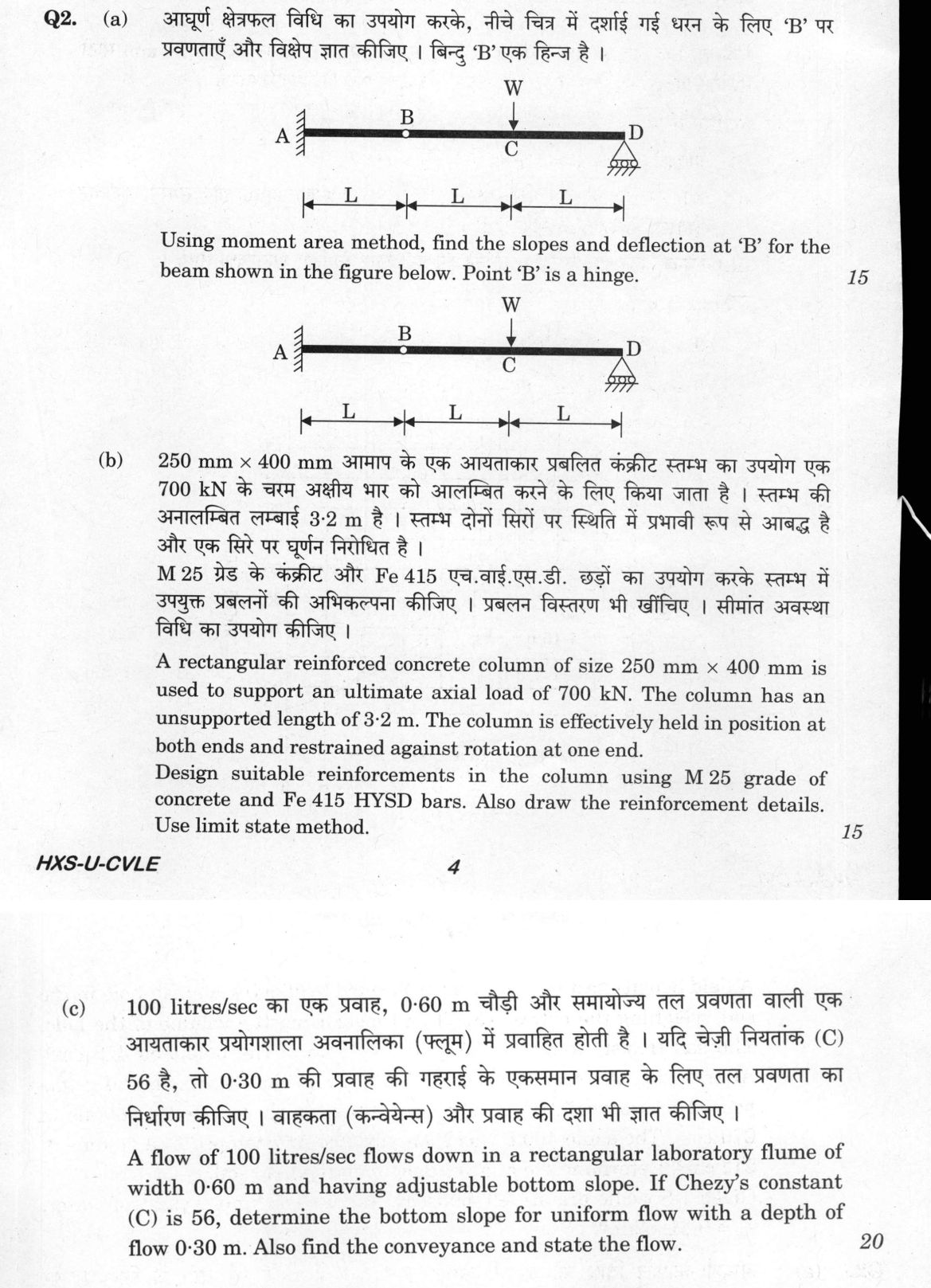
The figure this question refers to, in words
The question paper is a scan and the diagram did not survive as text. This is the figure as read from the original page — every component, value and label — so the question can be worked from the text below.
(a) A horizontal beam with a total length of 3L, divided into three equal segments of length L each. The beam is supported at the left end (point A) by a fixed support and at the right end (point D) by a roller support. There is an internal hinge located at point B, which is at a distance L from the left support A. A vertical point load labeled 'W' acts downwards at point C, which is located at the midpoint of the beam (distance 2L from A). The points are labeled A, B, C, and D from left to right. Dimension lines below the beam indicate the length of each segment (A to B, B to C, and C to D) is L.
Model answer
Written by UPSC Answer Check against this question's marking rubric, to the expected length. UPSC does not publish answers for Mains — this is one way to score well, not an official key.
(a) Assume EI constant, sagging moment positive, upward deflection positive. W in N, L in m, EI in N·m²; slopes in rad, deflection in m. From right portion B-D, moments about hinge B: R_D(2L) - W(L)=0, so R_D=W/2. Whole beam vertical equilibrium gives R_A=W/2. Whole-beam moment equilibrium about A gives support moment WL/2, so internal M_A=-WL/2 (hogging). For A-B, M(x)=(W/2)(x-L); M_B=0. For B-C, M=(W/2)(x-L); for C-D, M=(W/2)(3L-x).
First moment-area theorem: change in slope equals area of M/EI diagram. Between A and B, area=1/2×L×(-WL/2)=-WL²/(4EI). Since A is fixed, θ_A=0, so θ_B(left)=-WL²/(4EI), i.e. WL²/(4EI) clockwise.
Second moment-area theorem: deviation of B from tangent at A equals moment about B of M/EI area A-B. t_BA=(1/EI)∫ from 0 to L (W/2)(x-L)(L-x)dx=-WL³/(6EI). Tangent at A is horizontal, so y_B=-WL³/(6EI); deflection at B is WL³/(6EI) downward.
For slope just right of hinge, let θ_B(right)=θ. On B-D use x' from B. M=(W/2)x' for 0≤x'≤L and M=(W/2)(2L-x') for L≤x'≤2L. Second theorem gives deviation of D from tangent at B: t_DB=(1/EI)[∫ from 0 to L (2L-x')(W/2)x'dx'+∫ from L to 2L (2L-x')(W/2)(2L-x')dx']=WL³/(2EI). Compatibility: y_D-y_B-θ(2L)=t_DB. With y_D=0 and y_B=-WL³/(6EI): WL³/(6EI)-2Lθ=WL³/(2EI), so θ=-WL²/(6EI). Thus θ_B(right)=-WL²/(6EI), i.e. WL²/(6EI) clockwise. Hinge rotation jump=WL²/(12EI).
Final (a): θ_B(left)=WL²/(4EI) clockwise; θ_B(right)=WL²/(6EI) clockwise; δ_B=WL³/(6EI) downward.
(b) Given b=250 mm, D=400 mm, A_g=100000 mm², P_u=700 kN, f_ck=25 N/mm², f_y=415 N/mm², l=3.2 m. Load is ultimate, so no extra load factor. One end fixed and other pinned, so K=0.8. l_e=0.8×3.2=2.56 m=2560 mm. Least lateral dimension d=250 mm. Slenderness ratio l_e/d=2560/250=10.24<12, so short column.
Minimum eccentricity e_min=l/500+D/30=3200/500+400/30=19.73 mm, taken as 20 mm. Since 0.05D=20 mm, design for concentric axial load.
Limit state axial capacity: P_u=0.40f_ckA_g+0.67f_yA_sc. Concrete term=0.40×25×100000=1000000 N=1000 kN>700 kN, so steel is governed by minimum. Minimum longitudinal steel=0.8% A_g=0.008×100000=800 mm². Maximum 6%=6000 mm² not reached.
Provide 4 nos. 16 mm Fe 415 bars: A_sc=4×π/4×16²=256π=804.2 mm²=0.804% A_g. Check: P_u=1000+0.67×415×804.2/1000=1223.6 kN>700 kN. Safe. Ties: diameter=max(16/4,6)=6 mm. Pitch=least of 16×16=256 mm, 300 mm, least lateral dimension 250 mm, hence 250 mm c/c.
Reinforcement details: draw 250 mm×400 mm rectangle; four 16 mm bars at corners; clear cover 40 mm to main bars; 6 mm lateral ties enclosing bars with 135° hooks, spaced 250 mm c/c. Clear spacing is 138 mm on 250 mm face and 288 mm on 400 mm face, both >75 mm.
Final (b): 4-16 mm main bars and 6 mm ties @ 250 mm c/c.
(c) Q=100 L/s=0.100 m³/s, b=0.60 m, y=0.30 m, C=56 m⁰·⁵/s. Chezy formula for steady uniform open-channel flow: V=C√(RS). A=by=0.60×0.30=0.18 m². P=b+2y=0.60+0.60=1.20 m. R=A/P=0.18/1.20=0.15 m. V=Q/A=0.100/0.18=5/9=0.5556 m/s.
S=(V/C)²/R=(5/9÷56)²/0.15=(5/504)²/(3/20)=125/190512≈6.56×10⁻⁴. Thus bottom slope S≈0.000656, or 1 in 1524.
Conveyance K is defined by Q=K√S, so K=AC√R: K=0.18×56×√0.15=10.08×√(3/20)=126√15/125≈3.904 m³/s. Check: K√S≈0.100 m³/s.
Froude number for rectangular flow: F=V/√(gy)=(5/9)/√(9.81×0.30)=0.324. Since F<1, uniform flow is subcritical, i.e. tranquil.
Final (c): S=6.56×10⁻⁴ (1 in 1524); K=3.904 m³/s; flow is subcritical uniform flow.
What "Solve" is asking you to do
Choose the method, then carry it through to a final answer. Identifying what kind of problem this is and why that method applies is the first thing marked; a correct figure arrived at invisibly earns almost nothing.
Structure that answers it
Given data and what is required → method chosen, with the reason it applies → set-up (equation, circuit, free body, trial balance) → working, step by step → answer with units and any condition of validity
Where marks are lost
Doing the middle steps mentally and writing only the result. In mathematics papers, a further loss comes from giving a decimal where the exact value in surds or fractions was wanted, or from skipping the justification a part explicitly asks for.
How this answer will be evaluated
Approach
(a) calculate: given > formula > substitution > result with units > interpretation | (b) calculate: given > formula > substitution > result with units > interpretation | (c) calculate: given > formula > substitution > result with units > interpretation Full marks: Rigorous application of theorems/codes with all checks and neat sketches.
Key points expected
- Identify B as a hinge (M=0) to split beam
- Calculate support reactions at A and D
- Draw BMD for segments AB and BCD
- Apply moment area theorems to find slope/deflection
- Check slenderness ratio (Le/b) against IS 456 limits
- Apply IS 456:2000 design formula for columns
- Calculate required steel area (Asc) and select bars
- Provide transverse reinforcement (ties) details
Evaluation rubric
Each sub-part is marked on its own, against the marks and word limit printed on the paper.
- (a) Slope and deflection at hinge B using moment area method. 15 marks
calculate— given → formula → substitution → result with units → interpretation
Must cover
- Identify B as a hinge (M=0) to split beam
- Calculate support reactions at A and D
- Draw BMD for segments AB and BCD
- Apply moment area theorems to find slope/deflection
Loses marks
- Treats beam as continuous without hinge condition
- Omits reaction calculation before moment area
Earns more
- Correctly identifies indeterminate nature of beam
- Uses consistent sign convention for moments
- Calculates deflection relative to tangent at D
Extra mark
- Neatly labelled BMD and elastic curve sketch
- (b) Design of longitudinal reinforcement for RC column using LSM. 15 marks
calculate— given → formula → substitution → result with units → interpretation
Must cover
- Check slenderness ratio (Le/b) against IS 456 limits
- Apply IS 456:2000 design formula for columns
- Calculate required steel area (Asc) and select bars
- Provide transverse reinforcement (ties) details
Loses marks
- Ignores slenderness effect on load capacity
- Selects bar size without checking spacing
Earns more
- Checks minimum and maximum reinforcement limits
- Calculates effective length (Le) correctly
- Draws neat reinforcement layout sketch
Extra mark
- Explicitly cites IS 456:2000 clause numbers
- (c) Bottom slope, conveyance, and flow state for rectangular flume. 20 marks
calculate— given → formula → substitution → result with units → interpretation
Must cover
- Calculate hydraulic mean depth (m) and area (A)
- Apply Chezy's formula to find velocity (V)
- Determine bottom slope (S) from velocity equation
- Calculate conveyance (K) and classify flow regime
Loses marks
- Confuses hydraulic radius with hydraulic mean depth
- Fails to state flow regime (sub/supercritical)
Earns more
- Correctly identifies flow as subcritical/supercritical
- Calculates Froude number to justify flow state
- Carries units through all hydraulic calculations
Extra mark
- Sketch of flume cross-section with dimensions
Practice this exact question
Write your answer and it is marked point by point against the model answer above — what you covered, what you missed, what you got wrong.
Evaluate my answer →More from Civil Engineering 2021 Paper I
- Q1 (a) Determine the forces in members AC, DE and GH of the truss loaded and supported as sh…
- Q2 (a) Using moment area method, find the slopes and deflection at 'B' for the beam shown in…
- Q3 (a) The figure below represents time and consolidation relationship for a clay sample 30…
- Q4 (a) Determine the maximum tensile force in member DI of the truss shown below due to the…
- Q5 (a) A circular log of weight 1000 N and radius 18 cm is supported by a pair of brackets,…