Paper I — Q5
(a) A circular log of weight 1000 N and radius 18 cm is supported by a pair of brackets, one of which is shown in the figure…
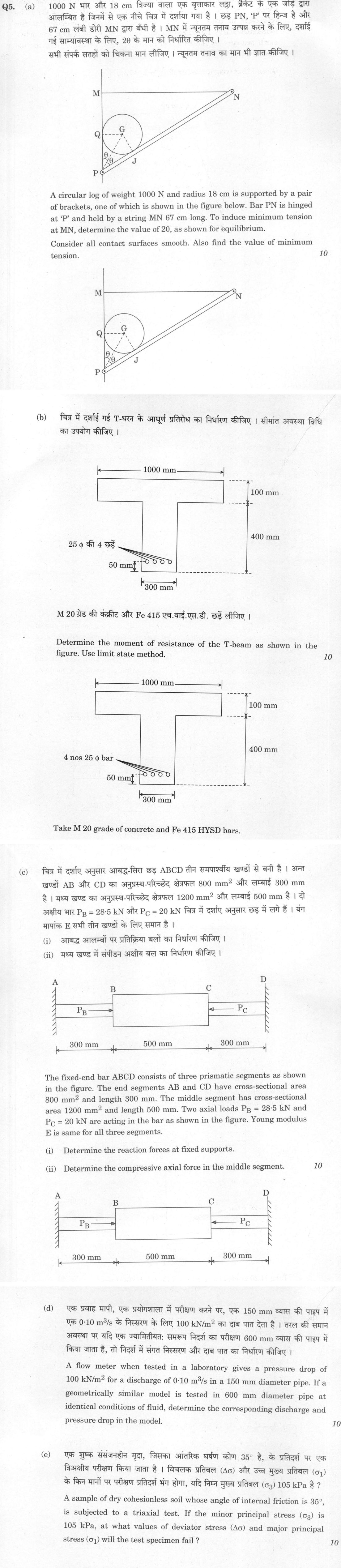
A circular log of weight 1000 N and radius 18 cm is supported by a pair of brackets, one of which is shown in the figure below. Bar PN is hinged at 'P' and held by a string MN 67 cm long. To induce minimum tension at MN, determine the value of 2θ, as shown for equilibrium. Consider all contact surfaces smooth. Also find the value of minimum tension. 10 marks
Determine the moment of resistance of the T-beam as shown in the figure. Use limit state method. Take M 20 grade of concrete and Fe 415 HYSD bars. 10 marks
The fixed-end bar ABCD consists of three prismatic segments as shown in the figure. The end segments AB and CD have cross-sectional area 800 mm² and length 300 mm. The middle segment has cross-sectional area 1200 mm² and length 500 mm. Two axial loads P_B = 28·5 kN and P_C = 20 kN are acting in the bar as shown in the figure. Young modulus E is same for all three segments. Determine the reaction forces at fixed supports.
Determine the compressive axial force in the middle segment. 10 marks
A flow meter when tested in a laboratory gives a pressure drop of 100 kN/m² for a discharge of 0·10 m³/s in a 150 mm diameter pipe. If a geometrically similar model is tested in 600 mm diameter pipe at identical conditions of fluid, determine the corresponding discharge and pressure drop in the model. 10 marks
A sample of dry cohesionless soil whose angle of internal friction is 35°, is subjected to a triaxial test. If the minor principal stress (σ₃) is 105 kPa, at what values of deviator stress (Δσ) and major principal stress (σ₁) will the test specimen fail? 10 marks
हिंदी में प्रश्न पढ़ें
1000 N भार और 18 cm त्रिज्या वाला एक वृत्ताकार लट्ठा, ब्रैकेट के एक जोड़े द्वारा आलंबित है जिनमें से एक नीचे चित्र में दर्शाया गया है । छड़ PN, 'P' पर हिंज है और 67 cm लंबी डोरी MN द्वारा बंधी है । MN में न्यूनतम तनाव उत्पन्न करने के लिए, दर्शाई गई साम्यावस्था के लिए, 2θ के मान को निर्धारित कीजिए । सभी संपर्क सतहों को चिकना मान लीजिए । न्यूनतम तनाव का मान भी ज्ञात कीजिए । (10 अंक)
चित्र में दर्शाई गई T-धन के आघूर्ण प्रतिरोध का निर्धारण कीजिए । सीमंत अवस्था विधि का उपयोग कीजिए । M 20 ग्रेड की कंक्रीट और Fe 415 एच.वाई.एस.डी. छड़ें लीजिए । (10 अंक)
चित्र में दर्शाए अनुसार आबद्ध-सिरा छड़ ABCD तीन समपार्श्वीय खंडों से बनी है । अंत खंडों AB और CD का अनुप्रस्थ-परिच्छेद क्षेत्रफल 800 mm² और लंबाई 300 mm है । मध्य खंड का अनुप्रस्थ-परिच्छेद क्षेत्रफल 1200 mm² और लंबाई 500 mm है । दो अक्षीय भार P_B = 28·5 kN और P_C = 20 kN चित्र में दर्शाए अनुसार छड़ में लगे हैं । यांग मापांक E सभी तीन खंडों के लिए समान है । आबद्ध आलम्बों पर प्रतिक्रिया बलों का निर्धारण कीजिए ।
मध्य खंड में संपीडन अक्षीय बल का निर्धारण कीजिए । (10 अंक)
एक प्रवाह मापी, एक प्रयोगशाला में परीक्षण करने पर, एक 150 mm व्यास की पाइप में एक 0·10 m³/s के निस्सरण के लिए 100 kN/m² का दाब पात देता है । तरल की समान अवस्था पर यदि एक ज्यामितियतः समरूप निदर्श का परीक्षण 600 mm व्यास की पाइप में किया जाता है, तो निदर्श में संगत निस्सरण और दाब पात का निर्धारण कीजिए । (10 अंक)
एक शुष्क संसजनहीन मृदा, जिसका आंतरिक घर्षण कोण 35° है, के प्रतिदर्श पर एक त्रिअक्षीय परीक्षण किया जाता है । विचलक प्रतिबल (Δσ) और उच्च मुख्य प्रतिबल (σ₁) के किन मानों पर परीक्षण प्रतिदर्श भंग होगा, यदि निम्न मुख्य प्रतिबल (σ₃) 105 kPa है ? (10 अंक)
The figure this question refers to, in words
The question paper is a scan and the diagram did not survive as text. This is the figure as read from the original page — every component, value and label — so the question can be worked from the text below.
(a) A 2D diagram showing a circular log resting in a corner formed by a vertical wall and an inclined bar. The vertical wall is a line segment labeled M at the top and P at the bottom. The inclined bar is a line segment labeled P at the bottom and N at the top right. A horizontal string connects point M to point N. A circle representing the log is centered at point G. The circle touches the vertical wall at point Q and the inclined bar at point J. A dashed line connects the center G to the contact point Q (horizontal) and to the contact point J. The angle between the vertical wall and the line segment PG is labeled theta. The angle between the line segment PG and the inclined bar PN is also labeled theta. The angle at the hinge P is thus 2theta.
(b) A cross-sectional diagram of a T-beam. The top flange has a width of 1000 mm and a thickness of 100 mm. The vertical web has a width of 300 mm and a height of 400 mm. The total depth of the beam is 500 mm. Reinforcement consists of 4 bars, each with a diameter of 25 mm, located at the bottom of the web. The center of these bars is positioned 50 mm from the bottom edge of the beam. The text below the figure specifies: 'Take M 20 grade of concrete and Fe 415 HYSD bars.'
(c) A horizontal bar ABCD is fixed at both ends A and D. The bar consists of three segments: AB, BC, and CD. Segment AB has a length of 300 mm. Segment BC has a length of 500 mm. Segment CD has a length of 300 mm. An axial load P_B is applied at point B, directed to the right. An axial load P_C is applied at point C, directed to the left. The supports at A and D are shown as fixed walls.
Model answer
Written by UPSC Answer Check against this question's marking rubric, to the expected length. UPSC does not publish answers for Mains — this is one way to score well, not an official key.
(a) Since the log is supported by a pair of identical brackets, the vertical load on the bracket shown is W = 1000/2 = 500 N. The bar weight is neglected because it is not given. Let r = 0.18 m and L = 0.67 m. The centre G is at equal normal distance r from the smooth vertical wall and the smooth inclined bar, so G lies on the bisector PG of the angle 2θ at P. Hence PG = r/sin θ. The foot of the perpendicular from G to PN is J, so PJ = PG cos θ = r cot θ. The reaction of the bar on the log is normal to PN. If its magnitude is R_J, vertical equilibrium of the log on this bracket gives R_J sin 2θ = W, so R_J = W/sin 2θ. The equal and opposite force on the bar acts normal to PN at J; its moment arm about P is PJ. The string MN is horizontal, so the tension T at N is horizontal. Since N is on PN and is horizontally L from the wall, its height above P is L cot 2θ, which is the moment arm of T about P. The hinge reaction at P has no moment about P. Taking moments about P for bar PN: T L cot 2θ = R_J PJ = (W/sin 2θ)(r cot θ). Therefore T = W r cot θ/(L cos 2θ). To minimise T, minimise f(θ) = cot θ/cos 2θ. Differentiating ln f gives -tan θ - cot θ + 2 tan 2θ = 0. Using tan θ + cot θ = 2/sin 2θ, this becomes tan 2θ = 1/sin 2θ, so sin² 2θ = cos 2θ. Let c = cos 2θ. Then 1 - c² = c, i.e. c² + c - 1 = 0, giving c = (√5 - 1)/2. The admissible range 0 < 2θ < 90° selects the positive root, and T tends to infinity at both ends of the range, so this is the minimum. Thus 2θ = arccos((√5 - 1)/2) = 51.83°. At this angle, cot² θ = (1 + c)/(1 - c) = 2 + √5. Hence T_min = (500 × 0.18/0.67) × √(2 + √5)/((√5 - 1)/2) = 447.3 N. 2θ = 51.83°, minimum tension = 447 N.
(b) The flange width is b_f = 1000 mm, flange thickness D_f = 100 mm, total depth = 500 mm, and the centroid of the four 25 mm bars is 50 mm from the bottom, so d = 500 - 50 = 450 mm. The steel area is A_s = 4 × (π/4) × 25² = 625π = 1963.5 mm². For M20 concrete, f_ck = 20 N/mm²; for Fe415 steel, f_y = 415 N/mm². In the IS 456 limit-state stress block, the concrete compression is C = 0.36 f_ck b x_u, the steel tension is T = 0.87 f_y A_s, and the resultant concrete force is taken at 0.42 x_u from the top. First assume the neutral axis lies in the flange and use b = b_f. Equating C and T gives x_u = (0.87 f_y A_s)/(0.36 f_ck b_f) = (0.87 × 415 × 1963.5)/(0.36 × 20 × 1000) = 98.46 mm. Since x_u < D_f = 100 mm, the neutral axis is indeed in the flange, so the rectangular flange assumption is valid. Also x_u < 0.48d = 216 mm, so the section is under-reinforced. The web width is not used because the compression zone is wholly in the flange. The internal force is C = T = 0.87 × 415 × 1963.5 = 708.9 kN. The lever arm is d - 0.42 x_u = 450 - 0.42 × 98.46 = 408.65 mm. Therefore M_R = 708.9 × 10³ N × 408.65 mm = 2.897 × 10⁸ N mm = 289.7 kN m. Moment of resistance = 289.7 kN m.
(c) Take rightward forces as positive and axial force positive in tension. Let R_D be the reaction at D on the bar, positive to the right. The applied loads are P_B = +28.5 kN and P_C = -20 kN. Considering the portion to the right of a section, the internal forces are N_CD = R_D, N_BC = R_D + P_C = R_D - 20 kN, and N_AB = R_D + P_C + P_B = R_D + 8.5 kN.
(i) The bar is fixed at both ends, so the total change in length is zero. Since E is the same for all segments, compatibility gives (300/800)(R_D + 8.5) + (500/1200)(R_D - 20) + (300/800)R_D = 0. In exact fractions, (3/8)(R_D + 17/2) + (5/12)(R_D - 20) + (3/8)R_D = 0. Collecting terms gives (7/6)R_D - 247/48 = 0, so R_D = 247/56 = 4.411 kN, acting to the right. Global equilibrium gives R_A + R_D + 28.5 - 20 = 0, so R_A = -R_D - 8.5 = -723/56 = -12.911 kN. The negative sign means the support at A pulls the bar to the left. Substitution of N_AB = 12.91 kN, N_BC = -15.59 kN, and N_CD = 4.41 kN into the compatibility sum gives zero, confirming the result. Reactions: A = 12.91 kN left, D = 4.41 kN right.
(ii) The middle segment force is N_BC = R_D - 20 = 4.411 - 20 = -15.589 kN. Negative tension is compression. Compressive axial force in the middle segment = 15.59 kN.
(d) Let p denote the 150 mm laboratory pipe and m the 600 mm model pipe. The diameter ratio is D_m/D_p = 600/150 = 4. For a geometrically similar flow meter with identical fluid, the corresponding dynamically similar condition requires the same Reynolds number, Re = ρVD/μ. Hence V_m/V_p = D_p/D_m = 1/4. The area ratio is (D_m/D_p)² = 16, so the discharge ratio is Q_m/Q_p = (V_m/V_p)(D_m/D_p)² = (1/4) × 16 = 4. Therefore Q_m = 4 × 0.10 = 0.40 m³/s. The pressure drop of a flow meter can be written Δp = K(ρV²/2), where K depends on Re and geometry. With the same Re and the same fluid, K_m = K_p, so Δp_m/Δp_p = (V_m/V_p)² = (1/4)² = 1/16. Hence Δp_m = 100/16 = 6.25 kN/m². Model discharge = 0.40 m³/s, model pressure drop = 6.25 kN/m².
(e) For dry cohesionless soil, cohesion c = 0 and total stresses equal effective stresses. The Mohr-Coulomb failure criterion in principal stresses is σ₁/σ₃ = (1 + sin φ)/(1 - sin φ) = tan²(45° + φ/2). Here φ = 35° and σ₃ = 105 kPa. Using sin 35° = 0.5736, σ₁/σ₃ = (1 + 0.5736)/(1 - 0.5736) = 3.690. Therefore σ₁ = 105 × 3.690 = 387.5 kPa. The deviator stress in a triaxial test is Δσ = σ₁ - σ₃, so Δσ = 387.5 - 105 = 282.5 kPa. Failure deviator stress = 282.5 kPa, major principal stress = 387.5 kPa.
What "Solve" is asking you to do
Choose the method, then carry it through to a final answer. Identifying what kind of problem this is and why that method applies is the first thing marked; a correct figure arrived at invisibly earns almost nothing.
Structure that answers it
Given data and what is required → method chosen, with the reason it applies → set-up (equation, circuit, free body, trial balance) → working, step by step → answer with units and any condition of validity
Where marks are lost
Doing the middle steps mentally and writing only the result. In mathematics papers, a further loss comes from giving a decimal where the exact value in surds or fractions was wanted, or from skipping the justification a part explicitly asks for.
How this answer will be evaluated
Approach
(a) calculate: given > formula > substitution > result with units > interpretation | (b) calculate: given > formula > substitution > result with units > interpretation | (c(i)) calculate: given > formula > substitution > result with units > interpretation | (c(ii)) calculate: given > formula > substitution > result with units > interpretation | (d) calculate: given > formula > substitution > result with units > interpretation | (e) calculate: given > formula > substitution > result with units > interpretation Full marks: All parts show complete method with correct formulas, units, and checks; neat diagrams; no conceptual errors.
Key points expected
- Free body diagram of log and bar PN
- Equilibrium equations (ΣF=0, ΣM=0) with units
- Geometric relation between θ and bar/string lengths
- Differentiation or optimization for minimum tension
- Calculation of effective flange width (bf)
- Determination of neutral axis depth (xu) and xu,max
- Calculation of steel area (Ast) and check for under/over-reinforced
- Final moment of resistance (Mu) with units
Evaluation rubric
Each sub-part is marked on its own, against the marks and word limit printed on the paper.
- (a) Determine the angle 2θ for minimum tension and the value of that tension. 10 marks
calculate— given → formula → substitution → result with units → interpretation
Must cover
- Free body diagram of log and bar PN
- Equilibrium equations (ΣF=0, ΣM=0) with units
- Geometric relation between θ and bar/string lengths
- Differentiation or optimization for minimum tension
Loses marks
- Missing free body diagram
- No units in force calculations
- Incorrect geometric setup for angle θ
Earns more
- Explicit statement of smooth surface assumption
- Correct identification of reaction points Q and J
Extra mark
- Neat labelled sketch of the bracket system
- (b) Determine the moment of resistance of the T-beam using limit state method. 10 marks
calculate— given → formula → substitution → result with units → interpretation
Must cover
- Calculation of effective flange width (bf)
- Determination of neutral axis depth (xu) and xu,max
- Calculation of steel area (Ast) and check for under/over-reinforced
- Final moment of resistance (Mu) with units
Loses marks
- Using working stress method instead of limit state
- Ignoring flange contribution in moment calculation
- No check against xu,max
Earns more
- Reference to IS 456:2000 clause for T-beams
- Check for minimum and maximum steel limits
Extra mark
- Sketch of stress block and strain diagram
- (c(i)) Determine the reaction forces at the fixed supports A and D.
calculate— given → formula → substitution → result with units → interpretation
Must cover
- Equilibrium equation ΣF = 0 for the bar
- Compatibility equation (total deformation = 0)
- Expression for deformation in each segment (PL/AE)
- Solving simultaneous equations for RA and RD
Loses marks
- Ignoring compatibility condition
- Incorrect area or length values in deformation formula
- No units in final reaction forces
Earns more
- Correct sign convention for tension/compression
- Clear FBD of the bar with all forces
Extra mark
- Verification of results by summing deformations
- (c(ii)) Determine the compressive axial force in the middle segment BC.
calculate— given → formula → substitution → result with units → interpretation
Must cover
- Use of reaction forces from part (i)
- Section cut through segment BC
- Equilibrium of the free body to find internal force
- Final value with units and sign (compression)
Loses marks
- Incorrect section cut location
- Forgetting to include applied loads PB or PC
- No indication of compression vs tension
Earns more
- Clear FBD of the cut section
- Consistent sign convention with part (i)
Extra mark
- Comparison of force in BC with AB and CD
- (d) Determine the corresponding discharge and pressure drop in the 600 mm model pipe. 10 marks
calculate— given → formula → substitution → result with units → interpretation
Must cover
- Application of Reynolds number similarity (Re_model = Re_prototype)
- Calculation of velocity ratio from diameter ratio
- Calculation of discharge ratio (Q ∝ D²V)
- Calculation of pressure drop ratio (ΔP ∝ ρV²)
Loses marks
- Ignoring Reynolds number similarity
- Incorrect scaling of velocity or discharge
- No units in final discharge and pressure drop
Earns more
- Explicit statement of geometric similarity
- Correct use of fluid properties (density, viscosity)
Extra mark
- Table comparing prototype and model parameters
- (e) Determine the deviator stress (Δσ) and major principal stress (σ₁) at failure. 10 marks
calculate— given → formula → substitution → result with units → interpretation
Must cover
- Use of Mohr-Coulomb failure criterion for cohesionless soil
- Relation σ₁ = σ₃ tan²(45+φ/2) + 2c tan(45+φ/2)
- Substitution of φ=35° and c=0
- Calculation of σ₁ and Δσ = σ₁ - σ₃
Loses marks
- Using wrong failure criterion (e.g., Tresca)
- Incorrect angle in tan²(45+φ/2) formula
- No units in final stresses
Earns more
- Sketch of Mohr's circle at failure
- Explicit statement of cohesionless soil assumption
Extra mark
- Verification using failure envelope equation
Practice this exact question
Write your answer and it is marked point by point against the model answer above — what you covered, what you missed, what you got wrong.
Evaluate my answer →More from Civil Engineering 2021 Paper I
- Q2 (a) Using moment area method, find the slopes and deflection at 'B' for the beam shown in…
- Q3 (a) The figure below represents time and consolidation relationship for a clay sample 30…
- Q4 (a) Determine the maximum tensile force in member DI of the truss shown below due to the…
- Q5 (a) A circular log of weight 1000 N and radius 18 cm is supported by a pair of brackets,…
- Q6 (a) A submarine can be assumed to have cylindrical shape with rounded nose. Assuming its…
- Q7 (a) The subsoil at a site consists of a 12·0 m thick homogeneous layer of dense sand havi…
- Q8 (a) A 300 mm diameter concrete pile is to be driven into a medium dense to dense sand wit…