Paper I — Q8
(a) A 300 mm diameter concrete pile is to be driven into a medium dense to dense sand with an embedded length of 12 m. The soil…
A 300 mm diameter concrete pile is to be driven into a medium dense to dense sand with an embedded length of 12 m. The soil conditions are shown in the figure. No ground water was encountered and the ground water table is not expected to rise during the life of the structure. Given: The coefficient lateral earth pressure (k) = 0·95, tan δ = 0·45 and for φ = 38° bearing capacity factor, N_q = 80. Determine the pile's axial capacity with a factor of safety of 2. Assume critical depth of the pile is equal to 20 times the diameter of the pile. 15 marks
A Pelton wheel develops 5520 kW power under a head of 240 m at an overall efficiency of 80% when revolving at a speed of 200 rpm. Find the unit discharge, unit power and unit speed. Assume peripheral coefficient as 0·46. If the head on the same turbine falls during summer season to 150 m, find the discharge, power and speed at this head. 15 marks
A 1 m long hollow shaft is to transmit a torque of 400 N-m. The outer diameter of the shaft must be 25 mm to fit existing attachments. The relative rotation of the two ends of the shaft is limited to 0·375 rad. The shaft can be made of either titanium alloy or aluminium. Using the data given in the table below, determine the maximum inner radius to the nearest millimeter of the lightest shaft that can be used for transmitting the torque. 20 marks
| Material | Shear Modulus G (GPa) | Maximum Shear Stress τₐₗₗₒw (MPa) | γ (density) (Mg/m³) |
|---|---|---|---|
| Titanium alloy | 36 | 450 | 4·4 |
| Aluminium | 28 | 150 | 2·8 |
हिंदी में प्रश्न पढ़ें
एक 300 mm व्यास की कंक्रीट स्तंभा को 12 m की अंतःस्थापित लंबाई के साथ मध्यम घनी से घनी बालू में गाड़ा जाना है । मृदा अवस्थाएँ चित्र में दर्शाई गई हैं । कोई भौम जल नहीं मिला और संरचना के जीवन काल में भौम जल तल का बढ़ना अपेक्षित नहीं है । प्रदत : पार्श्व मृदा दाब का गुणांक (k) = 0·95, tan δ = 0·45 और φ = 38° के लिए धारण क्षमता गुणक, N_q = 80 । सुरक्षा गुणक 2 के साथ स्तंभा की अक्षीय क्षमता का निर्धारण कीजिए । स्तंभा की कांतिक गहराई को स्तंभा के व्यास का 20 गुना के बराबर मान लीजिए । (15 अंक)
200 आर.पी.एम. की चाल से घूर्णन करने पर एक पेल्टन चक्र 240 m की दाबोच्चता पर, 80% समग्र दक्षता पर, 5520 kW शक्ति उत्पन्न करता है । एकक निस्सरण, एकक शक्ति और एकक चाल ज्ञात कीजिए । परिधीय गुणांक को 0·46 मान लीजिए । ग्रीष्म ऋतु में इसी टरबाइन पर दाबोच्चता यदि 150 m तक गिर जाती है, तो इस दाबोच्चता पर निस्सरण, शक्ति और चाल ज्ञात कीजिए । (15 अंक)
एक 1 m लंबी खोखली शैफ्ट को 400 N-m के एक बल-आघूर्ण का संचारण करना है । मौजूदा अनुलंबकों को फिट करने के लिए शैफ्ट का बाह्य व्यास 25 mm होना चाहिए । शैफ्ट के दो सिरों का सापेक्ष घूर्णन 0·375 रेडियन तक सीमित है । शैफ्ट या तो टाइटेनियम मिश्रधातु या एल्युमिनियम की बनाई जा सकती है । नीचे सारणी में दिए गए आंकड़ों का उपयोग करके ज्यादा से ज्यादा हल्की शैफ्ट के अधिकतम आंतरिक त्रिज्या का निर्धारण मिमी के निकटतम तक कीजिए, जिसे बल-आघूर्ण के संचारण के लिए उपयोग किया जा सके । (20 अंक)
| पदार्थ | अपरूपण मापांक G (GPa) | अधिकतम अपरूपण प्रतिबल τ_अनुज्ञेय (MPa) | γ (घनत्व) (Mg/m³) |
|---|---|---|---|
| टाइटेनियम मिश्रधातु | 36 | 450 | 4·4 |
| एल्युमिनियम | 28 | 150 | 2·8 |
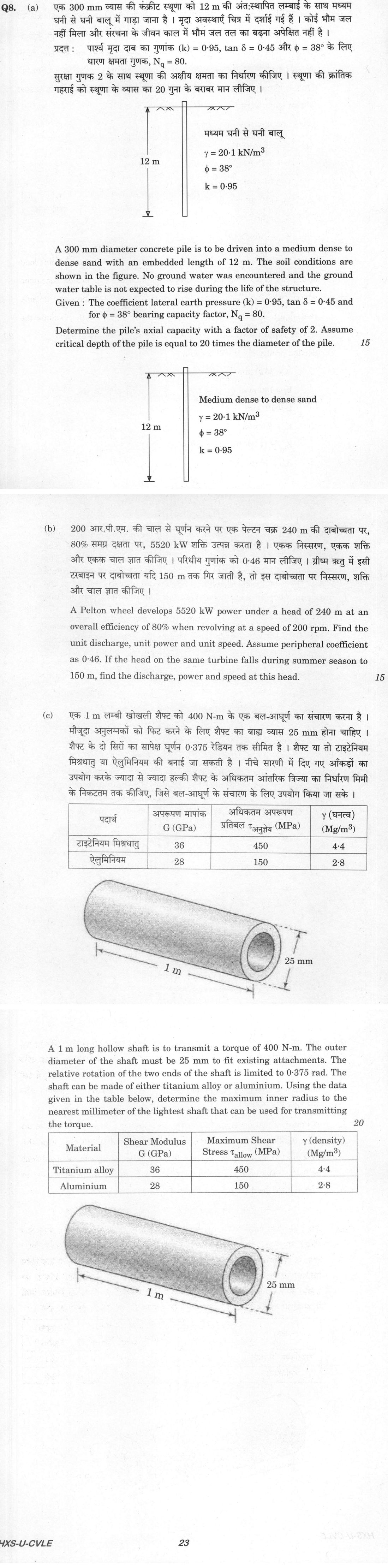
The figure this question refers to, in words
The question paper is a scan and the diagram did not survive as text. This is the figure as read from the original page — every component, value and label — so the question can be worked from the text below.
(a) A vertical pile embedded in a single soil layer. The ground surface is indicated at the top by horizontal ground lines with hatching. A vertical dimension line indicates an embedded pile length of 12 m from the ground level to the pile base. To the right of the pile, the soil stratum is labeled: 'Medium dense to dense sand', with parameters gamma = 20.1 kN/m3, phi = 38 degrees, and k = 0.95.
(c) phi Nc Nq Ngamma 10 8.34 2.47 0.37 12 9.28 2.97 0.60 14 10.37 3.59 0.92 16 11.63 4.34 1.37 18 13.10 5.26 2.00 20 14.83 6.40 2.87 22 16.88 7.82 4.07 24 19.32 9.60 5.72
(c) A perspective diagram of a hollow cylindrical shaft with length labeled 1 m between its two flat ends. The circular cross-section at the front right shows an outer diameter labeled 25 mm, with a concentric inner circular hole representing the hollow core.
Model answer
Written by UPSC Answer Check against this question's marking rubric, to the expected length. UPSC does not publish answers for Mains — this is one way to score well, not an official key.
(a) Use the static pile-capacity formula by effective stress. Since no groundwater is present, effective stress equals total stress. D = 300 mm = 0.30 m, L = 12 m, γ = 20.1 kN/m³, k = 0.95, tan δ = 0.45, N_q = 80. Critical depth L_c = 20D = 20 × 0.30 = 6 m.
Base area: A_b = πD²/4 = π(0.30)²/4 = 0.07069 m². Perimeter: p = πD = π × 0.30 = 0.94248 m.
Effective overburden at critical depth: σ′_c = γL_c = 20.1 × 6 = 120.6 kPa. Unit point resistance: q_p = N_q σ′_c = 80 × 120.6 = 9648 kPa. Point load: Q_p = q_p A_b = 9648 × 0.07069 = 681.98 kN.
For skin friction, up to L_c: f_s = k γ z tan δ = 0.95 × 20.1 × 0.45 z = 8.59275z kPa. At z = 6 m, f_s = 51.56 kPa. Below critical depth it remains constant at 51.56 kPa. Q_s = p [∫₀⁶ 8.59275z dz + ∫₆¹² 51.56 dz] = 0.94248 [(8.59275 × 18) + (51.56 × 6)] = 0.94248 [154.67 + 309.34] = 437.33 kN.
Ultimate capacity: Q_u = Q_p + Q_s = 681.98 + 437.33 = 1119.31 kN. Allowable capacity with FS = 2: Q_all = Q_u/2 = 1119.31/2 = 559.66 kN.
Final axial capacity = 560 kN (approximately). Valid for a single homogeneous sand layer in compression, with effective stress capped at L_c = 6 m.
(b) Use overall efficiency: P = η_o ρgQH. Given P = 5520 kW, H = 240 m, η_o = 0.80, N = 200 rpm.
Actual discharge: Q = P/(η_o ρgH) = 5520 × 10³/(0.80 × 1000 × 9.81 × 240) = 2.9307 m³/s.
Unit quantities: Unit speed N_u = N/√H = 200/√240 = 12.91 rpm. Unit discharge Q_u = Q/√H = 2.9307/√240 = 0.1892 m³/s. Unit power P_u = P/H^(3/2) = 5520/240^(3/2) = 1.485 kW.
Unit speed = 12.91 rpm, unit discharge = 0.1892 m³/s, unit power = 1.485 kW.
For H₂ = 150 m, assuming same unit quantities and efficiency: Q₂ = Q_u√H₂ = 0.1892 × √150 = 2.317 m³/s. N₂ = N_u√H₂ = 12.91 × √150 = 158.1 rpm. P₂ = P_u H₂^(3/2) = 1.485 × 150^(3/2) = 2727.5 kW.
At 150 m head: discharge = 2.317 m³/s, power = 2728 kW, speed = 158 rpm. The peripheral coefficient φ = 0.46 ensures the same peripheral velocity ratio; it does not alter the unit-quantity calculations.
(c) Use torsion formulae: τ_max = T rₒ/J ≤ τ_allow, and θ = TL/(GJ) ≤ 0.375 rad. Here T = 400 N·m = 400000 N·mm, L = 1000 mm, rₒ = 12.5 mm. J = π/2 (rₒ⁴ − rᵢ⁴) = π/32 (Dₒ⁴ − Dᵢ⁴).
Required J from stress: J_s = T rₒ/τ_allow. Required J from twist: J_t = TL/(Gθ).
For titanium alloy: G = 36000 N/mm², τ_allow = 450 N/mm². J_s = 400000 × 12.5/450 = 11111 mm⁴. J_t = 400000 × 1000/(36000 × 0.375) = 29630 mm⁴. Twist governs: J_req = 29630 mm⁴. rᵢ⁴ = rₒ⁴ − 2J_req/π = 12.5⁴ − 2 × 29630/π = 24414.06 − 18862.7 = 5551.4 mm⁴. rᵢ = 8.63 mm.
For aluminium: G = 28000 N/mm², τ_allow = 150 N/mm². J_s = 400000 × 12.5/150 = 33333 mm⁴. J_t = 400000 × 1000/(28000 × 0.375) = 38095 mm⁴. Twist governs: J_req = 38095 mm⁴. rᵢ⁴ = 24414.06 − 2 × 38095/π = 24414.06 − 24251.6 = 162.5 mm⁴. rᵢ = 3.57 mm.
Mass comparison per metre length: Titanium: rᵢ = 8.63 mm, area = π(12.5² − 8.63²) = 256.9 mm². Volume = 256900 mm³ = 2.569 × 10⁻⁴ m³. Mass = 4.4 × 2.569 × 10⁻⁴ = 1.13 kg.
Aluminium: rᵢ = 3.57 mm, area = π(12.5² − 3.57²) = 450.8 mm². Volume = 450800 mm³ = 4.508 × 10⁻⁴ m³. Mass = 2.8 × 4.508 × 10⁻⁴ = 1.26 kg.
Titanium alloy shaft is lighter.
Lightest shaft = titanium alloy; maximum inner radius = 8.63 mm ≈ 9 mm to the nearest millimetre. If only whole-millimetre sizes are permitted, the largest safe inner radius is 8 mm. Valid for elastic torsion of a homogeneous hollow shaft.
What "Calculate" is asking you to do
Apply the standard formula or schedule to data the question has already supplied — a table of readings, cost records, a balance sheet — and produce the number. The method is rarely in doubt; the marks sit in the named intermediate quantities, each of which has to appear as a labelled line.
Structure that answers it
Data as given → formula or standard treatment, named → substitution → each intermediate, labelled → result with units
Where marks are lost
Omitting an intermediate the marking scheme pays for separately, or rounding at an intermediate line so the final figure drifts. In commerce and accountancy, any figure in a statement that no numbered working note supports is treated as unearned.
How this answer will be evaluated
Approach
(a) calculate: given > formula > substitution > result with units > interpretation | (b) calculate: given > formula > substitution > result with units > interpretation | (c) calculate: given > formula > substitution > result with units > interpretation Full marks: All parts show complete, step-by-step calculations with correct formulas, units, and final checks.
Key points expected
- Calculate end bearing capacity using Nq and effective stress
- Calculate skin friction using k, tan δ, and critical depth
- Sum components to find ultimate capacity
- Apply factor of safety of 2 for final result
- Calculate unit discharge, unit power, and unit speed
- Use peripheral coefficient to find wheel diameter
- Apply similarity laws for new head of 150 m
- Calculate new discharge, power, and speed
Evaluation rubric
Each sub-part is marked on its own, against the marks and word limit printed on the paper.
- (a) Determine the pile's axial capacity with a factor of safety of 2. 15 marks
calculate— given → formula → substitution → result with units → interpretation
Must cover
- Calculate end bearing capacity using Nq and effective stress
- Calculate skin friction using k, tan δ, and critical depth
- Sum components to find ultimate capacity
- Apply factor of safety of 2 for final result
Loses marks
- Fails to apply the factor of safety
- Ignores the critical depth limit for skin friction
- Uses total stress instead of effective stress
Earns more
- Correctly identifies critical depth as 20D
- Uses effective unit weight for stress calculation
- Shows clear separation of end and skin components
Extra mark
- References specific IS code clause for pile design
- Includes a neat labelled sketch of the pile in soil
- (b) Find unit discharge, unit power, unit speed, and new operating parameters at 150 m head. 15 marks
calculate— given → formula → substitution → result with units → interpretation
Must cover
- Calculate unit discharge, unit power, and unit speed
- Use peripheral coefficient to find wheel diameter
- Apply similarity laws for new head of 150 m
- Calculate new discharge, power, and speed
Loses marks
- Incorrect application of similarity laws
- Fails to calculate the wheel diameter first
- Confuses unit power with actual power
Earns more
- Correctly applies the peripheral velocity formula
- Shows clear substitution in similarity laws
- Maintains consistent units throughout the calculation
Extra mark
- Mentions specific Pelton wheel design standards
- Provides a brief note on efficiency variation with head
- (c) Determine the maximum inner radius of the lightest shaft for the given torque and rotation. 20 marks
calculate— given → formula → substitution → result with units → interpretation
Must cover
- Check shear stress limit for both materials
- Check angle of twist limit for both materials
- Calculate mass for both materials to find the lightest
- Determine maximum inner radius to the nearest millimeter
Loses marks
- Ignores the angle of twist constraint
- Fails to compare the mass of the two materials
- Does not round the final answer to the nearest millimeter
Earns more
- Clearly compares both materials against both constraints
- Shows the calculation for the polar moment of inertia
- Explicitly states which material is lighter and why
Extra mark
- References specific material standards for shafts
- Includes a simple sketch of the hollow shaft with dimensions
Practice this exact question
Write your answer and it is marked point by point against the model answer above — what you covered, what you missed, what you got wrong.
Evaluate my answer →More from Civil Engineering 2021 Paper I
- Q5 (a) A circular log of weight 1000 N and radius 18 cm is supported by a pair of brackets,…
- Q6 (a) A submarine can be assumed to have cylindrical shape with rounded nose. Assuming its…
- Q7 (a) The subsoil at a site consists of a 12·0 m thick homogeneous layer of dense sand havi…
- Q8 (a) A 300 mm diameter concrete pile is to be driven into a medium dense to dense sand wit…