Paper I — Q4
(a) Determine the maximum tensile force in member DI of the truss shown below due to the series of three moving loads shown in…
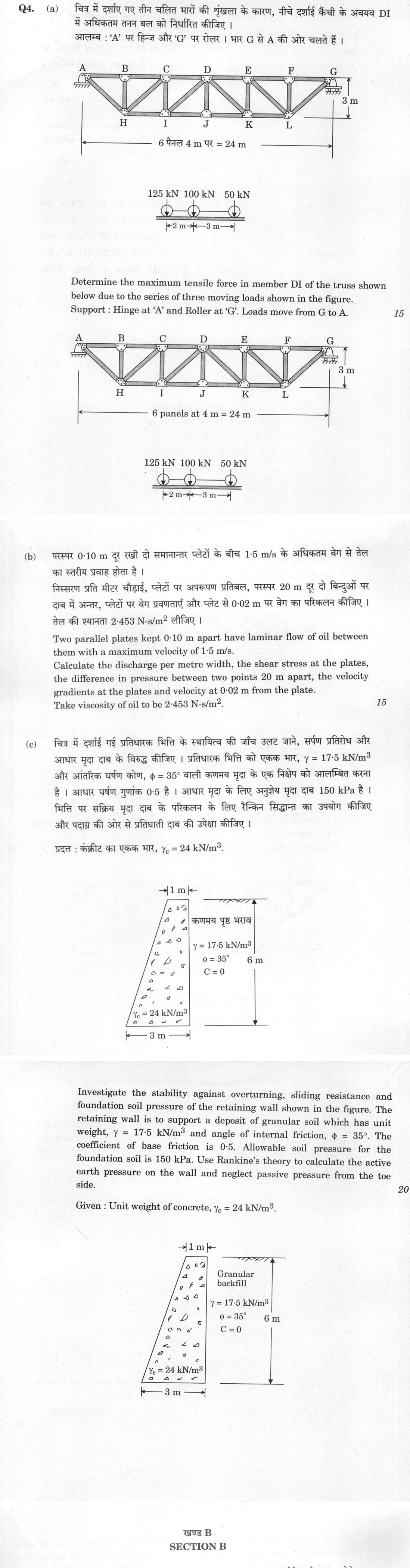
Determine the maximum tensile force in member DI of the truss shown below due to the series of three moving loads shown in the figure.
Support : Hinge at 'A' and Roller at 'G'. Loads move from G to A.
Two parallel plates kept 0·10 m apart have laminar flow of oil between them with a maximum velocity of 1·5 m/s.
Calculate the discharge per metre width, the shear stress at the plates, the difference in pressure between two points 20 m apart, the velocity gradients at the plates and velocity at 0·02 m from the plate.
Take viscosity of oil to be 2·453 N-s/m².
Investigate the stability against overturning, sliding resistance and foundation soil pressure of the retaining wall shown in the figure. The retaining wall is to support a deposit of granular soil which has unit weight, γ = 17·5 kN/m³ and angle of internal friction, φ = 35°. The coefficient of base friction is 0·5. Allowable soil pressure for the foundation soil is 150 kPa. Use Rankine's theory to calculate the active earth pressure on the wall and neglect passive pressure from the toe side.
Given : Unit weight of concrete, γc = 24 kN/m³.
हिंदी में प्रश्न पढ़ें
चित्र में दर्शाए गए तीन चलित भारों की श्रृंखला के कारण, नीचे दर्शाई कैंची के अवयव DI में अधिकतम तनन बल को निर्धारित कीजिए।
आलम्ब : 'A' पर हिंज और 'G' पर रोलर। भार G से A की ओर चलते हैं।
परस्पर 0·10 m दूर रखी दो समानांतर प्लेटों के बीच 1·5 m/s के अधिकतम वेग से तेल का स्तरीय प्रवाह होता है ।
निस्सरण प्रति मीटर चौड़ाई, प्लेटों पर अपरूपण प्रतिबल, परस्पर 20 m दूर दो बिंदुओं पर दाब में अंतर, प्लेटों पर वेग प्रवणताएं और प्लेट से 0·02 m पर वेग का परिकलन कीजिए ।
तेल की श्यानता 2·453 N-s/m² लीजिए ।
चित्र में दर्शाई गई प्रतिधारक भिति के स्थायित्व की जांच उलट जाने, सर्पण प्रतिरोध और आधार मृदा दाब के विरुद्ध कीजिए । प्रतिधारक भिति को एकक भार, γ = 17·5 kN/m³ और आंतरिक घर्षण कोण, φ = 35° वाली कणमय मृदा के एक निक्षेप को आलंबित करना है । आधार घर्षण गुणांक 0·5 है । आधार मृदा के लिए अनुज्ञेय मृदा दाब 150 kPa है । भिति पर सक्रिय मृदा दाब के परिकलन के लिए रैंकिन सिद्धांत का उपयोग कीजिए और पदार्थ की ओर से प्रतिघाती दाब की उपेक्षा कीजिए ।
प्रदत्त : कंक्रीट का एकक भार, γc = 24 kN/m³.
The figure this question refers to, in words
The question paper is a scan and the diagram did not survive as text. This is the figure as read from the original page — every component, value and label — so the question can be worked from the text below.
(a) A planar truss structure with a total span of 24 meters, divided into 6 panels of 4 meters each. The truss has a height of 3 meters. The top chord consists of nodes A, B, C, D, E, F, and G. The bottom chord consists of nodes H, I, J, K, and L. Node A is at the top left, and Node G is at the top right. Node H is directly below B, I below C, J below D, K below E, and L below F. The supports are a hinge at node A and a roller at node G. The truss members include the top chord segments (AB, BC, CD, DE, EF, FG), bottom chord segments (HI, IJ, JK, KL), verticals (BH, CI, DJ, EK, FL), and diagonals (AH, HC, CI, DJ, DK, EL, FL, GL). A series of three moving point loads is shown below the truss: 125 kN, 100 kN, and 50 kN. The distance between the 125 kN and 100 kN loads is 2 meters, and the distance between the 100 kN and 50 kN loads is 3 meters. The loads move from right to left (from G to A).
(c) A cross-sectional diagram of a gravity retaining wall. The wall is a trapezoidal concrete structure with a vertical back face and a sloping front face. The total height of the wall is 6 m. The top width of the wall is 1 m. The bottom width of the wall is 3 m. The unit weight of the concrete is labeled as gamma_c = 24 kN/m^3. To the right of the wall is a deposit of granular backfill soil extending to the top of the wall. The soil properties are labeled as: unit weight gamma = 17.5 kN/m^3, angle of internal friction phi = 35 degrees, and cohesion C = 0. The ground surface is horizontal.
Model answer
Written by UPSC Answer Check against this question's marking rubric, to the expected length. UPSC does not publish answers for Mains — this is one way to score well, not an official key.
(a) Use the influence-line method with the method of sections. Assume an ideal pin-jointed truss and loads transmitted to panel points. Take A at x=0, G at x=24 m, top chord y=3 m, bottom chord y=0 m. Member DI joins I(8,0) to D(12,3); length = √(4²+3²)=5 m, so its vertical component is 3/5. Cut CD, IJ and DI. For a unit vertical load at x, R_A=(24-x)/24. Vertical equilibrium of the left free body gives R_A+(3/5)F_DI-P_left=0, hence F_DI=(5/3)(P_left-R_A), tension positive. The influence line is: for x≤8, F=5x/72; for x≥12, F=-5(24-x)/72; between 8 and 12 m it is linear between 5/9 at x=8 and -5/6 at x=12, i.e. F=5/9-(25/72)(x-8). It is positive up to x=9.6 m. Taking the load order as shown, 125, 100, 50 kN from left to right, with spacings 2 m and 3 m, the maximum of a piecewise-linear influence line occurs when a load is at a peak or at a zero crossing. Check:
- 50 kN at x=8 m: loads at 3, 5, 8 m; ordinates 15/72, 25/72, 40/72; force = (125×15+100×25+50×40)/72=6375/72=88.54 kN.
- 100 kN at x=8 m: loads at 6, 8, 11 m; ordinates 30/72, 40/72, -35/72; force = 6000/72=83.33 kN.
- 125 kN at x=8 m: loads at 8, 10, 13 m; ordinates 40/72, -10/72, -55/72; force = 1250/72=17.36 kN.
- 50 kN at x=9.6 m: loads at 4.6, 6.6, 9.6 m; force = 85.8 kN. Maximum tensile force in DI = 88.54 kN.
(b) This is steady laminar plane Poiseuille flow between parallel plates; Newtonian oil, no slip, constant pressure gradient. Let h=0.10 m, μ=2.453 N-s/m², u_max=1.5 m/s, y measured from the centre line. The velocity profile is u=u_max(1-4y²/h²). Discharge per metre width: q = ∫ from -h/2 to h/2 of u dy=(2/3)u_max h=(2/3)(1.5)(0.10)=0.10 m²/s. Velocity gradient: du/dy=-8u_max y/h²; at the plates y=±h/2, so the gradients are +60 and -60 1/s. Shear stress at the plates: τ_w=μ|du/dy|=2.453×60=147.18 N/m². For two points 20 m apart in the flow direction, u_max=Δp h²/(8μL), so Δp=8μL u_max/h²=8(2.453)(20)(1.5)/(0.10)²=58872 N/m²=58.872 kPa. At 0.02 m from a plate, y=0.03 m from the centre, so u=1.5[1-4(0.03)²/(0.10)²]=0.96 m/s. q=0.10 m²/s; τ_w=147.18 Pa; Δp=58.872 kPa; gradients=±60 1/s; u=0.96 m/s.
(c) Use Rankine active earth pressure for a vertical wall, horizontal backfill, c=0; passive pressure is neglected. Work per metre length. K_a=tan²(45°-φ/2)=(1-sinφ)/(1+sinφ)=(1-sin35°)/(1+sin35°)=0.271. Active pressure at the base p_a=γHK_a=17.5×6×0.271=28.45 kN/m². Resultant P_a=1/2γH²K_a=0.5×17.5×36×0.271=85.36 kN/m, acting at H/3=2 m above the base. The wall section is a 1 m×6 m back rectangle plus a 2 m×6 m front triangle. W_1=1×6×24=144 kN/m at 2.5 m from the toe; W_2=1/2×2×6×24=144 kN/m at 4/3 m from the toe. Total W=288 kN/m, and xbar=(144×2.5+144×4/3)/288=23/12=1.917 m from the toe. Overturning about the toe: M_o=P_a×2=170.73 kN-m/m; M_r=W xbar=552 kN-m/m. FS against overturning=552/170.73=3.23, safe. Sliding: base friction resistance R=0.5W=144 kN/m. FS against sliding=144/85.36=1.69, safe. Foundation pressure: net moment about the toe M_net=M_r-M_o=381.27 kN-m/m, so the vertical resultant acts at x_r=M_net/W=1.324 m from the toe. Base width B=3 m; the centre is 1.5 m from the toe, so eccentricity e=0.176 m toward the toe. Since e<B/6=0.5 m, the base is fully compressed. q_avg=W/B=96 kPa. q_max=96(1+6e/B)=129.8 kPa at the toe; q_min=96(1-6e/B)=62.2 kPa at the heel. Both are below 150 kPa. Foundation pressure is safe: q_max=129.8 kPa, q_min=62.2 kPa.
What "Calculate" is asking you to do
Apply the standard formula or schedule to data the question has already supplied — a table of readings, cost records, a balance sheet — and produce the number. The method is rarely in doubt; the marks sit in the named intermediate quantities, each of which has to appear as a labelled line.
Structure that answers it
Data as given → formula or standard treatment, named → substitution → each intermediate, labelled → result with units
Where marks are lost
Omitting an intermediate the marking scheme pays for separately, or rounding at an intermediate line so the final figure drifts. In commerce and accountancy, any figure in a statement that no numbered working note supports is treated as unearned.
How this answer will be evaluated
Approach
(a) calculate: given > formula > substitution > result with units > interpretation | (b) calculate: given > formula > substitution > result with units > interpretation | (c) analyse: intro > causes > effects > stakeholders/linkages > way forward Full marks: Complete, accurate calculations with clear diagrams and all checks performed.
Key points expected
- Influence line diagram for force in member DI
- Identification of critical load position for maximum tension
- Calculation of maximum force using influence line ordinates
- Statement of final force value with units (kN)
- Calculation of discharge per metre width
- Determination of shear stress at the plates
- Calculation of pressure difference over 20m length
- Determination of velocity at 0.02m from the plate
Evaluation rubric
Each sub-part is marked on its own, against the marks and word limit printed on the paper.
- (a) Maximum tensile force in member DI due to moving loads.
calculate— given → formula → substitution → result with units → interpretation
Must cover
- Influence line diagram for force in member DI
- Identification of critical load position for maximum tension
- Calculation of maximum force using influence line ordinates
- Statement of final force value with units (kN)
Loses marks
- Omission of influence line diagram
- Incorrect identification of critical load position
- Failure to state units in final answer
Earns more
- Correct determination of support reactions
- Use of method of sections to find member force
- Clear labeling of influence line peaks and zero points
Extra mark
- Neat sketch of the truss with member DI highlighted
- Verification of result using a second method
- (b) Discharge, shear stress, pressure difference, velocity gradients, and velocity at 0.02m.
calculate— given → formula → substitution → result with units → interpretation
Must cover
- Calculation of discharge per metre width
- Determination of shear stress at the plates
- Calculation of pressure difference over 20m length
- Determination of velocity at 0.02m from the plate
Loses marks
- Incorrect use of flow equations
- Omission of any required calculation
- Failure to carry units through calculations
Earns more
- Correct application of Hagen-Poiseuille equation
- Accurate calculation of velocity gradients at the plates
- Clear step-by-step substitution of given values
Extra mark
- Neat diagram of flow between parallel plates
- Mention of Reynolds number to confirm laminar flow
- (c) Stability analysis against overturning, sliding, and foundation pressure.
analyse— intro → causes → effects → stakeholders/linkages → way forward
Must cover
- Calculation of active earth pressure using Rankine's theory
- Analysis of stability against overturning
- Analysis of stability against sliding
- Calculation of foundation soil pressure and comparison with allowable
Loses marks
- Incorrect application of Rankine's theory
- Omission of any stability check
- Failure to compare calculated pressure with allowable
Earns more
- Correct determination of resultant force and its line of action
- Accurate calculation of factors of safety for overturning and sliding
- Clear presentation of all forces and moments
Extra mark
- Neat free body diagram of the retaining wall
- Discussion of implications if any stability criterion is not met
Practice this exact question
Write your answer and it is marked point by point against the model answer above — what you covered, what you missed, what you got wrong.
Evaluate my answer →More from Civil Engineering 2021 Paper I
- Q1 (a) Determine the forces in members AC, DE and GH of the truss loaded and supported as sh…
- Q2 (a) Using moment area method, find the slopes and deflection at 'B' for the beam shown in…
- Q3 (a) The figure below represents time and consolidation relationship for a clay sample 30…
- Q4 (a) Determine the maximum tensile force in member DI of the truss shown below due to the…
- Q5 (a) A circular log of weight 1000 N and radius 18 cm is supported by a pair of brackets,…
- Q6 (a) A submarine can be assumed to have cylindrical shape with rounded nose. Assuming its…
- Q7 (a) The subsoil at a site consists of a 12·0 m thick homogeneous layer of dense sand havi…