Paper I — Q7
(a) The subsoil at a site consists of a 12·0 m thick homogeneous layer of dense sand having dry unit weight, γd = 17·2 kN/m³, GS…
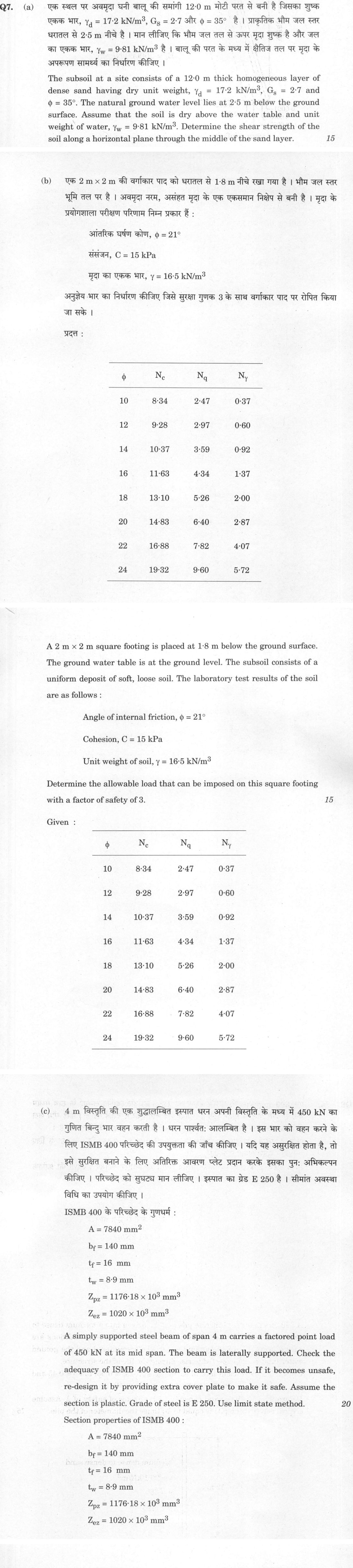
The subsoil at a site consists of a 12·0 m thick homogeneous layer of dense sand having dry unit weight, γd = 17·2 kN/m³, GS = 2·7 and φ = 35°. The natural ground water level lies at 2·5 m below the ground surface. Assume that the soil is dry above the water table and unit weight of water, γw = 9·81 kN/m³. Determine the shear strength of the soil along a horizontal plane through the middle of the sand layer. 15 marks
A 2 m × 2 m square footing is placed at 1·8 m below the ground surface. The ground water table is at the ground level. The subsoil consists of a uniform deposit of soft, loose soil. The laboratory test results of the soil are as follows: Angle of internal friction, φ = 21°; Cohesion, C = 15 kPa; Unit weight of soil, γ = 16·5 kN/m³. Determine the allowable load that can be imposed on this square footing with a factor of safety of 3. 15 marks
Given: φ | Nc | Nq | Nγ 10 | 8·34 | 2·47 | 0·37 12 | 9·28 | 2·97 | 0·60 14 | 10·37 | 3·59 | 0·92 16 | 11·63 | 4·34 | 1·37 18 | 13·10 | 5·26 | 2·00 20 | 14·83 | 6·40 | 2·87 22 | 16·88 | 7·82 | 4·07 24 | 19·32 | 9·60 | 5·72
A simply supported steel beam of span 4 m carries a factored point load of 450 kN at its mid span. The beam is laterally supported. Check the adequacy of ISMB 400 section to carry this load. If it becomes unsafe, re-design it by providing extra cover plate to make it safe. Assume the section is plastic. Grade of steel is E 250. Use limit state method. 20 marks
Section properties of ISMB 400: A = 7840 mm² b_f = 140 mm t_f = 16 mm t_w = 8·9 mm Z_pz = 1176·18 × 10³ mm³ Z_ez = 1020 × 10³ mm³
हिंदी में प्रश्न पढ़ें
एक स्थल पर अवमृदा घनी बालू की समांगी 12·0 m मोटी परत से बनी है जिसका शुष्क एकक भार, γd = 17·2 kN/m³, GS = 2·7 और φ = 35° है । प्राकृतिक भौम जल स्तर धरातल से 2·5 m नीचे है । मान लीजिए कि भौम जल तल से ऊपर मृदा शुष्क है और जल का एकक भार, γw = 9·81 kN/m³ है । बालू की परत के मध्य में क्षैतिज तल पर मृदा के अपरूपण सामर्थ्य का निर्धारण कीजिए । (15 अंक)
एक 2 m × 2 m की वर्गाकार पाद को धरातल से 1·8 m नीचे रखा गया है । भौम जल स्तर भूमि तल पर है । अवमृदा नरम, असंहत मृदा के एक एकसमान निक्षेप से बनी है । मृदा के प्रयोगशाला परीक्षण परिणाम निम्न प्रकार हैं : आंतरिक घर्षण कोण, φ = 21°; संसजन, C = 15 kPa; मृदा का एकक भार, γ = 16·5 kN/m³ । अनुज्ञेय भार का निर्धारण कीजिए जिसे सुरक्षा गुणक 3 के साथ वर्गाकार पाद पर रोपित किया जा सके । (15 अंक)
प्रदत्त :
| φ | Nc | Nq | Nγ |
|---|---|---|---|
| 10 | 8·34 | 2·47 | 0·37 |
| 12 | 9·28 | 2·97 | 0·60 |
| 14 | 10·37 | 3·59 | 0·92 |
| 16 | 11·63 | 4·34 | 1·37 |
| 18 | 13·10 | 5·26 | 2·00 |
| 20 | 14·83 | 6·40 | 2·87 |
| 22 | 16·88 | 7·82 | 4·07 |
| 24 | 19·32 | 9·60 | 5·72 |
4 m विस्तृत की एक सुदृढ़ालम्बित इस्पात धरन अपनी विस्तृति के मध्य में 450 kN का गुणित बिन्दु भार वहन करती है । धरन पार्श्वतः आलम्बित है । इस भार को वहन करने के लिए ISMB 400 परिछेद की उपयुक्तता की जाँच कीजिए । यदि यह असुरक्षित होता है, तो इसे सुरक्षित बनाने के लिए अतिरिक्त आवरण प्लेट प्रदान करके इसका पुनः अभिकल्पन कीजिए । परिछेद को सुच्य मान लीजिए । इस्पात का ग्रेड E 250 है । सीमant अवस्था विधि का उपयोग कीजिए । (20 अंक)
ISMB 400 के परिछेद के गुणधर्म : A = 7840 mm² b_f = 140 mm t_f = 16 mm t_w = 8·9 mm Z_pz = 1176·18 × 10³ mm³ Z_ez = 1020 × 10³ mm³
The figure this question refers to, in words
The question paper is a scan and the diagram did not survive as text. This is the figure as read from the original page — every component, value and label — so the question can be worked from the text below.
(b) Table of bearing capacity factors with columns: phi, Nc, Nq, Ngamma. Rows: 10, 8.34, 2.47, 0.37; 12, 9.28, 2.97, 0.60; 14, 10.37, 3.59, 0.92; 16, 11.63, 4.34, 1.37; 18, 13.10, 5.26, 2.00; 20, 14.83, 6.40, 2.87; 22, 16.88, 7.82, 4.07; 24, 19.32, 9.60, 5.72.
(c) A graph plotting stress (vertical axis) against strain (horizontal axis). The vertical axis is labeled 'Stress' and shows horizontal dashed lines at values 0.80 fy, 0.85 fy, 0.90 fy, 0.95 fy, and fy. The horizontal axis is labeled 'Strain' and shows tick marks at 0.0001, 0.0003, 0.0007, 0.001, 0.002, 0.003, and 0.0004. The graph displays two curves: an upper curve labeled 'fy' and a lower curve labeled 'fy/1.15'. Both curves start at the origin, rise linearly, and then curve to become horizontal. Dashed lines connect specific points on the curves to the axes. The text 'Es = 200000 N/mm2' is located in the lower right area of the graph. The caption below the graph reads 'Stress-strain curve for hot rolled steel'.
What "Solve" is asking you to do
Choose the method, then carry it through to a final answer. Identifying what kind of problem this is and why that method applies is the first thing marked; a correct figure arrived at invisibly earns almost nothing.
Structure that answers it
Given data and what is required → method chosen, with the reason it applies → set-up (equation, circuit, free body, trial balance) → working, step by step → answer with units and any condition of validity
Where marks are lost
Doing the middle steps mentally and writing only the result. In mathematics papers, a further loss comes from giving a decimal where the exact value in surds or fractions was wanted, or from skipping the justification a part explicitly asks for.
How this answer will be evaluated
Approach
Framework: null. (a) calculate: given > formula > substitution > result with units > interpretation | (b) calculate: given > formula > substitution > result with units > interpretation | (c) calculate: given > formula > substitution > result with units > interpretation Full marks: All parts solved with correct methodology, clear steps, and proper units.
Key points expected
- Calculate effective vertical stress at 6.0 m depth
- Distinguish dry and submerged unit weights
- Apply Mohr-Coulomb failure criterion
- State assumption of zero cohesion for dense sand
- Interpolate bearing capacity factors for φ = 21°
- Apply Terzaghi's bearing capacity equation
- Adjust for water table at ground level
- Divide ultimate capacity by factor of safety
Evaluation rubric
Each sub-part is marked on its own, against the marks and word limit printed on the paper.
- (a) Shear strength of soil at mid-depth of the sand layer. 15 marks
calculate— given → formula → substitution → result with units → interpretation
Must cover
- Calculate effective vertical stress at 6.0 m depth
- Distinguish dry and submerged unit weights
- Apply Mohr-Coulomb failure criterion
- State assumption of zero cohesion for dense sand
Loses marks
- Using total stress instead of effective stress
- Ignoring the water table depth
- Assuming non-zero cohesion for dense sand
Earns more
- Correct calculation of submerged unit weight
- Clear identification of water table depth
- Explicit statement of effective stress components
Extra mark
- Sketch of soil profile with water table
- Reference to specific geotechnical code
- (b) Allowable load on the square footing with FS = 3. 15 marks
calculate— given → formula → substitution → result with units → interpretation
Must cover
- Interpolate bearing capacity factors for φ = 21°
- Apply Terzaghi's bearing capacity equation
- Adjust for water table at ground level
- Divide ultimate capacity by factor of safety
Loses marks
- Using dry unit weight for submerged soil
- Failing to interpolate bearing capacity factors
- Omitting the factor of safety division
Earns more
- Correct interpolation of Nc, Nq, Nγ values
- Proper use of submerged unit weight
- Clear separation of ultimate and allowable load
Extra mark
- Reference to IS 6403 code
- Sketch of footing with water table
- (c) Adequacy check of ISMB 400 and redesign if unsafe. 20 marks
calculate— given → formula → substitution → result with units → interpretation
Must cover
- Calculate maximum bending moment at mid-span
- Determine design bending strength of ISMB 400
- Compare moment capacity with applied moment
- Design cover plate if section is inadequate
Loses marks
- Using elastic section modulus instead of plastic
- Ignoring the lateral support condition
- Failing to check the adequacy before redesign
Earns more
- Correct calculation of plastic section modulus
- Proper application of limit state method
- Accurate determination of required additional area
Extra mark
- Sketch of beam with loading and support
- Reference to IS 800 code
Model answer coming soon
Every evaluation on this site is marked against a verified model answer. This question's answer is still being written; evaluation opens the moment it lands.
More from Civil Engineering 2021 Paper I
- Q4 (a) Determine the maximum tensile force in member DI of the truss shown below due to the…
- Q5 (a) A circular log of weight 1000 N and radius 18 cm is supported by a pair of brackets,…
- Q6 (a) A submarine can be assumed to have cylindrical shape with rounded nose. Assuming its…
- Q7 (a) The subsoil at a site consists of a 12·0 m thick homogeneous layer of dense sand havi…
- Q8 (a) A 300 mm diameter concrete pile is to be driven into a medium dense to dense sand wit…