Paper II — Q1
(a) (i) What is the purpose of first coat of plastering ? (ii) What loads are taken by the formwork apart from its self-weight ?…
What is the purpose of first coat of plastering ? (ii) What loads are taken by the formwork apart from its self-weight ? (iii) Label the components (1, 2, 3 & 4) of pitched roof shown in the figure. 10 marks (b) Convert the given A-O-A (Activity on Arrow) to A-O-N (Activity on Node) Network and indicate the critical path. The duration of each activity is shown in the figure. 10 marks (c) The staff reading taken on a staff held at a distance of 80 m from the instrument when the bubble central was 1·455 m. When the bubble is moved 6 divisions out of centre, the staff reading observed is 1·487 m. If the length of one division is 2 mm, find the radius of curvature and the sensitivity of the tube. 10 marks (d) What is vertical curve and its significance ? Draw summit as well as valley curve for the following conditions : (i) Upward gradient (+g₁%) followed by another upward gradient (+g₂%) (ii) Downward gradient (−g₁%) followed by another downward gradient (−g₂%) 10 marks (e) A locomotive on M. G. Track has three pairs of driving wheels each carrying 20 tonnes. What maximum load can it pull on level track with curvature of 2° at 50 km/hr ? Take coefficient of friction = 0·166. 10 marks
हिंदी में प्रश्न पढ़ें
प्लास्टर के पहले लेप का उद्देश्य क्या है ? (ii) फर्मवर्क (फॉर्म वर्क) द्वारा अपने स्वयं के भार के अलावा और कौन से भार वहन किए जाते हैं ? (iii) ढालू छत के, दिए गए चित्र में दर्शाए गए अंगों (1, 2, 3, 4) को नामांकित कीजिए । 10 अंक (b) दिए गए ए-ओ-ए (शर पर क्रिया) जाल को ए-ओ-एन (संधि पर क्रिया) जाल में परिवर्तित कीजिए एवं क्रांतिक पथ इंगित कीजिए । प्रत्येक क्रिया की समयावधि चित्र में दर्शाई गई है । 10 अंक (c) उपकरण से 80 m की दूरी पर स्थित गज (स्टाफ) पर गज पाठ्यांक, बुलबुले के केंद्र में होने पर 1·455 m था । जब बुलबुले को केंद्र से 6 भाग बाहर खिसकाया गया, तब गज पाठ्यांक 1·487 m में देखा गया । यदि एक भाग की लंबाई 2 mm है, तो समतलन नलिका की वक्रता की त्रिज्या एवं सुग्राहिता ज्ञात कीजिए । 10 अंक (d) उद्वर्धर वक्र क्या है एवं इसका महत्व क्या है ? निम्नलिखित स्थितियों के लिए शिखर (समिट) वक्र और घाटी वक्र का चित्र बनाइए : (i) उद्वमुखी ढाल (+g₁%) के बाद एक और उद्वमुखी ढाल (+g₂%) (ii) अधोमुखी ढाल (−g₁%) के बाद एक और अधोमुखी ढाल (−g₂%) 10 अंक (e) एम. जी. रेलपथ पर एक रेल इंजिन के तीन जोड़ी चालक पहिये हैं जो प्रत्येक 20 टन वहन कर रहे हैं । एक समतल रेलपथ पर, 2° वक्रता के साथ एवं 50 km/hr पर यह कितना अधिकतम भार खींच पाएगा ? घर्षण गुणांक 0·166 लीजिए । 10 अंक
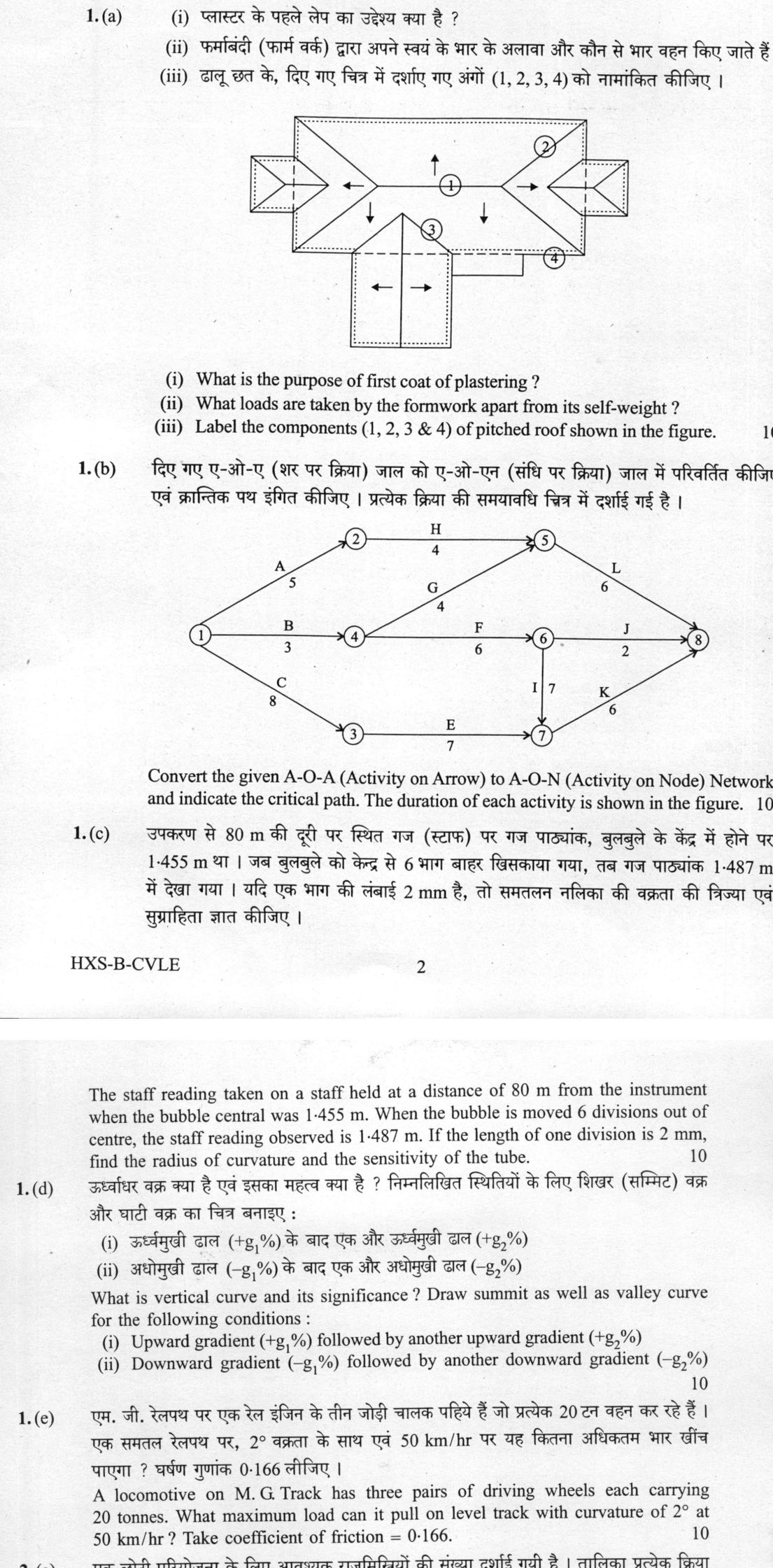
The figure this question refers to, in words
The question paper is a scan and the diagram did not survive as text. This is the figure as read from the original page — every component, value and label — so the question can be worked from the text below.
(a) A schematic diagram of a pitched roof structure. The main body is a rectangular prism with a gable roof. The roof has two sloping surfaces meeting at a central ridge. There are four numbered circles indicating specific components: (1) is located on the central ridge line; (2) is located on the upper right sloping surface; (3) is located on the lower right sloping surface near the eaves; (4) is located at the bottom right corner of the roof structure. Arrows indicate the direction of the roof slope. There is a chimney or vertical structure protruding from the front face of the roof.
(b) An Activity-on-Arrow (A-O-A) network diagram. The nodes are numbered 1 through 8. The activities are represented by arrows connecting the nodes, with labels (letters) and durations (numbers) associated with each arrow. The connections are as follows: Node 1 to Node 2 (Activity A, duration 5); Node 1 to Node 4 (Activity B, duration 3); Node 1 to Node 3 (Activity C, duration 8); Node 2 to Node 5 (Activity H, duration 4); Node 4 to Node 5 (Activity G, duration 4); Node 4 to Node 6 (Activity F, duration 6); Node 3 to Node 7 (Activity E, duration 7); Node 5 to Node 8 (Activity L, duration 6); Node 6 to Node 8 (Activity J, duration 2); Node 6 to Node 7 (Activity I, duration 7); Node 7 to Node 8 (Activity K, duration 6).
Model answer
Written by UPSC Answer Check against this question's marking rubric, to the expected length. UPSC does not publish answers for Mains — this is one way to score well, not an official key.
(a)(i) The first coat of plastering is the base or scratch coat. It fills joints, cracks and surface irregularities, gives a uniform thickness, provides a rough key, and ensures a strong bond with the masonry or concrete substrate so that the finish coat can be smooth and even.
(a)(ii) Apart from its self-weight, formwork must carry:
- dead load of wet concrete,
- live/construction loads of workers, materials, equipment and stock,
- lateral pressure of fresh concrete,
- dynamic and impact loads from placing, vibration and compaction,
- wind load and other imposed loads.
(a)(iii) From the figure: (1) ridge; (2) rafter; (3) eaves; (4) barge (sloping gable edge).
(b) Method: Critical Path Method on an Activity-on-Node network. The AON nodes are A, B, C, H, G, F, E, L, J, I, K. Precedence: start→A, B, C; A→H; B→G and B→F; C→E; H and G→L; F→J and F→I; E and I→K; J, L and K→end. No dummy activities are needed.
Forward pass, in the given duration units:
- A 0–5, B 0–3, C 0–8;
- H 5–9, G 3–7, F 3–9;
- E 8–15, L 9–15, J 9–11, I 9–16;
- K 16–22. Project duration = 22 time units.
Backward pass (LS–LF):
- K 16–22, I 9–16, F 3–9, B 0–3;
- E 9–16, C 1–8, L 16–22, H 12–16, G 12–16, A 7–12, J 20–22.
Total floats: A 7, B 0, C 1, H 7, G 9, F 0, E 1, L 7, J 11, I 0, K 0.
Critical path: B–F–I–K, duration 22 time units.
(c) Method: sensitivity of a circular bubble tube. The staff reading change is Δh = 1.487 m − 1.455 m = 0.032 m at D = 80 m. The line-of-sight tilt is θ = arctan(Δh/D) = arctan(0.032/80) ≈ 0.0004 rad. The bubble moves x = 6 × 2 mm = 12 mm = 0.012 m. For a circular tube, x = Rθ, so R = x/θ = 0.012/0.0004 = 30 m.
Sensitivity is the angle for one division: θ₁ = 0.002 m / 30 m = 1/15000 rad = 6.667×10⁻⁵ rad per division. In seconds of arc, θ₁ = (1/15000) × 206265 = 13.75 arcsec per division.
Radius of curvature = 30 m; sensitivity = 13.75 arcsec per division. Valid for small θ, vertical staff, and a circular tube.
(d) A vertical curve is a transition curve, normally parabolic, introduced between two different gradients. Its significance is to provide a smooth change of grade, vehicle comfort, safety, adequate sight distance, proper drainage, and reduced impact or jolting on vehicles.
(d)(i) For +g₁% followed by +g₂%:
- if g₁ > g₂, the grade decreases; draw a summit/crest curve: a convex curve below the PVI, with T.C. and C.T. on the two upward tangents.
- if g₂ > g₁, the grade increases; draw a valley/sag curve: a concave curve above the PVI.
(d)(ii) For −g₁% followed by −g₂%:
- if g₂ > g₁, the fall becomes steeper, so the grade decreases; draw a summit/crest curve.
- if g₁ > g₂, the fall becomes flatter, so the grade increases; draw a valley/sag curve.
In all cases the PVI is the intersection of the two tangent gradients, and the curve is tangent to them at T.C. and C.T.
(e) Method: available adhesive tractive effort divided by standard train resistance. Driving-wheel load = 3 × 20 t = 60 t. Gross tractive effort = μW = 0.166 × 60 = 9.96 tonne-force = 9960 kgf.
Using the usual level-track resistance formula at V = 50 km/h: R = 0.0033V² + 0.0025V + 0.0001 = 0.0033(50)² + 0.0025(50) + 0.0001 = 8.3751 kgf/tonne.
For a 2° curve, curvature resistance = 0.00005 D V² = 0.00005 × 2 × 50² = 0.25 kgf/tonne.
Total resistance = 8.3751 + 0.25 = 8.6251 kgf/tonne.
Maximum load = 9960 / 8.6251 = 1154.8 t ≈ 1155 tonnes.
Assumptions: level track, no acceleration, standard railway resistance formula, M.G. curve degree D = 2, and gross tractive effort is available for the train.
What "Solve" is asking you to do
Choose the method, then carry it through to a final answer. Identifying what kind of problem this is and why that method applies is the first thing marked; a correct figure arrived at invisibly earns almost nothing.
Structure that answers it
Given data and what is required → method chosen, with the reason it applies → set-up (equation, circuit, free body, trial balance) → working, step by step → answer with units and any condition of validity
Where marks are lost
Doing the middle steps mentally and writing only the result. In mathematics papers, a further loss comes from giving a decimal where the exact value in surds or fractions was wanted, or from skipping the justification a part explicitly asks for.
How this answer will be evaluated
Approach
Framework: Civil Engineering Paper 2 Method. (a(i)) explain: definition/context > points in order > small example > short close | (a(ii)) enumerate: list the items in order > one line each > no commentary | (a(iii)) map: locate accurately > label > one line on why it matters | (b) calculate: given > formula > substitution > result with units > interpretation | (c) calculate: given > formula > substitution > result with units > interpretation | (d) describe: define > structure or process in order > labelled diagram > significance | (e) calculate: given > formula > substitution > result with units > interpretation Full marks: All parts answered with correct calculations, clear diagrams, and proper units.
Key points expected
- Mention providing a rough base
- Mention filling voids and irregularities
- Mention ensuring adhesion for the finish coat
- List dead load of wet concrete
- List live load of workers and equipment
- List impact or vibration loads
- Identify 1 as Ridge
- Identify 2 as Rafter
Evaluation rubric
Each sub-part is marked on its own, against the marks and word limit printed on the paper.
- (a(i)) State the purpose of the first coat of plastering.
explain— definition/context → points in order → small example → short close
Must cover
- Mention providing a rough base
- Mention filling voids and irregularities
- Mention ensuring adhesion for the finish coat
Loses marks
- Confusing the first coat with the finish coat
- Failing to mention the function of the base layer
Earns more
- Mentioning the use of a 'dash' or 'scratch' coat
- (a(ii)) List the loads taken by formwork apart from self-weight.
enumerate— list the items in order → one line each → no commentary
Must cover
- List dead load of wet concrete
- List live load of workers and equipment
- List impact or vibration loads
Loses marks
- Listing self-weight as an external load
- Omitting the load of wet concrete
Earns more
- Mentioning wind or seismic loads if applicable
- (a(iii)) Label the components (1, 2, 3 & 4) of the pitched roof.
map— locate accurately → label → one line on why it matters
Must cover
- Identify 1 as Ridge
- Identify 2 as Rafter
- Identify 3 as Eaves
- Identify 4 as Gable
Loses marks
- Misidentifying the ridge as a rafter
- Confusing eaves with gables
Earns more
- Correctly identifying the 'Valley' if present
- (b) Convert A-O-A to A-O-N network and find the critical path. 10 marks
calculate— given → formula → substitution → result with units → interpretation
Must cover
- Draw the A-O-N network diagram
- Calculate Earliest Start (ES) and Latest Finish (LF)
- Identify the critical path (1-2-5-8)
- State the total project duration (14 days)
Loses marks
- Failing to convert to A-O-N format
- Incorrect calculation of path durations
Earns more
- Showing slack calculations for non-critical activities
- (c) Find the radius of curvature and sensitivity of the level tube. 10 marks
calculate— given → formula → substitution → result with units → interpretation
Must cover
- Calculate the change in staff reading (0.032 m)
- Calculate the angle of tilt in radians
- Calculate the radius of curvature (R = 200 m)
- Calculate the sensitivity (20 arc-seconds)
Loses marks
- Unit conversion errors (mm to m)
- Incorrect calculation of the angle of tilt
Earns more
- Showing the formula for sensitivity (206265/R)
- (d) Define vertical curve and draw summit/valley curves for given gradients. 10 marks
describe— define → structure or process in order → labelled diagram → significance
Must cover
- Define vertical curve as a transition between gradients
- Draw a summit curve for +g1 to +g2
- Draw a valley curve for -g1 to -g2
- Explain the significance (sight distance/comfort)
Loses marks
- Drawing a horizontal curve instead of vertical
- Failing to distinguish between summit and valley
Earns more
- Labeling the PVI (Point of Vertical Intersection)
- (e) Calculate the maximum load a locomotive can pull on a curved track. 10 marks
calculate— given → formula → substitution → result with units → interpretation
Must cover
- Calculate the total weight of driving wheels (60 tonnes)
- Calculate the tractive force (W * μ)
- Calculate the resistance due to curvature
- Calculate the maximum load (W - Resistance)
Loses marks
- Ignoring the resistance due to curvature
- Incorrect calculation of tractive force
Earns more
- Using the standard formula for curve resistance
Practice this exact question
Write your answer and it is marked point by point against the model answer above — what you covered, what you missed, what you got wrong.
Evaluate my answer →More from Civil Engineering 2021 Paper II
- Q1 (a) (i) What is the purpose of first coat of plastering ? (ii) What loads are taken by th…
- Q2 (a) For a small project, the number of masons required is shown. The table also indicates…
- Q3 (a) (i) Explain with neat sketches, how surface and sub-surface water can be removed from…
- Q4 (a) Design the size and spacing of dowel bars at the expansion joints of a cement concret…