Paper II — Q5
(a) A one-hour unit hydrograph of a catchment is shown in the figure. A storm of two hours duration with intensity of 70 mm/h in…
A one-hour unit hydrograph of a catchment is shown in the figure. A storm of two hours duration with intensity of 70 mm/h in the first hour and 40 mm/h in the second hour occurs over the catchment. Calculate the peak direct surface runoff value in m³/s. 10 marks
A temporary coffer dam is to be built to protect the 5 year construction activity for a major river valley project. If the coffer dam is designed to withstand the 25-year flood, what is the risk that the structure will be overtopped in the third year? 10 marks
A weir across an alluvial river has a horizontal floor length of 50 m and retains 5 m of water under full flow condition. The downstream sheet pile is driven to a depth of 5 m below the impervious floor of negligible thickness. Determine the exit gradient. 10 marks
What is an indicator organism ? Discuss the required characteristics for an ideal indicator organism. Name any two indicator organisms. 10 marks
Circular sewer of minimum diameter of 150 mm is recommended for the house connections. Calculate the discharge carried by this sewer, when flowing full, laid at a slope of 0·004. Take Manning's n as 0·013.
Why this sewer size has been recommended as the minimum size, when the waste water discharge from individual household will be substantially less ? 10 marks
हिंदी में प्रश्न पढ़ें
एक जलग्रहण क्षेत्र का एक-घंटा एकांकी जलालेख चित्र में दर्शाया गया है । जलग्रहण क्षेत्र पर दो घंटे की अवधि की एक वृष्टि, 70 mm प्रति घंटा की तीव्रता के साथ पहले घंटे में एवं 40 mm प्रति घंटा की तीव्रता के साथ दूसरे घंटे में होती है । चरम प्रत्यक्ष धरातलीय अपवाह के मान की गणना m³/s में कीजिए । (10 अंक)
एक मुख्य नदी घाटी परियोजना की 5 वर्ष की निर्माण गतिविधि की सुरक्षा के लिए एक अस्थायी कॉफर बांध बनाया जाना है । यदि कॉफर बांध का अभिकल्पन 25-साल की बाढ़ को सहने के लिए किया गया है, तो इस संरचना के तीसरे साल में उत्लावन होने का जोखिम कितना है ? (10 अंक)
एक जलोढ़ नदी के आरपार स्थित एक विवर का क्षैतिज फर्श 50 m लंबा है एवं पूर्ण प्रवाह की स्थिति में 5 m पानी रोकता है । अनुप्रवाह (डाउनस्ट्रीम) शीट पाइल, अगम्य मोटाई के अपारगम्य फर्श के नीचे, 5 m गहराई तक डाली गयी है । निर्गम प्रवणता निर्धारित कीजिए । (10 अंक)
एक सूचक जीव क्या है ? एक आदर्श सूचक जीव के लिए आवश्यक अभिलक्षणों की विवेचना कीजिए । किन्हीं दो सूचक जीवों के नाम लिखिए । (10 अंक)
घरेलू संयोजन के लिए न्यूनतम 150 mm व्यास का वृत्ताकार मलक नल (सीवर) अनुशंसित है । इस मलक नल द्वारा प्रवाहित निस्सरण की गणना कीजिए, जब यह पूरा भरा बह रहा है एवं 0·004 के ढाल पर बिछाया गया है । मैनिंग के n को 0·013 लीजिए ।
इस मलक नल के आमाप की अनुशंसा न्यूनतम आमाप के रूप में क्यों की गयी है, जबकि पृथक घर से निस्सरित अपशिष्ट जल प्रवाह अत्यंत ही कम होगा ? (10 अंक)
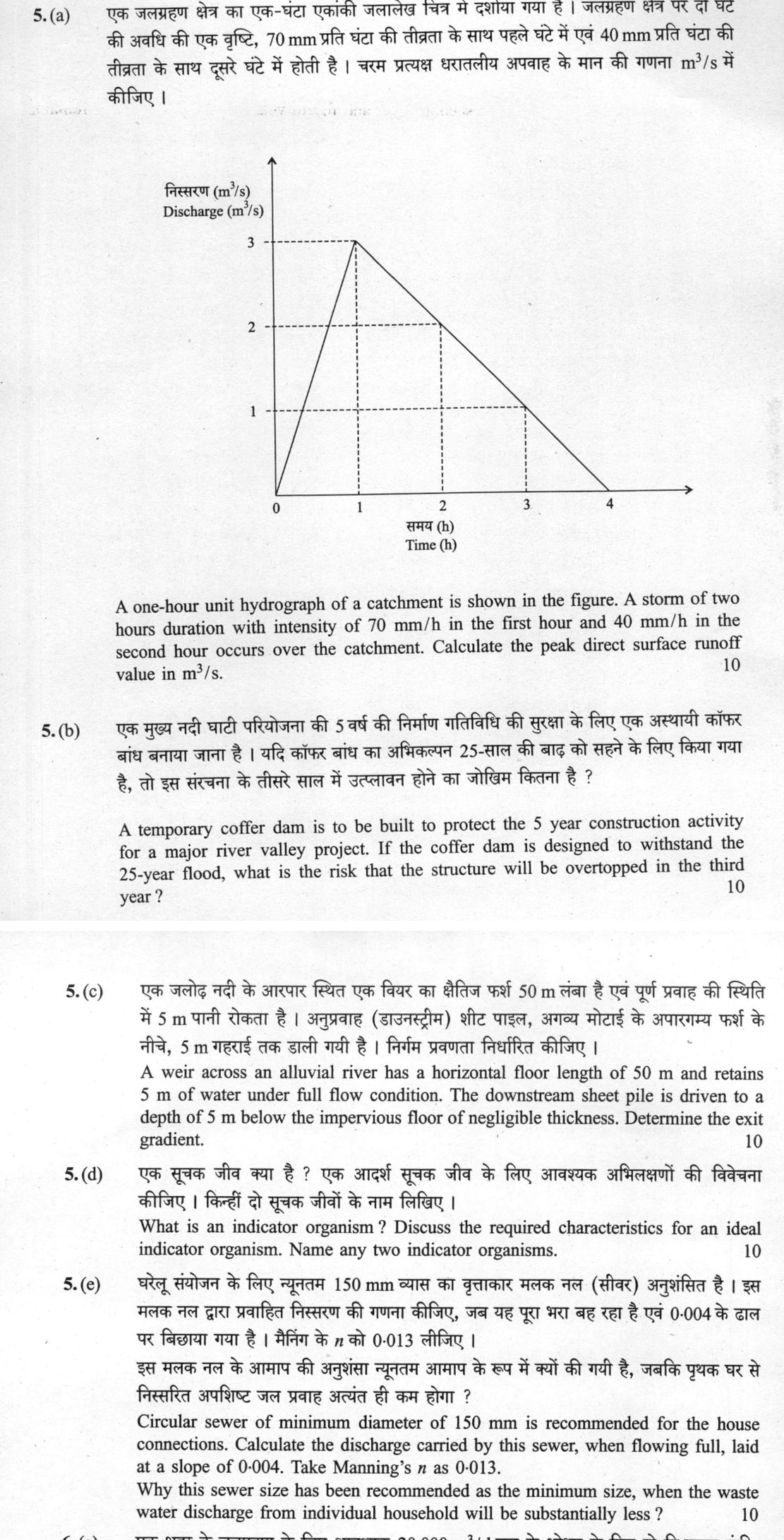
The figure this question refers to, in words
The question paper is a scan and the diagram did not survive as text. This is the figure as read from the original page — every component, value and label — so the question can be worked from the text below.
(a) A graph of a 1-hour unit hydrograph plotted with Discharge (m3/s) on the vertical y-axis and Time (h) on the horizontal x-axis. The y-axis is marked from 0 to 3 in intervals of 1. The x-axis is marked from 0 to 4 in intervals of 1. The hydrograph is triangular, starting at the origin (0, 0), rising linearly to a peak discharge of 3 m3/s at time t = 1 h, and then falling linearly to 0 m3/s at time t = 4 h. Dashed guide lines show the points along the recession limb: at t = 2 h, discharge = 2 m3/s; at t = 3 h, discharge = 1 m3/s.
Model answer
Written by UPSC Answer Check against this question's marking rubric, to the expected length. UPSC does not publish answers for Mains — this is one way to score well, not an official key.
(a) Method: unit-hydrograph convolution. Since no losses are given, the given rainfall intensities are taken as effective rainfall excess. The 1-hour unit hydrograph ordinates are:
- U(0)=0 m³/s per cm
- U(1)=3 m³/s per cm
- U(2)=2 m³/s per cm
- U(3)=1 m³/s per cm
- U(4)=0 m³/s per cm
Storm rainfall:
- First hour: 70 mm = 7 cm
- Second hour: 40 mm = 4 cm
Convolution ordinates:
- t=1 h: 7×3 = 21 m³/s
- t=2 h: 7×2 + 4×3 = 14+12 = 26 m³/s
- t=3 h: 7×1 + 4×2 = 7+8 = 15 m³/s
- t=4 h: 7×0 + 4×1 = 4 m³/s
- t=5 h: 0
Continuous check: for 1≤t≤2 h, Q(t)=7(4−t)+4[3(t−1)]=16+5t, which increases up to t=2 h. For 2≤t≤3 h, Q(t)=7(4−t)+4(5−t)=48−11t, which decreases. Hence the maximum occurs at t=2 h.
Peak direct surface runoff = 26 m³/s at t = 2 h after storm start.
(b) Method: annual exceedance probability for a return period T.
For T=25 years,
p = 1/T = 1/25 = 0·04
Assuming independent annual flood events, the probability that the coffer dam is overtopped during the third year alone is the same as the annual exceedance probability.
Risk of overtopping in the third year = 0·04 = 4%.
If the question is interpreted as cumulative risk by the third year, then: Risk = 1 − (1−p)³ = 1 − (0·96)³ = 1 − 0·884736 = 0·115264 = 11·5264%.
If interpreted as cumulative risk over the full 5-year construction period: Risk = 1 − (0·96)⁵ = 0·184627 = 18·4627%.
Since the wording asks “in the third year”, the answer is 4%.
(c) Method: Khosla’s exit-gradient formula for a downstream sheet pile.
For downstream sheet pile depth d, impervious floor length b, and head H,
G_E = (H/d) × 1/(π√λ)
λ = (1 + √(1+α²))/2
α = b/d
Given: H = 5 m, b = 50 m, d = 5 m.
α = 50/5 = 10
λ = (1 + √(1+10²))/2 = (1+√101)/2
√101 = 10·0498756
λ = (1+10·0498756)/2 = 5·5249378
√λ = √5·5249378 = 2·350518
G_E = (5/5) × 1/(π×2·350518)
G_E = 1/(7·38437)
G_E = 0·13542
Exit gradient = 0·1354 (dimensionless).
Condition of validity: floor thickness is negligible, downstream sheet pile is at the end of the impervious floor, and the formula applies to the Khosla exit-gradient condition in alluvial soil.
(d) An indicator organism is a microorganism whose presence in water indicates probable faecal contamination and therefore the possible presence of pathogenic bacteria, viruses, or protozoa. It is used because direct testing for every pathogen is difficult, costly, and slow.
Required characteristics of an ideal indicator organism:
- It should be present in faecal material in large numbers.
- It should be absent, or nearly absent, in uncontaminated water.
- It should not multiply outside the host, so its count reflects the degree of pollution.
- It should survive in water at least as long as the pathogens of concern.
- It should be more resistant to disinfection than pathogens, so its absence gives a margin of safety.
- It should be easily, rapidly, and economically detected by simple laboratory methods.
- It should be non-pathogenic or of very low pathogenicity to humans.
- It should be specific to faecal pollution and not originate from non-faecal sources.
- It should have stable and uniform characteristics in different water environments.
Two indicator organisms are:
- Escherichia coli
- Faecal streptococci, e.g. Enterococcus faecalis
(e)(i) Method: Manning’s formula for a circular sewer flowing full.
Given: D = 150 mm = 0·150 m S = 0·004 n = 0·013
For a circular pipe flowing full,
A = πD²/4 = π(0·150)²/4 = 0·0176715 m²
P = πD = π×0·150 = 0·471239 m
R = A/P = D/4 = 0·150/4 = 0·0375 m
R^(2/3) = (0·0375)^(2/3) = 0·112035
S^(1/2) = √0·004 = 0·0632456
Manning’s equation:
Q = (1/n) A R^(2/3) S^(1/2)
Q = (1/0·013)(0·0176715)(0·112035)(0·0632456)
Q = 0·009632 m³/s
Discharge when flowing full = 0·009632 m³/s = 9·632 L/s ≈ 9·63 L/s.
Condition: sewer is flowing full, flow is steady and uniform, and Manning’s n = 0·013.
(e)(ii) A 150 mm diameter is recommended as the minimum size for house connections mainly for reasons other than the average household discharge:
- It prevents frequent choking due to sanitary solids, paper, rags, and other domestic wastes.
- Smaller diameters, such as 100 mm, have a high risk of blockage at bends, junctions, and low-flow periods.
- It provides reserve hydraulic capacity for peak household flows, infiltration, and future additions.
- It allows easy cleaning, rodding, and inspection of the sewer line.
- It helps maintain reasonable self-cleansing conditions during peak flow and reduces long stagnation of sewage.
- It permits ventilation and safe movement of sewage gases.
- It is a standard minimum requirement in sanitary codes and practice, ensuring durability, maintainability, and reliable operation.
Thus, the minimum size is fixed by clogging avoidance and maintenance requirements, not by the small average discharge from an individual household.
What "Calculate" is asking you to do
Apply the standard formula or schedule to data the question has already supplied — a table of readings, cost records, a balance sheet — and produce the number. The method is rarely in doubt; the marks sit in the named intermediate quantities, each of which has to appear as a labelled line.
Structure that answers it
Data as given → formula or standard treatment, named → substitution → each intermediate, labelled → result with units
Where marks are lost
Omitting an intermediate the marking scheme pays for separately, or rounding at an intermediate line so the final figure drifts. In commerce and accountancy, any figure in a statement that no numbered working note supports is treated as unearned.
How this answer will be evaluated
Approach
Framework: null. (a) calculate: given > formula > substitution > result with units > interpretation | (b) calculate: given > formula > substitution > result with units > interpretation | (c) calculate: given > formula > substitution > result with units > interpretation | (d) discuss: intro > 3-4 dimensions > example > balanced close | (e) calculate: given > formula > substitution > result with units > interpretation Full marks: Accurate calculations with clear steps, correct formulas, and well-reasoned explanations for all parts.
Key points expected
- Extract UH ordinates from the provided graph
- Apply storm intensities (70 mm/h, 40 mm/h) to UH
- Perform lagged superposition of the two UHs
- Sum ordinates to find the peak value
- State the annual exceedance probability (p = 1/25)
- Apply the binomial probability formula for 3 years
- Calculate the specific probability for the 3rd year
- Identify the relevant parameters (L=50m, d=5m, H=5m)
Evaluation rubric
Each sub-part is marked on its own, against the marks and word limit printed on the paper.
- (a) Peak direct surface runoff value in m³/s using the unit hydrograph method. 10 marks
calculate— given → formula → substitution → result with units → interpretation
Must cover
- Extract UH ordinates from the provided graph
- Apply storm intensities (70 mm/h, 40 mm/h) to UH
- Perform lagged superposition of the two UHs
- Sum ordinates to find the peak value
Loses marks
- Incorrect reading of UH ordinates from graph
- Failure to lag the second UH by 1 hour
Earns more
- Tabular presentation of the superposition
- Clear identification of the peak time
Extra mark
- Sketch of the resulting storm hydrograph
- (b) Risk of overtopping in the third year for a 25-year flood design. 10 marks
calculate— given → formula → substitution → result with units → interpretation
Must cover
- State the annual exceedance probability (p = 1/25)
- Apply the binomial probability formula for 3 years
- Calculate the specific probability for the 3rd year
Loses marks
- Using the cumulative risk formula instead of specific year
- Confusing return period with probability
Earns more
- Clear definition of the risk variable
- Step-by-step substitution into the formula
Extra mark
- Comparison with the risk of the first year
- (c) Exit gradient for the weir using Khosla's theory. 10 marks
calculate— given → formula → substitution → result with units → interpretation
Must cover
- Identify the relevant parameters (L=50m, d=5m, H=5m)
- Calculate the shape factor (λ) using the standard formula
- Determine the exit gradient (G_e) using the G_e formula
Loses marks
- Incorrect formula for the shape factor
- Confusing head (H) with depth (d)
Earns more
- Correct identification of the weir type (Type 1)
- Accurate calculation of the shape factor
Extra mark
- Sketch of the weir section with dimensions
- (d) Definition, characteristics, and examples of indicator organisms. 10 marks
discuss— intro → 3-4 dimensions → example → balanced close
Must cover
- Define 'indicator organism' in the context of water quality
- List at least 3-4 required characteristics of an ideal indicator
- Name two specific indicator organisms (e.g., E. coli)
Loses marks
- Vague definition without context
- Listing characteristics without explanation
Earns more
- Explanation of why the characteristics are necessary
- Distinction between fecal and non-fecal indicators
Extra mark
- Mention of specific testing methods (e.g., MPN)
- (e) Discharge of a 150mm sewer flowing full and justification for minimum size. 10 marks
calculate— given → formula → substitution → result with units → interpretation
Must cover
- Use Manning's formula for full flow conditions
- Substitute given values (D=0.15m, S=0.004, n=0.013)
- Calculate the discharge in m³/s
- Explain the rationale for the 150mm minimum size
Loses marks
- Incorrect calculation of the hydraulic radius
- Failure to address the 'why' part of the question
Earns more
- Clear statement of the Manning's formula
- Logical explanation of self-cleansing velocity
Extra mark
- Mention of specific IS code for sewer sizing
Practice this exact question
Write your answer and it is marked point by point against the model answer above — what you covered, what you missed, what you got wrong.
Evaluate my answer →More from Civil Engineering 2021 Paper II
- Q2 (a) For a small project, the number of masons required is shown. The table also indicates…
- Q3 (a) (i) Explain with neat sketches, how surface and sub-surface water can be removed from…
- Q4 (a) Design the size and spacing of dowel bars at the expansion joints of a cement concret…
- Q5 (a) A one-hour unit hydrograph of a catchment is shown in the figure. A storm of two hour…
- Q6 (a) Two settling tanks – one rectangular, with length to width ratio of 3 : 1 and side wa…
- Q7 (a) An open drain is to be designed to prevent waterlogging for an area of 576 ha. Given…
- Q8 (a) From the basin map of a given watershed with drainage area 3000 km², the length of th…