Paper II — Q4
(a) Design the size and spacing of dowel bars at the expansion joints of a cement concrete pavement of thickness 25 cm with…
Design the size and spacing of dowel bars at the expansion joints of a cement concrete pavement of thickness 25 cm with radius of relative stiffness 80 cm, for a design wheel load of 5000 kg. Assume load capacity of dowel system as 40% of the design wheel load. Joint width is 2.0 cm, permissible shear and flexural stresses in dowel bar are 1000 kg/cm² and 1400 kg/cm² respectively and permissible bearing stress in cement concrete is 100 kg/cm². 20 marks
Work out the cost of a plot, in terms of per m² of land measuring 60,000 sq m. The cost of development for roadways, water supply, sewerage system, electricity and all other engineering works is Rs. 100/- per sq m, which is spent in following manner :
First year : 10%, second year : 15%, third year : 20% and fourth year remaining area. Average market rate for plot is Rs. 5000/- per sq m. 10%, 20%, 20% and 30% plots are sold in first, second, third and fourth year respectively whereas remaining plots are sold in fifth year.
Assume the discount rate = 7%. Write your assumptions clearly, if any (like stamp duty, etc.) 15 marks
Indicate (in bulleted form) the advantages of ferro-cement over the conventional RCC. Can we use the ferro-cement tanks for high capacity like 25000 litres or above ? Justify your answer.
Label the terms (technical) that applies to the door (shown in figure) parts. 10+5
हिंदी में प्रश्न पढ़ें
25 cm मोटाई, 80 cm आपेक्षिक दुर्नम्यता त्रिज्या के सीमेंट कंक्रीट कुट्टिम के प्रसार-जोड़ के लिए, 5000 kg अभिकल्प चक्रभार के लिए गुज्जी छड़ (डोवेल बार) के आमाप एवं अंतराल का अभिकल्पन कीजिए। गुज्जी तंत्र की भार क्षमता अभिकल्प चक्र भार की 40% मान लीजिए। जोड़ की चौड़ाई 2.0 cm, गुज्जी छड़ में अनुज्ञेय अपरूपण एवं नम्य प्रतिबल क्रमशः: 1000 kg/cm², एवं 1400 kg/cm², एवं सीमेंट कंक्रीट में अनुज्ञेय धारण प्रतिबल 100 kg/cm² है। 20
एक 60,000 m² माप की भूमि के भूखंड की कीमत प्रति m² में निकालिए। सड़कों, जलप्रदाय, अपशिष्ट प्रणाली, बिजली एवं अन्य अभियांत्रिकी कार्यों के विकास का मूल्य रु. 100 प्रति m² है, जो निम्नानुसार खर्च होता है :
प्रथम वर्ष में 10%, द्वितीय वर्ष में 15%, तृतीय वर्ष में 20% एवं चतुर्थ वर्ष में शेष बचा हुआ क्षेत्र। भूखंड का औसत बाजार मूल्य रु. 5000 प्रति m² है। प्रथम, द्वितीय, तृतीय एवं चतुर्थ वर्ष में क्रमशः: 10%, 20%, 20% एवं 30% भूखंड बेचे जाते हैं, एवं पांचवें साल में शेष बचे हुए भूखंड बेचे जाते हैं।
छूट दर 7% मानिए। अपनी अभिधारणाओं को, यदि कोई हों (जैसे मुद्रांक शुल्क आदि), स्पष्ट रूप से लिखिए। 15
परंपरागत आर.सी.सी. पर लोहे (फेरो) सीमेंट के लाभ (बिन्दुवार) दर्शाइए । क्या हम लोहे सीमेंट की टंकियां 25000 लीटर या अधिक जैसी उच्च क्षमता के लिए उपयोग कर सकते हैं ? अपने उत्तर का औचित्य सिद्ध कीजिए ।
चित्र में दर्शाए गए दरवाजे के अंगों के लिए उपयुक्त (तकनीकी) शब्द नामांकित कीजिए । 10+5
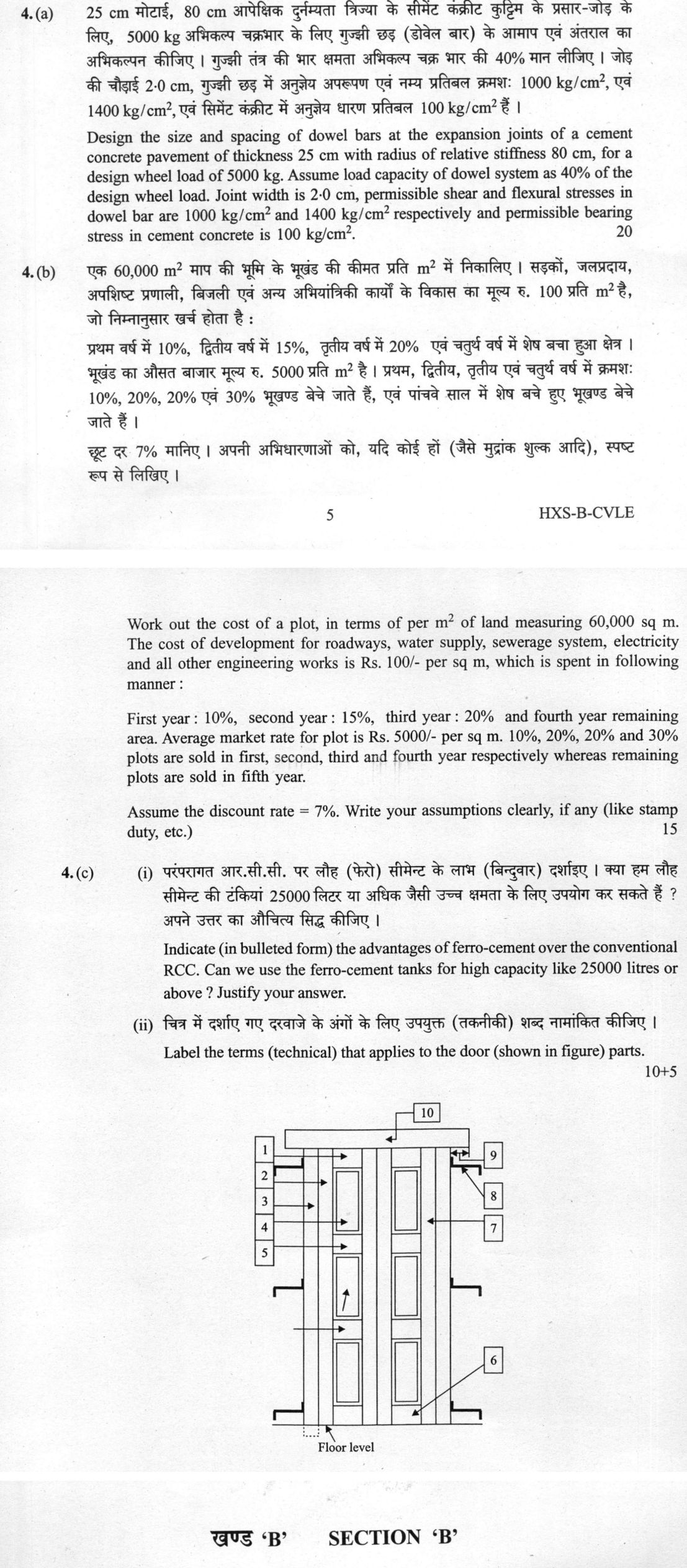
The figure this question refers to, in words
The question paper is a scan and the diagram did not survive as text. This is the figure as read from the original page — every component, value and label — so the question can be worked from the text below.
(c) Elevation view of a paneled door with frame, resting on the 'Floor level', with holdfasts embedded on both left and right sides of the frame. Ten parts are marked with numbered boxes (1 to 10) and leader lines with arrows:
- 1: Points to the top rail of the door shutter.
- 2: Points to an upper panel of the door.
- 3: Points to the hanging stile (outer vertical member of the shutter).
- 4: Points to an intermediate horizontal rail (frieze rail/lock rail).
- 5: Points to the bottom rail of the door shutter.
- 6: Points to the base of the frame jamb / post at the floor level.
- 7: Points to the meeting stile or vertical central member.
- 8: Points to the vertical frame member (door jamb / frame post).
- 9: Points to the horn (projection of the frame head).
- 10: Points to the top horizontal member of the frame (head).
Model answer
Written by UPSC Answer Check against this question's marking rubric, to the expected length. UPSC does not publish answers for Mains — this is one way to score well, not an official key.
(a) Use dowel-bar design by load transfer through the radius of relative stiffness l = 80 cm. The transferred load is shared by dowels according to Westergaard deflection decay, P_x = P_0 e^(−x/l).
Design load transferred: P_t = 0.40 × 5000 = 2000 kg.
Adopt spacing s = 30 cm for trial. Load on critical dowel: P_c = P_t tanh(s/(2l)) = 2000 tanh(30/(2 × 80)) = 2000 tanh(0.1875) = 2000 × 0.18533 = 370.67 kg.
Assume dowel length L = 50 cm, joint width z = 2 cm. Flexural stress in dowel: σ_f = 16 P_c (L/2 + z/2) / (π d³) ≤ 1400 kg/cm². d³ = 16 × 370.67 × (25 + 1) / (π × 1400) = 154,197 / 4398.2 = 35.06 cm³. d = 35.06^(1/3) = 3.27 cm. Adopt 33 mm diameter.
Check shear: τ = P_c / (π d²/4) = 370.67 / (π × 3.3² / 4) = 43.3 kg/cm² < 1000 kg/cm².
Check bearing: Embedded length each side = (50 − 2)/2 = 24 cm. σ_b = P_c / (d × 24) = 370.67 / (3.3 × 24) = 4.68 kg/cm² < 100 kg/cm².
For adopted d = 3.3 cm, allowable P_c from flexure: P_c = π d³ σ_f / [16(L/2 + z/2)] = π × 3.3³ × 1400 / (16 × 26) = 379.95 kg. Then tanh(s/160) = 379.95/2000 = 0.1900 ⇒ s = 2 × 80 artanh(0.1900) = 30.8 cm. Adopt 30 cm.
Final: Dowel size = 33 mm diameter, 50 cm length; spacing = 30 cm centre-to-centre.
(b) Assumptions: cash flows at year-end; 7% discount rate; no stamp duty, registration, taxes, inflation, or overheads; market rate constant; all plots sold as given. Discount factors: v_n = 1/(1.07)^n. v1 = 0.934579, v2 = 0.873439, v3 = 0.816298, v4 = 0.762895, v5 = 0.712986.
Development cost: total = 100 × 60,000 = Rs. 60,00,000. Spent: Y1 = 6,00,000; Y2 = 9,00,000; Y3 = 12,00,000; Y4 = 33,00,000. PV cost = 6,00,000v1 + 9,00,000v2 + 12,00,000v3 + 33,00,000v4 = Rs. 48,43,954.17.
Revenue: total = 60,000 × 5000 = Rs. 30,00,00,000. Sales: Y1 = 3,00,00,000 (10%); Y2 = 6,00,00,000 (20%); Y3 = 6,00,00,000 (20%); Y4 = 9,00,00,000 (30%); Y5 = 6,00,00,000 (20%). PV revenue = 3cr v1 + 6cr v2 + 6cr v3 + 9cr v4 + 6cr v5 = Rs. 24,08,61,319.30.
Net PV = PV revenue − PV cost = 24,08,61,319.30 − 48,43,954.17 = Rs. 23,60,17,365.13.
Per m² = 23,60,17,365.13 / 60,000 = Rs. 3,933.62 per m².
(c)(i) Advantages of ferro-cement over conventional RCC:
- High tensile strength-to-weight ratio and ductility due to closely spaced wire mesh.
- Thin sections (10–30 mm) possible, reducing dead load and material.
- No heavy formwork; can be moulded into curved, cylindrical, or complex shapes.
- High impermeability and crack resistance; distributed reinforcement controls cracking.
- Good impact, fatigue, and corrosion resistance when properly protected.
- Easy repair, low maintenance, and use of local materials/semi-skilled labour.
- Economical for water tanks, roofs, boats, and thin shells.
Can ferro-cement tanks be used for 25,000 litres or above? Yes. Ferro-cement has adequate tensile capacity from mesh reinforcement and impermeability from mortar. For a 25,000 L (25 m³) tank, design as a cylindrical or rectangular tank: compute hoop tension T = γ h D/2, provide multiple mesh layers, adequate wall thickness, ribs/buttresses, and a proper foundation. Larger tanks up to 100,000 L and more have been built. The limitation is mainly economic and quality control; for very large capacities, RCC may be more economical. So technically feasible with proper structural design.
(c)(ii) 1 Top rail 2 Panel 3 Hanging stile 4 Lock rail (or frieze rail) 5 Bottom rail 6 Floor level (jamb foot) 7 Meeting stile 8 Jamb (door frame post) 9 Horn 10 Head (frame head)
What "Design" is asking you to do
Produce a specification that meets the given brief and demonstrate that it does. In civil and electrical papers the design is incomplete until it is expressed in buildable numbers — diameter, spacing, section, component value — and checked back against every limit stated.
Structure that answers it
Requirements and permissible values listed → code clause or design basis adopted → proportioning calculations → the specification in final dimensions → check against each requirement → sketch
Where marks are lost
Stopping at a required area or a required value without converting it into the bar size, spacing or component actually provided. The provided-against-required comparison and the serviceability or stability check are separately marked and routinely left out.
How this answer will be evaluated
Approach
Framework: null. (a) calculate: given > formula > substitution > result with units > interpretation | (b) calculate: given > formula > substitution > result with units > interpretation | (c(i)) justify: claim > 3-4 reasons > evidence > conclusion | (c(ii)) map: locate accurately > label > one line on why it matters Full marks: Complete, accurate calculations with all steps shown, clear assumptions, and correct technical terminology. All parts fully addressed with justification and checks.
Key points expected
- Calculate design load as 40% of 5000 kg wheel load
- Determine dowel diameter using shear and flexural stress formulas
- Calculate dowel spacing using bearing stress and load transfer
- Verify final dimensions against permissible stress limits
- Calculate total development cost based on 60,000 sq m area
- Apply 7% discount rate to development costs over 4 years
- Calculate revenue from plot sales over 5 years
- Determine final cost per m² by balancing cost and revenue
Evaluation rubric
Each sub-part is marked on its own, against the marks and word limit printed on the paper.
- (a) Determine the diameter and spacing of dowel bars at expansion joints. 20 marks
calculate— given → formula → substitution → result with units → interpretation
Must cover
- Calculate design load as 40% of 5000 kg wheel load
- Determine dowel diameter using shear and flexural stress formulas
- Calculate dowel spacing using bearing stress and load transfer
- Verify final dimensions against permissible stress limits
Loses marks
- Final value without showing design check steps
- Unstated assumptions about load capacity or joint width
- Omitting units in intermediate calculation steps
Earns more
- Explicitly state assumptions regarding load distribution
- Show free body diagram of dowel bar
- Check for dowel bar pull-out resistance
- Reference relevant pavement design code (e.g., IRC:37)
Extra mark
- Provide a neat, labelled sketch of the dowel bar arrangement
- Mention specific IS code clause for dowel design
- (b) Compute the cost per m² of the plot including development and discounting. 15 marks
calculate— given → formula → substitution → result with units → interpretation
Must cover
- Calculate total development cost based on 60,000 sq m area
- Apply 7% discount rate to development costs over 4 years
- Calculate revenue from plot sales over 5 years
- Determine final cost per m² by balancing cost and revenue
Loses marks
- Ignoring the time value of money (discount rate)
- Failing to account for the remaining area sold in the fifth year
- Not clearly stating assumptions about additional costs
Earns more
- Clearly state assumptions like stamp duty or taxes
- Show year-wise breakdown of development expenditure
- Show year-wise breakdown of plot sales revenue
- Use present value formulas for discounting
Extra mark
- Provide a table summarizing year-wise costs and revenues
- Mention specific financial formulas used for discounting
- (c(i)) List advantages of ferro-cement and justify its use for high-capacity tanks. 10 marks
justify— claim → 3-4 reasons → evidence → conclusion
Must cover
- List at least 3-4 advantages of ferro-cement over RCC
- State whether ferro-cement is suitable for 25000L+ tanks
- Provide technical justification for the suitability/unsuitability
- Mention key properties like crack resistance or weight
Loses marks
- Listing advantages without justifying the high-capacity tank question
- Vague or general statements without technical specifics
- Failing to clearly state the suitability/unsuitability conclusion
Earns more
- Compare cost-effectiveness with RCC
- Discuss ease of construction and maintenance
- Mention specific applications where ferro-cement is preferred
- Reference relevant standards or codes for ferro-cement
Extra mark
- Provide a small comparative table of ferro-cement vs RCC properties
- Mention specific research or case studies on high-capacity ferro-cement tanks
- (c(ii)) Label the technical terms for the parts of the door shown in the figure. 5 marks
map— locate accurately → label → one line on why it matters
Must cover
- Correctly identify and label all 10 numbered parts
- Use standard technical terminology for door components
- Ensure labels correspond accurately to the figure
- Include terms like frame, stile, rail, panel, etc.
Loses marks
- Incorrect or missing labels for any of the 10 parts
- Using non-technical or colloquial terms instead of standard terminology
- Labels not clearly corresponding to the numbered parts in the figure
Earns more
- Provide a brief definition or function for each labelled part
- Mention material or construction details if visible
- Identify any specific hardware or fittings shown
- Reference standard door construction terminology
Extra mark
- Provide a small diagram or sketch illustrating the door parts
- Mention specific types of doors where these parts are common
Practice this exact question
Write your answer and it is marked point by point against the model answer above — what you covered, what you missed, what you got wrong.
Evaluate my answer →More from Civil Engineering 2021 Paper II
- Q1 (a) (i) What is the purpose of first coat of plastering ? (ii) What loads are taken by th…
- Q2 (a) For a small project, the number of masons required is shown. The table also indicates…
- Q3 (a) (i) Explain with neat sketches, how surface and sub-surface water can be removed from…
- Q4 (a) Design the size and spacing of dowel bars at the expansion joints of a cement concret…
- Q5 (a) A one-hour unit hydrograph of a catchment is shown in the figure. A storm of two hour…
- Q6 (a) Two settling tanks – one rectangular, with length to width ratio of 3 : 1 and side wa…
- Q7 (a) An open drain is to be designed to prevent waterlogging for an area of 576 ha. Given…