Paper II — Q8
(a) From the basin map of a given watershed with drainage area 3000 km², the length of the mainstream (L) is measured as 125 km…
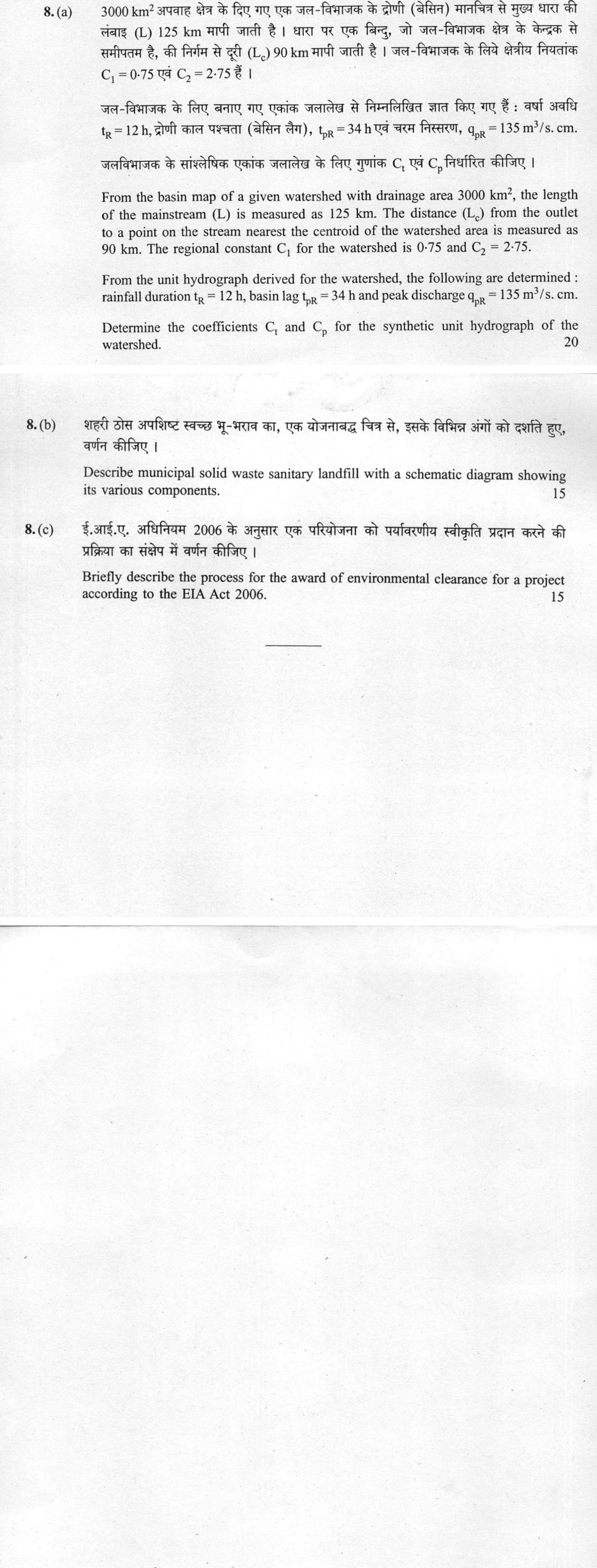
From the basin map of a given watershed with drainage area 3000 km², the length of the mainstream (L) is measured as 125 km. The distance (Lc) from the outlet to a point on the stream nearest the centroid of the watershed area is measured as 90 km. The regional constant C₁ for the watershed is 0·75 and C₂ = 2·75.
From the unit hydrograph derived for the watershed, the following are determined : rainfall duration tR = 12 h, basin lag tpR = 34 h and peak discharge qpR = 135 m³/s. cm.
Determine the coefficients Ct and Cp for the synthetic unit hydrograph of the watershed. 20 marks
Describe municipal solid waste sanitary landfill with a schematic diagram showing its various components. 15 marks
Briefly describe the process for the award of environmental clearance for a project according to the EIA Act 2006. 15 marks
हिंदी में प्रश्न पढ़ें
3000 km² अपवाह क्षेत्र के दिए गए एक जल-विभाजक के द्रोणी (बेसिन) मानचित्र से मुख्य धारा की लंबाई (L) 125 km मापी जाती है। धारा पर एक बिंदु, जो जल-विभाजक क्षेत्र के केन्द्रक से समीपतम है, की निगम से दूरी (Lc) 90 km मापी जाती है। जल-विभाजक के लिए क्षेत्रीय नियतांक C₁ = 0·75 एवं C₂ = 2·75 हैं ।
जल-विभाजक के लिए बनाए गए एकांक जलालेख से निम्नलिखित ज्ञात किए गए हैं : वर्षा अवधि tR = 12 h, द्रोणी काल पश्चाता (बेसिन लैग), tpR = 34 h एवं चरम निस्सरण, qpR = 135 m³/s. cm.
जलविभाजक के संश्लेषिक एकांक जलालेख के लिए गुणांक Ct एवं Cp निर्धारित कीजिए । (20 अंक)
शहरी ठोस अपशिष्ट स्वच्छ भू-भराव का, एक योजनाबद्ध चित्र से, इसके विभिन्न अंगों को दर्शाते हुए, वर्णन कीजिए । (15 अंक)
ई.आई.ए. अधिनियम 2006 के अनुसार एक परियोजना को पर्यावरणीय स्वीकृति प्रदान करने की प्रक्रिया का संक्षेप में वर्णन कीजिए । (15 अंक)
Model answer
Written by UPSC Answer Check against this question's marking rubric, to the expected length. UPSC does not publish answers for Mains — this is one way to score well, not an official key.
(a) The Snyder synthetic unit hydrograph method is used. In SI units the forms are:
tₚ = C₁ Cₜ (L Lc)^0·3 qₚ = C₂ Cₚ A / tₚ
where C₁ = 0·75, C₂ = 2·75, L = 125 km, Lc = 90 km, A = 3000 km².
Compute: L Lc = 125 × 90 = 11250 km² (11250)^0·3 = 16·419
For the given unit hydrograph: tR = 12 h, tpR = 34 h, qpR = 135 m³/s per cm. Standard rainfall duration for Snyder’s UH is tr = tₚ/5·5. The duration adjustment is:
tpR = tₚ + (tR − tr)/4
Substitute:
34 = tₚ + (12 − tₚ/5·5)/4 34 = tₚ + 3 − tₚ/22 34 = (21/22)tₚ + 3
So:
(21/22)tₚ = 31 tₚ = 31 × 22 / 21 = 682/21 = 32·476 h
Then:
Cₜ = tₚ / [C₁ (L Lc)^0·3] Cₜ = 32·476 / (0·75 × 16·419) Cₜ = 32·476 / 12·314 = 2·637
Peak adjustment:
qpR = qₚ (tₚ/tpR) qₚ = qpR × tpR / tₚ qₚ = 135 × 34 / 32·476 = 141·334 m³/s per cm
Now:
Cₚ = qₚ tₚ / (C₂ A) Cₚ = 141·334 × 32·476 / (2·75 × 3000) Cₚ = 4590 / 8250 = 0·556
Cₜ = 2·637; Cₚ = 0·556
(b) A municipal solid waste sanitary landfill is an engineered facility where waste is deposited in compacted cells, covered daily, and leachate and landfill gas are controlled to protect public health and the environment.
Main components:
- Bottom liner system: compacted clay liner, HDPE geomembrane, geotextile protection layer.
- Leachate collection and removal system: perforated pipes in a granular blanket, sump, pumps, leachate treatment.
- Waste cells: compacted MSW placed in lifts; daily cover and intermediate cover.
- Gas collection system: vertical wells, headers, blower, flare or gas engine.
- Final cover or cap: clay layer, geomembrane, drainage layer, topsoil and vegetation.
- Surface water drainage: stormwater diversion drains and sedimentation pond.
- Environmental monitoring: groundwater monitoring wells, gas probes, fence, buffer zone, weighbridge, access road.
Schematic cross-section:
vegetation / topsoil ───────────────────────────── clay cap + geomembrane ───────────────────────────── | gas well | compacted MSW | gas well | | ↑ | + daily cover | ↑ | | header | | header | ───────────────────────────── leachate collection pipes → sump → treatment ───────────────────────────── HDPE geomembrane + compacted clay liner ───────────────────────────── natural soil / bedrock groundwater monitoring well (side)
After closure, the landfill is capped and monitored for leachate, gas, settlement and groundwater quality.
(c) Under the EIA Notification, 2006 (under the Environment (Protection) Act, 1986), the award of environmental clearance involves the following stages:
- Categorization: Projects in the Schedule are classified as Category A or B. Category A is appraised by the Expert Appraisal Committee at central level and approved by MoEFCC. Category B is handled by SEIAA/SEAC at state level.
- Application: The project proponent submits Form 1, pre-feasibility report, conceptual plan and other documents online through PARIVESH to the concerned authority.
- Screening: For Category B projects, SEAC screens the project as B1, requiring EIA, or B2, not requiring EIA.
- Scoping: For Category A and B1 projects, EAC/SEAC issues Terms of Reference specifying baseline studies, study area and impact-assessment requirements.
- EIA/EMP preparation: An accredited consultant conducts baseline studies, predicts impacts and prepares the Environmental Impact Assessment and Environmental Management Plan.
- Public consultation: A public hearing is conducted by the State Pollution Control Board, with newspaper notice, summary in local language and collection of written responses. Some projects are exempt.
- Appraisal: EAC/SEAC appraises the EIA, EMP, public hearing report and site visit, if needed, and recommends grant or rejection of clearance with conditions.
- Decision: MoEFCC/SEIAA grants environmental clearance with valid period and conditions, or rejects with reasons. Validity is generally 5 years, and 10 years for river valley projects.
- Post-clearance: Compliance monitoring, half-yearly compliance reports and action for violations continue after clearance.
What "Calculate" is asking you to do
Apply the standard formula or schedule to data the question has already supplied — a table of readings, cost records, a balance sheet — and produce the number. The method is rarely in doubt; the marks sit in the named intermediate quantities, each of which has to appear as a labelled line.
Structure that answers it
Data as given → formula or standard treatment, named → substitution → each intermediate, labelled → result with units
Where marks are lost
Omitting an intermediate the marking scheme pays for separately, or rounding at an intermediate line so the final figure drifts. In commerce and accountancy, any figure in a statement that no numbered working note supports is treated as unearned.
How this answer will be evaluated
Approach
Framework: SCS Synthetic Unit Hydrograph Method. (a) calculate: given > formula > substitution > result with units > interpretation | (b) describe: define > structure or process in order > labelled diagram > significance | (c) describe: define > structure or process in order > labelled diagram > significance Full marks: Part (a) shows full derivation with units; (b) has a neat, labelled diagram; (c) lists all stages in correct order.
Key points expected
- State given data: A, L, Lc, C1, C2, tR, tpR, qpR.
- Calculate SCS basin lag (tp) using C1, L, Lc.
- Compute Ct as ratio of SCS tp to given lag.
- Compute Cp as ratio of given qp to SCS qp.
- Define municipal solid waste sanitary landfill.
- List key components: liner, leachate, gas, cover.
- Provide a labelled schematic diagram of the landfill.
- Explain the function of the leachate collection system.
Evaluation rubric
Each sub-part is marked on its own, against the marks and word limit printed on the paper.
- (a) Compute coefficients Ct and Cp for the synthetic unit hydrograph. 20 marks
calculate— given → formula → substitution → result with units → interpretation
Must cover
- State given data: A, L, Lc, C1, C2, tR, tpR, qpR.
- Calculate SCS basin lag (tp) using C1, L, Lc.
- Compute Ct as ratio of SCS tp to given lag.
- Compute Cp as ratio of given qp to SCS qp.
Loses marks
- Using wrong formula for SCS lag or peak.
- Omitting units in intermediate calculations.
- Final answer without showing substitution steps.
Earns more
- Correct SCS lag formula: tp = C1(L/Lc)^C2.
- Correct SCS peak formula: qp = 0.208 A / tp.
- Carry units (km, h, m³/s) through all steps.
- Final values for Ct and Cp clearly stated.
Extra mark
- Mention SCS (Soil Conservation Service) method explicitly.
- Check if Ct and Cp are within typical range (0.8-1.2).
- (b) Describe sanitary landfill components with a schematic diagram. 15 marks
describe— define → structure or process in order → labelled diagram → significance
Must cover
- Define municipal solid waste sanitary landfill.
- List key components: liner, leachate, gas, cover.
- Provide a labelled schematic diagram of the landfill.
- Explain the function of the leachate collection system.
Loses marks
- Diagram missing critical components like liner or gas vents.
- Confusing sanitary landfill with open dumping.
- No explanation of how leachate is managed.
Earns more
- Mention daily and final cover materials.
- Describe the landfill gas collection and flaring system.
- Label the diagram clearly with all major parts.
- Mention the role of the bottom liner (clay/HDPE).
Extra mark
- Mention specific IS code for landfill design (e.g., IS 11169).
- Include a small sketch of the leachate treatment unit.
- (c) Describe the environmental clearance process under EIA Act 2006. 15 marks
describe— define → structure or process in order → labelled diagram → significance
Must cover
- Identify the regulatory body (MoEFCC) and EIA Act 2006.
- Outline the sequence: Screening, Scoping, EIA, Appraisal.
- Mention the role of the Expert Appraisal Committee (EAC).
- Describe the final decision: Clearance, Rejection, or Modification.
Loses marks
- Skipping the public consultation stage.
- Confusing EIA with Environmental Impact Assessment (the study itself).
- Failing to mention the final authority (Central/State Government).
Earns more
- Mention the role of the State Level Environment Impact Assessment Authority.
- Include the public consultation/hearing stage in the process.
- Distinguish between Category A and B projects.
- Mention the validity period of the clearance (usually 5 years).
Extra mark
- Cite specific sections of the EIA Act 2006.
- Mention the National Environment Appraisal Board (NEAB) role.
Practice this exact question
Write your answer and it is marked point by point against the model answer above — what you covered, what you missed, what you got wrong.
Evaluate my answer →More from Civil Engineering 2021 Paper II
- Q5 (a) A one-hour unit hydrograph of a catchment is shown in the figure. A storm of two hour…
- Q6 (a) Two settling tanks – one rectangular, with length to width ratio of 3 : 1 and side wa…
- Q7 (a) An open drain is to be designed to prevent waterlogging for an area of 576 ha. Given…
- Q8 (a) From the basin map of a given watershed with drainage area 3000 km², the length of th…