Paper II — Q6
(a) Two settling tanks – one rectangular, with length to width ratio of 3 : 1 and side water depth of 3·5 m; and the other…
Two settling tanks – one rectangular, with length to width ratio of 3 : 1 and side water depth of 3·5 m; and the other circular, with side water depth of 4·0 m – are to be designed to treat 20,000 m³/d of water required for a city's water supply. The surface overflow rate for satisfactory removal of solids is 20 m/d. Determine the dimensions of the settling zone of the two tanks. Check for retention time, horizontal velocity and weir overflow rate which should respectively be 3–5 hours, less than 10 m/h and 6 to 10 m³/h per m. Also determine the overall dimensions of the basins keeping length of inlet zone and outlet zone equal to the side water depth of the basin. 20 marks
Although it would be expected that the value of the ultimate carbonaceous BOD would be as high as the COD, this is seldom the case. What are the reasons for the observed differences? 15 marks
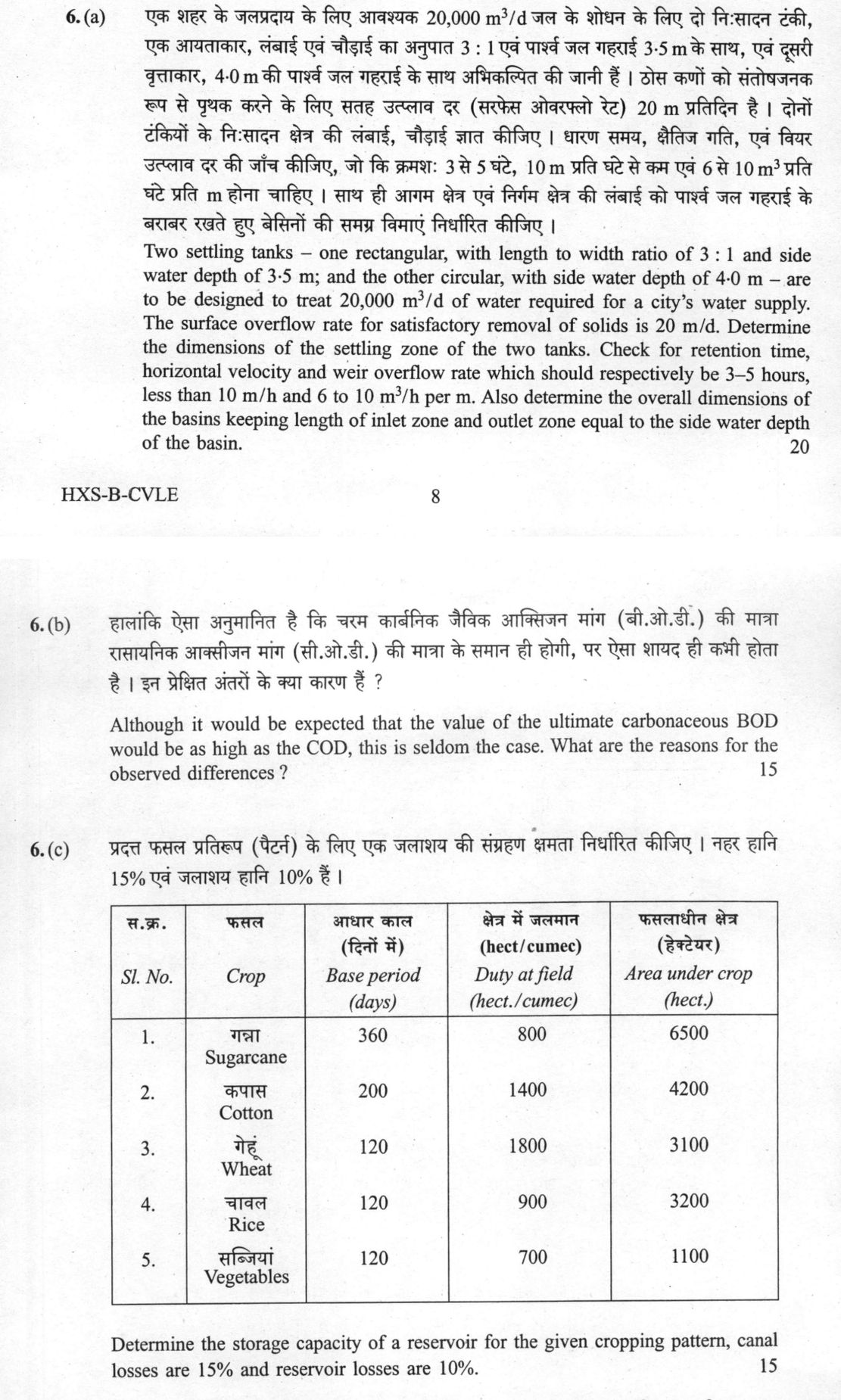
Determine the storage capacity of a reservoir for the given cropping pattern, canal losses are 15% and reservoir losses are 10%. 15 marks
हिंदी में प्रश्न पढ़ें
एक शहर के जलप्रदाय के लिए आवश्यक 20,000 m³/d जल के शोधन के लिए दो नि:सादन टंकी, एक आयताकार, लंबाई एवं चौड़ाई का अनुपात 3 : 1 एवं पार्श्व जल गहराई 3·5 m के साथ, एवं दूसरी वृत्ताकार, 4·0 m की पार्श्व जल गहराई के साथ अभिकल्पित की जानी हैं । ठोस कणों को संतोषजनक रूप से पृथक करने के लिए सतह उत्प्लाव दर (सरफेस ओवरफ्लो रेट) 20 m प्रतिदिन है । दोनों टंकियों के नि:सादन क्षेत्र की लंबाई, चौड़ाई ज्ञात कीजिए । धारण समय, क्षैतिज गति, एवं विवर उत्प्लाव दर की जाँच कीजिए, जो कि क्रमशः 3 से 5 घंटे, 10 m प्रति घंटे से कम एवं 6 से 10 m³ प्रति घंटे प्रति m होना चाहिए । साथ ही आगम क्षेत्र एवं निर्गम क्षेत्र की लंबाई को पार्श्व जल गहराई के बराबर रखते हुए बेसिनों की समग्र विमाएँ निर्धारित कीजिए । (20 अंक)
हालांकि ऐसा अनुमानित है कि चरम कार्बनिक जैविक ऑक्सीजन मांग (बी.ओ.डी.) की मात्रा रासायनिक ऑक्सीजन मांग (सी.ओ.डी.) की मात्रा के समान ही होगी, पर ऐसा शायद ही कभी होता है । इन प्रेक्षित अंतरों के क्या कारण हैं ? (15 अंक)
प्रदत्त फसल प्रतिरूप (पैटर्न) के लिए एक जलाशय की संग्रहण क्षमता निर्धारित कीजिए । नहर हानि 15% एवं जलाशय हानि 10% है । (15 अंक)
The figure this question refers to, in words
The question paper is a scan and the diagram did not survive as text. This is the figure as read from the original page — every component, value and label — so the question can be worked from the text below.
(c) Table with 5 rows of data and 5 columns. The columns are: Sl. No., Crop, Base period (days), Duty at field (hect./cumec), Area under crop (hect.).
Row 1: 1, Sugarcane, 360, 800, 6500 Row 2: 2, Cotton, 200, 1400, 4200 Row 3: 3, Wheat, 120, 1800, 3100 Row 4: 4, Rice, 120, 900, 3200 Row 5: 5, Vegetables, 120, 700, 1100
What "Solve" is asking you to do
Choose the method, then carry it through to a final answer. Identifying what kind of problem this is and why that method applies is the first thing marked; a correct figure arrived at invisibly earns almost nothing.
Structure that answers it
Given data and what is required → method chosen, with the reason it applies → set-up (equation, circuit, free body, trial balance) → working, step by step → answer with units and any condition of validity
Where marks are lost
Doing the middle steps mentally and writing only the result. In mathematics papers, a further loss comes from giving a decimal where the exact value in surds or fractions was wanted, or from skipping the justification a part explicitly asks for.
How this answer will be evaluated
Approach
(a) calculate: given > formula > substitution > result with units > interpretation | (b) explain: definition/context > points in order > small example > short close | (c) calculate: given > formula > substitution > result with units > interpretation Full marks: Complete calculations with all checks, clear presentation, correct units, and design verification
Key points expected
- Calculate settling zone area using 20 m/d overflow rate
- Determine rectangular tank dimensions (L:W = 3:1, depth 3.5 m)
- Determine circular tank diameter (depth 4.0 m)
- Check retention time, horizontal velocity, and weir overflow rate
- Define BOD and COD measurement principles
- Identify non-biodegradable organic compounds
- Explain limitations of biological oxidation
- Mention specific compounds not oxidized by bacteria
Evaluation rubric
Each sub-part is marked on its own, against the marks and word limit printed on the paper.
- (a) Design rectangular and circular settling tanks for 20,000 m³/d flow. 20 marks
calculate— given → formula → substitution → result with units → interpretation
Must cover
- Calculate settling zone area using 20 m/d overflow rate
- Determine rectangular tank dimensions (L:W = 3:1, depth 3.5 m)
- Determine circular tank diameter (depth 4.0 m)
- Check retention time, horizontal velocity, and weir overflow rate
Loses marks
- Missing design checks for retention time or velocity
- Incorrect unit conversion or calculation errors
- Failure to distinguish settling zone from overall dimensions
Earns more
- Calculate overall basin dimensions including inlet/outlet zones
- Show step-by-step substitution of values
- Verify results against specified limits (3-5 hrs, <10 m/h, 6-10 m³/h/m)
Extra mark
- Provide neat labelled sketch of tank cross-sections
- (b) Explain why ultimate carbonaceous BOD is typically less than COD. 15 marks
explain— definition/context → points in order → small example → short close
Must cover
- Define BOD and COD measurement principles
- Identify non-biodegradable organic compounds
- Explain limitations of biological oxidation
- Mention specific compounds not oxidized by bacteria
Loses marks
- Confusing BOD with DO or other parameters
- Vague statements without specific chemical reasons
- Failing to distinguish carbonaceous from total BOD
Earns more
- Discuss refractory organic matter
- Mention toxic substances inhibiting bacteria
- Reference specific examples of non-biodegradable compounds
Extra mark
- Provide quantitative comparison of typical BOD/COD ratios
- (c) Calculate reservoir storage capacity for given cropping pattern. 15 marks
calculate— given → formula → substitution → result with units → interpretation
Must cover
- Calculate duty for each crop from base period
- Determine water requirement for each crop area
- Sum total water requirement for all crops
- Apply canal (15%) and reservoir (10%) loss factors
Loses marks
- Incorrect application of loss percentages
- Missing crops from calculation
- Unit errors in area or water volume
Earns more
- Show tabular calculation for each crop
- Clearly state formula for duty and water requirement
- Present final answer with appropriate units
Extra mark
- Include sensitivity analysis or alternative calculation method
Model answer coming soon
Every evaluation on this site is marked against a verified model answer. This question's answer is still being written; evaluation opens the moment it lands.
More from Civil Engineering 2021 Paper II
- Q3 (a) (i) Explain with neat sketches, how surface and sub-surface water can be removed from…
- Q4 (a) Design the size and spacing of dowel bars at the expansion joints of a cement concret…
- Q5 (a) A one-hour unit hydrograph of a catchment is shown in the figure. A storm of two hour…
- Q6 (a) Two settling tanks – one rectangular, with length to width ratio of 3 : 1 and side wa…
- Q7 (a) An open drain is to be designed to prevent waterlogging for an area of 576 ha. Given…
- Q8 (a) From the basin map of a given watershed with drainage area 3000 km², the length of th…