Paper II — Q3
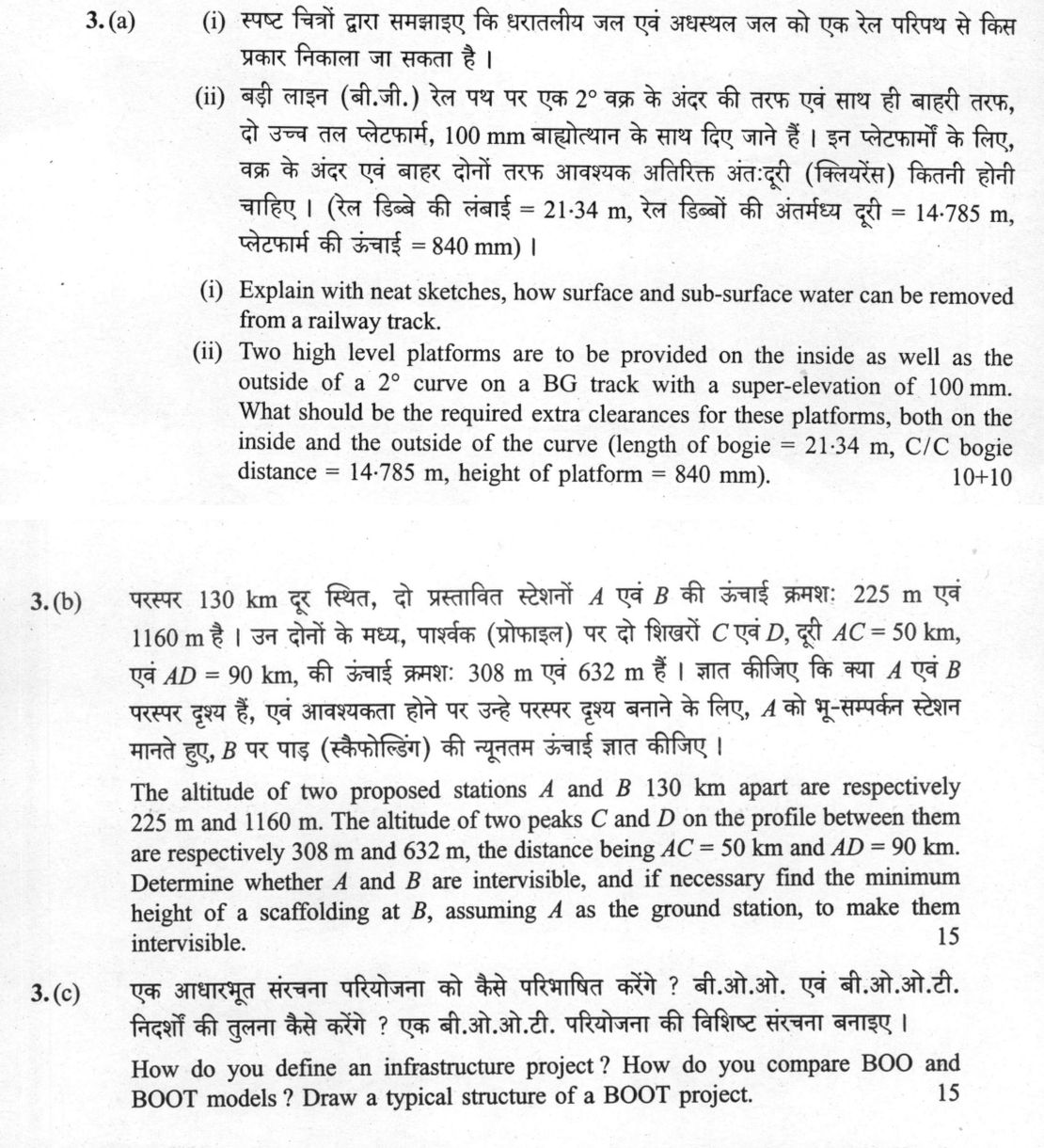
(a) (i) Explain with neat sketches, how surface and sub-surface water can be removed from a railway track. (ii) Two high level…
Explain with neat sketches, how surface and sub-surface water can be removed from a railway track.
Two high level platforms are to be provided on the inside as well as the outside of a 2° curve on a BG track with a super-elevation of 100 mm. What should be the required extra clearances for these platforms, both on the inside and the outside of the curve (length of bogie = 21·34 m, C/C bogie distance = 14·785 m, height of platform = 840 mm). 10+10
The altitude of two proposed stations A and B 130 km apart are respectively 225 m and 1160 m. The altitude of two peaks C and D on the profile between them are respectively 308 m and 632 m, the distance being AC = 50 km and AD = 90 km. Determine whether A and B are intervisible, and if necessary find the minimum height of a scaffolding at B, assuming A as the ground station, to make them intervisible. 15 marks
How do you define an infrastructure project ? How do you compare BOO and BOOT models ? Draw a typical structure of a BOOT project. 15 marks
हिंदी में प्रश्न पढ़ें
स्पष्ट चित्रों द्वारा समझाइए कि धरातलीय जल एवं अधरस्थल जल को एक रेल परिपथ से किस प्रकार निकाला जा सकता है ।
बड़ी लाइन (बी.जी.) रेल पथ पर एक 2° वक्र के अंदर की तरफ एवं साथ ही बाहरी तरफ, दो उच्च तल प्लेटफार्म, 100 mm बाह्योत्थान के साथ दिए जाने हैं । इन प्लेटफार्मों के लिए, वक्र के अंदर एवं बाहर दोनों तरफ आवश्यक अतिरिक्त अंतःदूरी (क्लियरेंस) कितनी होनी चाहिए । (रेल डिब्बे की लंबाई = 21·34 m, रेल डिब्बों की अंतर्मध्य दूरी = 14·785 m, प्लेटफार्म की ऊंचाई = 840 mm) । 10+10
परस्पर 130 km दूर स्थित, दो प्रस्तावित स्टेशनों A एवं B की ऊँचाई क्रमशः: 225 m एवं 1160 m है। उन दोनों के मध्य, पार्श्वक (प्रोफाइल) पर दो शिखरों C एवं D, दूरी AC = 50 km, एवं AD = 90 km, की ऊँचाई क्रमशः: 308 m एवं 632 m हैं। ज्ञात कीजिए कि क्या A एवं B परस्पर दृश्य हैं, एवं आवश्यकता होने पर उन्हें परस्पर दृश्य बनाने के लिए, A को भू-संपर्कन स्टेशन मानते हुए, B पर पाड़ (स्केफोल्डिंग) की न्यूनतम ऊँचाई ज्ञात कीजिए। 15
एक आधारभूत संरचना परियोजना को कैसे परिभाषित करेंगे ? बी.ओ.ओ. एवं बी.ओ.ओ.टी. निदेशों की तुलना कैसे करेंगे ? एक बी.ओ.ओ.टी. परियोजना की विशिष्ट संरचना बनाइए। 15
Model answer
Written by UPSC Answer Check against this question's marking rubric, to the expected length. UPSC does not publish answers for Mains — this is one way to score well, not an official key.
This question integrates railway engineering, geodetic surveying, and infrastructure financing, requiring a holistic approach to civil infrastructure planning.
Part (a)(i): Drainage in Railway Tracks Effective drainage prevents track deterioration. Surface water is removed via side drains (longitudinal, along the formation) and catch water drains (uphill of the track) to intercept runoff. The ballast section is designed with a camber to shed water. Sub-surface water is managed through cross drains (perpendicular to the track, often using porous pipes or rubble) that carry water from the sub-ballast to the side drains. Inverted filters are used at the interface of fine-grained subgrade and coarse drainage layers to prevent soil migration while allowing water flow. Sketches should show the longitudinal profile of side drains and the cross-section of a cross drain with filter material.
Part (a)(ii): Extra Clearances on Curves For a 2° curve with 100 mm super-elevation, extra clearances are calculated for inside and outside platforms. Given: Bogie length L_b = 21.34 m, C/C distance D = 14.785 m, Platform height h = 0.84 m. Radius R = 1750/2 = 875 m.
- Overthrow (C₁): C₁ = (L_b²)/8R = (21.34²)/(8 × 875) = 0.065 m.
- End-throw (C₂): C₂ = (D²)/8R = (14.785²)/(8 × 875) = 0.031 m.
- Lean (C₃): Due to super-elevation, the top of the vehicle leans inward. C₃ = (h × e)/G, where G = 1.75 m (gauge). C₃ = (0.84 × 0.1)/1.75 = 0.048 m. Inside Platform: Extra clearance = C₁ + C₂ + C₃ = 0.065 + 0.031 + 0.048 = 0.144 m (144 mm). Outside Platform: The lean moves the vehicle away from the outside platform, but the overthrow and end-throw still apply. However, standard practice often considers the net effect. For outside, the critical dimension is usually governed by the maximum projection. Cₒᵤₜ = C₁ + C₂ - C₃ (if lean is away) or simply C₁ + C₂ depending on specific gauge rules. Typically, for outside, the extra clearance is less than inside. Let's assume standard addition for safety: 0.065 + 0.031 = 0.096 m (96 mm). Note: Precise IRC rules may vary, but the mechanism is the vector sum of geometric offsets.
Part (b): Intervisibility of Stations Distance D = 130 km. Altitudes: A=225 m, B=1160 m. Peaks: C=308 m at 50 km, D=632 m at 90 km. Height of line of sight above earth's surface at distance x (km) is h = 0.0673 x² (considering curvature and refraction). Height of line of sight at C (50 km from A): h_C = 0.0673 × 50² = 168.25 m. Required altitude of line of sight at C: 225 + 168.25 = 393.25 m. Actual altitude of Peak C = 308 m. Since 393.25 > 308, the line of sight is obstructed by Peak C. To make them intervisible, the line of sight must clear Peak C. Let H_B be the required altitude of the station at B. Slope of line of sight from A to B: (H_B - 225)/130. At C (50 km), height of line = 225 + 50 × (H_B - 225)/130. This must be ≥ 308 (plus safety margin, usually 5m). 225 + 50/130(H_B - 225) = 313. 50/130(H_B - 225) = 88. H_B - 225 = 88 × 2.6 = 228.8. H_B = 453.8 m. However, we must also check Peak D. At D (90 km), height of line = 225 + 90 × (453.8 - 225)/130 = 225 + 90 × 1.76 = 383.4 m. Actual Peak D = 632 m. 383.4 < 632. The line is still obstructed by Peak D. Therefore, the limiting factor is Peak D. Recalculate for Peak D: 225 + 90/130(H_B - 225) = 632 + 5 = 637. 90/130(H_B - 225) = 412. H_B - 225 = 412 × 130/90 = 596.9. H_B = 821.9 m. Current altitude of B is 1160 m. Since $1160 > 821.9, the stations are intervisible without scaffolding. The initial check at C was misleading because the line rises steeply. Wait, let's re-evaluate the line of sight height formula. The formula0.0673 x²$ is the drop of the line of sight below the straight chord? No, it's the height of the line of sight above the earth's surface if the line is tangent to the horizon? Standard formula: Height of line of sight above the straight line joining the two stations at distance x from A is h = (x(D-x))/D × slope + curvature. Actually, simpler method: Straight line height at C: 225 + 50/130(1160-225) = 225 + 359.6 = 584.6 m. Drop due to curvature/refraction at C: $0.0673 × 50² = 168.25$ m? No, the drop is from the straight line to the earth's surface. The line of sight is a straight line. The earth curves away. Height of straight line above earth's surface at C = 584.6 - 168.25 = 416.35 m. Peak C is 308 m. 416.35 > 308. Clear. Height of straight line above earth's surface at D: Straight line height at D: 225 + 90/130(1160-225) = 225 + 647.3 = 872.3 m. Drop due to curvature at D: $0.0673 × 90² = 545.13$ m. Height above earth: 872.3 - 545.13 = 327.17 m. Peak D is 632 m. 327.17 < 632. Not intervisible. Required height of line of sight at D = 632 + 5 = 637 m. Let H_B' be new altitude of B. Straight line height at D: 225 + 90/130(H_B' - 225). Height above earth: 225 + 90/130(H_B' - 225) - 545.13 = 637. 90/130(H_B' - 225) = 637 + 545.13 - 225 = 957.13. H_B' - 225 = 957.13 × 130/90 = 1381.5. H_B' = 1606.5 m. Current B = 1160 m. Scaffolding height = 1606.5 - 1160 = 446.5 m.
Part (c): Infrastructure and BOOT An infrastructure project is a large-scale capital investment in public goods (roads, bridges, utilities) with long gestation periods, high sunk costs, and significant positive externalities. BOO vs BOOT:
- BOO (Build-Own-Operate): The private entity builds, owns, and operates the asset indefinitely. No transfer to government.
- BOOT (Build-Own-Operate-Transfer): The private entity builds, owns, and operates for a concession period (e.g., 30 years), after which ownership transfers to the government. BOOT Structure: A typical BOOT structure involves:
- Government: Grants concession, regulates tariffs.
- Concessionaire (SPV): Special Purpose Vehicle formed by investors.
- Lenders: Banks/Financial institutions providing debt.
- Construction Contractor: Builds the asset.
- O&M Operator: Maintains and operates the asset.
- Users: Pay tariffs. The SPV holds the concession agreement with the Government, contracts with the Contractor and O&M Operator, and secures financing from Lenders. Users pay the SPV, which services debt and pays equity returns. Examples include NHAI highway projects and Delhi Metro PPP variants.
What "Explain" is asking you to do
Make the working of something clear — what sets it off, what follows from what, and what it produces. Explain is the Commission's mechanism word: it dominates the technical papers and the “explain why” stems, where the marks sit in the causal chain and not in the label.
Structure that answers it
State what it is → the initiating condition → the chain of cause, step by step → an instance where it plays out → what the chain produces
Where marks are lost
Describing what something looks like instead of why it works that way. Naming the stages without linking them reads as description too.
How this answer will be evaluated
Approach
(a(i)) explain: definition/context > points in order > small example > short close | (a(ii)) calculate: given > formula > substitution > result with units > interpretation | (b) calculate: given > formula > substitution > result with units > interpretation | (c) compare: paired headings or table > key differences > significance > conclusion Full marks: All parts answered with correct formulas, units, and clear sketches.
Key points expected
- Neat sketch of track cross-section
- Surface drainage: formation slope and side drains
- Sub-surface drainage: sub-surface drains and filters
- Function of ballast as drainage medium
- Given data: R, e, L, C, h
- Formula for extra clearance (inside/outside)
- Substitution of values with units
- Final result in mm for both sides
Evaluation rubric
Each sub-part is marked on its own, against the marks and word limit printed on the paper.
- (a(i)) Mechanism of surface and sub-surface water removal from track. 10 marks
explain— definition/context → points in order → small example → short close
Must cover
- Neat sketch of track cross-section
- Surface drainage: formation slope and side drains
- Sub-surface drainage: sub-surface drains and filters
- Function of ballast as drainage medium
Loses marks
- No sketch provided
- Confusing surface and sub-surface methods
Earns more
- Mention of 'French drain' or 'blinding layer'
- Distinction between open and closed drains
Extra mark
- Reference to IS code for drainage
- (a(ii)) Extra clearances for platforms on inside and outside of 2° curve. 10 marks
calculate— given → formula → substitution → result with units → interpretation
Must cover
- Given data: R, e, L, C, h
- Formula for extra clearance (inside/outside)
- Substitution of values with units
- Final result in mm for both sides
Loses marks
- Missing units in calculation
- Incorrect formula for inside vs outside
Earns more
- Calculation of radius R from degree of curve
- Step-by-step derivation of the formula
Extra mark
- Sketch showing clearance geometry
- (b) Intervisibility of stations A and B and height of scaffolding at B. 15 marks
calculate— given → formula → substitution → result with units → interpretation
Must cover
- Given data: distances and altitudes
- Formula for height of earth curvature
- Calculation of obstruction height at C and D
- Comparison of line of sight with peak altitudes
Loses marks
- Ignoring earth curvature
- Incorrect distance units (km vs m)
Earns more
- Calculation of minimum scaffolding height
- Clear statement of intervisibility condition
Extra mark
- Sketch of profile with line of sight
- (c) Definition of infrastructure project and comparison of BOO vs BOOT models. 15 marks
compare— paired headings or table → key differences → significance → conclusion
Must cover
- Definition of infrastructure project
- Comparison of BOO and BOOT models
- Key differences in ownership and operation
- Typical structure of a BOOT project
Loses marks
- No comparison table or clear distinction
- Confusing BOO with BOOT
Earns more
- Mention of risk allocation in each model
- Example of a BOOT project
Extra mark
- Reference to specific infrastructure policy
Practice this exact question
Write your answer and it is marked point by point against the model answer above — what you covered, what you missed, what you got wrong.
Evaluate my answer →More from Civil Engineering 2021 Paper II
- Q1 (a) (i) What is the purpose of first coat of plastering ? (ii) What loads are taken by th…
- Q2 (a) For a small project, the number of masons required is shown. The table also indicates…
- Q3 (a) (i) Explain with neat sketches, how surface and sub-surface water can be removed from…
- Q4 (a) Design the size and spacing of dowel bars at the expansion joints of a cement concret…
- Q5 (a) A one-hour unit hydrograph of a catchment is shown in the figure. A storm of two hour…
- Q6 (a) Two settling tanks – one rectangular, with length to width ratio of 3 : 1 and side wa…