Paper II — Q2
(a) For a small project, the number of masons required is shown. The table also indicates the duration of each activity along…
For a small project, the number of masons required is shown. The table also indicates the duration of each activity along with the masons required. Carry out the resource allocation with unlimited and limited number of resources. Indicate the advantages and disadvantages of both. 20 marks (b) There is a horizontal curve of radius 400 m and length 200 m on a highway. Compute the set-back distances required from the centre line on the inner side of the curve so as to provide for : (i) stopping sight distance of 100 m (ii) safe overtaking sight distance of 320 m The distance between the centre lines of the road and the inner lane is 1·9 m. 15 marks (c) A dumpy level was set up at P exactly between A and B, 50 m apart. The readings on staff held at A and B were 2·4 m and 1·4 m respectively. The instrument was then shifted and set up at Q on the line BA produced at 10 m from A. The readings on staff held at A and B were respectively 2·50 m and 1·4 m. Determine the staff reading on A and B to give a horizontal line of sight. Determine R.L. of B if that of A is 200·00 m. 15 marks
हिंदी में प्रश्न पढ़ें
एक छोटी परियोजना के लिए आवश्यक राजमिस्त्रियों की संख्या दर्शाई गयी है । तालिका प्रत्येक क्रिया की अवधि के साथ आवश्यक राजमिस्त्रियों को भी दर्शाती है । संसाधनों की असीमित एवं सीमित संख्या के साथ संसाधन नियतन कार्यान्वित कीजिए । दोनों के लाभ एवं हानियाँ बताइए । 20 अंक (b) एक राजमार्ग पर 400 m त्रिज्या एवं 200 m लंबाई का एक क्षैतिज वक्र है । वक्र की मध्यरेखा से अंदर की ओर आवश्यक पश्चात्तर (सेट बैक) दूरियों की गणना निम्नलिखित को प्रदान करने के लिए कीजिए : (i) 100 m की विराम दृष्टि दूरी (स्टॉपिंग साइट डिस्टेंस) (ii) 320 m की सुरक्षित अभिलंघन दृष्टि दूरी (ओवरटेकिंग साइट डिस्टेंस) सड़क की एवं आंतरिक लेन की मध्यरेखाओं के बीच की दूरी 1·9 है । 15 अंक (c) एक डंपी तलमापी, परस्पर 50 m दूर A एवं B के ठीक मध्य में P पर स्थापित किया गया । A एवं B पर गज (स्टाफ) पाठ्यांक क्रमशः: 2·4 m एवं 1·4 m थे । उपकरण को फिर हटाकर, बढ़ाई गयी रेखा BA पर, A से 10 m दूर Q पर स्थापित किया गया । A एवं B पर रखे गज पर पाठ्यांक क्रमशः: 2·50 m एवं 1·4 m थे । क्षैतिज दृष्टि रेखा देने के लिए A एवं B पर गज पाठ्यांक ज्ञात कीजिए । B का समानीत तल निर्धारित कीजिए यदि A का 200·00 m है । 15 अंक
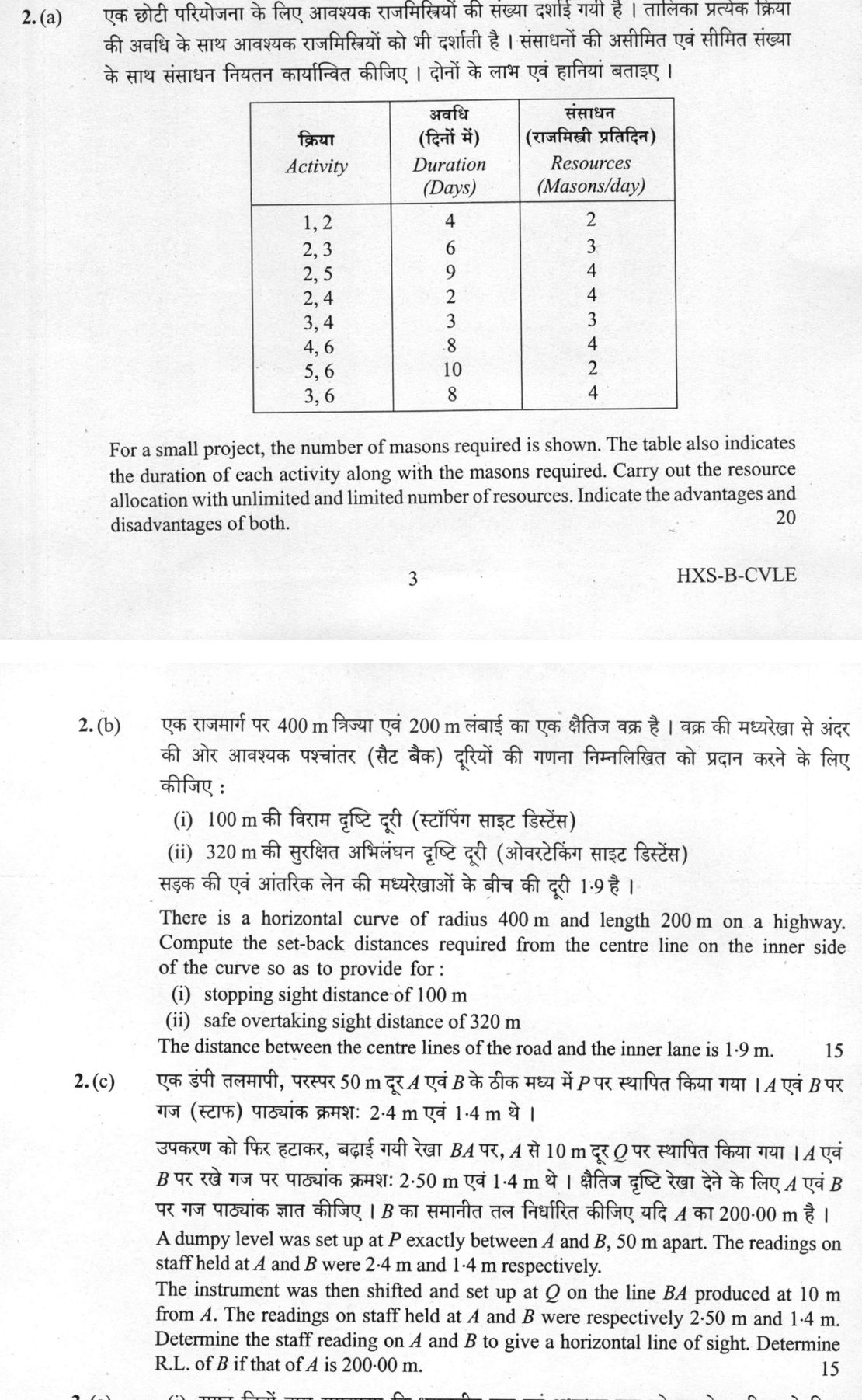
The figure this question refers to, in words
The question paper is a scan and the diagram did not survive as text. This is the figure as read from the original page — every component, value and label — so the question can be worked from the text below.
(a) Table with three columns: Activity, Duration (Days), Resources (Masons/day). Rows: 1, 2 | 4 | 2 2, 3 | 6 | 3 2, 5 | 9 | 4 2, 4 | 2 | 4 3, 4 | 3 | 3 4, 6 | 8 | 4 5, 6 | 10 | 2 3, 6 | 8 | 4
Model answer
Written by UPSC Answer Check against this question's marking rubric, to the expected length. UPSC does not publish answers for Mains — this is one way to score well, not an official key.
(a) Use CPM for the unlimited-resource case. Earliest path lengths to node 6 are:
- 1-2-5-6 = 4 + 9 + 10 = 23 d
- 1-2-3-6 = 4 + 6 + 8 = 18 d
- 1-2-3-4-6 = 4 + 6 + 3 + 8 = 21 d
- 1-2-4-6 = 4 + 2 + 8 = 14 d
Critical path is 1-2, 2-5, 5-6, so unlimited-resource duration = 23 d. Latest starts: 2-3 = 6 d, 3-4 = 12 d, 3-6 = 15 d, 4-6 = 15 d, 2-4 = 13 d.
Earliest-start mason demand:
- 0-4 d: 2
- 4-6 d: 3 + 4 + 4 = 11
- 6-10 d: 3 + 4 = 7
- 10-13 d: 4 + 3 + 4 = 11
- 13-18 d: 4 + 4 + 2 = 10
- 18-21 d: 4 + 2 = 6
- 21-23 d: 2
Peak = 11 masons; total = 163 mason-days.
For the limited case, take the minimum feasible availability that does not extend the 23 d duration, i.e. 10 masons. Since 5-6 is fixed at 13-23 d, 4-6 cannot start after 15 d, and 3-6 cannot finish before 18 d, 4-6 and 3-6 must overlap while 5-6 is active; hence a 10-mason peak is unavoidable. A valid 10-mason schedule is:
- 1-2: 0-4 d; 2-5: 4-13 d; 5-6: 13-23 d
- 2-4: 4-6 d; 2-3: 6-12 d; 3-4: 12-15 d
- 3-6: 13-21 d; 4-6: 15-23 d
Demand:
- 0-4: 2; 4-6: 8; 6-12: 7; 12-13: 7; 13-15: 9; 15-21: 10; 21-23: 6.
Thus unlimited: 23 d, peak 11 masons. Limited (10 masons): 23 d, peak 10 masons. Unlimited gives shortest duration but high peak and higher labour cost. Limited/levelled gives smoother demand and lower peak, but consumes float, reduces flexibility, and may extend duration if availability is lower.
(b) Use the horizontal-curve sight-distance setback formula. R = 400 m, L = 200 m, e = 1.9 m, inner-lane radius r = R - e = 398.1 m.
(i) S = 100 m < L. E = R - r cos(S/(2R)) = 400 - 398.1 cos(100/800) = 400 - 398.1 cos(0.125 rad) = 5.006 m ≈ 5.01 m
(ii) S = 320 m > L, so the sight line extends on to the tangents. Curve angle Δ = L/R = 0.5 rad, θ = Δ/2 = 0.25 rad, tangent extension each side x = (S - L)/2 = 60 m. E = R - r cosθ + x sinθ = 400 - 398.1 cos(0.25) + 60 sin(0.25) = 400 - 385.724 + 14.844 = 29.12 m
(c) Use the collimation-error method. Let observed reading = true horizontal reading + k d, where d is distance from the instrument and k is collimation error per metre.
At P, PA = PB = 25 m, so errors cancel. True staff-reading difference = 2.4 - 1.4 = 1.0 m.
At Q, Q is on BA produced beyond A, so QA = 10 m and QB = 60 m. Observed difference = 2.50 - 1.40 = 1.10 m. 1.10 = 1.00 + k(10 - 60) = 1.00 - 50k k = -0.002 m/m.
Corrected horizontal readings:
- A: 2.50 - k(10) = 2.50 + 0.02 = 2.52 m
- B: 1.40 - k(60) = 1.40 + 0.12 = 1.52 m Check: 2.52 - 1.52 = 1.00 m. Curvature and refraction are neglected for these short distances.
Since reading_A - reading_B = RL_B - RL_A, RL_B = 200.00 + 1.00 = 201.00 m.
What "Solve" is asking you to do
Choose the method, then carry it through to a final answer. Identifying what kind of problem this is and why that method applies is the first thing marked; a correct figure arrived at invisibly earns almost nothing.
Structure that answers it
Given data and what is required → method chosen, with the reason it applies → set-up (equation, circuit, free body, trial balance) → working, step by step → answer with units and any condition of validity
Where marks are lost
Doing the middle steps mentally and writing only the result. In mathematics papers, a further loss comes from giving a decimal where the exact value in surds or fractions was wanted, or from skipping the justification a part explicitly asks for.
How this answer will be evaluated
Approach
(a) compare: paired headings or table > key differences > significance > conclusion | (b) calculate: given > formula > substitution > result with units > interpretation | (c) calculate: given > formula > substitution > result with units > interpretation Full marks: Complete working with all formulas, diagrams, and correct final values with units
Key points expected
- Construct network diagram from activity table
- Calculate CPM schedule (ES, EF, LS, LF, Float)
- Perform resource leveling for limited resources
- List advantages and disadvantages of both methods
- State formula for set-back distance on curve
- Calculate set-back for 100m SSD
- Calculate set-back for 320m OSD
- Include lane width offset (1.9m) in calculation
Evaluation rubric
Each sub-part is marked on its own, against the marks and word limit printed on the paper.
- (a) Resource allocation schedule and comparison of unlimited vs limited resource scenarios. 20 marks
compare— paired headings or table → key differences → significance → conclusion
Must cover
- Construct network diagram from activity table
- Calculate CPM schedule (ES, EF, LS, LF, Float)
- Perform resource leveling for limited resources
- List advantages and disadvantages of both methods
Loses marks
- Missing float calculations
- No comparison of advantages/disadvantages
- Incorrect network logic
Earns more
- Draw resource histogram for unlimited case
- Draw resource histogram for limited case
- Identify critical path explicitly
- Show day-by-day resource allocation table
Extra mark
- Calculate project duration difference between methods
- Mention specific resource leveling algorithm used
- (b) Set-back distances for stopping and overtaking sight distances on a curve. 15 marks
calculate— given → formula → substitution → result with units → interpretation
Must cover
- State formula for set-back distance on curve
- Calculate set-back for 100m SSD
- Calculate set-back for 320m OSD
- Include lane width offset (1.9m) in calculation
Loses marks
- Ignoring lane width offset
- Using straight road formula instead of curve
- Missing units in final answer
Earns more
- Draw diagram of curve with sight distance
- Show intermediate calculation steps
- State assumptions about vehicle position
Extra mark
- Mention IS code for sight distance requirements
- Calculate mid-curve set-back specifically
- (c) Corrected staff readings for horizontal line of sight and R.L. of B. 15 marks
calculate— given → formula → substitution → result with units → interpretation
Must cover
- Calculate instrument error from two setups
- Determine corrected readings at A and B
- Calculate R.L. of B using corrected readings
- Show error calculation formula
Loses marks
- Not accounting for instrument error
- Incorrect R.L. calculation
- Missing intermediate steps
Earns more
- Draw diagram of instrument positions P and Q
- Show step-by-step error determination
- Verify result with alternative method
Extra mark
- Mention specific type of level error (collimation)
- Calculate error in mm per 100m
Practice this exact question
Write your answer and it is marked point by point against the model answer above — what you covered, what you missed, what you got wrong.
Evaluate my answer →More from Civil Engineering 2021 Paper II
- Q1 (a) (i) What is the purpose of first coat of plastering ? (ii) What loads are taken by th…
- Q2 (a) For a small project, the number of masons required is shown. The table also indicates…
- Q3 (a) (i) Explain with neat sketches, how surface and sub-surface water can be removed from…
- Q4 (a) Design the size and spacing of dowel bars at the expansion joints of a cement concret…
- Q5 (a) A one-hour unit hydrograph of a catchment is shown in the figure. A storm of two hour…