Paper II — Q7
(a) An open drain is to be designed to prevent waterlogging for an area of 576 ha. Given that the drainage coefficient is 0·06…
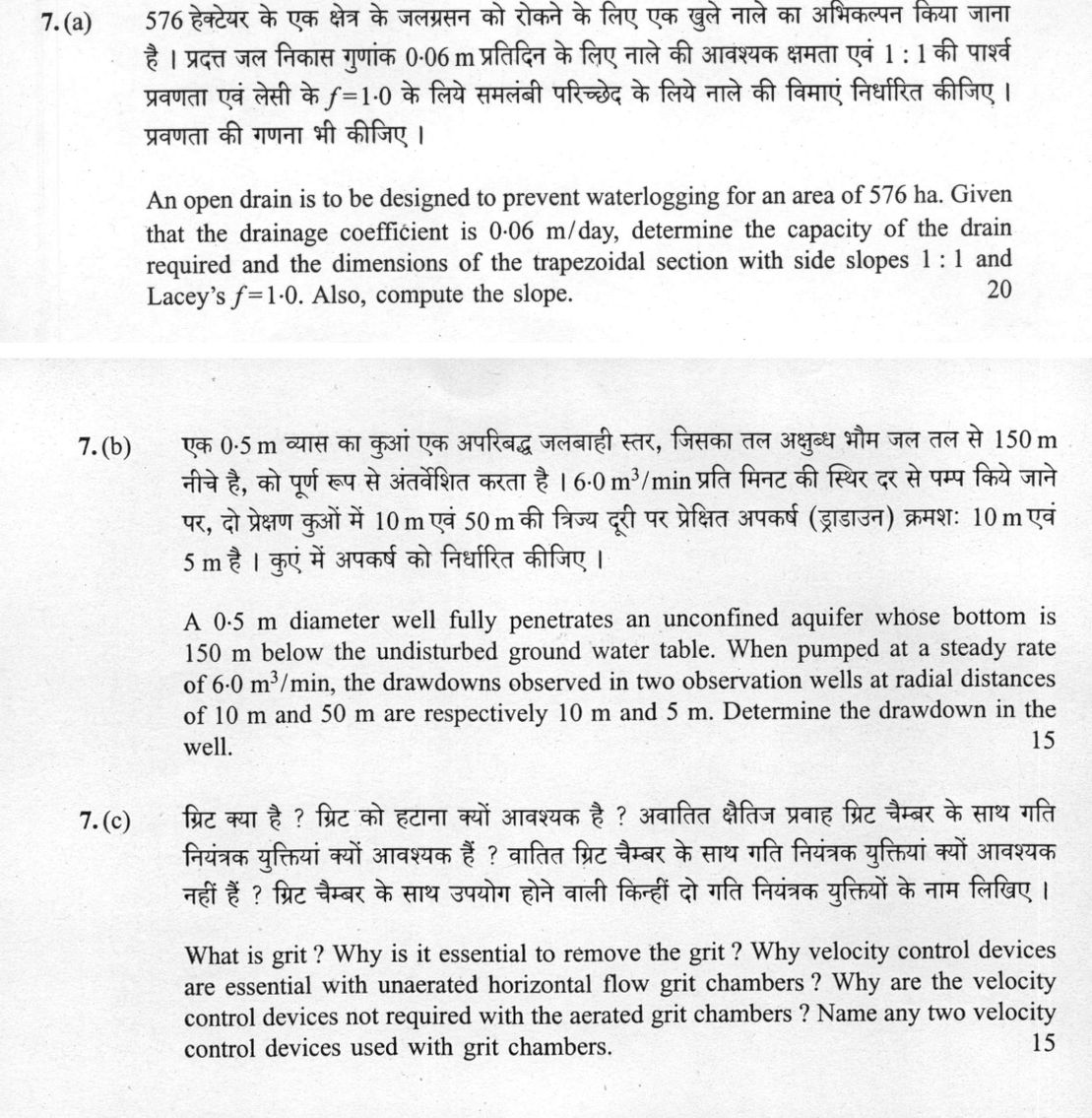
An open drain is to be designed to prevent waterlogging for an area of 576 ha. Given that the drainage coefficient is 0·06 m/day, determine the capacity of the drain required and the dimensions of the trapezoidal section with side slopes 1 : 1 and Lacey's f=1·0. Also, compute the slope. 20 marks
A 0·5 m diameter well fully penetrates an unconfined aquifer whose bottom is 150 m below the undisturbed ground water table. When pumped at a steady rate of 6·0 m³/min, the drawdowns observed in two observation wells at radial distances of 10 m and 50 m are respectively 10 m and 5 m. Determine the drawdown in the well. 15 marks
What is grit ? Why is it essential to remove the grit ? Why velocity control devices are essential with unaerated horizontal flow grit chambers ? Why are the velocity control devices not required with the aerated grit chambers ? Name any two velocity control devices used with grit chambers. 15 marks
हिंदी में प्रश्न पढ़ें
576 हेक्टेयर के एक क्षेत्र के जलप्रसन को रोकने के लिए एक खुले नाले का अभिकल्पन किया जाना है । प्रदत्त जल निकास गुणांक 0·06 m प्रतिदिन के लिए नाले की आवश्यक क्षमता एवं 1 : 1 की पार्श्व प्रवणता एवं लेसी के f=1·0 के लिये समलंबी परिच्छेद के लिये नाले की विमाएं निर्धारित कीजिए । प्रवणता की गणना भी कीजिए । (20 अंक)
एक 0·5 m व्यास का कुआँ एक अपरिबद्ध जलबाही स्तर, जिसका तल अक्षुण्भ भौम जल तल से 150 m नीचे है, को पूर्ण रूप से अंतर्वेशित करता है। 6·0 m³/min प्रति मिनट की स्थिर दर से पम्प किये जाने पर, दो प्रेक्षण कुओं में 10 m एवं 50 m की त्रिज्य दूरी पर प्रेक्षित अपकर्ष (ड्राडाउन) क्रमशः 10 m एवं 5 m है। कुएँ में अपकर्ष को निर्धारित कीजिए । (15 अंक)
ग्रिट क्या है ? ग्रिट को हटाना क्यों आवश्यक है ? अवातित क्षैतिज प्रवाह ग्रिट चैम्बर के साथ गति नियंत्रक युक्तियाँ क्यों आवश्यक हैं ? वातित ग्रिट चैम्बर के साथ गति नियंत्रक युक्तियाँ क्यों आवश्यक नहीं हैं ? ग्रिट चैम्बर के साथ उपयोग होने वाली किन्हीं दो गति नियंत्रक युक्तियों के नाम लिखिए । (15 अंक)
Model answer
Written by UPSC Answer Check against this question's marking rubric, to the expected length. UPSC does not publish answers for Mains — this is one way to score well, not an official key.
(a)
Drainage coefficient = 0.06 m/day. Area = 576 ha = 576 × 10⁴ m² = 5.76 × 10⁶ m².
Capacity required: Q = area × drainage coefficient = 5.76 × 10⁶ × 0.06 = 3.456 × 10⁵ m³/day Q = 3.456 × 10⁵ / 86400 = 4.00 m³/s.
Using Lacey’s regime equations with f = 1.0:
V = (Q f² / 140)^(1/6) = (4 × 1 / 140)^(1/6) = (1/35)^(1/6) = 0.5529 m/s. A = Q / V = 4 / 0.5529 = 7.234 m². P = 4.75 √Q = 4.75 × 2 = 9.50 m. R = A / P = 7.234 / 9.50 = 0.7615 m.
For a trapezoidal section with side slopes 1:1, let bed width = b, depth = y. A = b y + y². P = b + 2√2 y.
From P: b = 9.50 − 2√2 y.
Substituting in A: (9.50 − 2√2 y)y + y² = 7.234 9.50 y − (2√2 − 1)y² = 7.234 1.8284 y² − 9.50 y + 7.234 = 0.
Solving: y = [9.50 − √(9.50² − 4 × 1.8284 × 7.234)] / (2 × 1.8284) = 0.927 m. The other root gives negative bed width, so it is rejected.
Then: b = 9.50 − 2.8284 × 0.927 = 6.878 m.
Thus:
- Bed width = 6.88 m
- Flow depth = 0.927 m
- Top width = b + 2y = 6.878 + 1.854 = 8.73 m
Slope by Lacey’s equation: S = f^(5/3) / (3340 Q^(1/6)) = 1 / (3340 × 4^(1/6)) S = 1 / (3340 × 1.2599) = 0.0002376 = 1 in 4208.
So, capacity = 4.00 m³/s, slope = 2.38 × 10⁻⁴, i.e. 1 in 4208. Valid for a Lacey regime channel; add freeboard separately as per design practice.
(b)
Use the Dupuit–Thiem equation for steady radial flow to a fully penetrating well in an unconfined aquifer: Q = πK(h₂² − h₁²) / ln(r₂/r₁).
Given: Q = 6.0 m³/min = 0.10 m³/s. Aquifer thickness H = 150 m.
At r₁ = 10 m, drawdown s₁ = 10 m, so h₁ = 150 − 10 = 140 m. At r₂ = 50 m, drawdown s₂ = 5 m, so h₂ = 150 − 5 = 145 m.
ln(r₂/r₁) = ln(50/10) = ln 5 = 1.6094. h₂² − h₁² = 145² − 140² = 21025 − 19600 = 1425 m².
Thus: K = Q ln 5 / [π(h₂² − h₁²)] K = 0.10 × 1.6094 / (π × 1425) = 3.595 × 10⁻⁵ m/s.
Well radius rw = 0.5 / 2 = 0.25 m.
Using the well and the first observation well: Q = πK(h₁² − hw²) / ln(r₁/rw).
So: h₁² − hw² = (h₂² − h₁²) × ln(r₁/rw) / ln(r₂/r₁) = 1425 × ln(10/0.25) / ln 5 = 1425 × ln 40 / 1.6094 = 1425 × 3.6889 / 1.6094 = 3266.14 m².
Therefore: hw² = 140² − 3266.14 = 19600 − 3266.14 = 16333.86 m² hw = √16333.86 = 127.804 m.
Drawdown in the well: sw = H − hw = 150 − 127.804 = 22.196 m ≈ 22.2 m.
Final: drawdown in the well = 22.2 m. Assumptions: steady, homogeneous isotropic unconfined aquifer, no recharge, fully penetrating well, Dupuit assumptions.
(c)
- Grit is the inert, dense, abrasive mineral matter present in sewage, such as sand, gravel, cinders, eggshells and bone chips. It generally has specific gravity about 2.5–2.65 and particle size above about 0.2 mm.
- Grit must be removed because it:
- abrades and wears pumps, valves, pipes and other mechanical equipment;
- settles in channels, pipelines, sumps and digesters, reducing capacity and causing blockages;
- contaminates sludge, making sludge handling and digestion more difficult;
- increases maintenance, cleaning and energy costs;
- can damage downstream treatment units.
- Velocity control devices are essential with unaerated horizontal-flow grit chambers because the horizontal velocity must remain nearly constant, usually about 0.3 m/s. If velocity is too high, grit does not settle; if too low, organic solids settle with grit, causing septicity and odour. Since sewage flow varies diurnally, a fixed channel section cannot maintain the required velocity. Hence velocity control devices adjust the velocity over the flow range.
- Velocity control devices are not required with aerated grit chambers because compressed air creates a spiral rolling motion. The air supply can be adjusted to maintain agitation and velocity independent of flow variation. The rolling motion keeps organic matter in suspension while heavier grit settles at the bottom.
- Two velocity control devices used with grit chambers: Sutro proportional weir and Parshall flume.
What "Solve" is asking you to do
Choose the method, then carry it through to a final answer. Identifying what kind of problem this is and why that method applies is the first thing marked; a correct figure arrived at invisibly earns almost nothing.
Structure that answers it
Given data and what is required → method chosen, with the reason it applies → set-up (equation, circuit, free body, trial balance) → working, step by step → answer with units and any condition of validity
Where marks are lost
Doing the middle steps mentally and writing only the result. In mathematics papers, a further loss comes from giving a decimal where the exact value in surds or fractions was wanted, or from skipping the justification a part explicitly asks for.
How this answer will be evaluated
Approach
(a) calculate: given > formula > substitution > result with units > interpretation | (b) calculate: given > formula > substitution > result with units > interpretation | (c) explain: definition/context > points in order > small example > short close Full marks: All parts show complete working with correct formulas, units, and assumptions; part (c) clearly distinguishes chamber types.
Key points expected
- Calculate discharge Q from area and drainage coefficient
- Apply Lacey's equations for wetted perimeter and hydraulic mean depth
- Solve for trapezoidal dimensions (b, d) with 1:1 side slopes
- Compute bed slope S using Lacey's formula
- Identify aquifer type as unconfined (Dupuit assumption)
- Use formula: Q = πK[(h2²-h1²)/(ln(r2/r1))]
- Calculate hydraulic conductivity K from given data
- Determine drawdown in the well (r=0.25m)
Evaluation rubric
Each sub-part is marked on its own, against the marks and word limit printed on the paper.
- (a) Determine drain capacity, trapezoidal dimensions, and slope using Lacey's theory. 20 marks
calculate— given → formula → substitution → result with units → interpretation
Must cover
- Calculate discharge Q from area and drainage coefficient
- Apply Lacey's equations for wetted perimeter and hydraulic mean depth
- Solve for trapezoidal dimensions (b, d) with 1:1 side slopes
- Compute bed slope S using Lacey's formula
Loses marks
- Omitting the calculation of bed slope S
- Using Manning's equation instead of Lacey's
- Ignoring the 1:1 side slope in area calculation
Earns more
- Explicitly state Lacey's silt factor f=1.0
- Show unit conversions (ha to m², day to sec)
- Verify hydraulic radius R = A/P consistency
Extra mark
- Sketch of trapezoidal section with labelled dimensions
- (b) Determine drawdown in the well using the Theis equation for unconfined aquifers. 15 marks
calculate— given → formula → substitution → result with units → interpretation
Must cover
- Identify aquifer type as unconfined (Dupuit assumption)
- Use formula: Q = πK[(h2²-h1²)/(ln(r2/r1))]
- Calculate hydraulic conductivity K from given data
- Determine drawdown in the well (r=0.25m)
Loses marks
- Using confined aquifer formula (h instead of h²)
- Incorrect substitution of well radius (0.5m vs 0.25m)
- Failing to convert units consistently
Earns more
- State assumption of steady-state flow
- Show calculation of K with units (m/min or m/day)
- Verify r2 > r1 in logarithmic term
Extra mark
- Sketch of aquifer cross-section with observation wells
- (c) Define grit, explain removal necessity, and contrast velocity control in aerated vs unaerated chambers. 15 marks
explain— definition/context → points in order → small example → short close
Must cover
- Define grit as inorganic particles (sand, gravel) >0.21mm
- Explain grit removal to prevent pump/pipe abrasion
- Explain velocity control in unaerated chambers (settle grit, not organics)
- Explain why aerated chambers don't need velocity control
Loses marks
- Confusing grit with organic matter
- Failing to explain why velocity control is needed
- Not distinguishing aerated from unaerated operation
Earns more
- Name two velocity control devices (e.g., V-notch, weir)
- Mention grit removal efficiency target (>90%)
- Distinguish grit from organic solids
Extra mark
- Sketch of aerated vs unaerated grit chamber
Practice this exact question
Write your answer and it is marked point by point against the model answer above — what you covered, what you missed, what you got wrong.
Evaluate my answer →More from Civil Engineering 2021 Paper II
- Q4 (a) Design the size and spacing of dowel bars at the expansion joints of a cement concret…
- Q5 (a) A one-hour unit hydrograph of a catchment is shown in the figure. A storm of two hour…
- Q6 (a) Two settling tanks – one rectangular, with length to width ratio of 3 : 1 and side wa…
- Q7 (a) An open drain is to be designed to prevent waterlogging for an area of 576 ha. Given…
- Q8 (a) From the basin map of a given watershed with drainage area 3000 km², the length of th…