Paper I — Q1
(a) A rod shown in the figure below is subjected to a force of 95 kN. Determine the diameter d of the portion ②, if the stress…
A rod shown in the figure below is subjected to a force of 95 kN. Determine the diameter d of the portion ②, if the stress there is not to exceed 115 N/mm². Also, determine the axial deformation of the rod. Use E = 205 GPa : 10 marks
A reinforced concrete beam of 250 mm × 500 mm is reinforced with 3 nos. 16 mm dia bars as tension reinforcement. The nominal cover to the reinforcement is 30 mm and diameter of stirrups is 8 mm. Calculate the moment of resistance of the beam. Use M20 and Fe500. Adopt limit state method of design. 10 marks
A three-hinged parabolic arch of uniform cross-section has a span of 60 m and a central rise of 10 m. It is subjected to a UDL of intensity 15 kN/m covering the whole span. Show that the bending moment is zero at any cross-section of the arch. 10 marks
Use Castigliano's theorems and determine the vertical displacement of point C of the beam shown in the figure below. Take E = 210 GPa and I = 150×10⁶ mm⁴ : 10 marks
A vertical member of a truss consisting of an angle section ISA 75×75×8 of E250 grade is welded to a 10 mm thick gusset plate. The factored tensile and compressive forces in the member are 100 kN and 90 kN respectively. Design the weld connection (shop weld) having weld size of 4 mm; only two sides of the angle are welded. Cᵧ = Cᵤ = 21·4 mm for ISA 75×75×8. 10 marks
हिंदी में प्रश्न पढ़ें
नीचे चित्र में दर्शाई गई एक छड़ पर 95 kN का एक बल लगा है। भाग ② का व्यास d ज्ञात कीजिए, यदि इसमें प्रतिबल 115 N/mm² से अधिक नहीं हो। छड़ का अक्षीय विरूपण भी ज्ञात कीजिए। E = 205 GPa का उपयोग कीजिए : (10 अंक)
एक 250 mm × 500 mm की प्रबलित कंक्रीट धरन को तनन प्रबलन के लिए 16 mm व्यास वाली तीन छड़ों द्वारा प्रबलित किया गया है। प्रबलन का अभिहित आवरण 30 mm है एवं वलयकों का व्यास 8 mm है। धरन के प्रतिरोध-आघूर्ण की गणना कीजिए। M20 एवं Fe500 का उपयोग कीजिए। अभिकल्पना की सीमांत अवस्था विधि का उपयोग कीजिए। (10 अंक)
एकसमान अनुप्रस्थ परिच्छेद वाली एक त्रि-कब्जीय परवलयिक डाट की विस्तृति 60 m एवं मध्य उत्थान 10 m है। इसकी पूरी विस्तृति पर 15 kN/m तीव्रता का एकसमान वितरित भार लगा है। दर्शाइए कि डाट के किसी भी अनुप्रस्थ परिच्छेद पर बंकन आघूर्ण शून्य है। (10 अंक)
कास्टिग्लियानो के प्रमेयों का उपयोग करके नीचे चित्र में दर्शाई गई धरन के बिंदु C पर उद्वधर विस्थापन को निर्धारित कीजिए। E = 210 GPa एवं I = 150×10⁶ mm⁴ लीजिए : (10 अंक)
E250 ग्रेड के एक कोण परिच्छेद ISA 75×75×8 से बना एक कैंची का उद्वधर अवयव 10 mm मोटी गसेट प्लेट से वेल्डित है। अवयव में गुणित तनन एवं संपीडन बल क्रमशः: 100 kN एवं 90 kN हैं। 4 mm वेल्ड आमाप के वेल्ड जोड़ (कार्यशाला वेल्ड) की अभिकल्पना कीजिए; कोण को केवल दो तरफ से वेल्ड किया गया है। ISA 75×75×8 के लिए Cᵧ = Cᵤ = 21·4 mm. (10 अंक)
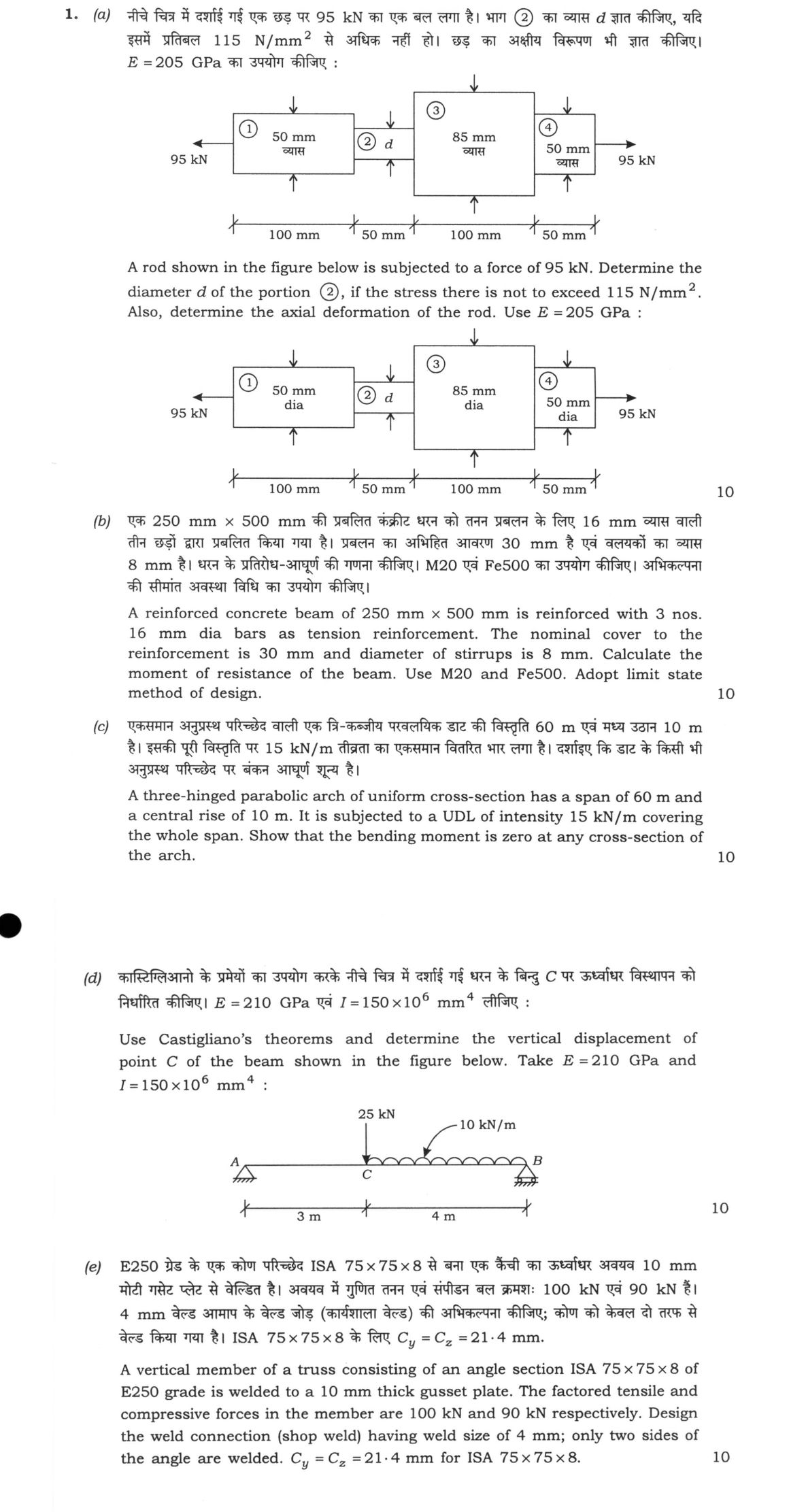
The figure this question refers to, in words
The question paper is a scan and the diagram did not survive as text. This is the figure as read from the original page — every component, value and label — so the question can be worked from the text below.
(a) A horizontal stepped rod consisting of four segments connected in series, subjected to a tensile force of 95 kN applied at both the left and right ends. The rod is divided into four sections labeled 1, 2, 3, and 4 from left to right. Section 1 has a length of 100 mm and a diameter of 50 mm. Section 2 has a length of 50 mm and a diameter labeled 'd'. Section 3 has a length of 100 mm and a diameter of 85 mm. Section 4 has a length of 50 mm and a diameter of 50 mm. The force arrows point outward from the ends, indicating tension.
(c) A cross-sectional elevation of a reinforced concrete retaining wall. The structure consists of a vertical stem and a horizontal base slab. The total height of the vertical stem is 3 m. The base slab has a thickness of 400 mm. The base slab is divided into three horizontal segments with widths of 700 mm, 250 mm, and 1300 mm, respectively. The vertical stem is positioned above the 250 mm segment of the base. The back of the wall (left side) is retained by earth. The water table (EGL) is shown at a level 1 m above the top of the base slab. The top of the wall is 2 m above the water table level. The ground surface behind the wall is level with the top of the wall.
(d) A horizontal simply supported beam with supports at the left end (point A) and the right end (point B). The total length of the beam is 7 meters. Point C is located on the beam at a distance of 3 meters from support A. A vertical downward point load of 25 kN is applied at point C. A uniformly distributed load (UDL) of 10 kN/m acts vertically downwards over the segment from point C to support B (a length of 4 meters). The dimensions are marked as 3 m between A and C, and 4 m between C and B.
What "Solve" is asking you to do
Choose the method, then carry it through to a final answer. Identifying what kind of problem this is and why that method applies is the first thing marked; a correct figure arrived at invisibly earns almost nothing.
Structure that answers it
Given data and what is required → method chosen, with the reason it applies → set-up (equation, circuit, free body, trial balance) → working, step by step → answer with units and any condition of validity
Where marks are lost
Doing the middle steps mentally and writing only the result. In mathematics papers, a further loss comes from giving a decimal where the exact value in surds or fractions was wanted, or from skipping the justification a part explicitly asks for.
How this answer will be evaluated
Approach
Framework: Civil Engineering, Paper 1. (a) calculate: given > formula > substitution > result with units > interpretation | (b) calculate: given > formula > substitution > result with units > interpretation | (c) justify: claim > 3-4 reasons > evidence > conclusion | (d) calculate: given > formula > substitution > result with units > interpretation | (e) calculate: given > formula > substitution > result with units > interpretation Full marks: All parts show complete method with correct calculations, proper units, and design checks; neat sketches where relevant.
Key points expected
- Calculate internal force in each segment via equilibrium
- Apply stress limit (115 N/mm²) to find diameter d
- Compute axial deformation using δ = PL/AE for each segment
- Sum deformations for total rod elongation
- Determine effective depth d from cover and bar diameter
- Calculate area of steel As from 3 nos. 16 mm bars
- Apply IS 456 limit state design equations for singly reinforced beam
- Compute moment of resistance Mu using M20 and Fe500
Evaluation rubric
Each sub-part is marked on its own, against the marks and word limit printed on the paper.
- (a) Determine diameter d of portion ② and total axial deformation of the rod. 10 marks
calculate— given → formula → substitution → result with units → interpretation
Must cover
- Calculate internal force in each segment via equilibrium
- Apply stress limit (115 N/mm²) to find diameter d
- Compute axial deformation using δ = PL/AE for each segment
- Sum deformations for total rod elongation
Loses marks
- Omitting internal force calculation
- Unit inconsistency (e.g., mixing kN and N)
- Final value without deformation summation
Earns more
- Correct free body diagram with internal forces
- Consistent units (kN, mm, N/mm²) throughout
- Explicit area calculation for each segment
- Final result with appropriate significant figures
Extra mark
- Neat labelled sketch of rod with dimensions
- Verification of stress in other segments
- (b) Calculate moment of resistance of the reinforced concrete beam using limit state method. 10 marks
calculate— given → formula → substitution → result with units → interpretation
Must cover
- Determine effective depth d from cover and bar diameter
- Calculate area of steel As from 3 nos. 16 mm bars
- Apply IS 456 limit state design equations for singly reinforced beam
- Compute moment of resistance Mu using M20 and Fe500
Loses marks
- Incorrect effective depth calculation
- Using working stress method instead of limit state
- Omitting check for reinforcement limits
Earns more
- Correct calculation of effective depth (500 - 30 - 8 - 8)
- Proper use of stress block parameters for M20
- Check for under/over-reinforcement
- Final Mu in kN-m with clear units
Extra mark
- Reference to IS 456:2000 clause numbers
- Sketch of beam cross-section with dimensions
- (c) Show that bending moment is zero at any cross-section of the three-hinged parabolic arch. 10 marks
justify— claim → 3-4 reasons → evidence → conclusion
Must cover
- Derive equation of parabolic arch y = 4h x(L-x)/L²
- Calculate horizontal thrust H from equilibrium
- Show that M(x) = M_simple - H·y = 0 for all x
- Verify at key sections (crown, quarter points)
Loses marks
- Assuming result without derivation
- Incorrect arch equation or thrust calculation
- Failing to show M(x) = 0 algebraically
Earns more
- Correct calculation of reactions at supports
- Clear derivation of horizontal thrust H = wL²/8h
- Algebraic proof that M(x) vanishes identically
- Physical interpretation of parabolic shape
Extra mark
- Sketch of arch with loading and reactions
- Mention of practical significance (pure compression)
- (d) Determine vertical displacement of point C using Castigliano's theorem. 10 marks
calculate— given → formula → substitution → result with units → interpretation
Must cover
- Apply unit load method or Castigliano's first theorem
- Calculate bending moment M(x) in each segment
- Compute ∫(M·∂M/∂P)dx/EI over entire beam
- Substitute E = 210 GPa and I = 150×10⁶ mm⁴
Loses marks
- Incorrect moment expressions in segments
- Unit conversion errors (GPa to N/mm²)
- Omitting one segment in integration
Earns more
- Correct free body diagram with reactions
- Proper segmentation at point C (3m and 4m)
- Accurate integration of moment expressions
- Final displacement in mm with correct sign
Extra mark
- Neat sketch of beam with loading and point C
- Verification using alternative method (e.g., virtual work)
- (e) Design the weld connection for the angle section with 4 mm weld size. 10 marks
calculate— given → formula → substitution → result with units → interpretation
Must cover
- Calculate weld strength per mm length for 4 mm shop weld
- Determine required weld length for 100 kN tension
- Distribute weld length using Cy = 21.4 mm for two-sided weld
- Check compressive capacity for 90 kN
Loses marks
- Incorrect weld strength formula
- Ignoring Cy for force distribution
- Omitting compressive force check
Earns more
- Correct weld strength calculation (0.7×s×fu/√3×γmw)
- Proper use of Cy for force distribution
- Check for block shear or other failure modes
- Final weld layout with lengths on each side
Extra mark
- Reference to IS 800:2007 weld design clauses
- Sketch of angle section with weld locations
Model answer coming soon
Every evaluation on this site is marked against a verified model answer. This question's answer is still being written; evaluation opens the moment it lands.
More from Civil Engineering 2022 Paper I
- Q1 (a) A rod shown in the figure below is subjected to a force of 95 kN. Determine the diame…
- Q2 (a) Determine the forces in all the members of a pin-jointed truss shown in the figure be…
- Q3 (a) (i) A simple girder of 20 m span is traversed by a moving uniformly distributed load…
- Q4 (a) Find the maximum load P, which the bracket as shown can transmit. The bolt strength o…