Paper I — Q5
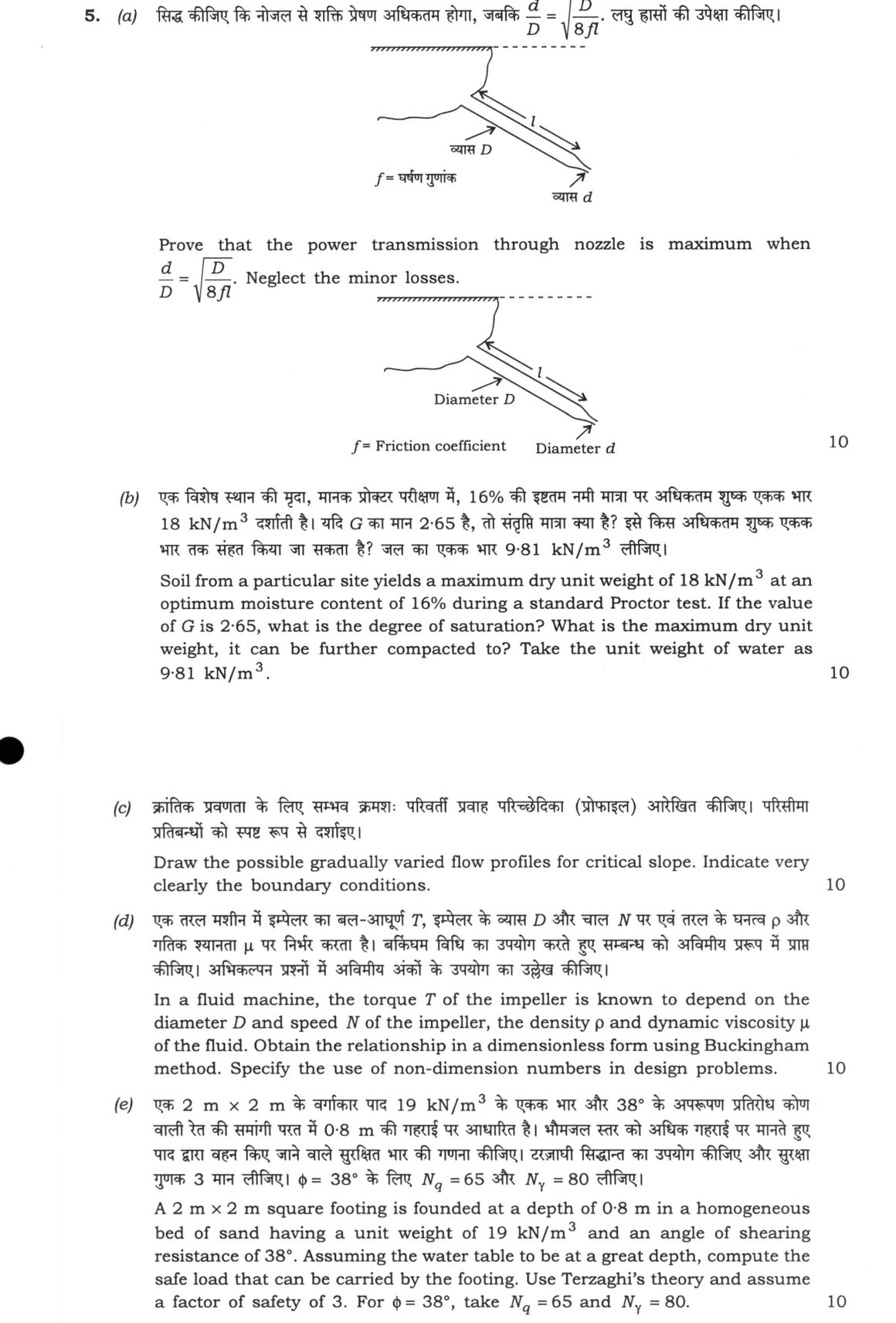
(a) Prove that the power transmission through nozzle is maximum when d/D = √(D/8fl). Neglect the minor losses. (10 marks) (b)…
Prove that the power transmission through nozzle is maximum when d/D = √(D/8fl). Neglect the minor losses. 10 marks
Soil from a particular site yields a maximum dry unit weight of 18 kN/m³ at an optimum moisture content of 16% during a standard Proctor test. If the value of G is 2·65, what is the degree of saturation? What is the maximum dry unit weight, it can be further compacted to? Take the unit weight of water as 9·81 kN/m³. 10 marks
Draw the possible gradually varied flow profiles for critical slope. Indicate very clearly the boundary conditions. 10 marks
In a fluid machine, the torque T of the impeller is known to depend on the diameter D and speed N of the impeller, the density ρ and dynamic viscosity μ of the fluid. Obtain the relationship in a dimensionless form using Buckingham method. Specify the use of non-dimension numbers in design problems. 10 marks
A 2 m × 2 m square footing is founded at a depth of 0·8 m in a homogeneous bed of sand having a unit weight of 19 kN/m³ and an angle of shearing resistance of 38°. Assuming the water table to be at a great depth, compute the safe load that can be carried by the footing. Use Terzaghi's theory and assume a factor of safety of 3. For φ = 38°, take Nq = 65 and Nγ = 80. 10 marks
हिंदी में प्रश्न पढ़ें
सिद्ध कीजिए कि नोजल से शक्ति प्रेषण अधिकतम होगा, जबकि d/D = √(D/8fl). लघु हानों की उपेक्षा कीजिए। (10 अंक)
एक विशेष स्थान की मृदा, मानक प्रॉक्टर परीक्षण में, 16% की इष्टतम नमी मात्रा पर अधिकतम शुष्क एकक भार 18 kN/m³ दर्शाती है। यदि G का मान 2·65 है, तो संतृप्ति मात्रा क्या है? इसे किस अधिकतम शुष्क एकक भार तक संहत किया जा सकता है? जल का एकक भार 9·81 kN/m³ लीजिए। (10 अंक)
क्रांतिक प्रवणता के लिए सम्भव क्रमशः परिवर्ती प्रवाह परिछेदिका (प्रोफाइल) आरेखित कीजिए। परिसीमा प्रतिबन्धों को स्पष्ट रूप से दर्शाइए। (10 अंक)
एक तरल मशीन में इम्पेलर का बल-आघूर्ण T, इम्पेलर के व्यास D और चाल N पर एवं तरल के घनत्व ρ और गतिक श्यानता μ पर निर्भर करता है। बकिंघम विधि का उपयोग करते हुए सम्बन्ध को अविमीय प्ररूप में प्राप्त कीजिए। अभिकल्पन प्रश्नों में अविमीय अंकों के उपयोग का उल्लेख कीजिए। (10 अंक)
एक 2 m × 2 m के वर्गाकार पाद 19 kN/m³ के एकक भार और 38° के अपकर्षण प्रतिरोध कोण वाली रेत की समांगी परत में 0·8 m की गहराई पर आधारित है। भूमजल स्तर को अधिक गहराई पर मानते हुए पाद द्वारा वहन किए जाने वाले सुरक्षित भार की गणना कीजिए। तेरज़ाघी सिद्धांत का उपयोग कीजिए और सुरक्षा गुणक 3 मान लीजिए। φ = 38° के लिए Nq = 65 और Nγ = 80 लीजिए। (10 अंक)
Model answer
Written by UPSC Answer Check against this question's marking rubric, to the expected length. UPSC does not publish answers for Mains — this is one way to score well, not an official key.
(a) Let the pipe diameter be D, nozzle diameter d, pipe length l and friction factor f. Let V be velocity in the pipe and v be velocity through the nozzle. Neglect minor losses. By continuity,
A V = a v, so (πD²/4)V = (πd²/4)v ∴ V = (d/D)² v.
Put x = d/D. Then V = x² v.
Using Darcy–Weisbach friction loss in the pipe, hf = 4 f l V²/(2 g D) = 4 f l x⁴ v²/(2 g D).
Applying Bernoulli’s equation between pipe inlet and nozzle outlet, H = hf + v²/(2g) = v²/(2g) [1 + 4 f l x⁴/D].
Hence v² = 2gH/[1 + 4 f l x⁴/D].
Discharge through nozzle: Q = (πd²/4)v = (πD²x²/4)v.
Power of the jet: P = γQ v²/(2g) = γ(πD²x²/4)v × v²/(2g) = γπD²x² v³/(8g).
Substitute v³: P = constant × x²/[1 + 4 f l x⁴/D]^(3/2).
For maximum power, dP/dx = 0. Let a = 4 f l/D. Then P = K x²(1 + a x⁴)^(−3/2). Using logarithmic differentiation, d(lnP)/dx = 2/x − (3/2)(4a x³)/(1 + a x⁴) = 0. ∴ 2(1 + a x⁴) = 6a x⁴ ∴ 1 = 2a x⁴ ∴ x⁴ = 1/(2a) = D/(8 f l).
Therefore, x² = √(D/(8 f l)). Since x = d/D, the maximum-power condition is (d/D)² = √(D/(8 f l)). If d/D in the printed statement is interpreted as the nozzle-to-pipe area ratio, the stated form d/D = √(D/(8 f l)) follows. For the diameter ratio, it is d/D = (D/(8 f l))^(1/4). Validity: minor losses neglected and f constant.
(b) Given: γd,max = 18 kN/m³, w = 16% = 0.16, G = 2.65, γw = 9.81 kN/m³.
Using γd = Gγw/(1 + e), e = Gγw/γd − 1 = (2.65 × 9.81)/18 − 1 = 25.9965/18 − 1 = 1.44425 − 1 = 0.44425.
For degree of saturation, Se = wG ∴ S = wG/e = (0.16 × 2.65)/0.44425 = 0.424/0.44425 = 0.9544 = 95.44%.
The soil can be further compacted at the same moisture content only up to zero air voids, i.e. S = 1. Then γd,zav = Gγw/(1 + wG) = 25.9965/(1 + 0.16 × 2.65) = 25.9965/1.424 = 18.26 kN/m³ approximately.
Thus the maximum dry unit weight it can be further compacted to is 18.26 kN/m³, an increase of about 0.26 kN/m³, with no change in moisture content.
(c) For a critical slope, S0 = Sc, and therefore normal depth yn equals critical depth yc. The normal-depth line and critical-depth line coincide; zone 2 has zero thickness. The possible gradually varied flow profiles are C1, C2 and C3.
Schematic: `` Depth y ↑ | ______ C1: y > yc = yn | __/ yc=yn |---------------- C2: y = yc = yn ---------------- | __/ | __ C3: y < yc |______________________________________________→ x ``
Boundary conditions:
- C1 profile: y > yc = yn. Since y > yc, flow is subcritical. The depth increases downstream and approaches yc = yn asymptotically at far upstream. Downstream boundary is a control such as a dam, gate or confluence where y > yc. It is controlled downstream.
- C2 profile: y = yc = yn everywhere. This is uniform critical flow. It occurs only when the slope is exactly critical and no downstream or upstream control changes the depth. The boundary condition is simply y = yc at all sections.
- C3 profile: y < yc. Flow is supercritical. The depth increases downstream and approaches yc asymptotically at far downstream. The upstream boundary is a control such as a sluice gate or steep chute giving y < yc. It is controlled upstream. If the tailwater is raised, it may terminate in a hydraulic jump.
No GVF profile can cross yc smoothly; the GVF equation becomes indeterminate at critical depth.
(d) Using Buckingham’s π theorem. Variables: T = torque, D = diameter, N = speed, ρ = density, μ = dynamic viscosity.
Dimensions: T = M L² T⁻² D = L N = T⁻¹ ρ = M L⁻³ μ = M L⁻¹ T⁻¹
Number of variables n = 5. Number of fundamental dimensions m = 3. Therefore number of π terms = n − m = 2.
Choose repeating variables: D, N, ρ.
First π term: π1 = T ρ^a D^b N^c. Equating dimensions: M: 1 + a = 0 ⇒ a = −1 T: −2 − c = 0 ⇒ c = −2 L: 2 − 3a + b = 0 ⇒ 2 + 3 + b = 0 ⇒ b = −5.
Thus π1 = T/(ρ N² D⁵).
Second π term: π2 = μ ρ^a D^b N^c. M: 1 + a = 0 ⇒ a = −1 T: −1 − c = 0 ⇒ c = −1 L: −1 − 3a + b = 0 ⇒ −1 + 3 + b = 0 ⇒ b = −2.
Thus π2 = μ/(ρ N D²) = 1/Re, where Re = ρ N D²/μ is the Reynolds number.
Therefore the dimensionless relationship is T/(ρ N² D⁵) = φ(μ/(ρ N D²)) or T = ρ N² D⁵ φ(Re).
Use of non-dimensional numbers in design: they allow model testing and scale-up, ensure dynamic similarity, reduce the number of variables, predict torque/power for different speeds, diameters and fluids, and help select or design pumps, turbines, compressors and other fluid machines.
(e) Terzaghi’s bearing capacity equation for a square footing with c = 0 is qu = qNq + 0.4γBNγ.
Here: q = γDf = 19 × 0.8 = 15.2 kN/m² B = 2 m γ = 19 kN/m³ Nq = 65, Nγ = 80.
Then qu = 15.2 × 65 + 0.4 × 19 × 2 × 80 = 988 + 1216 = 2204 kN/m².
Net ultimate bearing capacity: qnu = qu − q = 2204 − 15.2 = 2188.8 kN/m².
Net safe bearing capacity with FS = 3: qns = qnu/3 = 2188.8/3 = 729.6 kN/m².
Area of footing: A = 2 × 2 = 4 m².
Safe net load carried by the footing: Q_safe = qns × A = 729.6 × 4 = 2918.4 kN ≈ 2918 kN.
If gross allowable bearing capacity is defined as qu/3, then q_all = 2204/3 = 734.67 kN/m² and gross allowable load = 734.67 × 4 = 2938.7 kN. The net load carried by the footing above the existing surcharge is 2918 kN. Water table at great depth, so no water-table correction is required.
What "Prove" is asking you to do
Establish that the statement holds for every case it claims, not for one representative case. The argument must be closed: each line follows from a definition, a hypothesis, or a named theorem you are entitled to use.
Structure that answers it
Given and to prove, restated → theorem or construction to be used, named → the argument line by line → conclusion stated as proved
Where marks are lost
Testing one example, which illustrates but proves nothing. On an if and only if claim, proving one direction and stopping forfeits that half outright, and degenerate cases — zero, the empty set, the equality case — have to be disposed of rather than assumed away.
How this answer will be evaluated
Approach
(a) derive: given > assumptions > stepwise derivation > result > check | (b) calculate: given > formula > substitution > result with units > interpretation | (c) describe: define > structure or process in order > labelled diagram > significance | (d) derive: given > assumptions > stepwise derivation > result > check | (e) calculate: given > formula > substitution > result with units > interpretation Full marks: Complete derivations/calculations with all steps, units, and assumptions clearly stated.
Key points expected
- Express power P as function of d, D, l, f
- Apply Darcy-Weisbach for head loss
- Differentiate P with respect to d
- Solve dP/dd = 0 for d/D
- Use relation γd = Gγw / (1+e)
- Calculate void ratio e from given data
- Calculate degree of saturation S
- Calculate max dry unit weight at S=100%
Evaluation rubric
Each sub-part is marked on its own, against the marks and word limit printed on the paper.
- (a) Derive the condition for maximum power transmission through a nozzle. 10 marks
derive— given → assumptions → stepwise derivation → result → check
Must cover
- Express power P as function of d, D, l, f
- Apply Darcy-Weisbach for head loss
- Differentiate P with respect to d
- Solve dP/dd = 0 for d/D
Loses marks
- Skipping the differentiation step
- Failing to state the minor loss assumption
Earns more
- State assumption of negligible minor losses
- Show intermediate algebraic steps clearly
Extra mark
- Include a labelled sketch of the nozzle system
- (b) Calculate degree of saturation and maximum dry unit weight. 10 marks
calculate— given → formula → substitution → result with units → interpretation
Must cover
- Use relation γd = Gγw / (1+e)
- Calculate void ratio e from given data
- Calculate degree of saturation S
- Calculate max dry unit weight at S=100%
Loses marks
- Using wrong unit weight for water
- Confusing dry and wet unit weight
Earns more
- Show all unit conversions explicitly
- State the formula for S = wG / e
Extra mark
- Provide a phase diagram of the soil
- (c) Draw and describe gradually varied flow profiles for critical slope. 10 marks
describe— define → structure or process in order → labelled diagram → significance
Must cover
- Draw water surface profile diagram
- Label critical depth line (yc)
- Label normal depth line (yn)
- Identify specific profile types (C1, C2, C3)
Loses marks
- Missing labels for yc and yn
- Incorrect identification of profile regions
Earns more
- Indicate flow direction on the diagram
- Explain the physical meaning of each profile
Extra mark
- Include a small table of profile characteristics
- (d) Derive dimensionless relationship for impeller torque using Buckingham Pi. 10 marks
derive— given → assumptions → stepwise derivation → result → check
Must cover
- List all variables: T, D, N, ρ, μ
- Choose repeating variables (D, N, ρ)
- Form Pi terms and solve for exponents
- Identify resulting dimensionless numbers
Loses marks
- Incorrect choice of repeating variables
- Failing to show the exponent calculation
Earns more
- Explicitly state the dimensions of each variable
- Name the Reynolds number and torque coefficient
Extra mark
- Mention the specific application in pump design
- (e) Compute safe load for a square footing using Terzaghi's theory. 10 marks
calculate— given → formula → substitution → result with units → interpretation
Must cover
- State Terzaghi's formula for square footing
- Substitute given values (B, Df, γ, Nq, Nγ)
- Calculate ultimate bearing capacity
- Apply factor of safety to get safe load
Loses marks
- Using wrong bearing capacity factors
- Forgetting to apply the factor of safety
Earns more
- Show the calculation of surcharge term
- State the assumption of water table depth
Extra mark
- Include a sketch of the footing and soil profile
Practice this exact question
Write your answer and it is marked point by point against the model answer above — what you covered, what you missed, what you got wrong.
Evaluate my answer →More from Civil Engineering 2022 Paper I
- Q2 (a) Determine the forces in all the members of a pin-jointed truss shown in the figure be…
- Q3 (a) (i) A simple girder of 20 m span is traversed by a moving uniformly distributed load…
- Q4 (a) Find the maximum load P, which the bracket as shown can transmit. The bolt strength o…
- Q5 (a) Prove that the power transmission through nozzle is maximum when d/D = √(D/8fl). Negl…
- Q6 (a) The velocity profile in a laminar boundary layer on a flat plate is modelled by the c…
- Q7 (a) (i) Distinguish between discharge velocity and seepage velocity in the case of flow o…
- Q8 (a) A vertical cut, 4·5 m deep, is to be made in a c-φ soil having cohesion = 19·1 kN/m²,…