Paper I — Q6
(a) The velocity profile in a laminar boundary layer on a flat plate is modelled by the cubic expression μ/μ₁ = a₀ + a₁y + a₂y²…
The velocity profile in a laminar boundary layer on a flat plate is modelled by the cubic expression
μ/μ₁ = a₀ + a₁y + a₂y² + a₃y³
μ = velocity at a distance y from the surface of the plate μ₁ = main stream velocity
Evaluate all the constants in terms of boundary layer thickness. Draw the velocity distribution and stress distribution curves. Indicate the application and significance of boundary layer. If the plate is moving with a velocity of 2 m/s in positive x-direction, what will be the velocity distribution curve? 15 marks
Plot the variations of (i) total pressure, (ii) neutral stress and (iii) effective stress for a fine sand deposit, having a porosity of 40% and specific gravity of 2.7, extending to a depth of 10 m below the ground surface. The groundwater table is 5 m below the ground surface and the sand is saturated by capillary water up to a height of 1 m above the water table. The degree of saturation of the first 4 m of moist soil below the ground surface is 10%. Take the unit weight of water as 10 kN/m³. 20 marks
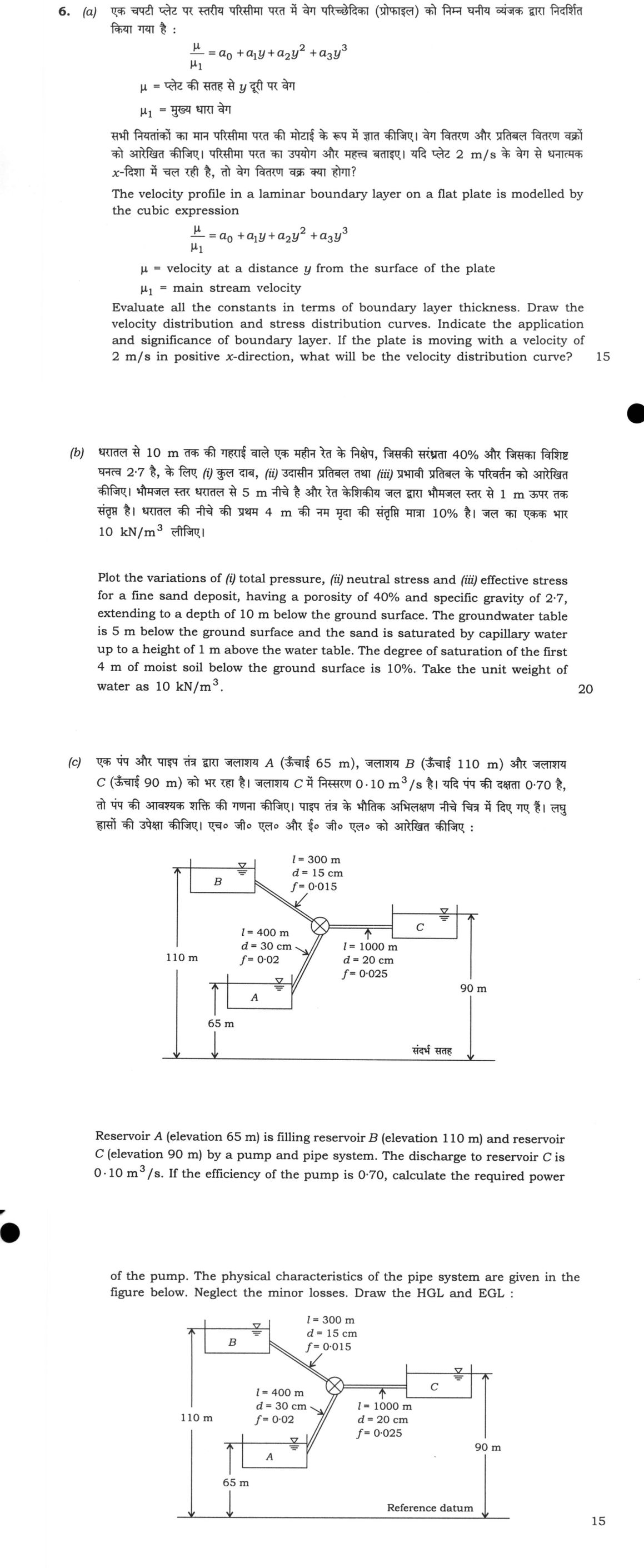
Reservoir A (elevation 65 m) is filling reservoir B (elevation 110 m) and reservoir C (elevation 90 m) by a pump and pipe system. The discharge to reservoir C is 0.10 m³/s. If the efficiency of the pump is 0.70, calculate the required power of the pump. The physical characteristics of the pipe system are given in the figure below. Neglect the minor losses. Draw the HGL and EGL : 10 marks
हिंदी में प्रश्न पढ़ें
एक चपटी प्लेट पर स्तरीय परिसीमा परत में वेग परिछेदिका (प्रोफाइल) को निम्न घनीय व्यंजक द्वारा निर्देशित किया गया है :
μ/μ₁ = a₀ + a₁y + a₂y² + a₃y³
μ = प्लेट की सतह से y दूरी पर वेग μ₁ = मुख्य धारा वेग
सभी नियतांकों का मान परिसीमा परत की मोटाई के रूप में ज्ञात कीजिए। वेग वितरण और प्रतिबल वितरण वक्रों को आरेखित कीजिए। परिसीमा परत का उपयोग और महत्व बताइए। यदि प्लेट 2 m/s के वेग से धनात्मक x-दिशा में चल रही है, तो वेग वितरण वक्र क्या होगा? (15 अंक)
धरातल से 10 m तक की गहराई वाले एक महीन रेत के निक्षेप, जिसकी संरचना 40% और जिसका विशिष्ट घनत्व 2.7 है, के लिए (i) कुल दाब, (ii) उदासीन प्रतिबल तथा (iii) प्रभावी प्रतिबल के परिवर्तन को आरेखित कीजिए। भूमजल स्तर धरातल से 5 m नीचे है और रेत केशिकीय जल द्वारा भूमजल स्तर से 1 m ऊपर तक संतृप्त है। धरातल की नीचे की प्रथम 4 m की नम मृदा की संतृप्ति मात्रा 10% है। जल का एकक भार 10 kN/m³ लीजिए। (20 अंक)
एक पंप और पाइप तंत्र द्वारा जलाशय A (ऊँचाई 65 m), जलाशय B (ऊँचाई 110 m) और जलाशय C (ऊँचाई 90 m) को भर रहा है। जलाशय C में निस्सरण 0.10 m³/s है। यदि पंप की दक्षता 0.70 है, तो पंप की आवश्यक शक्ति की गणना कीजिए। पाइप तंत्र के भौतिक अभिलक्षण नीचे चित्र में दिए गए हैं। लघु हानियों की उपेक्षा कीजिए। एच० जी० एल० और ई० जी० एल० को आरेखित कीजिए : (10 अंक)
The figure this question refers to, in words
The question paper is a scan and the diagram did not survive as text. This is the figure as read from the original page — every component, value and label — so the question can be worked from the text below.
(b) A schematic diagram of a fluid flow setup. Two parallel horizontal plates are shown. The top plate is labeled 'Plate 1' and has a velocity vector pointing to the right labeled 'V = 1 m/s'. The bottom plate is labeled 'Plate 2' and has a velocity vector pointing to the left labeled '2 m/s'. A Cartesian coordinate system is defined with the x-axis pointing to the right along the centerline between the plates and the y-axis pointing vertically upwards from the centerline. The vertical distance from the centerline to the top plate is labeled 'B/2' and the distance from the centerline to the bottom plate is labeled 'B/2'.
(c) A schematic diagram of a pipe system connecting three reservoirs (A, B, and C) via a central junction. A horizontal line at the bottom is labeled 'Reference datum'.
Reservoir A is located on the left, with its water surface elevation marked as 65 m above the datum. Reservoir B is located at the top left, with its water surface elevation marked as 110 m above the datum. Reservoir C is located on the right, with its water surface elevation marked as 90 m above the datum.
A pipe connects Reservoir A to a central junction node. The pipe is labeled with: l = 400 m, d = 30 cm, f = 0.02. A pipe connects Reservoir B to the same central junction node. The pipe is labeled with: l = 300 m, d = 15 cm, f = 0.015. A pipe connects the central junction node to Reservoir C. The pipe is labeled with: l = 1000 m, d = 20 cm, f = 0.025.
A pump symbol (a circle with an 'X' inside) is located on the pipe segment between the central junction and Reservoir C. An arrow indicates the flow direction is from the junction towards Reservoir C.
What "Solve" is asking you to do
Choose the method, then carry it through to a final answer. Identifying what kind of problem this is and why that method applies is the first thing marked; a correct figure arrived at invisibly earns almost nothing.
Structure that answers it
Given data and what is required → method chosen, with the reason it applies → set-up (equation, circuit, free body, trial balance) → working, step by step → answer with units and any condition of validity
Where marks are lost
Doing the middle steps mentally and writing only the result. In mathematics papers, a further loss comes from giving a decimal where the exact value in surds or fractions was wanted, or from skipping the justification a part explicitly asks for.
How this answer will be evaluated
Approach
(a) derive: given > assumptions > stepwise derivation > result > check | (b) calculate: given > formula > substitution > result with units > interpretation | (c) calculate: given > formula > substitution > result with units > interpretation Full marks: Complete derivations, accurate calculations, clear plots, and correct HGL/EGL diagrams.
Key points expected
- Apply boundary conditions to find a0, a1, a2, a3
- Draw velocity and stress distribution curves
- Explain application and significance of boundary layer
- Analyze effect of plate moving at 2 m/s
- Calculate unit weights for moist and saturated zones
- Determine total stress (σ) at key depths
- Determine neutral stress (u) considering capillary rise
- Plot all three stress variations against depth
Evaluation rubric
Each sub-part is marked on its own, against the marks and word limit printed on the paper.
- (a) Determine constants of cubic velocity profile and discuss boundary layer significance. 15 marks
derive— given → assumptions → stepwise derivation → result → check
Must cover
- Apply boundary conditions to find a0, a1, a2, a3
- Draw velocity and stress distribution curves
- Explain application and significance of boundary layer
- Analyze effect of plate moving at 2 m/s
Loses marks
- Missing boundary conditions for constant evaluation
- Confusing velocity and stress distribution curves
Earns more
- Correctly identifies no-slip condition at y=0
- Shows zero shear stress at y=δ
Extra mark
- Mentions Prandtl's boundary layer theory
- (b) Plot variations of total, neutral, and effective stress for the sand deposit. 20 marks
calculate— given → formula → substitution → result with units → interpretation
Must cover
- Calculate unit weights for moist and saturated zones
- Determine total stress (σ) at key depths
- Determine neutral stress (u) considering capillary rise
- Plot all three stress variations against depth
Loses marks
- Incorrect unit weight calculation for moist soil
- Ignoring capillary rise in neutral stress calculation
Earns more
- Correctly handles capillary water zone (1m above GWT)
- Accurate calculation of degree of saturation effects
Extra mark
- Labels all zones clearly on the plot
- (c) Calculate pump power and draw HGL/EGL for the pipe system. 15 marks
calculate— given → formula → substitution → result with units → interpretation
Must cover
- Calculate head loss in each pipe segment
- Determine total head required by pump
- Calculate required power using efficiency
- Draw HGL and EGL for the system
Loses marks
- Ignoring minor losses if not explicitly stated to neglect
- Incorrect head loss calculation for parallel pipes
Earns more
- Correct application of Darcy-Weisbach equation
- Accurate head loss calculation for parallel pipes
Extra mark
- Shows energy grade line dropping correctly
Model answer coming soon
Every evaluation on this site is marked against a verified model answer. This question's answer is still being written; evaluation opens the moment it lands.
More from Civil Engineering 2022 Paper I
- Q3 (a) (i) A simple girder of 20 m span is traversed by a moving uniformly distributed load…
- Q4 (a) Find the maximum load P, which the bracket as shown can transmit. The bolt strength o…
- Q5 (a) Prove that the power transmission through nozzle is maximum when d/D = √(D/8fl). Negl…
- Q6 (a) The velocity profile in a laminar boundary layer on a flat plate is modelled by the c…
- Q7 (a) (i) Distinguish between discharge velocity and seepage velocity in the case of flow o…
- Q8 (a) A vertical cut, 4·5 m deep, is to be made in a c-φ soil having cohesion = 19·1 kN/m²,…