Paper I — Q7
(a) (i) Distinguish between discharge velocity and seepage velocity in the case of flow of water through soils. 5 (ii) A soil…
Distinguish between discharge velocity and seepage velocity in the case of flow of water through soils. 5 marks
A soil sample 90 mm high and 6000 mm² in cross-section was subjected to a falling head permeability test. The head fell from 500 mm to 300 mm in 1500 seconds. The permeability of the soil was 2.4×10⁻³ mm/s. Determine the diameter of the standpipe. 10 marks
Two parallel plates are moving in opposite direction with velocities 1 m/s and 2 m/s respectively. For the given coordinate system (shown below), draw the velocity and shear stress profile for positive and negative pressure gradient after obtaining the profile equations : 20 marks
Laboratory results of a soil have shown that its unconfined compressive strength is 120 kN/m². In a triaxial compression test, a specimen of the soil when subjected to a confining pressure of 40 kN/m² failed at an additional stress of 160 kN/m². Estimate the shearing strength of the same soil along a horizontal plane at a depth of 4 m at the site. The groundwater table is at a depth of 2·5 m from the ground level. Take the dry unit weight of the soil as 17 kN/m³ and specific gravity as 2·7. Also, assume the unit weight of water as 10 kN/m³. 15 marks
हिंदी में प्रश्न पढ़ें
मृदा में जल के प्रवाह के लिए निस्सरण वेग और रिसन वेग में अंतर बताइए।
90 mm ऊँचाई और 6000 mm² अनुप्रस्थ परिच्छेद वाले एक मृदा प्रतिदर्श पर पतन दाबोच्चता पारगम्यतामापी परीक्षण किया गया। 1500 सेकंड में दाबोच्चता का पतन 500 mm से 300 mm हुआ। मृदा की पारगम्यता 2.4×10⁻³ mm/s थी। स्टैंडपाइप के व्यास को निर्धारित कीजिए।
दो समानांतर प्लेट विपरीत दिशा में क्रमशः 1 m/s और 2 m/s के वेग से चल रही हैं। परिच्छेदिका (प्रोफाइल) समीकरण प्राप्त करने के पश्चात्, धनात्मक और ऋणात्मक दाब प्रवणता के लिए, दी गई निर्देशांक पद्धति (नीचे दर्शाई गई) के लिए, वेग और अपरूपण प्रतिबल परिच्छेदिका (प्रोफाइल) अंकित कीजिए :
प्रयोगशाला परिणाम दर्शाते हैं कि एक मृदा की अपरिबद्ध संपीडन सामर्थ्य 120 kN/m² है। एक त्रि-अक्षीय संपीडन परीक्षण में, एक मृदा प्रतिदर्श जिस पर 40 kN/m² का परिरोधी दाब लगा था, वह 160 kN/m² के अतिरिक्त प्रतिबल पर विफल हो गया। स्थल की 4 m गहराई पर क्षैतिज तल पर इसी मृदा की अपरूपण सामर्थ्य का आकलन कीजिए। भूमजल स्तर, धरातल से 2·5 m नीचे है। मृदा का शुष्क एकक भार 17 kN/m³ और विशिष्ट घनत्व 2·7 लीजिए। जल का एकक भार 10 kN/m³ मान लीजिए।
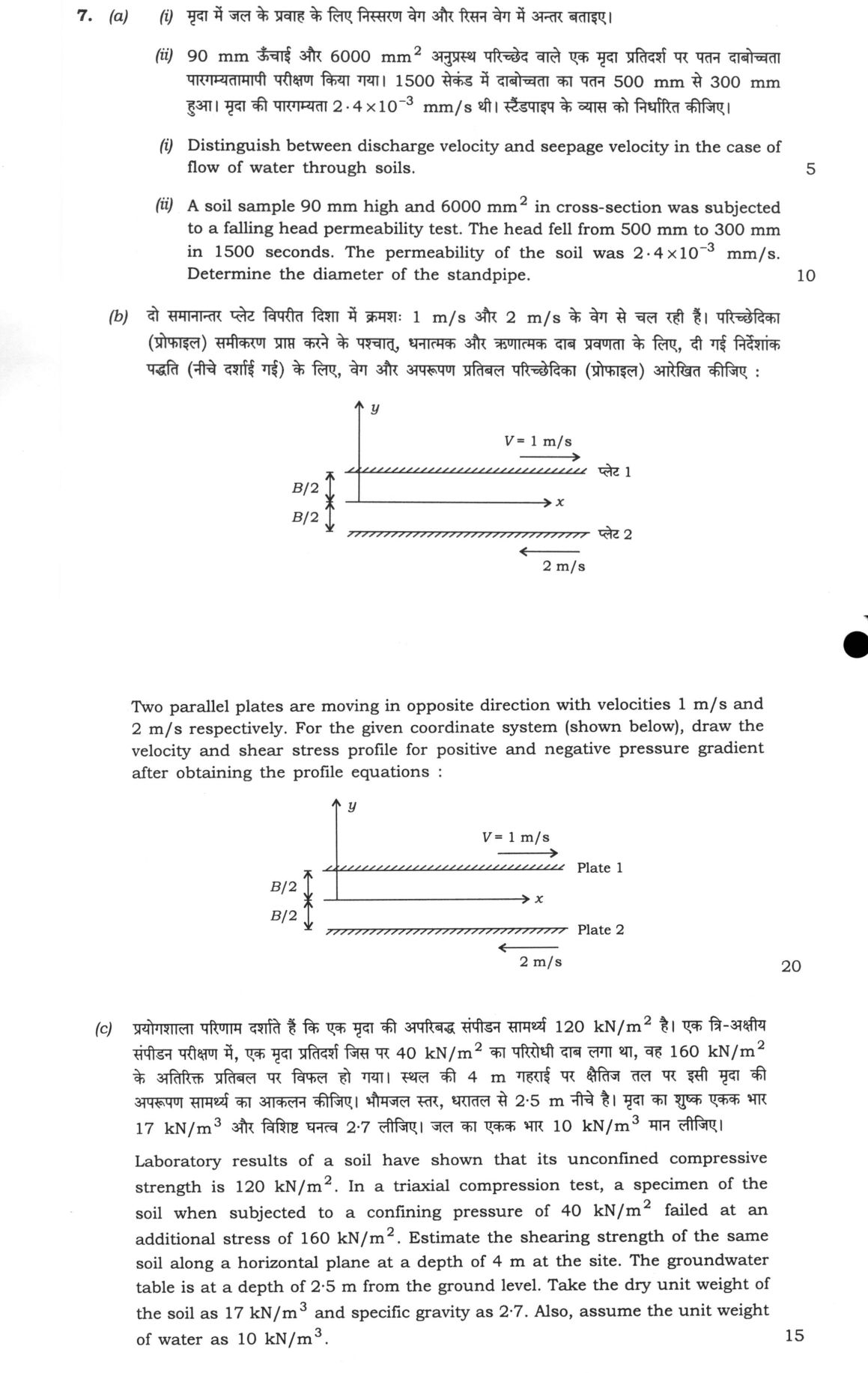
The figure this question refers to, in words
The question paper is a scan and the diagram did not survive as text. This is the figure as read from the original page — every component, value and label — so the question can be worked from the text below.
(b) A coordinate system with two parallel horizontal plates:
- The horizontal x-axis lies midway between the two plates; the vertical y-axis points upward.
- The upper plate (labelled 'प्लेट 1' / Plate 1) is located at y = +B/2 and moves to the right with velocity V = 1 m/s.
- The lower plate (labelled 'प्लेट 2' / Plate 2) is located at y = -B/2 and moves to the left with velocity 2 m/s.
- The vertical distance from the x-axis to each plate is labelled as B/2, giving a total distance of B between the plates.
(b) A schematic diagram showing two parallel horizontal plates separated by a fluid layer with a Cartesian coordinate system. The origin is located at the midpoint between the plates. The horizontal x-axis points to the right along the centerline between the plates, and the vertical y-axis points upwards. The upper plate (Plate 1) is at y = B/2 and is moving to the right with velocity V = 1 m/s. The lower plate (Plate 2) is at y = -B/2 and is moving to the left with velocity 2 m/s. The vertical distances from the x-axis to Plate 1 and Plate 2 are both marked as B/2.
Model answer
Written by UPSC Answer Check against this question's marking rubric, to the expected length. UPSC does not publish answers for Mains — this is one way to score well, not an official key.
(a)(i) Discharge velocity, or Darcy velocity, is the fictitious velocity obtained by dividing discharge by the total cross-sectional area of the soil: v = Q/A. It assumes that flow occurs through the entire area, including the solid particles. Seepage velocity is the actual average velocity of water through the void spaces: vs = Q/Av = v/n, where n is porosity. If only connected voids are considered, vs = v/ne, where ne is effective porosity. Thus vs is always greater than v. Darcy’s law is written using discharge velocity.
(a)(ii) For a falling-head permeability test: k = (a L)/(A t) ln(h0/h1)
Hence: a = k A t / [L ln(h0/h1)]
Given: k = 2.4×10⁻³ mm/s, A = 6000 mm², L = 90 mm, t = 1500 s, h0 = 500 mm, h1 = 300 mm.
h0/h1 = 500/300 = 5/3 ln(5/3) = 0.5108
a = (2.4×10⁻³ × 6000 × 1500) / (90 × 0.5108) a = 21600 / (90 × 0.5108) a = 469.83 mm²
For a standpipe of diameter d: a = πd²/4 d = √(4a/π) d = √(4 × 469.83/π) d = 24.46 mm
d ≈ 24.46 mm
(b) Let P = dp/dx. For steady, laminar, fully developed flow between parallel plates: μ d²u/dy² = P
Integrating twice: u = P y²/(2μ) + C1 y + C2
Boundary conditions from the figure: At y = B/2, u = +1 m/s. At y = −B/2, u = −2 m/s.
Let U = 3 m/s. Subtracting the two boundary conditions: C1 = U/B = (3 m/s)/B
Adding them: C2 = −0.5 m/s − P B²/(8μ)
Thus: u(y) = P/(2μ)(y² − B²/4) + (3 m/s)(y/B) − 0.5 m/s
The shear stress is: τ = μ du/dy = P y + μU/B τ(y) = P y + 3μ (m/s)/B
For P = 0, the velocity profile is linear: u0(y) = (3 m/s)(y/B) − 0.5 m/s and τ0 = 3μ (m/s)/B is constant.
For P > 0, that is pressure increasing in the +x direction:
- Velocity profile is a parabola opening upward, lying below the linear Couette profile.
- Shear stress varies linearly with y and increases with y.
- τ(−B/2) = 3μ (m/s)/B − P B/2
- τ(+B/2) = 3μ (m/s)/B + P B/2
For P < 0, that is pressure decreasing in the +x direction:
- Velocity profile is a parabola opening downward, lying above the linear Couette profile.
- Shear stress varies linearly with y and decreases with y.
- τ(−B/2) = 3μ (m/s)/B + |P| B/2
- τ(+B/2) = 3μ (m/s)/B − |P| B/2
Sketch: plot y vertically and u horizontally. Mark u = +1 m/s at y = B/2 and u = −2 m/s at y = −B/2. Draw the straight reference line. For P > 0, draw the parabola below it; for P < 0, draw the parabola above it. For shear stress, plot τ horizontally. For P > 0, the τ-line rises from lower wall to upper wall; for P < 0, it falls.
(c) Let Nφ = tan²(45° + φ/2).
Unconfined compression test: σ3 = 0, σ1 = qu = 120 kN/m². 120 = 2c tan(45° + φ/2) … (1)
Triaxial compression test: σ3 = 40 kN/m², additional stress = 160 kN/m². σ1 = 40 + 160 = 200 kN/m². 200 = 40Nφ + 2c tan(45° + φ/2) … (2)
From (1): 2c tan(45° + φ/2) = 120
Substitute in (2): 200 = 40Nφ + 120 40Nφ = 80 Nφ = 2
Thus: sin φ = (Nφ − 1)/(Nφ + 1) = (2 − 1)/(2 + 1) = 1/3 φ = arcsin(1/3) = 19.47°
Also: tan(45° + φ/2) = √2 c = 120/(2√2) = 30√2 = 42.43 kN/m²
Now: tan φ = 1/(2√2) = √2/4 = 0.3536
At the site: e = (Gs γw)/γd − 1 e = (2.7 × 10)/17 − 1 e = 10/17 = 0.5882
n = e/(1 + e) = 10/27
γsat = γd + nγw γsat = 17 + (10/27) × 10 γsat = 559/27 = 20.704 kN/m³
Effective vertical stress at depth 4 m: σ′v = 17 × 2.5 + (γsat − 10) × 1.5 σ′v = 42.5 + (559/27 − 10) × 1.5 σ′v = 42.5 + (289/27) × 1.5 σ′v = 42.5 + 289/18 σ′v = 527/9 = 58.556 kN/m²
Shearing strength on a horizontal plane: τf = c + σ′v tan φ τf = 30√2 + (527/9)(√2/4) τf = 30√2 + 527√2/36 τf = (1080√2 + 527√2)/36 τf = 1607√2/36 τf = 63.13 kN/m²
τf ≈ 63.13 kN/m²
What "Solve" is asking you to do
Choose the method, then carry it through to a final answer. Identifying what kind of problem this is and why that method applies is the first thing marked; a correct figure arrived at invisibly earns almost nothing.
Structure that answers it
Given data and what is required → method chosen, with the reason it applies → set-up (equation, circuit, free body, trial balance) → working, step by step → answer with units and any condition of validity
Where marks are lost
Doing the middle steps mentally and writing only the result. In mathematics papers, a further loss comes from giving a decimal where the exact value in surds or fractions was wanted, or from skipping the justification a part explicitly asks for.
How this answer will be evaluated
Approach
(a(i)) compare: paired headings or table > key differences > significance > conclusion | (a(ii)) calculate: given > formula > substitution > result with units > interpretation | (b) derive: given > assumptions > stepwise derivation > result > check | (c) calculate: given > formula > substitution > result with units > interpretation Full marks: Complete derivations with all steps, correct units, and clear diagrams
Key points expected
- Define discharge velocity as flow rate per total area
- Define seepage velocity as flow rate per void area
- State relationship $v_s = v/n$ where n is porosity
- Note seepage velocity is greater than discharge velocity
- State falling head permeability formula
- List given values: L, A, h1, h2, t, k
- Rearrange formula to solve for standpipe area
- Calculate diameter from area with units
Evaluation rubric
Each sub-part is marked on its own, against the marks and word limit printed on the paper.
- (a(i)) Distinguish discharge velocity from seepage velocity in soil flow. 5 marks
compare— paired headings or table → key differences → significance → conclusion
Must cover
- Define discharge velocity as flow rate per total area
- Define seepage velocity as flow rate per void area
- State relationship $v_s = v/n$ where n is porosity
- Note seepage velocity is greater than discharge velocity
Loses marks
- Confusing the two definitions
- Omitting the porosity relationship
Earns more
- Mention Darcy's law context
- Note seepage velocity is actual particle velocity
Extra mark
- Provide numerical example of the difference
- (a(ii)) Determine standpipe diameter from falling head test data. 10 marks
calculate— given → formula → substitution → result with units → interpretation
Must cover
- State falling head permeability formula
- List given values: L, A, h1, h2, t, k
- Rearrange formula to solve for standpipe area
- Calculate diameter from area with units
Loses marks
- Using constant head formula instead
- Arithmetic error in logarithm calculation
Earns more
- Show step-by-step substitution
- Verify units consistency throughout
Extra mark
- Check result against typical standpipe sizes
- (b) Derive and draw velocity and shear stress profiles for moving plates. 20 marks
derive— given → assumptions → stepwise derivation → result → check
Must cover
- State Navier-Stokes equation for this flow
- Apply boundary conditions at both plates
- Derive velocity profile equation for both gradients
- Derive shear stress profile equation
Loses marks
- Incorrect boundary conditions
- Missing one of the two gradient cases
Earns more
- Draw labelled velocity profile diagrams
- Draw labelled shear stress profile diagrams
- Show positive and negative gradient cases separately
- Identify zero-shear location if applicable
Extra mark
- Calculate numerical values for specific B
- (c) Estimate shearing strength at 4 m depth using Mohr-Coulomb. 15 marks
calculate— given → formula → substitution → result with units → interpretation
Must cover
- Determine c and φ from triaxial test data
- Calculate effective stress at 4 m depth
- Apply Mohr-Coulomb failure criterion
- Compute shear strength with units
Loses marks
- Using total stress instead of effective
- Incorrect unit weight below water table
Earns more
- Show pore pressure calculation
- Draw Mohr circle for clarity
- State assumptions about soil behavior
Extra mark
- Verify against unconfined compressive strength
Practice this exact question
Write your answer and it is marked point by point against the model answer above — what you covered, what you missed, what you got wrong.
Evaluate my answer →More from Civil Engineering 2022 Paper I
- Q4 (a) Find the maximum load P, which the bracket as shown can transmit. The bolt strength o…
- Q5 (a) Prove that the power transmission through nozzle is maximum when d/D = √(D/8fl). Negl…
- Q6 (a) The velocity profile in a laminar boundary layer on a flat plate is modelled by the c…
- Q7 (a) (i) Distinguish between discharge velocity and seepage velocity in the case of flow o…
- Q8 (a) A vertical cut, 4·5 m deep, is to be made in a c-φ soil having cohesion = 19·1 kN/m²,…