Paper I — Q4
(a) Find the maximum load P, which the bracket as shown can transmit. The bolt strength of 20 mm dia and 8·8 grade is assumed to…
Find the maximum load P, which the bracket as shown can transmit. The bolt strength of 20 mm dia and 8·8 grade is assumed to be 82 kN, considering shear and bearing under limit state method. 15 marks
A continuous beam ABC has span AB = 6 m and BC = 6 m and carries a uniformly distributed load of 25 kN/m covering both the spans AB and BC. Supports A and C are simple supports. If the load factor is 1·75 and the shape factor is 1·144 for the I-section, determine the section modulus required. Use the yield stress for the material as 245 MPa. 15 marks
Design the vertical stem of a reinforced concrete retaining wall as shown below. The angle of repose of the earth is 30° and its density is 18 kN/m³. Use M25 grade of concrete and Fe500 grade of steel. The wall is safe against stability. Detail the reinforcement in the stem only.
Given:
| M_u/bd² | 1·5 | 1·6 | 1·7 | 1·8 | 1·9 | 2·0 | 2·1 | 2·2 | 2·3 | 2·4 | 2·5 |
|---|---|---|---|---|---|---|---|---|---|---|---|
| p_t | 0·373 | 0·40 | 0·427 | 0·455 | 0·484 | 0·512 | 0·541 | 0·571 | 0·601 | 0·631 | 0·662 |
Assume nominal cover to reinforcement as 50 mm. Curtailment of bars is not required.
Given:
| τ_c (MPa) | 0·36 | 0·49 | 0·57 | 0·64 | 0·70 | 0·74 | 0·78 | 0·82 | 0·85 | 0·88 | |
|---|---|---|---|---|---|---|---|---|---|---|---|
| p_t | 0·25 | 0·5 | 0·75 | 1·0 | 1·25 | 1·5 | 1·75 | 2·0 | 2·25 | 2·5 | (20 marks) |
हिंदी में प्रश्न पढ़ें
अधिकतम भार P ज्ञात कीजिए, जिसे दर्शाया गया ब्रैकेट प्रेषित कर सकता है। सीमांत अवस्था विधि में अपरूपण और धारण के लिए 20 mm व्यास वाले तथा 8·8 ग्रेड के बोल्ट की सामर्थ्य को 82 kN माना गया है। (15 अंक)
एक सतत धरन ABC, विस्तृति AB = 6 m और BC = 6 m, AB तथा BC दोनों की पूरी विस्तृति पर 25 kN/m का एकसमान वितरित भार वहन करती है। आलम्ब A और C शुद्ध आलम्ब हैं। यदि I-परिच्छेद के लिए भार गुणक 1·75 और आकार गुणक 1·144 है, तो आवश्यक परिच्छेद मापांक निर्धारित कीजिए। पदार्थ के लिए प्रारंभ प्रतिबल 245 MPa का उपयोग कीजिए। (15 अंक)
दर्शाए अनुसार प्रबलित कंक्रीट की प्रतिधारक भित्ति के उद्व पट्ट का अभिकल्प कीजिए। मृदा का विश्राम-कोण 30° और इसका घनत्व 18 kN/m³ है। M25 ग्रेड कंक्रीट और Fe500 ग्रेड इस्पात का उपयोग कीजिए। भित्ति स्थायित्व के विरुद्ध सुरक्षित है। प्रबलन का विवरण केवल उद्व पट्ट के लिए दीजिए।
प्रदत :
| M_u/bd² | 1.5 | 1.6 | 1.7 | 1.8 | 1.9 | 2.0 | 2.1 | 2.2 | 2.3 | 2.4 | 2.5 |
|---|---|---|---|---|---|---|---|---|---|---|---|
| p_t | 0.373 | 0.40 | 0.427 | 0.455 | 0.484 | 0.512 | 0.541 | 0.571 | 0.601 | 0.631 | 0.662 |
प्रबलन का अभीष्ट आवरण 50 mm मान लीजिए। छड़ों के छिन्नीकरण की आवश्यकता नहीं है।
प्रदत :
| τ_c (MPa) | 0.36 | 0.49 | 0.57 | 0.64 | 0.70 | 0.74 | 0.78 | 0.82 | 0.85 | 0.88 | |
|---|---|---|---|---|---|---|---|---|---|---|---|
| p_t | 0.25 | 0.5 | 0.75 | 1.0 | 1.25 | 1.5 | 1.75 | 2.0 | 2.25 | 2.5 | (20 अंक) |
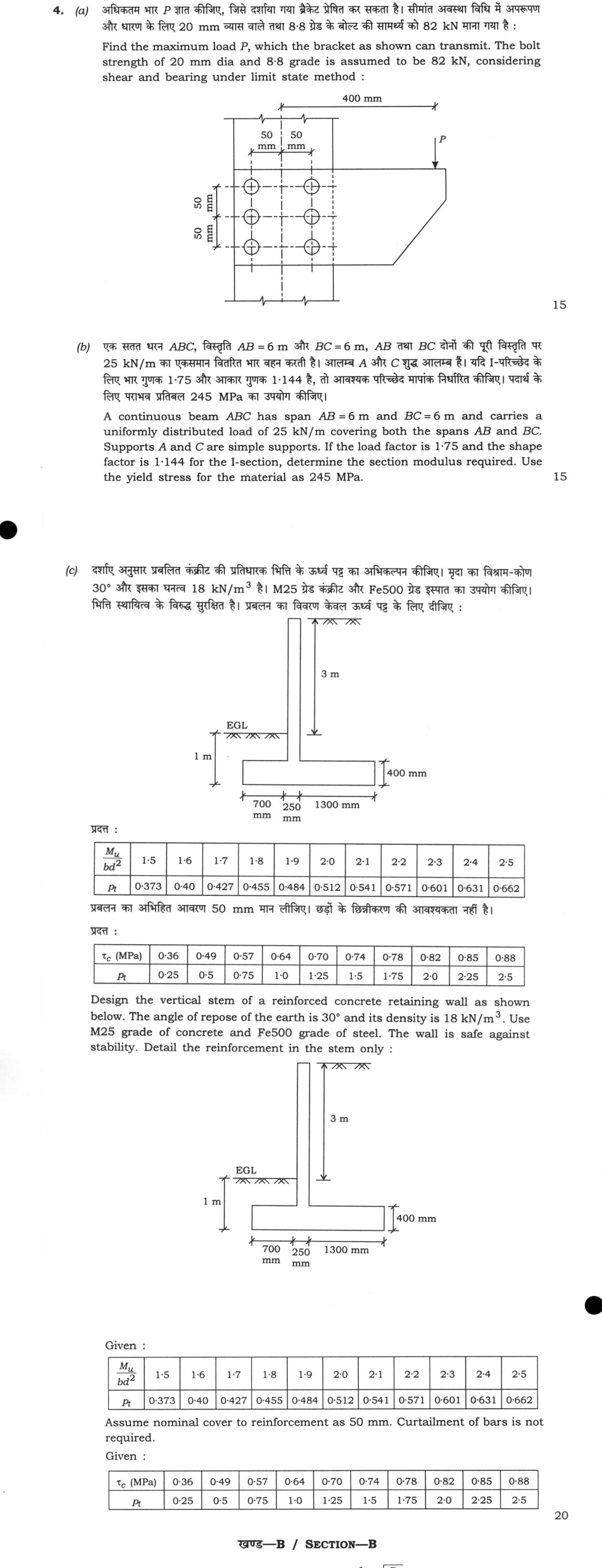
The figure this question refers to, in words
The question paper is a scan and the diagram did not survive as text. This is the figure as read from the original page — every component, value and label — so the question can be worked from the text below.
(a) A schematic diagram of a bracket connection. A vertical plate is attached to a vertical support on the left side. The bracket extends horizontally to the right. A vertical downward force labeled 'P' is applied at the far right end of the bracket. The total horizontal length of the bracket is dimensioned as 400 mm. The connection is secured by six bolts arranged in a rectangular grid of 2 columns and 3 rows. The horizontal spacing between the two columns of bolts is 50 mm. The vertical spacing between the three rows of bolts is 50 mm. The bolts are depicted as circles with a cross inside.
(c) A cross-sectional diagram of a reinforced concrete retaining wall. The structure consists of a vertical stem and a horizontal base slab. The total height of the vertical stem is 3 m. The base slab has a thickness of 400 mm. The base slab extends 700 mm to the left of the stem and 1300 mm to the right. The width of the vertical stem is 250 mm. A horizontal line labeled 'EGL' (Earth Ground Level) is shown on the left side, located 1 m above the top surface of the base slab. The ground surface on the right side is level with the top of the base slab.
Model answer
Written by UPSC Answer Check against this question's marking rubric, to the expected length. UPSC does not publish answers for Mains — this is one way to score well, not an official key.
(a) Use the eccentric bolt-group method. Take the bolt-group centroid as origin. The six bolts are at x = ±25 mm and y = -50, 0, +50 mm. Hence Σr² = 2(25²) + 4(25² + 50²) = 13750 mm². The 400 mm dimension is the eccentricity e of P from the centroid, so M = P e = 400P kN·mm. Direct shear in each bolt = P/6 kN. For a clockwise moment, torsional components are F_x = M y/Σr² and F_y = -M x/Σr². The critical bolts are the upper and lower bolts of the right-hand column (x = +25 mm, |y| = 50 mm): F_x = 400P×50/13750 = 1.4545P kN, and the vertical component is P/6 + 400P×25/13750 = 0.1667P + 0.7273P = 0.8940P kN. The left-column bolts have the torsional vertical component opposing the direct shear, so they are less critical. Thus R = P√(1.4545² + 0.8940²) = 1.707P kN. The given 82 kN is the resultant shear/bearing capacity of one bolt, so 1.707P ≤ 82 kN. P_max = 82/1.707 ≈ 48.0 kN.
(b) Use plastic collapse by virtual work. Factored load w_u = 1.75×25 = 43.75 kN/m. The simple supports A and C cannot develop moment, so the governing mechanism has plastic hinges at support B and at the midspan of one span. Let the rotation at B be θ; the midspan hinge rotation is 2θ. The maximum deflection under the UDL is (L/2)θ, so external work = w_u L × (Lθ/4) = w_u L²θ/4. Internal work = M_p θ + M_p(2θ) = 3M_pθ. Equating gives M_p = w_u L²/12 = 43.75×6²/12 = 131.25 kN·m. Required plastic section modulus Z_p = M_p/f_y = 131.25×10⁶ N·mm / 245 N/mm² = 535.7×10³ mm³ = 535.7 cm³. Shape factor SF = Z_p/S, therefore the elastic section modulus is S = Z_p/SF = 535.7/1.144 = 468.3 cm³. Required elastic section modulus S ≈ 468 cm³; corresponding plastic modulus Z_p ≈ 536 cm³.
(c) The retained height read from the figure is H = 4 m. Use Rankine active pressure for a vertical stem with horizontal backfill and φ = 30°. K_a = tan²(45° - φ/2) = tan²30° = 1/3. Pressure at the base p_a = K_a γ H = (1/3)×18×4 = 24 kN/m². Per metre length of wall, base shear V = 0.5 p_a H = 0.5×24×4 = 48 kN/m, and base moment M = V×H/3 = 48×4/3 = 64 kN·m/m. No separate load factor is specified for the earth load, so the computed earth moment is used with the supplied ultimate-strength table. The stem is designed as a cantilever slab of thickness t = 250 mm and unit width b = 1000 mm. The tension face is the face away from the earth. With 50 mm cover and 12 mm main bars, d = 250 - 50 - 6 = 194 mm. M_u/bd² = 64×10⁶/(1000×194²) = 1.70 N/mm². From the given table, p_t at 1.7 is 0.427% and at 1.8 is 0.455%; interpolation gives p_t,req ≈ 0.427%. Required A_st = (0.427/100)×1000×194 = 828 mm²/m. Provide 12 mm bars at 125 mm c/c on the tension face: A_st = (π/4)×12²×1000/125 = 905 mm²/m, p_t = 0.466%. Spacing is less than 300 mm and less than 3d, and it exceeds the 0.12% minimum. Shear check: τ_v = V/(bd) = 48×10³/(1000×194) = 0.247 MPa. Interpolating τ_c for p_t = 0.466% between 0.25% and 0.5% gives τ_c = 0.36 + (0.466 - 0.25)/(0.5 - 0.25)×(0.49 - 0.36) = 0.472 MPa. Since τ_v < τ_c, no shear reinforcement is needed. Provide vertical distribution bars 10 mm at 250 mm c/c on both faces; area per face = (π/4)×10²×1000/250 = 314 mm²/m, total 628 mm²/m, greater than 0.12%×1000×250 = 300 mm²/m. Curtailment is not required. Stem reinforcement: main horizontal 12 mm @125 c/c on the face away from the earth, full height; vertical distribution 10 mm @250 c/c on both faces.
What "Solve" is asking you to do
Choose the method, then carry it through to a final answer. Identifying what kind of problem this is and why that method applies is the first thing marked; a correct figure arrived at invisibly earns almost nothing.
Structure that answers it
Given data and what is required → method chosen, with the reason it applies → set-up (equation, circuit, free body, trial balance) → working, step by step → answer with units and any condition of validity
Where marks are lost
Doing the middle steps mentally and writing only the result. In mathematics papers, a further loss comes from giving a decimal where the exact value in surds or fractions was wanted, or from skipping the justification a part explicitly asks for.
How this answer will be evaluated
Approach
Framework: Civil Engineering, Paper 1. (a) calculate: given > formula > substitution > result with units > interpretation | (b) calculate: given > formula > substitution > result with units > interpretation | (c) calculate: given > formula > substitution > result with units > interpretation Full marks: Complete method with all checks, units, and code references
Key points expected
- Locate centroid of 6-bolt group
- Calculate primary and secondary shear forces
- Compute resultant force on critical bolt
- Equate resultant to 82 kN to find P
- Determine maximum design moment (factored load)
- Apply load factor 1.75 to UDL
- Use shape factor 1.144 in plastic moment calc
- Calculate Zp = Mu / fy
Evaluation rubric
Each sub-part is marked on its own, against the marks and word limit printed on the paper.
- (a) Maximum load P the bracket can transmit 15 marks
calculate— given → formula → substitution → result with units → interpretation
Must cover
- Locate centroid of 6-bolt group
- Calculate primary and secondary shear forces
- Compute resultant force on critical bolt
- Equate resultant to 82 kN to find P
Loses marks
- Ignoring secondary shear due to eccentricity
- Incorrect identification of critical bolt
- Missing units in force calculations
Earns more
- Neat sketch of bolt group with dimensions
- Explicit calculation of moment of inertia of group
- Verification of bearing strength if applicable
Extra mark
- Reference to IS 800:2007 clause for bolt strength
- (b) Required section modulus for the continuous beam 15 marks
calculate— given → formula → substitution → result with units → interpretation
Must cover
- Determine maximum design moment (factored load)
- Apply load factor 1.75 to UDL
- Use shape factor 1.144 in plastic moment calc
- Calculate Zp = Mu / fy
Loses marks
- Using service load instead of factored load
- Ignoring shape factor in calculation
- Incorrect moment for continuous beam
Earns more
- Correct moment distribution for continuous beam
- Clear BMD or moment calculation steps
- Explicit statement of design moment value
Extra mark
- Reference to IS 800:2007 for plastic design
- (c) Reinforcement design for vertical stem of retaining wall 20 marks
calculate— given → formula → substitution → result with units → interpretation
Must cover
- Calculate active earth pressure at base
- Determine design moment at critical section
- Use Mu/bd² table to find pt
- Calculate Ast and provide bar details
Loses marks
- Incorrect earth pressure calculation
- Ignoring nominal cover in effective depth
- Not checking minimum reinforcement
Earns more
- Correct calculation of earth pressure coefficient
- Proper use of given design tables
- Check for minimum reinforcement
- Shear check using τc table
Extra mark
- Reference to IS 456:2000 for RC design
- Neat sketch of reinforcement layout
Practice this exact question
Write your answer and it is marked point by point against the model answer above — what you covered, what you missed, what you got wrong.
Evaluate my answer →More from Civil Engineering 2022 Paper I
- Q1 (a) A rod shown in the figure below is subjected to a force of 95 kN. Determine the diame…
- Q2 (a) Determine the forces in all the members of a pin-jointed truss shown in the figure be…
- Q3 (a) (i) A simple girder of 20 m span is traversed by a moving uniformly distributed load…
- Q4 (a) Find the maximum load P, which the bracket as shown can transmit. The bolt strength o…
- Q5 (a) Prove that the power transmission through nozzle is maximum when d/D = √(D/8fl). Negl…
- Q6 (a) The velocity profile in a laminar boundary layer on a flat plate is modelled by the c…
- Q7 (a) (i) Distinguish between discharge velocity and seepage velocity in the case of flow o…