Paper I — Q3
(a) (i) A simple girder of 20 m span is traversed by a moving uniformly distributed load of 6 m long with an intensity of 2 kN/m…
A simple girder of 20 m span is traversed by a moving uniformly distributed load of 6 m long with an intensity of 2 kN/m, from left to right. Determine the maximum bending moment and shear force at 4 m distant section from the left support. Also, determine the absolute maximum bending moment that may occur anywhere in the girder. 10 marks
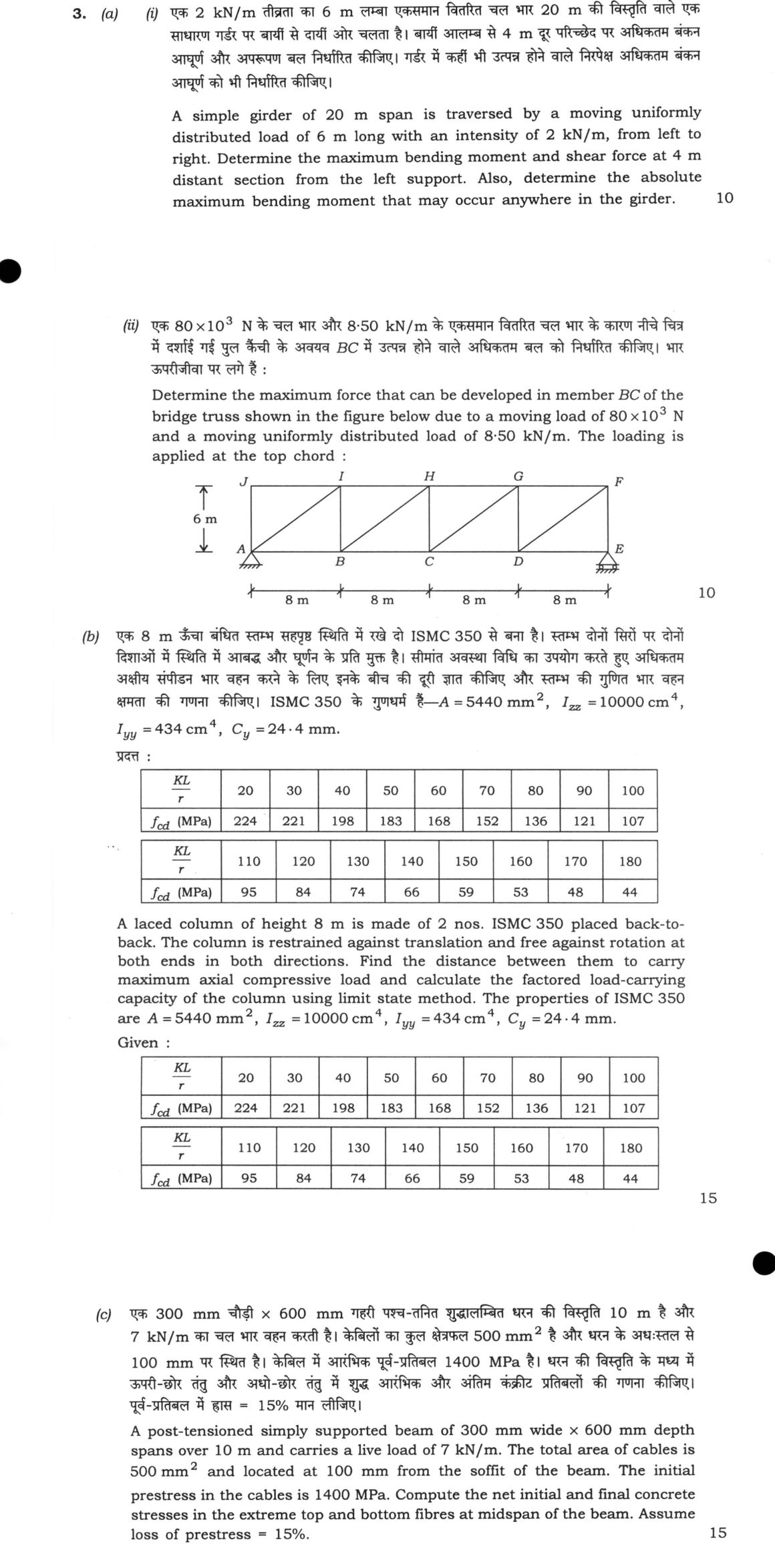
Determine the maximum force that can be developed in member BC of the bridge truss shown in the figure below due to a moving load of 80×10³ N and a moving uniformly distributed load of 8·50 kN/m. The loading is applied at the top chord. 10 marks
A laced column of height 8 m is made of 2 nos. ISMC 350 placed back-to-back. The column is restrained against translation and free against rotation at both ends in both directions. Find the distance between them to carry maximum axial compressive load and calculate the factored load-carrying capacity of the column using limit state method. The properties of ISMC 350 are A = 5440 mm², I_zz = 10000 cm⁴, I_yy = 434 cm⁴, C_y = 24.4 mm.
Given:
| KL/r | 20 | 30 | 40 | 50 | 60 | 70 | 80 | 90 | 100 |
|---|---|---|---|---|---|---|---|---|---|
| f_cd (MPa) | 224 | 221 | 198 | 183 | 168 | 152 | 136 | 121 | 107 |
| KL/r | 110 | 120 | 130 | 140 | 150 | 160 | 170 | 180 | |
|---|---|---|---|---|---|---|---|---|---|
| f_cd (MPa) | 95 | 84 | 74 | 66 | 59 | 53 | 48 | 44 | (15 marks) |
A post-tensioned simply supported beam of 300 mm wide × 600 mm depth spans over 10 m and carries a live load of 7 kN/m. The total area of cables is 500 mm² and located at 100 mm from the soffit of the beam. The initial prestress in the cables is 1400 MPa. Compute the net initial and final concrete stresses in the extreme top and bottom fibres at midspan of the beam. Assume loss of prestress = 15%. 15 marks
हिंदी में प्रश्न पढ़ें
एक 2 kN/m तीव्रता का 6 m लम्बा एकसमान विस्तृत चल भार 20 m की विस्तृति वाले एक साधारण गर्डर पर बायीं से दायीं ओर चलता है। बायीं आलम्ब से 4 m दूर परिच्छेद पर अधिकतम बंकन आघूर्ण और अपरूपण बल निर्धारित कीजिए। गर्डर में कहीं भी उत्पन्न होने वाले निरपेक्ष अधिकतम बंकन आघूर्ण को भी निर्धारित कीजिए। (10 अंक)
एक 80×10³ N के चल भार और 8·50 kN/m के एकसमान वितरित चल भार के कारण नीचे चित्र में दर्शाई गई पुल ट्रस के अवयव BC में उत्पन्न होने वाले अधिकतम बल को निर्धारित कीजिए। भार उपरीजीवा पर लगे हैं। (10 अंक)
एक 8 m ऊँचा बंधित स्तंभ सहपृष्ठ स्थिति में रखे दो ISMC 350 से बना है। स्तंभ दोनों सिरों पर दोनों दिशाओं में स्थिति में आबद्ध और घूर्णन के प्रति मुक्त है। सीमान्त अवस्था विधि का उपयोग करते हुए अधिकतम अक्षीय संपीडन भार वहन करने के लिए इनके बीच की दूरी ज्ञात कीजिए और स्तंभ की गुणित भार वहन क्षमता की गणना कीजिए। ISMC 350 के गुणधर्म हैं—A = 5440 mm², I_zz = 10000 cm⁴, I_yy = 434 cm⁴, C_y = 24·4 mm।
प्रदत :
| KL/r | 20 | 30 | 40 | 50 | 60 | 70 | 80 | 90 | 100 |
|---|---|---|---|---|---|---|---|---|---|
| f_cd (MPa) | 224 | 221 | 198 | 183 | 168 | 152 | 136 | 121 | 107 |
| KL/r | 110 | 120 | 130 | 140 | 150 | 160 | 170 | 180 | |
|---|---|---|---|---|---|---|---|---|---|
| f_cd (MPa) | 95 | 84 | 74 | 66 | 59 | 53 | 48 | 44 | (15 अंक) |
एक 300 mm चौड़ी × 600 mm गहरी पश्च-तानित शुद्धालम्बित धरन की विस्तृति 10 m है और 7 kN/m का चल भार वहन करती है। केबिलों का कुल क्षेत्रफल 500 mm² है और धरन के अधःस्तल से 100 mm पर स्थित है। केबिल में आरंभिक पूर्व-प्रतिबल 1400 MPa है। धरन की विस्तृति के मध्य में ऊपरी-छोर तंतु और अधो-छोर तंतु में शुद्ध आरंभिक और अंतिम कंक्रीट प्रतिबलों की गणना कीजिए। पूर्व-प्रतिबल में ह्रास = 15% मान लीजिए। (15 अंक)
The figure this question refers to, in words
The question paper is a scan and the diagram did not survive as text. This is the figure as read from the original page — every component, value and label — so the question can be worked from the text below.
(c) A cross-sectional diagram of a reinforced concrete retaining wall. The wall consists of a vertical stem and a horizontal base slab. The total height of the vertical stem is 3 m. The base slab has a thickness of 400 mm. The base slab is divided into three horizontal sections with widths of 700 mm, 250 mm, and 1300 mm, respectively. The vertical stem is positioned above the 250 mm section of the base. On the left side of the stem, there is a soil fill with a height of 1 m from the base level. The top of this soil fill is marked as 'EGL' (Earth Ground Level). The top of the wall is open to the sky.
What "Solve" is asking you to do
Choose the method, then carry it through to a final answer. Identifying what kind of problem this is and why that method applies is the first thing marked; a correct figure arrived at invisibly earns almost nothing.
Structure that answers it
Given data and what is required → method chosen, with the reason it applies → set-up (equation, circuit, free body, trial balance) → working, step by step → answer with units and any condition of validity
Where marks are lost
Doing the middle steps mentally and writing only the result. In mathematics papers, a further loss comes from giving a decimal where the exact value in surds or fractions was wanted, or from skipping the justification a part explicitly asks for.
How this answer will be evaluated
Approach
(a(i)) calculate: given > formula > substitution > result with units > interpretation | (a(ii)) calculate: given > formula > substitution > result with units > interpretation | (b) calculate: given > formula > substitution > result with units > interpretation | (c) calculate: given > formula > substitution > result with units > interpretation Full marks: All parts solved with correct methods, clear diagrams, and accurate calculations.
Key points expected
- Influence line diagrams for SF and BM at 4m
- Positioning of 6m UDL for max SF at 4m
- Positioning of 6m UDL for max BM at 4m
- Calculation of absolute maximum BM
- Influence line diagram for force in member BC
- Calculation for 80 kN moving point load
- Calculation for 8.50 kN/m moving UDL
- Summation of effects for maximum force
Evaluation rubric
Each sub-part is marked on its own, against the marks and word limit printed on the paper.
- (a(i)) Max BM and SF at 4m section and absolute max BM for a 20m girder with a 6m UDL. 10 marks
calculate— given → formula → substitution → result with units → interpretation
Must cover
- Influence line diagrams for SF and BM at 4m
- Positioning of 6m UDL for max SF at 4m
- Positioning of 6m UDL for max BM at 4m
- Calculation of absolute maximum BM
Loses marks
- Missing influence line diagrams
- Incorrect load placement for maxima
- Final values without working
Earns more
- Correct application of Muller-Breslau principle
- Clear sketch of load positions
- Units carried through all steps
Extra mark
- Verification of absolute max BM location
- (a(ii)) Max force in member BC of a bridge truss due to moving point and UDL loads. 10 marks
calculate— given → formula → substitution → result with units → interpretation
Must cover
- Influence line diagram for force in member BC
- Calculation for 80 kN moving point load
- Calculation for 8.50 kN/m moving UDL
- Summation of effects for maximum force
Loses marks
- Incorrect influence line shape
- Ignoring the UDL component
- No units in final answer
Earns more
- Correct identification of truss panel
- Accurate area calculation for UDL
- Clear labeling of truss joints
Extra mark
- Check for tension vs compression
- (b) Distance between ISMC 350 channels and factored load capacity of a laced column. 15 marks
calculate— given → formula → substitution → result with units → interpretation
Must cover
- Calculation of effective slenderness ratio KL/r
- Determination of distance for max load
- Interpolation of f_cd from the provided table
- Calculation of factored load-carrying capacity
Loses marks
- Incorrect slenderness ratio calculation
- Failure to use the provided table
- Missing units in final capacity
Earns more
- Correct use of limit state method
- Accurate calculation of radius of gyration
- Clear statement of assumptions
Extra mark
- Reference to specific IS code clauses
- (c) Net initial and final concrete stresses in a post-tensioned beam at midspan. 15 marks
calculate— given → formula → substitution → result with units → interpretation
Must cover
- Calculation of prestress loss (15%)
- Determination of net prestress force
- Calculation of stresses due to prestress
- Calculation of stresses due to live load
Loses marks
- Ignoring prestress loss
- Incorrect stress distribution calculation
- Missing units in final stresses
Earns more
- Correct application of section properties
- Clear separation of initial and final stresses
- Accurate calculation of eccentricity
Extra mark
- Check for cracking or failure
Model answer coming soon
Every evaluation on this site is marked against a verified model answer. This question's answer is still being written; evaluation opens the moment it lands.
More from Civil Engineering 2022 Paper I
- Q1 (a) A rod shown in the figure below is subjected to a force of 95 kN. Determine the diame…
- Q2 (a) Determine the forces in all the members of a pin-jointed truss shown in the figure be…
- Q3 (a) (i) A simple girder of 20 m span is traversed by a moving uniformly distributed load…
- Q4 (a) Find the maximum load P, which the bracket as shown can transmit. The bolt strength o…
- Q5 (a) Prove that the power transmission through nozzle is maximum when d/D = √(D/8fl). Negl…
- Q6 (a) The velocity profile in a laminar boundary layer on a flat plate is modelled by the c…