Paper I — Q8
(a) A vertical cut, 4·5 m deep, is to be made in a c-φ soil having cohesion = 19·1 kN/m², angle of internal friction = 16° and…
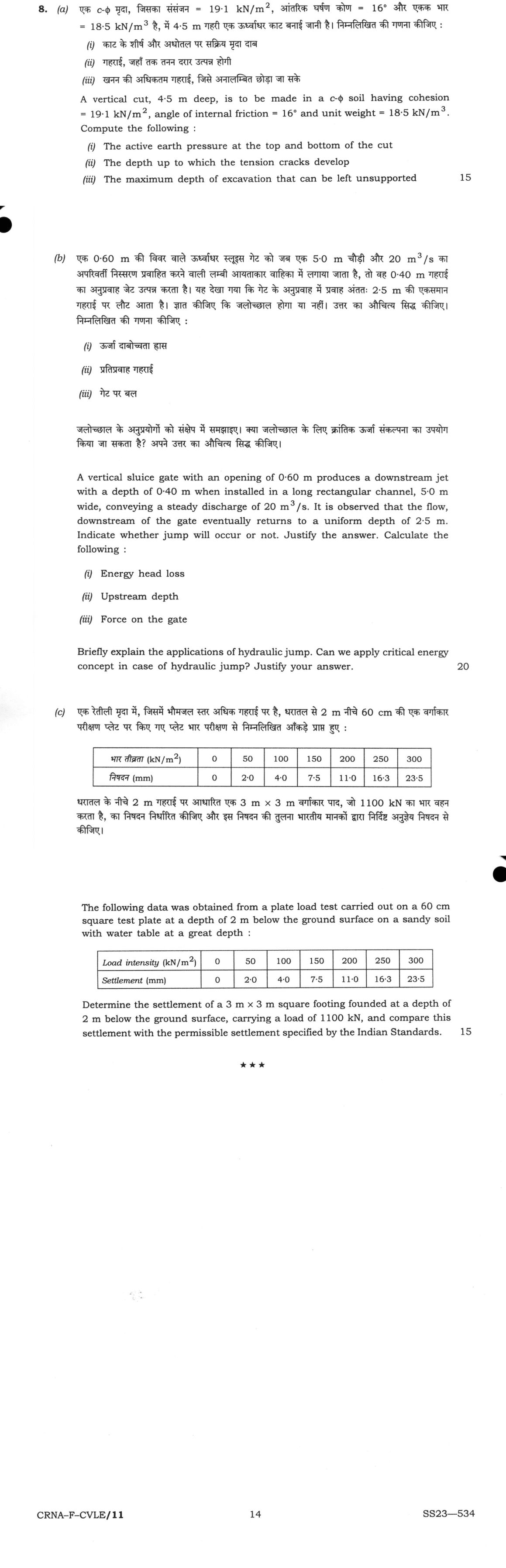
A vertical cut, 4·5 m deep, is to be made in a c-φ soil having cohesion = 19·1 kN/m², angle of internal friction = 16° and unit weight = 18·5 kN/m³. Compute the following :
The active earth pressure at the top and bottom of the cut
The depth up to which the tension cracks develop
The maximum depth of excavation that can be left unsupported
15
A vertical sluice gate with an opening of 0·60 m produces a downstream jet with a depth of 0·40 m when installed in a long rectangular channel, 5·0 m wide, conveying a steady discharge of 20 m³/s. It is observed that the flow, downstream of the gate eventually returns to a uniform depth of 2·5 m. Indicate whether jump will occur or not. Justify the answer. Calculate the following :
Energy head loss
Upstream depth
Force on the gate
Briefly explain the applications of hydraulic jump. Can we apply critical energy concept in case of hydraulic jump? Justify your answer. 20 marks
The following data was obtained from a plate load test carried out on a 60 cm square test plate at a depth of 2 m below the ground surface on a sandy soil with water table at a great depth :
| Load intensity (kN/m²) | 0 | 50 | 100 | 150 | 200 | 250 | 300 |
|---|---|---|---|---|---|---|---|
| Settlement (mm) | 0 | 2·0 | 4·0 | 7·5 | 11·0 | 16·3 | 23·5 |
Determine the settlement of a 3 m × 3 m square footing founded at a depth of 2 m below the ground surface, carrying a load of 1100 kN, and compare this settlement with the permissible settlement specified by the Indian Standards. 15 marks
हिंदी में प्रश्न पढ़ें
एक c-φ मृदा, जिसका संसजन = 19·1 kN/m², आंतरिक घर्षण कोण = 16° और एकक भार = 18·5 kN/m³ है, में 4·5 m गहरी एक उद्वाधर काट बनाई जानी है। निम्नलिखित की गणना कीजिए :
काट के शीर्ष और अधोतल पर सक्रिय मृदा दाब
गहराई, जहाँ तक तनन दरार उत्पन्न होंगी
खनन की अधिकतम गहराई, जिसे अनालंबित छोड़ा जा सके
15
एक 0·60 m की विवर वाले उद्वाधर स्लूस गेट को जब एक 5·0 m चौड़ी और 20 m³/s का अपरिवर्ती निस्सरण प्रवाहित करने वाली लंबी आयताकार वाहिका में लगाया जाता है, तो वह 0·40 m गहराई का अनुप्रवाह जेट उत्पन्न करता है। यह देखा गया कि गेट के अनुप्रवाह में प्रवाह अंततः 2·5 m की एकसमान गहराई पर लौट आता है। ज्ञात कीजिए कि जलोच्छाल होगा या नहीं। उत्तर का औचित्य सिद्ध कीजिए। निम्नलिखित की गणना कीजिए :
ऊर्जा दाबोच्चता ह्रास
प्रतिप्रवाह गहराई
गेट पर बल
जलोच्छाल के अनुप्रयोगों को संक्षेप में समझाइए। क्या जलोच्छाल के लिए कांतिक ऊर्जा संकल्पना का उपयोग किया जा सकता है? अपने उत्तर का औचित्य सिद्ध कीजिए।
20
एक रेतीली मृदा में, जिसमें भौमजल स्तर अधिक गहराई पर है, धरातल से 2 m नीचे 60 cm की एक वर्गाकार परीक्षण प्लेट पर किए गए प्लेट भार परीक्षण से निम्नलिखित आंकड़े प्राप्त हुए :
भार तीव्रता (kN/m²) | 0 | 50 | 100 | 150 | 200 | 250 | 300 निपदन (mm) | 0 | 2·0 | 4·0 | 7·5 | 11·0 | 16·3 | 23·5
धरातल के नीचे 2 m गहराई पर आधारित एक 3 m × 3 m वर्गाकार पाद, जो 1100 kN का भार वहन करता है, का निपदन निर्धारित कीजिए और इस निपदन की तुलना भारतीय मानकों द्वारा विहित अनुज्ञेय निपदन से कीजिए।
15
The figure this question refers to, in words
The question paper is a scan and the diagram did not survive as text. This is the figure as read from the original page — every component, value and label — so the question can be worked from the text below.
(c) Table with two rows and eight columns. Header row: 'Load intensity (kN/m2)', 0, 50, 100, 150, 200, 250, 300. Data row: 'Settlement (mm)', 0, 2.0, 4.0, 7.5, 11.0, 16.3, 23.5.
What "Calculate" is asking you to do
Apply the standard formula or schedule to data the question has already supplied — a table of readings, cost records, a balance sheet — and produce the number. The method is rarely in doubt; the marks sit in the named intermediate quantities, each of which has to appear as a labelled line.
Structure that answers it
Data as given → formula or standard treatment, named → substitution → each intermediate, labelled → result with units
Where marks are lost
Omitting an intermediate the marking scheme pays for separately, or rounding at an intermediate line so the final figure drifts. In commerce and accountancy, any figure in a statement that no numbered working note supports is treated as unearned.
How this answer will be evaluated
Approach
Framework: null. (a) calculate: given > formula > substitution > result with units > interpretation | (b) calculate: given > formula > substitution > result with units > interpretation | (c) calculate: given > formula > substitution > result with units > interpretation Full marks: All calculations correct with proper units, complete diagrams, and code references
Key points expected
- Calculate Ka using Rankine's theory
- Compute active pressure at top and bottom
- Determine depth of tension cracks
- Calculate critical depth for unsupported cut
- Calculate Froude number for jump check
- Compute energy head loss in jump
- Determine upstream depth using continuity
- Calculate force on gate using momentum
Evaluation rubric
Each sub-part is marked on its own, against the marks and word limit printed on the paper.
- (a) Compute active earth pressure, tension crack depth, and maximum unsupported excavation depth. 15 marks
calculate— given → formula → substitution → result with units → interpretation
Must cover
- Calculate Ka using Rankine's theory
- Compute active pressure at top and bottom
- Determine depth of tension cracks
- Calculate critical depth for unsupported cut
Loses marks
- Omit tension crack depth calculation
- Use wrong Ka formula
- No units in final answers
Earns more
- Draw pressure distribution diagram
- Show tension crack zone clearly
- State assumptions for c-phi soil
Extra mark
- Include safety factor discussion
- Reference IS code for earth pressure
- (b) Determine if hydraulic jump occurs, calculate energy loss, upstream depth, and gate force. 20 marks
calculate— given → formula → substitution → result with units → interpretation
Must cover
- Calculate Froude number for jump check
- Compute energy head loss in jump
- Determine upstream depth using continuity
- Calculate force on gate using momentum
Loses marks
- Skip Froude number calculation
- Wrong momentum equation application
- No justification for jump occurrence
Earns more
- Draw channel section with jump location
- Show momentum equation setup
- Justify jump occurrence with Froude number
Extra mark
- Explain hydraulic jump applications
- Discuss critical energy concept applicability
- (c) Determine settlement of 3m×3m footing from plate load test data and compare with IS standards. 15 marks
calculate— given → formula → substitution → result with units → interpretation
Must cover
- Use plate load test data for settlement
- Apply size correction for 3m×3m footing
- Calculate settlement at 1100 kN load
- Compare with IS permissible settlement
Loses marks
- No size correction applied
- Wrong interpolation method
- Omit IS standard comparison
Earns more
- Show interpolation from test data
- State IS code clause for settlement
- Include depth correction if applicable
Extra mark
- Reference specific IS code number
- Discuss factors affecting settlement
Model answer coming soon
Every evaluation on this site is marked against a verified model answer. This question's answer is still being written; evaluation opens the moment it lands.
More from Civil Engineering 2022 Paper I
- Q5 (a) Prove that the power transmission through nozzle is maximum when d/D = √(D/8fl). Negl…
- Q6 (a) The velocity profile in a laminar boundary layer on a flat plate is modelled by the c…
- Q7 (a) (i) Distinguish between discharge velocity and seepage velocity in the case of flow o…
- Q8 (a) A vertical cut, 4·5 m deep, is to be made in a c-φ soil having cohesion = 19·1 kN/m²,…