Paper II — Q3
(a) A two-lane State Highway in plain terrain, with cutting section having camber of 2·0%, negotiates a curve of radius 480 m…
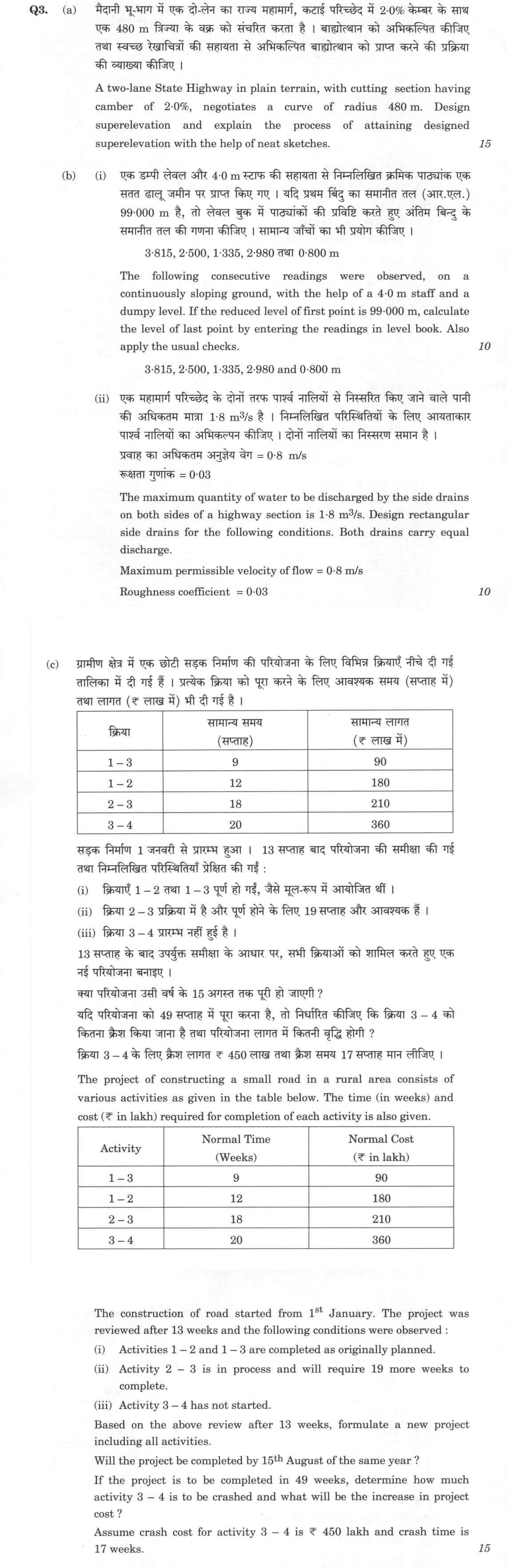
A two-lane State Highway in plain terrain, with cutting section having camber of 2·0%, negotiates a curve of radius 480 m. Design superelevation and explain the process of attaining designed superelevation with the help of neat sketches. 15 marks
The following consecutive readings were observed, on a continuously sloping ground, with the help of a 4·0 m staff and a dumpy level. If the reduced level of first point is 99·000 m, calculate the level of last point by entering the readings in level book. Also apply the usual checks. 10 marks 3·815, 2·500, 1·335, 2·980 and 0·800 m
The maximum quantity of water to be discharged by the side drains on both sides of a highway section is 1·8 m³/s. Design rectangular side drains for the following conditions. Both drains carry equal discharge. Maximum permissible velocity of flow = 0·8 m/s Roughness coefficient = 0·03 10 marks
The project of constructing a small road in a rural area consists of various activities as given in the table below. The time (in weeks) and cost (₹ in lakh) required for completion of each activity is also given.
| Activity | Normal Time (Weeks) | Normal Cost (₹ in lakh) |
|---|---|---|
| 1-3 | 9 | 90 |
| 1-2 | 12 | 180 |
| 2-3 | 18 | 210 |
| 3-4 | 20 | 360 |
The construction of road started from 1st January. The project was reviewed after 13 weeks and the following conditions were observed: Activities 1 – 2 and 1 – 3 are completed as originally planned.
Activity 2 – 3 is in process and will require 19 more weeks to complete.
Activity 3 – 4 has not started.
Based on the above review after 13 weeks, formulate a new project including all activities.
Will the project be completed by 15th August of the same year?
If the project is to be completed in 49 weeks, determine how much activity 3 – 4 is to be crashed and what will be the increase in project cost?
Assume crash cost for activity 3 – 4 is ₹ 450 lakh and crash time is 17 weeks. 15 marks
हिंदी में प्रश्न पढ़ें
मैदानी भू-भाग में एक दो-लेन का राज्य महामार्ग, कटाई परिछेद में 2·0% कैम्बर के साथ एक 480 m त्रिज्या के वक्र को संचरित करता है । बाह्योथान को अभिकल्पित कीजिए तथा स्वच्छ रेखाचित्रों की सहायता से अभिकल्पित बाह्योथान को प्राप्त करने की प्रक्रिया की व्याख्या कीजिए । 15 अंक
एक डम्पी लेवल और 4·0 m स्टाफ की सहायता से निम्नलिखित क्रमिक पाठ्यांक एक सतत ढालु जमीन पर प्राप्त किए गए । यदि प्रथम बिंदु का समानित तल (आर.एल.) 99·000 m है, तो लेवल बुक में पाठ्यांकों की प्रविष्टि करते हुए अंतिम बिंदु के समानित तल की गणना कीजिए । सामान्य जाँचों का भी प्रयोग कीजिए । 10 अंक 3·815, 2·500, 1·335, 2·980 तथा 0·800 m
एक महामार्ग परिछेद के दोनों तरफ पार्श्व नालियों से निस्सारित किए जाने वाले पानी की अधिकतम मात्रा 1·8 m³/s है । निम्नलिखित परिस्थितियों के लिए आयताकार पार्श्व नालियों का अभिकल्पन कीजिए । दोनों नालियों का निस्सरण समान है । प्रवाह का अधिकतम अनुज्ञेय वेग = 0·8 m/s रुक्षता गुणांक = 0·03 10 अंक
ग्रामीण क्षेत्र में एक छोटी सड़क निर्माण की परियोजना के लिए विभिन्न क्रियाएं नीचे दी गई तालिका में दी गई हैं । प्रत्येक क्रिया को पूरा करने के लिए आवश्यक समय (सप्ताह में) तथा लागत (₹ लाख में) भी दी गई है ।
| क्रिया | सामान्य समय (सप्ताह) | सामान्य लागत (₹ लाख में) |
|---|---|---|
| 1-3 | 9 | 90 |
| 1-2 | 12 | 180 |
| 2-3 | 18 | 210 |
| 3-4 | 20 | 360 |
सड़क निर्माण 1 जनवरी से प्रारंभ हुआ । 13 सप्ताह बाद परियोजना की समीक्षा की गई तथा निम्नलिखित परिस्थितियाँ प्रेक्षित की गईं : क्रियाएं 1-2 तथा 1-3 पूर्ण हो गईं, जैसे मूल-रूप में आयोजित थीं ।
क्रिया 2-3 प्रक्रिया में है और पूर्ण होने के लिए 19 सप्ताह और आवश्यक हैं ।
क्रिया 3-4 प्रारंभ नहीं हुई है ।
13 सप्ताह के बाद उपर्युक्त समीक्षा के आधार पर, सभी क्रियाओं को शामिल करते हुए एक नई परियोजना बनाइए ।
क्या परियोजना उसी वर्ष के 15 अगस्त तक पूरी हो जाएगी ?
यदि परियोजना को 49 सप्ताह में पूरा करना है, तो निर्धारित कीजिए कि क्रिया 3-4 को कितना क्रैश किया जाना है तथा परियोजना लागत में कितनी वृद्धि होगी ?
क्रिया 3-4 के लिए क्रैश लागत ₹ 450 लाख तथा क्रैश समय 17 सप्ताह मान लीजिए । 15 अंक
The figure this question refers to, in words
The question paper is a scan and the diagram did not survive as text. This is the figure as read from the original page — every component, value and label — so the question can be worked from the text below.
(c) Table with columns: Activity, Normal Time (Weeks), Normal Cost (₹ in lakh). Rows: 1-3, 9, 90; 1-2, 12, 180; 2-3, 18, 210; 3-4, 20, 360.
What "Design" is asking you to do
Produce a specification that meets the given brief and demonstrate that it does. In civil and electrical papers the design is incomplete until it is expressed in buildable numbers — diameter, spacing, section, component value — and checked back against every limit stated.
Structure that answers it
Requirements and permissible values listed → code clause or design basis adopted → proportioning calculations → the specification in final dimensions → check against each requirement → sketch
Where marks are lost
Stopping at a required area or a required value without converting it into the bar size, spacing or component actually provided. The provided-against-required comparison and the serviceability or stability check are separately marked and routinely left out.
How this answer will be evaluated
Approach
Framework: Civil Engineering Paper 2: Design/Analysis/Calculation. (a) explain: definition/context > points in order > small example > short close | (b(i)) calculate: given > formula > substitution > result with units > interpretation | (b(ii)) calculate: given > formula > substitution > result with units > interpretation | (c) analyse: intro > causes > effects > stakeholders/linkages > way forward Full marks: Complete calculations with code references, neat sketches, and all checks applied
Key points expected
- Calculate superelevation using IRC formula
- Determine transition curve length
- Describe transition from normal to full superelevation
- Provide neat sketches of transition
- Enter readings in level book format
- Calculate intermediate levels correctly
- Apply arithmetic checks on readings
- State final reduced level with units
Evaluation rubric
Each sub-part is marked on its own, against the marks and word limit printed on the paper.
- (a) Design superelevation for 480m curve and explain transition process. 15 marks
explain— definition/context → points in order → small example → short close
Must cover
- Calculate superelevation using IRC formula
- Determine transition curve length
- Describe transition from normal to full superelevation
- Provide neat sketches of transition
Loses marks
- Missing transition curve length calculation
- No sketches of superelevation transition
- Ignoring camber in superelevation calc
Earns more
- Mention IRC 37/38 code clauses
- Calculate rate of change of camber
- Show spiral transition details
Extra mark
- Mention specific IRC 37 clause number
- Include numerical example of camber change
- (b(i)) Calculate last point level using level book method. 10 marks
calculate— given → formula → substitution → result with units → interpretation
Must cover
- Enter readings in level book format
- Calculate intermediate levels correctly
- Apply arithmetic checks on readings
- State final reduced level with units
Loses marks
- Missing level book format
- Arithmetic errors in level calculations
- No final reduced level stated
Earns more
- Show height of instrument calculations
- Verify sum of BS equals sum of FS
- Identify change points in readings
Extra mark
- Include error correction if applicable
- Show staff reading verification
- (b(ii)) Design rectangular side drains for 1.8 m³/s discharge. 10 marks
calculate— given → formula → substitution → result with units → interpretation
Must cover
- Apply Manning's equation for design
- Calculate required cross-sectional area
- Determine hydraulic radius and slope
- Verify velocity within 0.8 m/s limit
Loses marks
- Velocity exceeds 0.8 m/s limit
- Missing Manning's equation application
- No hydraulic radius calculation
Earns more
- Show Manning's n=0.03 application
- Calculate wetted perimeter
- Verify Froude number for stability
Extra mark
- Include freeboard calculation
- Show velocity distribution check
- (c) Formulate new project schedule and determine crash requirements. 15 marks
analyse— intro → causes → effects → stakeholders/linkages → way forward
Must cover
- Update activity times after 13 weeks
- Calculate new project duration
- Determine crash amount for activity 3-4
- Calculate cost increase for crashing
Loses marks
- Missing new project formulation
- No crash cost calculation
- Incorrect critical path identification
Earns more
- Show critical path identification
- Calculate crash cost per week
- Verify 49-week completion feasibility
- Show date calculation for Aug 15
Extra mark
- Include Gantt chart update
- Show float calculations
Model answer coming soon
Every evaluation on this site is marked against a verified model answer. This question's answer is still being written; evaluation opens the moment it lands.
More from Civil Engineering 2022 Paper II
- Q1 (a) (i) Briefly explain the deterioration of concrete caused by leaching action, and (ii)…
- Q2 (a) A construction company is planning to purchase an excavation equipment for operating…
- Q3 (a) A two-lane State Highway in plain terrain, with cutting section having camber of 2·0%…
- Q4 (a) In a layout of B.G. Yard, an 8° curve branches off from a 4° main curve in an opposit…
- Q5 (a) A catchment has six rain gauge stations. In a year, the annual rainfall recorded by t…
- Q6 (a) (i) Define unit hydrograph. Explain two basic assumptions made in the derivation of a…