Paper II — Q4
(a) In a layout of B.G. Yard, an 8° curve branches off from a 4° main curve in an opposite direction. If speed is restricted to…
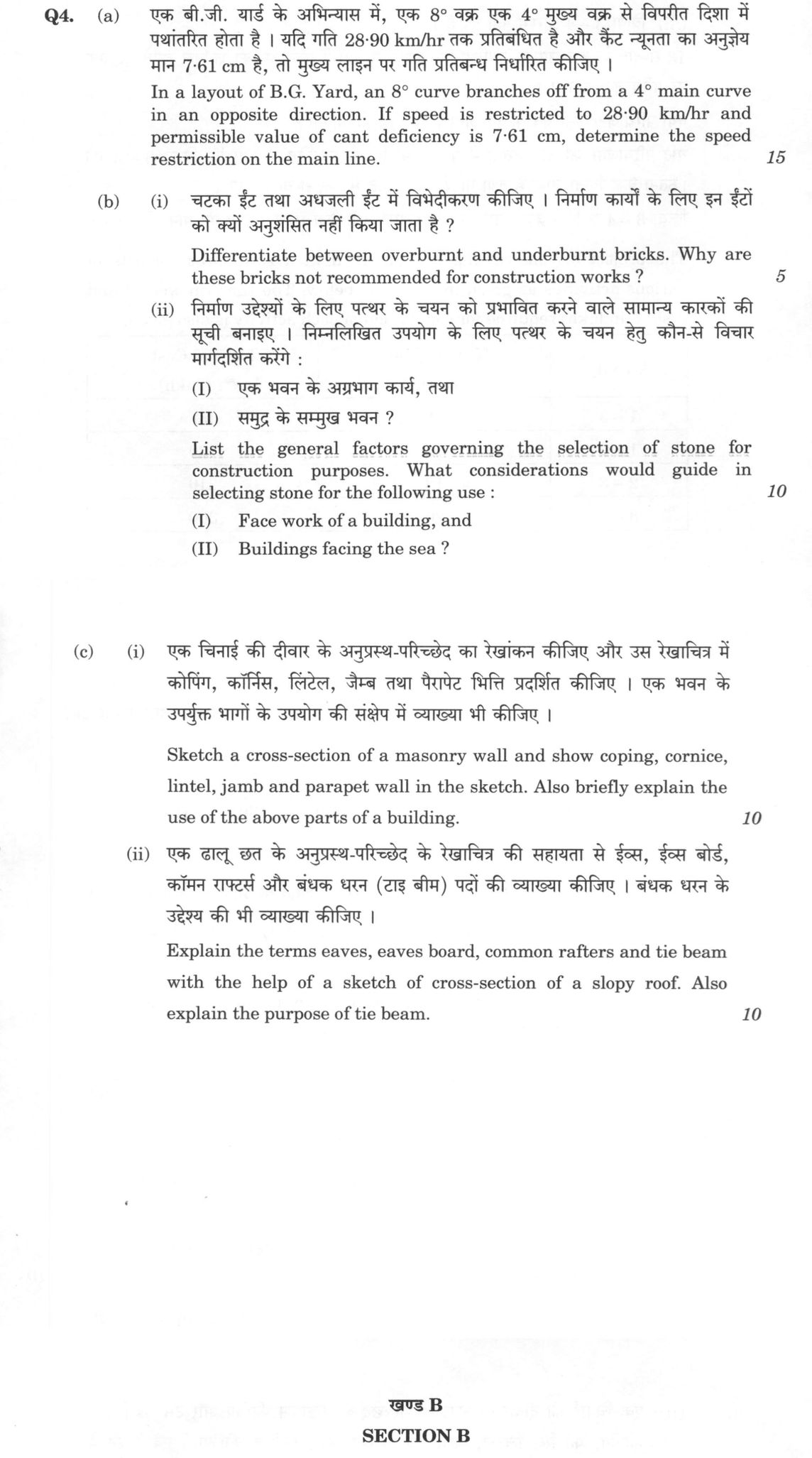
In a layout of B.G. Yard, an 8° curve branches off from a 4° main curve in an opposite direction. If speed is restricted to 28·90 km/hr and permissible value of cant deficiency is 7·61 cm, determine the speed restriction on the main line. 15 marks
Differentiate between overburnt and underburnt bricks. Why are these bricks not recommended for construction works? 5 marks
List the general factors governing the selection of stone for construction purposes. What considerations would guide in selecting stone for the following use: (I) Face work of a building, and (II) Buildings facing the sea? 10 marks
Sketch a cross-section of a masonry wall and show coping, cornice, lintel, jamb and parapet wall in the sketch. Also briefly explain the use of the above parts of a building. 10 marks
Explain the terms eaves, eaves board, common rafters and tie beam with the help of a sketch of cross-section of a slopy roof. Also explain the purpose of tie beam. 10 marks
हिंदी में प्रश्न पढ़ें
एक बी.जी. यार्ड के अभिन्यास में, एक 8° वक्र एक 4° मुख्य वक्र से विपरीत दिशा में पथांतरित होता है । यदि गति 28·90 km/hr तक प्रतिबंधित है और कैंट न्यूनता का अनुज्ञेय मान 7·61 cm है, तो मुख्य लाइन पर गति प्रतिबंध निर्धारित कीजिए । 15 अंक
चटका ईंट तथा अधजली ईंट में विभेदीकरण कीजिए । निर्माण कार्यों के लिए इन ईंटों को क्यों अनुशंसित नहीं किया जाता है ? 5 अंक
निर्माण उद्देश्यों के लिए पत्थर के चयन को प्रभावित करने वाले सामान्य कारकों की सूची बनाइए । निम्नलिखित उपयोग के लिए पत्थर के चयन हेतु कौन-से विचार मार्गदर्शित करेंगे : (I) एक भवन के अग्रभाग कार्य, तथा (II) समुद्र के सम्मुख भवन ? 10 अंक
एक चिनाई की दीवार के अनुप्रस्थ-पारिच्छेद का रेखांकन कीजिए और उस रेखाचित्र में कोपिंग, कॉर्निस, लिंटेल, जैम्ब तथा पैरापेट भित्ति प्रदर्शित कीजिए । एक भवन के उपर्युक्त भागों के उपयोग की संक्षेप में व्याख्या भी कीजिए । 10 अंक
एक ढालू छत के अनुप्रस्थ-पारिच्छेद के रेखाचित्र की सहायता से ईव्स, ईव्स बोर्ड, कॉमन राफ्टर्स और बंधक धरन (टाई बीम) पदों की व्याख्या कीजिए । बंधक धरन के उद्देश्य की भी व्याख्या कीजिए । 10 अंक
Model answer
Written by UPSC Answer Check against this question's marking rubric, to the expected length. UPSC does not publish answers for Mains — this is one way to score well, not an official key.
(a) Method: Equilibrium cant formula e = G V² / (127 R) and negative superelevation at opposite curves.
For B.G., effective gauge G = 1750 mm = 175 cm.
Radius of branch curve: R_b = 1750 / 8 = 218.75 m. Radius of main curve: Rₘ = 1750 / 4 = 437.5 m.
Equilibrium cant on branch at V_b = 28.90 km/h: e_b = G V_b² / (127 R_b) = 175 × (28.90)² / (127 × 218.75) = 175 × 835.21 / 27781.25 = 146161.75 / 27781.25 = 5.2612 cm.
Since the branch curve is opposite to the main curve, the main-curve cant eₘ acts as negative superelevation on the branch. Thus cant deficiency on branch is: cd = e_b + eₘ 7.61 = 5.2612 + eₘ eₘ = 2.3488 cm.
On the main curve, the actual cant is eₘ = 2.3488 cm. With the same permissible cant deficiency 7.61 cm, the maximum equilibrium cant on the main curve is: eₘ_eq = eₘ + cd = 2.3488 + 7.61 = 9.9588 cm.
Therefore main-line speed: Vₘ = √(eₘ_eq × 127 × Rₘ / G) = √(9.9588 × 127 × 437.5 / 175) = √(9.9588 × 317.5) = √3161.93 = 56.23 km/h.
Speed restriction on the main line = 56.23 km/h.
(b)(i) Overburnt bricks: burnt at excessive temperature or for too long. They are dark/blackish, vitrified, hard, brittle, fused, distorted, low in porosity, high in strength but poor in shape, difficult to dress, and may contain internal cracks. Underburnt bricks: burnt at low temperature or for insufficient time. They are light/yellowish, soft, porous, high in water absorption, low in compressive strength, liable to efflorescence, weathering and volume change. These bricks are not recommended for permanent construction because overburnt bricks are brittle and non-uniform, break during handling, give poor bond and cannot be easily cut or dressed; underburnt bricks are weak, absorb water, cause dampness and efflorescence, and have low durability. They may be used only as road metal/aggregate (overburnt) or in temporary works (underburnt).
(b)(ii) General factors governing selection of stone: strength and durability; hardness, toughness and abrasion resistance; porosity and water absorption; density and specific gravity; weathering resistance against rain, frost, salt and chemicals; appearance, colour and texture; ease of quarrying, dressing and carving; grain size and uniformity; fire resistance; thermal expansion; workability; availability and cost; absence of soluble salts, cracks and flaws.
(I) Face work of a building: choose stone with pleasing and uniform colour/texture, ability to take polish or fine dressing, no staining minerals, low porosity to resist damp, sufficient strength, good weather resistance and economical availability. Suitable examples are granite, marble, compact sandstone and dense limestone. (II) Buildings facing the sea: marine atmosphere contains salt spray and wind-driven rain. Select dense, low-porosity, high-durability stones resistant to salt crystallisation, chemical attack and abrasion, such as granite, basalt, quartzite and compact sandstone. Avoid porous limestone, soft sandstone and soluble/efflorescent stones. Low water absorption, high strength and resistance to weathering are essential.
(c)(i) Sketch of masonry wall cross-section:
`` Coping __________ | | Parapet wall | | | | |__________| | Cornice | ____| |____ | | | Lintel | | ______________ | | | | | | | | | J | | Opening | | J a | | | | a m | | | | m b | | | | b |__|______________|__| Masonry wall ``
Coping: sloping top cover on a parapet or boundary wall. It sheds rainwater and protects the top of masonry from percolation. Cornice: projecting moulded course at the top of a wall. It throws rainwater away from the wall and gives architectural finish. Lintel: horizontal member over a door/window opening. It supports the masonry above the opening and transfers the load to the jambs. Jamb: vertical sides of an opening in masonry. It supports the lintel or arch and provides fixing for door/window frames. Parapet wall: low wall at the edge of a roof, balcony or terrace. It provides safety against fall, hides roof projections and can act as a fire barrier.
(c)(ii) Sketch of slopy-roof cross-section:
`` Ridge /\ / \ / \ / \ / \ / \ / \ /______________ Tie beam (wall plate level) / \ / \ / \ / \ / \ Wall Wall Eaves Eaves ``
Eaves: the lower edge of a sloping roof projecting beyond the external wall. It throws rainwater clear of the wall. Eaves board: a board fixed along the eaves at the feet of the common rafters. It closes the roof edge, supports the gutter and gives a finished appearance. Common rafters: inclined members placed at regular intervals from the ridge to the wall plate/eaves. They support the roof covering and transfer loads to the ridge, wall plates and tie beam. Tie beam: a horizontal member connecting opposite ends of the principal rafters or opposite walls at wall-plate level. Purpose of tie beam: it resists the outward thrust of the rafters, prevents the walls from spreading, keeps the roof frame triangular and stable, and also carries ceiling load where provided.
What "Solve" is asking you to do
Choose the method, then carry it through to a final answer. Identifying what kind of problem this is and why that method applies is the first thing marked; a correct figure arrived at invisibly earns almost nothing.
Structure that answers it
Given data and what is required → method chosen, with the reason it applies → set-up (equation, circuit, free body, trial balance) → working, step by step → answer with units and any condition of validity
Where marks are lost
Doing the middle steps mentally and writing only the result. In mathematics papers, a further loss comes from giving a decimal where the exact value in surds or fractions was wanted, or from skipping the justification a part explicitly asks for.
How this answer will be evaluated
Approach
Framework: Civil Engineering Paper 2 (UPSC). (a) calculate: given > formula > substitution > result with units > interpretation | (b(i)) compare: paired headings or table > key differences > significance > conclusion | (b(ii)) enumerate: list the items in order > one line each > no commentary | (c(i)) describe: define > structure or process in order > labelled diagram > significance | (c(ii)) explain: definition/context > points in order > small example > short close Full marks: All parts answered with correct method, units, and checks; sketches are neat and labelled; no major errors.
Key points expected
- State formula for cant deficiency (Cd = h - h_req)
- Calculate required cant for 8° curve at 28.90 km/hr
- Determine actual cant provided on the track
- Calculate speed for 4° main curve using actual cant and Cd
- Define overburnt bricks (excess firing, dark color, hard)
- Define underburnt bricks (insufficient firing, soft, porous)
- State why overburnt bricks are unsuitable (too hard, difficult to cut)
- State why underburnt bricks are unsuitable (low strength, water absorption)
Evaluation rubric
Each sub-part is marked on its own, against the marks and word limit printed on the paper.
- (a) Determine speed restriction on the main line given branch curve speed and cant deficiency. 15 marks
calculate— given → formula → substitution → result with units → interpretation
Must cover
- State formula for cant deficiency (Cd = h - h_req)
- Calculate required cant for 8° curve at 28.90 km/hr
- Determine actual cant provided on the track
- Calculate speed for 4° main curve using actual cant and Cd
Loses marks
- Missing unit conversions in speed calculations
- Confusing cant deficiency with cant excess
- No final check against permissible limits
Earns more
- Use of standard gauge (1.676 m) in calculations
- Explicit statement of assumptions (e.g., equal gauge)
- Unit conversion for speed (km/hr to m/s)
Extra mark
- Reference to IS code for cant deficiency limits
- (b(i)) Differentiate overburnt and underburnt bricks and explain why they are not recommended. 5 marks
compare— paired headings or table → key differences → significance → conclusion
Must cover
- Define overburnt bricks (excess firing, dark color, hard)
- Define underburnt bricks (insufficient firing, soft, porous)
- State why overburnt bricks are unsuitable (too hard, difficult to cut)
- State why underburnt bricks are unsuitable (low strength, water absorption)
Loses marks
- Confusing overburnt with normal burnt bricks
- Failing to link properties to construction unsuitability
Earns more
- Mention of specific firing temperatures
- Comparison of physical properties (strength, durability)
Extra mark
- Reference to IS 1077 for brick classification
- (b(ii)) List factors for stone selection and considerations for face work and sea-facing buildings. 10 marks
enumerate— list the items in order → one line each → no commentary
Must cover
- List general factors (strength, durability, cost, availability)
- Considerations for face work (appearance, weathering resistance)
- Considerations for sea-facing buildings (salt resistance, durability)
- Mention specific stone types suitable for each use
Loses marks
- Generic factors without specific application
- Failing to distinguish between face work and sea-facing requirements
Earns more
- Reference to specific stone types (e.g., granite, sandstone)
- Mention of testing methods for stone selection
Extra mark
- Reference to IS code for stone testing
- (c(i)) Sketch masonry wall cross-section and explain use of coping, cornice, lintel, jamb, parapet. 10 marks
describe— define → structure or process in order → labelled diagram → significance
Must cover
- Draw labelled cross-section of masonry wall
- Identify coping, cornice, lintel, jamb, parapet in sketch
- Explain function of each part (e.g., coping protects wall top)
- Briefly describe use of each part in building
Loses marks
- Missing or mislabelled parts in sketch
- Vague or incorrect explanation of part functions
Earns more
- Neat and clear sketch with proper labels
- Mention of materials used for each part
Extra mark
- Reference to IS code for masonry construction
- (c(ii)) Explain eaves, eaves board, common rafters, tie beam with sketch of slopy roof. 10 marks
explain— definition/context → points in order → small example → short close
Must cover
- Draw cross-section of slopy roof
- Label eaves, eaves board, common rafters, tie beam
- Define each term clearly
- Explain purpose of tie beam (prevents wall spreading)
Loses marks
- Missing or mislabelled components in sketch
- Incorrect explanation of tie beam function
Earns more
- Clear and accurate sketch with proper labels
- Mention of structural role of each component
Extra mark
- Reference to IS code for roof construction
Practice this exact question
Write your answer and it is marked point by point against the model answer above — what you covered, what you missed, what you got wrong.
Evaluate my answer →More from Civil Engineering 2022 Paper II
- Q1 (a) (i) Briefly explain the deterioration of concrete caused by leaching action, and (ii)…
- Q2 (a) A construction company is planning to purchase an excavation equipment for operating…
- Q3 (a) A two-lane State Highway in plain terrain, with cutting section having camber of 2·0%…
- Q4 (a) In a layout of B.G. Yard, an 8° curve branches off from a 4° main curve in an opposit…
- Q5 (a) A catchment has six rain gauge stations. In a year, the annual rainfall recorded by t…
- Q6 (a) (i) Define unit hydrograph. Explain two basic assumptions made in the derivation of a…
- Q7 Answer the following questions in about 250 words each: (a) Analyse the growth of communa…