Paper II — Q8
Answer the following questions in about 250 words each: (a) Discuss the major environmental movements in India. How have they…
Answer the following questions in about 250 words each: Discuss the major environmental movements in India. How have they influenced policy-making? 15 marks
Critically evaluate the National Food Security Act, 2013. What are its achievements and shortcomings? 15 marks
Model answer
Written by UPSC Answer Check against this question's marking rubric, to the 250-word length. UPSC does not publish answers for Mains — this is one way to score well, not an official key.
India’s development has intertwined environmental sustainability and food security: growth based on forests, rivers and land has repeatedly raised questions of who bears ecological costs and who receives nutritional entitlements.
Environmental movements. The Chipko movement (1973) in Uttarakhand, led by Sunderlal Bahuguna and local women, linked tree protection to forest-dependent livelihoods and forced the state to reconsider commercial felling. The Narmada Bachao Andolan (1985), led by Medha Patkar, challenged large dam displacement and created a template for environmental impact assessment, rehabilitation and public hearing. The Silent Valley movement (1973) in Kerala saved a rainforest from hydroelectric diversion and led to its protection as a national park; Appiko (1983) and Tehri Dam protests extended the same logic. These were not isolated protests; they mobilised villagers, lawyers, scientists and media, converting local grievances into national litigation, policy review and legislative pressure. They also shaped judicial and administrative practice by making courts and authorities insist on rehabilitation plans, forest clearance and public participation. The causal mechanism was clear: sustained on-ground resistance exposed the limits of top-down planning, compelled courts and commissions to examine displacement and ecology, and created political space for rights-based and environmental law. This contributed to the Forest Rights Act, 2006, which recognised tribal and forest-dweller rights; the National Green Tribunal Act, 2010, which provided specialised environmental justice; and the broader environmental regulatory framework anchored in the Environment (Protection) Act, 1986, and its rules and amendments, enacted after Bhopal but strengthened by public demand for accountability.
NFSA, 2013. The National Food Security Act, 2013, is a landmark entitlement law. It covers 75 per cent of rural and 50 per cent of urban population, provides 5 kg of subsidised cereals per person per month, 35 kg per AAY household per month, and prices of Rs 3, Rs 2 and Rs 1 per kg for rice, wheat and coarse grains. It also provides maternity benefit of at least Rs 6,000 and children’s nutrition schemes, including ICDS-linked support. Its achievements are real: it expanded PDS coverage, supported digitisation of beneficiary lists, strengthened women’s entitlements through maternity benefits and children’s nutrition support, and contributed to reduced hunger and improved food access. Yet a critical evaluation shows serious gaps. Aadhaar-linked PDS has caused exclusion errors for poor, elderly and migrant households. Storage and supply-chain losses remain a concern; FCI storage losses are low, but broader post-harvest/supply losses are estimated at around 30–33 per cent, and recent CAG/PIB reports have flagged stock availability, diversion and beneficiary identification problems, with Bihar and Jharkhand showing weaker implementation compared with Kerala and Chhattisgarh. Grievance redressal is often inadequate, and the fiscal burden on states, especially for procurement, transport and distribution, limits uniform implementation. The central-state funding gap for PDS operations further strains weaker states. Thus, NFSA is a strong rights-based framework but an incomplete delivery system; its success depends on fixing exclusion, storage and leakage, grievance mechanisms and state fiscal coordination, while environmental conservation remains essential for sustainable food security. A rights-based food system must therefore be ecologically sustainable.
What "Critically evaluate" is asking you to do
Judge how well something has performed against the standard it set for itself — its stated aim, mandate or promise — and commit to a verdict. Name the yardstick before you judge; an unanchored judgement reads as opinion. “Critically” is not a section added at the end: name the yardstick you are judging by — the evidence, the stated objective, a constitutional principle, a rival explanation — and let a verdict close each part of the body. Where the question quotes a claim, that verdict must land on the claim itself, accepted, qualified or rejected, and not on the theme in general.
Structure that answers it
Name the yardstick — stated aim, mandate or benchmark → performance against it → shortfall against it → why the gap exists → verdict
Where marks are lost
Merits in one paragraph, demerits in the next, and a conclusion calling for a balanced and holistic approach. That is a survey with the judgement left out and it holds the answer in the middle band. The opposite error is reading “critically” as permission to attack — and with the odd pairings, critically describe or critically explain, the exposition still carries most of the marks, the judgement being a layer on it rather than a substitute for it.
How this answer will be evaluated
Approach
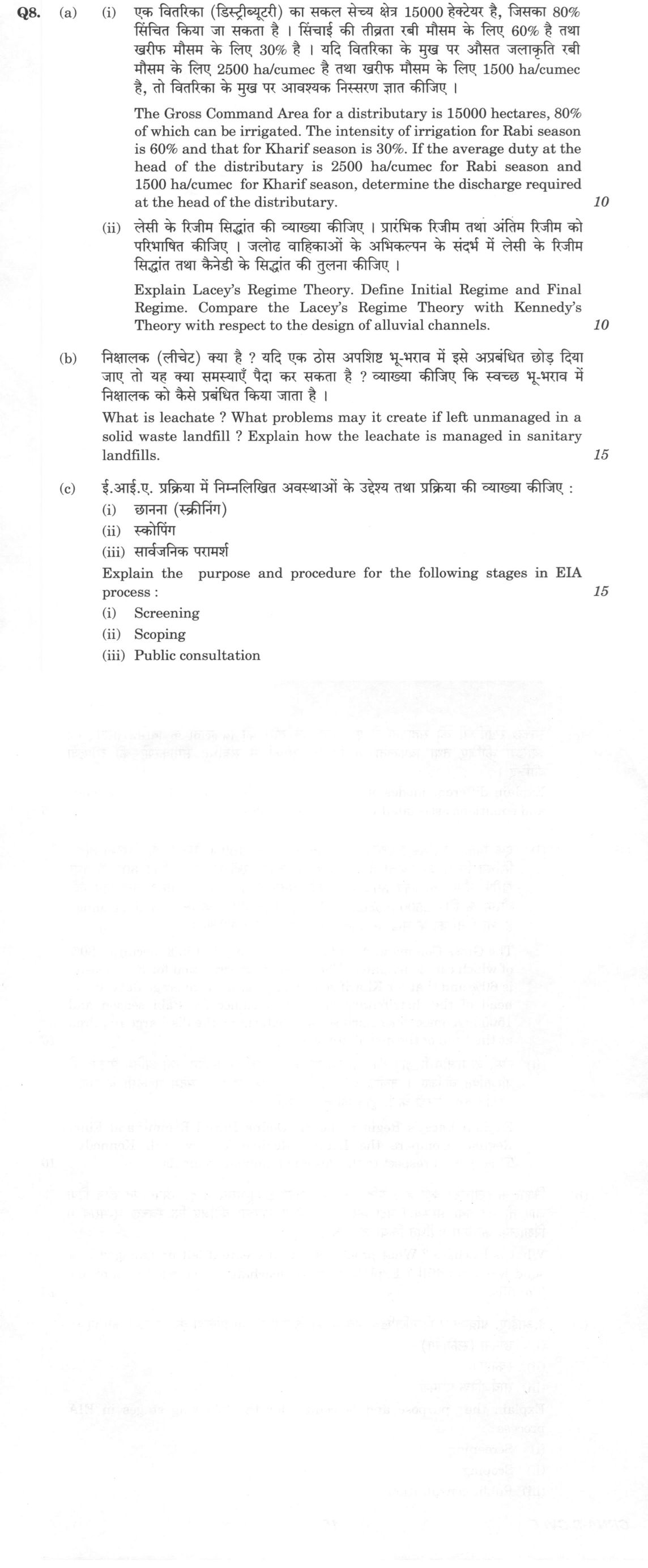
Framework: Irrigation Hydraulic Design & Environmental Engineering. (a) calculate: Given data > Calculation steps > Final result | (b) explain: Definition > Key concepts > Comparison | (c) explain: Definition > Problems > Management Full marks: Accurate calculations, clear definitions, and detailed comparisons.
Key points expected
- Net Command Area calculation
- Duty formula application
- Lacey's Regime Theory definition
- Initial and Final Regime definitions
- Lacey vs Kennedy comparison
- Leachate definition
- Leachate problems
- Sanitary landfill leachate management
Evaluation rubric
Each sub-part is marked on its own, against the marks and word limit printed on the paper.
- (a) Calculate discharge for Rabi and Kharif seasons using duty and area. 20 marks
calculate— Given data → Calculation steps → Final result
Must cover
- Calculate Net Command Area (NCA)
- Apply Duty formula Q = A/D
- Compute Rabi discharge (2500 ha/cumec)
- Compute Kharif discharge (1500 ha/cumec)
Loses marks
- Using Gross Command Area directly
- Missing final discharge values
Earns more
- Correct unit conversion (ha to cumec)
- Clear separation of Rabi and Kharif calcs
Extra mark
- Mentioning peak flow considerations
- (b) Define Lacey's theory, regimes, and compare with Kennedy's theory. 15 marks
explain— Definition → Key concepts → Comparison
Must cover
- Define Lacey's Regime Theory
- Define Initial and Final Regime
- Compare Lacey vs Kennedy (alluvial channels)
- Mention Lacey's silt factor
Loses marks
- Failing to define regimes
- No comparison with Kennedy
Earns more
- Mentioning Kennedy's critical velocity theory
- Noting Lacey's applicability to alluvial channels
Extra mark
- Sketch of alluvial channel cross-section
- (c) Define leachate, its problems, and management in sanitary landfills. 15 marks
explain— Definition → Problems → Management
Must cover
- Define leachate
- List problems of unmanaged leachate
- Explain leachate management in sanitary landfills
- Mention collection and treatment systems
Loses marks
- No mention of sanitary landfill management
- Vague description of problems
Earns more
- Mentioning groundwater contamination
- Describing leachate treatment methods
Extra mark
- Diagram of leachate collection system
Practice this exact question
Write your answer and it is marked point by point against the model answer above — what you covered, what you missed, what you got wrong.
Evaluate my answer →More from Civil Engineering 2022 Paper II
- Q5 (a) A catchment has six rain gauge stations. In a year, the annual rainfall recorded by t…
- Q6 (a) (i) Define unit hydrograph. Explain two basic assumptions made in the derivation of a…
- Q7 Answer the following questions in about 250 words each: (a) Analyse the growth of communa…
- Q8 Answer the following questions in about 250 words each: (a) Discuss the major environment…