Paper II — Q6
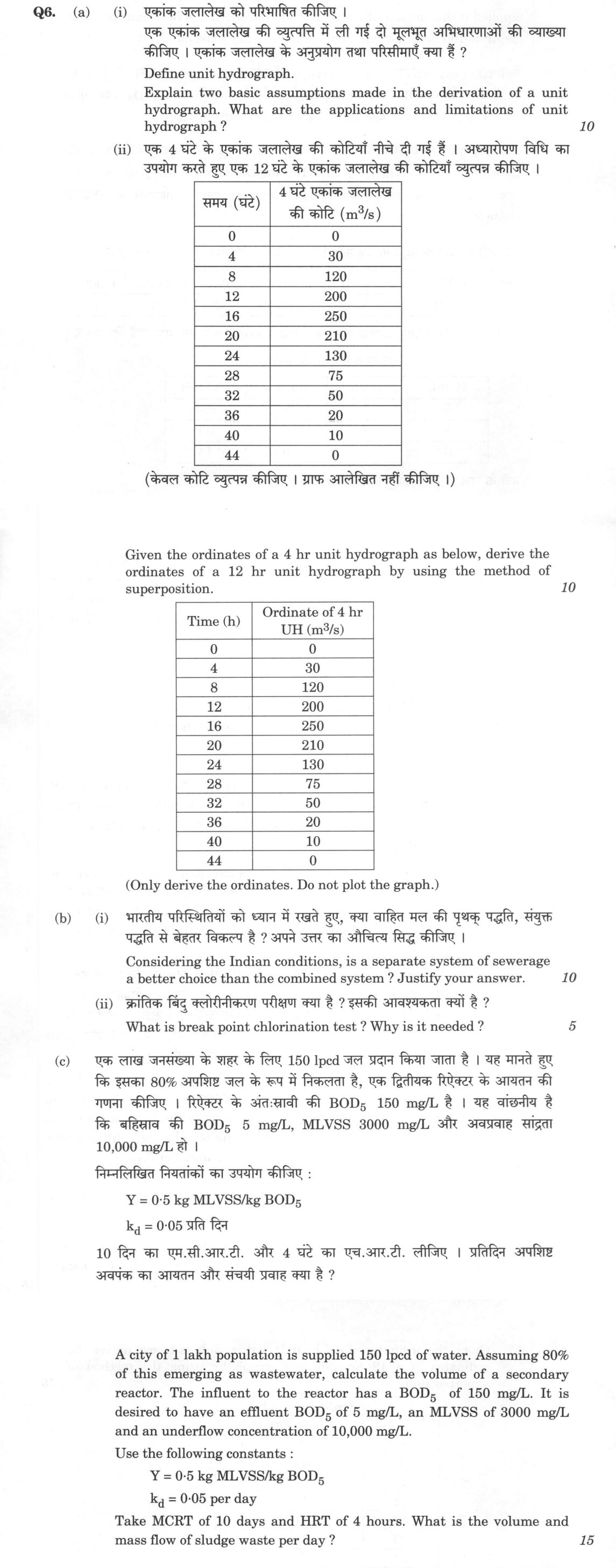
(a) (i) Define unit hydrograph. Explain two basic assumptions made in the derivation of a unit hydrograph. What are the…
Define unit hydrograph. Explain two basic assumptions made in the derivation of a unit hydrograph. What are the applications and limitations of unit hydrograph? 10 marks
Given the ordinates of a 4 hr unit hydrograph as below, derive the ordinates of a 12 hr unit hydrograph by using the method of superposition.
| Time (h) | Ordinate of 4 hr UH (m³/s) |
|---|---|
| 0 | 0 |
| 4 | 30 |
| 8 | 120 |
| 12 | 200 |
| 16 | 250 |
| 20 | 210 |
| 24 | 130 |
| 28 | 75 |
| 32 | 50 |
| 36 | 20 |
| 40 | 10 |
| 44 | 0 |
(Only derive the ordinates. Do not plot the graph.) 10 marks
Considering the Indian conditions, is a separate system of sewerage a better choice than the combined system? Justify your answer. 10 marks
What is break point chlorination test? Why is it needed? 5 marks
A city of 1 lakh population is supplied 150 lpcd of water. Assuming 80% of this emerging as wastewater, calculate the volume of a secondary reactor. The influent to the reactor has a BOD₅ of 150 mg/L. It is desired to have an effluent BOD₅ of 5 mg/L, an MLVSS of 3000 mg/L and an underflow concentration of 10,000 mg/L.
Use the following constants: Y = 0·5 kg MLVSS/kg BOD₅ kₐ = 0·05 per day
Take MCRT of 10 days and HRT of 4 hours. What is the volume and mass flow of sludge waste per day? 15 marks
हिंदी में प्रश्न पढ़ें
एकांक जलालेख को परिभाषित कीजिए । एक एकांक जलालेख की व्युत्पत्ति में ली गई दो मूलभूत अभिधारणाओं की व्याख्या कीजिए । एकांक जलालेख के अनुप्रयोग तथा परिसीमाएं क्या हैं ? (10 अंक)
एक 4 घंटे के एकांक जलालेख की कोटियाँ नीचे दी गई हैं । अध्यारोपण विधि का उपयोग करते हुए एक 12 घंटे के एकांक जलालेख की कोटियाँ व्युत्पन्न कीजिए ।
| समय (घंटे) | 4 घंटे एकांक जलालेख की कोटि (m³/s) |
|---|---|
| 0 | 0 |
| 4 | 30 |
| 8 | 120 |
| 12 | 200 |
| 16 | 250 |
| 20 | 210 |
| 24 | 130 |
| 28 | 75 |
| 32 | 50 |
| 36 | 20 |
| 40 | 10 |
| 44 | 0 |
(केवल कोटि व्युत्पन्न कीजिए । ग्राफ आलेखित नहीं कीजिए ।) (10 अंक)
भारतीय परिस्थितियों को ध्यान में रखते हुए, क्या वाहित मल की पृथक् पद्धति, संयुक्त पद्धति से बेहतर विकल्प है ? अपने उत्तर का औचित्य सिद्ध कीजिए । (10 अंक)
क्रांतिक बिंदु क्लोरीनीकरण परीक्षण क्या है ? इसकी आवश्यकता क्यों है ? (5 अंक)
एक लाख जनसंख्या के शहर के लिए 150 lpcd जल प्रदान किया जाता है । यह मानते हुए कि इसका 80% अपशिष्ट जल के रूप में निकलता है, एक द्वितीयक रिएक्टर के आयतन की गणना कीजिए । रिएक्टर के अंतःश्वासी की BOD₅ 150 mg/L है । यह वांछनीय है कि बहिस्राव की BOD₅ 5 mg/L, MLVSS 3000 mg/L और अवप्रवाह सांद्रता 10,000 mg/L हो ।
निम्नलिखित नियतांकों का उपयोग कीजिए : Y = 0·5 kg MLVSS/kg BOD₅ kₐ = 0·05 प्रति दिन
10 दिन का एम.सी.आर.टी. और 4 घंटे का एच.आर.टी. लीजिए । प्रतिदिन अपशिष्ट अवपंक का आयतन और संचयी प्रवाह क्या है ? (15 अंक)
Model answer
Written by UPSC Answer Check against this question's marking rubric, to the expected length. UPSC does not publish answers for Mains — this is one way to score well, not an official key.
(a)(i) A unit hydrograph is the direct-runoff hydrograph resulting from one unit depth (usually 1 cm) of effective rainfall occurring uniformly over the catchment at a uniform rate during a specified duration D. It is applicable only to that catchment and that duration.
Two basic assumptions:
- Linear response: direct runoff is proportional to effective rainfall. Thus R cm of rainfall excess gives ordinates R times those of the unit hydrograph.
- Time invariance and uniform distribution: the same effective rainfall pattern produces the same time distribution, merely shifted in time; rainfall excess is uniformly distributed over the catchment and uniformly intense during the duration.
Applications: flood forecasting, design of spillways and culverts, extension of unit hydrographs to different durations, derivation of synthetic unit hydrographs, and storm-drainage design.
Limitations: it is not valid for very large catchments, snow-melt runoff, non-uniform rainfall, or catchments with large storage; linearity fails for extreme storms; adequate rainfall-runoff records are needed.
(a)(ii) By the method of superposition, a 12 h unit hydrograph is obtained by adding three 4 h unit hydrographs lagged by 4 h and 8 h, then dividing by 3. Thus y(t) = [u(t) + u(t−4) + u(t−8)]/3.
- 0 h: y = 0
- 4 h: y = (30+0+0)/3 = 10 m³/s
- 8 h: y = (120+30+0)/3 = 50 m³/s
- 12 h: y = (200+120+30)/3 = 350/3 = 116.67 m³/s
- 16 h: y = (250+200+120)/3 = 190 m³/s
- 20 h: y = (210+250+200)/3 = 220 m³/s
- 24 h: y = (130+210+250)/3 = 590/3 = 196.67 m³/s
- 28 h: y = (75+130+210)/3 = 415/3 = 138.33 m³/s
- 32 h: y = (50+75+130)/3 = 85 m³/s
- 36 h: y = (20+50+75)/3 = 145/3 = 48.33 m³/s
- 40 h: y = (10+20+50)/3 = 80/3 = 26.67 m³/s
- 44 h: y = (0+10+20)/3 = 10 m³/s
- 48 h: y = (0+0+10)/3 = 10/3 = 3.33 m³/s
- 52 h: y = 0
Final 12 h UH ordinates: 0, 10, 50, 350/3, 190, 220, 590/3, 415/3, 85, 145/3, 80/3, 10, 10/3, 0 m³/s at 0, 4, 8, 12, 16, 20, 24, 28, 32, 36, 40, 44, 48, 52 h respectively.
(b)(i) For Indian conditions, a separate system is generally better for new and planned areas. India receives intense monsoon rainfall in short spells, while dry-weather sewage flow is relatively small. A combined system must be designed for storm flow, making sewers and treatment units very large and costly. During storms, combined sewers overflow and discharge dilute but polluted sewage into rivers, causing serious pollution.
A separate system keeps sanitary sewage free of storm water, so the treatment plant receives a more uniform flow and stronger sewage; storm water can be managed by rainwater harvesting, recharge, or separate drains. This suits water-scarce Indian cities where treated sewage can be reused and storm water can recharge groundwater. It also reduces urban flooding if storm drains are properly designed.
However, in old congested Indian city cores with narrow streets and existing combined sewers, complete separation may be impractical and costly. There, combined or partially separate systems with interception and treatment of overflows may be preferred. Overall, for new Indian towns and planned areas, the separate system is the better choice.
(b)(ii) Break point chlorination test is a test in which increasing doses of chlorine are added to water samples and the residual chlorine is measured after a fixed contact time. Initially chlorine is consumed by reducing matter and ammonia; chloramines form. As the dose increases, the residual may fall again as chloramines are destroyed. The break point is the dose at which ammonia and other chlorine-demanding substances are fully oxidized and free residual chlorine begins to increase almost linearly.
It is needed to determine the minimum chlorine dose that gives a stable free chlorine residual for effective disinfection, avoids chloramine taste and odour, removes ammonia, and controls algae and slime growth.
(c) Wastewater flow: Q = 100000 × 150 × 0.80 L/d = 12,000,000 L/d = 12,000 m³/d.
BOD removed: S₀ = 150 mg/L = 0.150 kg/m³, S = 5 mg/L = 0.005 kg/m³. ΔS = 0.145 kg/m³. BOD removed per day = QΔS = 12000 × 0.145 = 1740 kg/d.
MLVSS X = 3000 mg/L = 3 kg/m³. Using the activated-sludge MCRT relation: 1/θc = YQΔS/(VX) − kd So V = θc YQΔS / [X(1 + kdθc)]. V = 10 × 0.5 × 12000 × 0.145 / [3(1 + 0.05 × 10)] = 8700 / (3 × 1.5) = 8700/4.5 = 1933.33 m³.
Check HRT = V/Q = 1933.33/12000 = 0.1611 d = 3.87 h ≈ 4 h.
MLVSS in reactor = VX = 1933.33 × 3 = 5800 kg. Sludge waste mass per day = VX/θc = 5800/10 = 580 kg/d. Also net production = YQΔS − kd VX = 0.5 × 1740 − 0.05 × 5800 = 870 − 290 = 580 kg/d.
Underflow concentration = 10000 mg/L = 10 kg/m³. Waste sludge volume = 580/10 = 58 m³/d.
Final: Reactor volume ≈ 1933.33 m³; sludge waste mass ≈ 580 kg/d; waste sludge volume ≈ 58 m³/d. If HRT = 4 h is imposed exactly, V = 2000 m³ and the corresponding waste values are 600 kg/d and 60 m³/d.
What "Derive" is asking you to do
Reach the stated expression from a starting relation, justifying every step. The destination is printed in the question, so only the route earns marks, and the assumptions you work under are part of that route.
Structure that answers it
Assumptions and notation defined → starting relation or governing equation → each step with its justification → the required expression → limiting case or boundary check
Where marks are lost
Writing the standard result first and fitting three lines to it, which an examiner reads at a glance. Marks also go on assumptions left unstated — lossless medium, small amplitude, errors independent with zero mean — and on symbols used before they are defined, even when the question says usual notations.
How this answer will be evaluated
Approach
Framework: Hydrology (Unit Hydrograph) & Wastewater Engineering (Activated Sludge Design). (a) derive: definition > assumptions > superposition table > final ordinates | (b) discuss: comparison > Indian context > definition > necessity | (c) derive: data extraction > formula application > volume calculation > sludge mass calculation Full marks: Precise calculations, clear superposition table, strong local context for sewerage.
Key points expected
- 12hr UH ordinates are 1/3 of the superimposed 4hr UH
- Separate sewerage preferred in India due to water scarcity
- Reactor volume determined by HRT, not MCRT
- Sludge waste calculated using MCRT balance equation
Evaluation rubric
Each sub-part is marked on its own, against the marks and word limit printed on the paper.
- (a) Define UH, state assumptions, and calculate 12hr UH ordinates via superposition.
derive— definition → assumptions → superposition table → final ordinates
Must cover
- Define UH as runoff from 1 unit rainfall
- State linearity and time-invariance assumptions
- Show superposition table with 4hr lag
- Divide total ordinates by 3 for 12hr UH
Loses marks
- Missing the division by 3 step
- Arithmetic errors in the table
Earns more
- Mention applications like flood forecasting
- List limitations like non-linear response
Extra mark
- Sketch of superposition concept
- (b) Justify separate vs combined systems in India and explain break point chlorination.
discuss— comparison → Indian context → definition → necessity
Must cover
- Argue separate system is better for India
- Cite low water availability as reason
- Define break point as chlorine demand end
- State need for disinfection assurance
Loses marks
- Failing to mention water scarcity
- Confusing break point with residual chlorine
Earns more
- Mention cost of pumping in combined
- Reference ammonia removal at break point
Extra mark
- Mention IS code for sewerage
- (c) Calculate reactor volume and daily sludge waste mass flow.
derive— data extraction → formula application → volume calculation → sludge mass calculation
Must cover
- Calculate wastewater flow Q from population
- Use HRT to find reactor volume V
- Apply MCRT formula for sludge waste
- State final volume and mass flow
Loses marks
- Using MCRT instead of HRT for volume
- Missing units in final answer
Earns more
- Show unit conversions clearly
- Verify BOD removal efficiency
Extra mark
- Mention F/M ratio check
Practice this exact question
Write your answer and it is marked point by point against the model answer above — what you covered, what you missed, what you got wrong.
Evaluate my answer →More from Civil Engineering 2022 Paper II
- Q3 (a) A two-lane State Highway in plain terrain, with cutting section having camber of 2·0%…
- Q4 (a) In a layout of B.G. Yard, an 8° curve branches off from a 4° main curve in an opposit…
- Q5 (a) A catchment has six rain gauge stations. In a year, the annual rainfall recorded by t…
- Q6 (a) (i) Define unit hydrograph. Explain two basic assumptions made in the derivation of a…
- Q7 Answer the following questions in about 250 words each: (a) Analyse the growth of communa…
- Q8 Answer the following questions in about 250 words each: (a) Discuss the major environment…