Paper II — Q7
Answer the following questions in about 250 words each: (a) Analyse the growth of communalism in India during the freedom…
Answer the following questions in about 250 words each: Analyse the growth of communalism in India during the freedom struggle. What were its social and political implications? 15 marks
Examine the role of the Indian diaspora in India's economic development. How can their potential be better utilized? 15 marks
Model answer
Written by UPSC Answer Check against this question's marking rubric, to the 250-word length. UPSC does not publish answers for Mains — this is one way to score well, not an official key.
(a) Growth of Communalism in India and its Implications
Communalism during the freedom struggle evolved as a modern political ideology, shaped by colonial divide-and-rule tactics and socio-economic competition between religious elites.
Phases of Growth Late 19th Century: The Urdu-Hindi controversy and Sir Syed Ahmed Khan’s Aligarh Movement sowed early seeds by projecting distinct Muslim political interests separate from the Indian National Congress. 1905–1920: The 1905 Partition of Bengal and the formation of the All-India Muslim League (1906) formalized separatist politics. The Morley-Minto Reforms (1909) institutionalized division via separate electorates. The Lucknow Pact (1916) and Khilafat Movement provided temporary unity, but their collapse exacerbated identity friction. 1920s–1937: Post-Khilafat riots, alongside the rise of the Hindu Mahasabha, RSS, and Tablighi movements, deepened polarization. The British further solidified divisions through the Communal Award (1932). 1940–1947: The Muslim League’s Lahore Resolution (1940) demanded Pakistan. Mass mobilization climaxed in the Direct Action Day (1946) and horrific communal pogroms.
Social and Political Implications Social: Communalism fractured composite cultural traditions (Ganga-Jamuni tehzeeb), fostered persistent communal riots, and triggered the catastrophic 1947 refugee crisis that displaced over 15 million people. Political: It obstructed anti-colonial unity, delayed constitutional settlements, and culminated in Partition. While it challenged secular nationalism, it compelled the Constituent Assembly to institutionalize explicit fundamental rights and minority safeguards under Articles 25 to 30.
(b) Role of the Indian Diaspora in Economic Development
Comprising over 32 million people, the Indian diaspora is a major driver of India's macroeconomic resilience and global integration.
Economic Contributions Remittances: India is the world's largest remittance recipient, drawing over $125 billion annually, which stabilizes the current account balance and sustains consumption in states like Kerala and Punjab. Capital and Enterprise: The diaspora contributes significantly to Foreign Direct Investment (FDI), angel investments, and venture capital, particularly in the domestic startup and fintech ecosystems. Knowledge and Technology Transfer: STEM professionals and IIT/IIM alumni in hubs like Silicon Valley have integrated India into global value chains, fostering R&D, patent filings, and software exports.
Utilization Gaps and Way Forward Despite these contributions, challenges like the legacy of brain drain, bureaucratic hurdles in domestic investments, and limited diaspora participation in governance persist. Their potential can be better harnessed through: Diaspora Financial Vehicles: Issuing sovereign Diaspora Bonds and creating single-window NRI clearance mechanisms to redirect Gulf remittances from real estate into infrastructure and manufacturing. Institutional Knowledge Networks: Expanding scientific exchange frameworks like the Visiting Advanced Joint Research (VAJRA) scheme and GIAN to institutionalize reverse knowledge flows and industrial research. Regulatory and Political Reforms: Rationalizing Overseas Citizen of India (OCI) regulatory processes and enabling remote voting (such as Electronically Transmitted Postal Ballots) to strengthen their institutional stake.
Transforming brain drain into structured "brain circulation" through predictable policy and innovative financial instruments will be essential for realizing India's long-term economic aspirations.
What "Analyse" is asking you to do
Break the subject into its working parts and show how they act on each other. The marks are in the interconnections — which factor drives which, and what the resulting structure explains — not in the inventory of factors.
Structure that answers it
Define the whole → separate it into its parts → show which part drives which → what that interaction produces → what the structure implies
Where marks are lost
A flat list of causes with no account of which drives which. An answer of neatly separated headings, each self-contained, scores as description.
How this answer will be evaluated
Approach
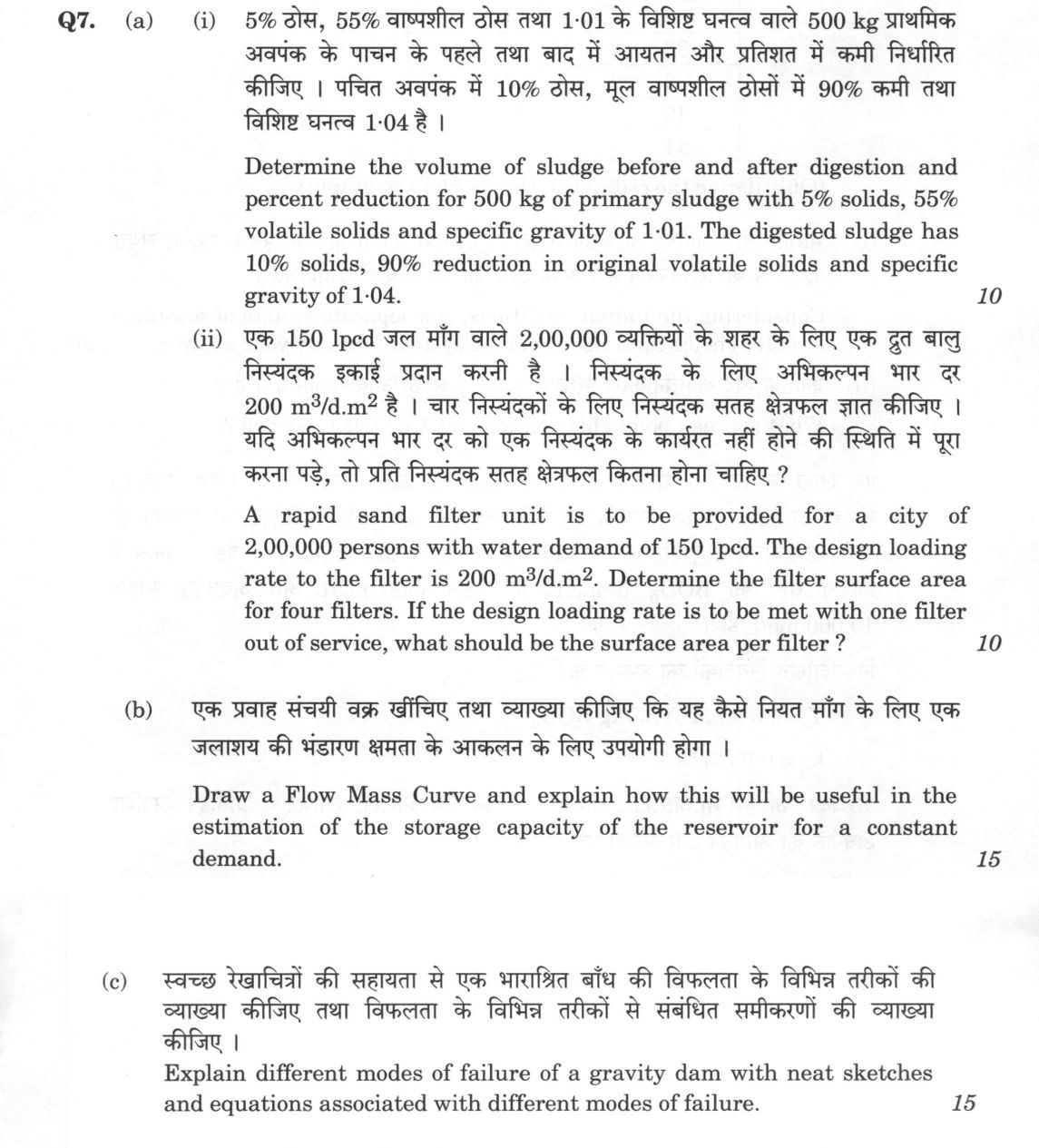
(a(i)) calculate: given > formula > substitution > result with units > interpretation | (a(ii)) calculate: given > formula > substitution > result with units > interpretation | (b) explain: definition/context > points in order > small example > short close | (c) explain: definition/context > points in order > small example > short close Full marks: Complete calculations with units, clear diagrams, and correct application of principles.
Key points expected
- Mass balance on solids (500 kg, 5% solids)
- Volume calculation using specific gravity (1.01, 1.04)
- Volatile solids reduction calculation (90%)
- Percent reduction in volume
- Total water demand calculation (2,000,000 persons × 150 lpcd)
- Filter area calculation using loading rate (200 m³/d.m²)
- Area per filter for 4 filters
- Area per filter for 3 filters (one out of service)
Evaluation rubric
Each sub-part is marked on its own, against the marks and word limit printed on the paper.
- (a(i)) Sludge volume before/after digestion and percent reduction. 10 marks
calculate— given → formula → substitution → result with units → interpretation
Must cover
- Mass balance on solids (500 kg, 5% solids)
- Volume calculation using specific gravity (1.01, 1.04)
- Volatile solids reduction calculation (90%)
- Percent reduction in volume
Loses marks
- Ignoring specific gravity in volume calculation
- Confusing solids percentage with volatile solids percentage
Earns more
- Explicit statement of assumptions (e.g., no water loss)
- Clear unit conversion (kg to m³)
Extra mark
- Reference to standard sludge digestion design parameters
- (a(ii)) Filter surface area for 4 filters and 3 filters (one out of service). 10 marks
calculate— given → formula → substitution → result with units → interpretation
Must cover
- Total water demand calculation (2,000,000 persons × 150 lpcd)
- Filter area calculation using loading rate (200 m³/d.m²)
- Area per filter for 4 filters
- Area per filter for 3 filters (one out of service)
Loses marks
- Using total area for the 'one out of service' calculation
- Unit errors in water demand or loading rate
Earns more
- Clear distinction between total area and area per filter
- Explicit handling of the 'one filter out of service' condition
Extra mark
- Mention of standard rapid sand filter design guidelines
- (b) Flow Mass Curve and its use in reservoir storage estimation. 15 marks
explain— definition/context → points in order → small example → short close
Must cover
- Definition and construction of Flow Mass Curve
- Explanation of how it estimates storage capacity
- Application to constant demand scenario
- Identification of maximum storage requirement
Loses marks
- Confusing Flow Mass Curve with hydrograph
- Failing to link the curve to storage estimation
Earns more
- Clear diagram of Flow Mass Curve
- Explanation of the 'mass' concept (cumulative flow)
Extra mark
- Example calculation or specific case study
- (c) Modes of failure of a gravity dam with sketches and equations. 15 marks
explain— definition/context → points in order → small example → short close
Must cover
- Sliding failure mode and equation
- Overturning failure mode and equation
- Shear failure mode and equation
- Neat sketches for each mode
Loses marks
- Missing equations for any failure mode
- Unclear or missing sketches
Earns more
- Clear labeling of forces in sketches
- Explanation of safety factors for each mode
Extra mark
- Reference to specific dam failure case studies
Practice this exact question
Write your answer and it is marked point by point against the model answer above — what you covered, what you missed, what you got wrong.
Evaluate my answer →More from Civil Engineering 2022 Paper II
- Q4 (a) In a layout of B.G. Yard, an 8° curve branches off from a 4° main curve in an opposit…
- Q5 (a) A catchment has six rain gauge stations. In a year, the annual rainfall recorded by t…
- Q6 (a) (i) Define unit hydrograph. Explain two basic assumptions made in the derivation of a…
- Q7 Answer the following questions in about 250 words each: (a) Analyse the growth of communa…
- Q8 Answer the following questions in about 250 words each: (a) Discuss the major environment…