Paper II — Q5
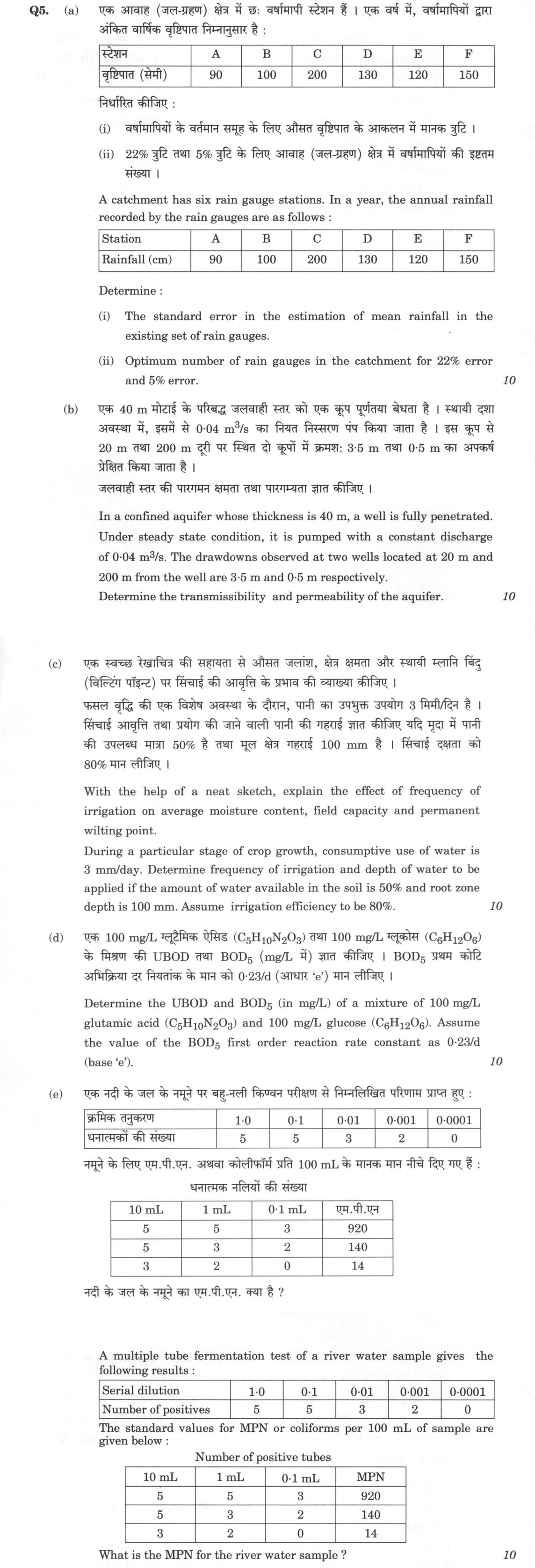
(a) A catchment has six rain gauge stations. In a year, the annual rainfall recorded by the rain gauges are as follows: |…
A catchment has six rain gauge stations. In a year, the annual rainfall recorded by the rain gauges are as follows:
| Station | A | B | C | D | E | F |
|---|---|---|---|---|---|---|
| Rainfall (cm) | 90 | 100 | 200 | 130 | 120 | 150 |
Determine: The standard error in the estimation of mean rainfall in the existing set of rain gauges.
Optimum number of rain gauges in the catchment for 22% error and 5% error. 10 marks
In a confined aquifer whose thickness is 40 m, a well is fully penetrated. Under steady state condition, it is pumped with a constant discharge of 0·04 m³/s. The drawdowns observed at two wells located at 20 m and 200 m from the well are 3·5 m and 0·5 m respectively.
Determine the transmissibility and permeability of the aquifer. 10 marks
With the help of a neat sketch, explain the effect of frequency of irrigation on average moisture content, field capacity and permanent wilting point.
During a particular stage of crop growth, consumptive use of water is 3 mm/day. Determine frequency of irrigation and depth of water to be applied if the amount of water available in the soil is 50% and root zone depth is 100 mm. Assume irrigation efficiency to be 80%. 10 marks
Determine the UBOD and BOD₅ (in mg/L) of a mixture of 100 mg/L glutamic acid (C₅H₁₀N₂O₃) and 100 mg/L glucose (C₆H₁₂O₆). Assume the value of the BOD₅ first order reaction rate constant as 0·23/d (base 'e'). 10 marks
A multiple tube fermentation test of a river water sample gives the following results:
| Serial dilution | 1·0 | 0·1 | 0·01 | 0·001 | 0·0001 |
|---|---|---|---|---|---|
| Number of positives | 5 | 5 | 3 | 2 | 0 |
The standard values for MPN or coliforms per 100 mL of sample are given below:
Number of positive tubes
| 10 mL | 1 mL | 0·1 mL | MPN |
|---|---|---|---|
| 5 | 5 | 3 | 920 |
| 5 | 3 | 2 | 140 |
| 3 | 2 | 0 | 14 |
What is the MPN for the river water sample? 10 marks
हिंदी में प्रश्न पढ़ें
एक आवाह (जल-ग्रहण) क्षेत्र में छः वर्षामापी स्टेशन हैं । एक वर्ष में, वर्षामापियों द्वारा अंकित वार्षिक वृष्टिपात निम्नानुसार है :
| स्टेशन | A | B | C | D | E | F |
|---|---|---|---|---|---|---|
| वृष्टिपात (सेमी) | 90 | 100 | 200 | 130 | 120 | 150 |
निर्धारित कीजिए : वर्षामापियों के वर्तमान समूह के लिए औसत वृष्टिपात के आकलन में मानक त्रुटि ।
22% त्रुटि तथा 5% त्रुटि के लिए आवाह (जल-ग्रहण) क्षेत्र में वर्षामापियों की इष्टतम संख्या । (10 अंक)
एक 40 m मोटाई के परिबद्ध जलवाही स्तर को एक कूप पूर्णतया बेधता है । स्थायी दशा अवस्था में, इसमें से 0·04 m³/s का नियत निस्सरण पंप किया जाता है । इस कूप से 20 m तथा 200 m दूरी पर स्थित दो कूपों में क्रमशः 3·5 m तथा 0·5 m का अपकर्ष प्रेक्षित किया जाता है ।
जलवाही स्तर की पारगमन क्षमता तथा पारगम्यता ज्ञात कीजिए । (10 अंक)
एक स्वच्छ रेखाचित्र की सहायता से औसत जलांश, क्षेत्र क्षमता और स्थायी म्लानी बिंदु (विल्टिंग पॉइंट) पर सिंचाई की आवृत्ति के प्रभाव की व्याख्या कीजिए ।
फसल वृद्धि की एक विशेष अवस्था के दौरान, पानी का उपभुक्त उपयोग 3 मिमी/दिन है । सिंचाई आवृत्ति तथा प्रयोग की जाने वाली पानी की गहराई ज्ञात कीजिए यदि मृदा में पानी की उपलब्ध मात्रा 50% है तथा मूल क्षेत्र गहराई 100 mm है । सिंचाई दक्षता को 80% मान लीजिए । (10 अंक)
एक 100 mg/L ग्लूटेमिक एसिड (C₅H₁₀N₂O₃) तथा 100 mg/L ग्लूकोस (C₆H₁₂O₆) के मिश्रण की UBOD तथा BOD₅ (mg/L में) ज्ञात कीजिए । BOD₅ प्रथम कोटि अभिक्रिया दर नियतांक के मान को 0·23/d (आधार 'e') मान लीजिए । (10 अंक)
एक नदी के जल के नमूने पर बहु-नली किंवन परीक्षण से निम्नलिखित परिणाम प्राप्त हुए :
| क्रमिक तनुकरण | 1·0 | 0·1 | 0·01 | 0·001 | 0·0001 |
|---|---|---|---|---|---|
| धनात्मकों की संख्या | 5 | 5 | 3 | 2 | 0 |
नमूने के लिए एम.पी.एन. अथवा कोलीफॉर्म प्रति 100 mL के मानक मान नीचे दिए गए हैं :
| धनात्मक नलियों की संख्या | |||
|---|---|---|---|
| 10 mL | 1 mL | 0·1 mL | एम.पी.एन |
| 5 | 5 | 3 | 920 |
| 5 | 3 | 2 | 140 |
| 3 | 2 | 0 | 14 |
नदी के जल के नमूने का एम.पी.एन. क्या है ? (10 अंक)
The figure this question refers to, in words
The question paper is a scan and the diagram did not survive as text. This is the figure as read from the original page — every component, value and label — so the question can be worked from the text below.
(a) Table with two rows: Station: A | B | C | D | E | F Rainfall (cm): 90 | 100 | 200 | 130 | 120 | 150
(e) Table 1 (Serial dilution results): Serial dilution: 1.0 | 0.1 | 0.01 | 0.001 | 0.0001 Number of positives: 5 | 5 | 3 | 2 | 0
Table 2 (Standard values for MPN or coliforms per 100 mL of sample): Number of positive tubes: 10 mL | 1 mL | 0.1 mL | MPN 5 | 5 | 3 | 920 5 | 3 | 2 | 140 3 | 2 | 0 | 14
Model answer
Written by UPSC Answer Check against this question's marking rubric, to the expected length. UPSC does not publish answers for Mains — this is one way to score well, not an official key.
(a)(i) The standard error in the estimation of mean rainfall for an existing set of rain gauges is obtained from the sample mean and sample standard deviation.
Mean rainfall of the six stations: P̄ = (90 + 100 + 200 + 130 + 120 + 150) ÷ 6 = 790 ÷ 6 = 131.667 cm.
Using the sample standard deviation formula: s = √[Σ(P − P̄)² ÷ (n − 1)]
Deviations and squares:
- A: 90 − 131.667 = −41.667; square = 1736.111 cm²
- B: 100 − 131.667 = −31.667; square = 1002.778 cm²
- C: 200 − 131.667 = 68.333; square = 4669.444 cm²
- D: 130 − 131.667 = −1.667; square = 2.778 cm²
- E: 120 − 131.667 = −11.667; square = 136.111 cm²
- F: 150 − 131.667 = 18.333; square = 336.111 cm²
Σ(P − P̄)² = 7883.333 cm² s² = 7883.333 ÷ (6 − 1) = 1576.667 cm² s = √1576.667 = 39.707 cm
Standard error of the mean: SE = s ÷ √n = 39.707 ÷ √6 = 16.210 cm
Coefficient of variation: Cv = 100 × s ÷ P̄ = 100 × 39.707 ÷ 131.667 = 30.157%
Percentage standard error: = Cv ÷ √n = 30.157 ÷ √6 = 12.312%
Final answer: Standard error = 16.21 cm, or 12.31% of the mean.
(a)(ii) The optimum number of rain gauges is found by the hydrologic relation: N = (Cv ÷ E)² where E is the allowable percentage error.
For 22% error: N = (30.157 ÷ 22)² = (1.3708)² = 1.879 Adopt N = 2 gauges. Thus the existing 6 gauges are more than sufficient for 22% error.
For 5% error: N = (30.157 ÷ 5)² = (6.0314)² = 36.378 Adopt N = 37 gauges.
Final answer: Optimum number = 2 gauges for 22% error and 37 gauges for 5% error. This assumes the same coefficient of variation and that the allowable error is expressed as a percentage of the mean rainfall.
(b) For steady radial flow to a fully penetrating well in a confined aquifer, Thiem’s equation is used: s₁ − s₂ = Q × ln(r₂ ÷ r₁) ÷ (2πT) where s is drawdown, r is radial distance, Q is discharge, and T is transmissibility.
Given: Q = 0.04 m³/s r₁ = 20 m, r₂ = 200 m s₁ = 3.5 m, s₂ = 0.5 m s₁ − s₂ = 3.5 − 0.5 = 3.0 m
ln(r₂ ÷ r₁) = ln(200 ÷ 20) = ln 10 = 2.302585
Therefore: T = Q × ln(r₂ ÷ r₁) ÷ [2π(s₁ − s₂)] T = 0.04 × 2.302585 ÷ (2π × 3.0) T = 0.0921034 ÷ 18.84956 T = 0.004886 m²/s
In m²/day: T = 0.004886 × 86400 = 422.2 m²/day
Aquifer thickness b = 40 m. Permeability k = T ÷ b: k = 0.004886 ÷ 40 = 1.2215 × 10⁻⁴ m/s
In cm/s: k = 1.2215 × 10⁻⁴ × 100 = 0.01222 cm/s
In m/day: k = 1.2215 × 10⁻⁴ × 86400 = 10.55 m/day
Final answer: Transmissibility T = 4.886 × 10⁻³ m²/s = 422.2 m²/day. Permeability k = 1.222 × 10⁻⁴ m/s = 0.01222 cm/s = 10.55 m/day. Valid for steady, confined, homogeneous, isotropic aquifer with negligible well loss.
(c) For the sketch, draw time on the horizontal axis and soil moisture on the vertical axis. Mark two horizontal lines: field capacity, FC, above and permanent wilting point, PWP, below.
- A frequent-irrigation curve is a small-amplitude saw-tooth lying high between FC and PWP. Its average moisture content is close to FC.
- An infrequent-irrigation curve is a large-amplitude saw-tooth. It starts near FC, falls close to PWP, and then rises again after irrigation. Its average moisture content is much lower.
- FC and PWP are soil properties and remain unchanged by irrigation frequency. Only the average moisture content and the fluctuation between successive irrigations change.
Frequent irrigation keeps the soil moisture high and reduces crop stress, but excessive frequency may cause waterlogging and poor aeration. Infrequent irrigation allows greater depletion, lowers the average moisture, and may approach PWP, causing moisture stress to the crop.
Calculation: Available water in soil = 50% of root-zone depth = 0.50 × 100 mm = 50 mm
Consumptive use = 3 mm/day
Frequency of irrigation: = available water ÷ consumptive use = 50 ÷ 3 = 16.67 days
Gross depth of water to be applied: = net depth ÷ irrigation efficiency = 50 ÷ 0.80 = 62.5 mm
Final answer: Frequency of irrigation = 16.67 days, approximately 1.8 irrigations per month. Depth of water to be applied = 62.5 mm.
(d) For carbonaceous ultimate BOD, use the stoichiometric oxygen demand formula for an organic compound C_aH_bO_cN_d, assuming nitrogen is released as ammonia: O₂ required = a + b/4 − c/2 − 3d/4 mol O₂ per mol of compound.
For glutamic acid C₅H₁₀N₂O₃: a = 5, b = 10, c = 3, d = 2 O₂ = 5 + 10/4 − 3/2 − 3×2/4 O₂ = 5 + 2.5 − 1.5 − 1.5 = 4.5 mol O₂/mol
Molecular weight of C₅H₁₀N₂O₃: = 5×12 + 10×1 + 2×14 + 3×16 = 146 g/mol
UBOD from 100 mg/L glutamic acid: = 100 × (4.5 × 32) ÷ 146 = 100 × 144 ÷ 146 = 98.63 mg/L
For glucose C₆H₁₂O₆: a = 6, b = 12, c = 6, d = 0 O₂ = 6 + 12/4 − 6/2 = 6 + 3 − 3 = 6 mol O₂/mol
Molecular weight of C₆H₁₂O₆: = 6×12 + 12×1 + 6×16 = 180 g/mol
UBOD from 100 mg/L glucose: = 100 × (6 × 32) ÷ 180 = 100 × 192 ÷ 180 = 106.67 mg/L
Total UBOD of mixture: = 98.63 + 106.67 = 205.30 mg/L
For BOD₅: BOD₅ = UBOD × (1 − e^(−k t)) k = 0.23/d, t = 5 d k t = 0.23 × 5 = 1.15 e^(−1.15) = 0.31664 1 − e^(−1.15) = 0.68336
BOD₅ = 205.30 × 0.68336 = 140.29 mg/L
Final answer: UBOD = 205.30 mg/L. BOD₅ = 140.29 mg/L. This treats ultimate BOD as carbonaceous demand; nitrogenous oxygen demand is not included.
(e) The observed positive tubes are:
- Serial dilution 1.0: 5 positives
- 0.1: 5 positives
- 0.01: 3 positives
- 0.001: 2 positives
- 0.0001: 0 positives
For MPN determination, select three consecutive dilutions such that the highest dilution has at least one positive tube and the next higher dilution has none. The highest positive dilution is 0.001 with 2 positives, and the next dilution 0.0001 has zero positives.
Thus the three consecutive dilutions to be used are: 0.1, 0.01, 0.001 with positive tubes 5, 3, 2.
From the given standard MPN table, the row for positive tubes 5 | 3 | 2 gives: MPN = 140 per 100 mL.
Final answer: MPN = 140 coliforms per 100 mL of river water sample.
What "Solve" is asking you to do
Choose the method, then carry it through to a final answer. Identifying what kind of problem this is and why that method applies is the first thing marked; a correct figure arrived at invisibly earns almost nothing.
Structure that answers it
Given data and what is required → method chosen, with the reason it applies → set-up (equation, circuit, free body, trial balance) → working, step by step → answer with units and any condition of validity
Where marks are lost
Doing the middle steps mentally and writing only the result. In mathematics papers, a further loss comes from giving a decimal where the exact value in surds or fractions was wanted, or from skipping the justification a part explicitly asks for.
How this answer will be evaluated
Approach
(a) calculate: given > formula > substitution > result with units > interpretation | (b) calculate: given > formula > substitution > result with units > interpretation | (c) calculate: given > formula > substitution > result with units > interpretation | (d) calculate: given > formula > substitution > result with units > interpretation | (e) calculate: given > formula > substitution > result with units > interpretation Full marks: All parts solved with correct formulas, units, and clear steps; sketches where required.
Key points expected
- Calculate mean rainfall (138.33 cm)
- Calculate standard deviation (45.09 cm)
- Compute coefficient of variation (32.6%)
- Apply formula N = (CV/P)^2 for both error limits
- Use Thiem equation for confined aquifer
- Substitute Q, r1, r2, s1, s2 correctly
- Calculate Transmissibility (T) in m²/s
- Calculate Permeability (k) using T = k * b
Evaluation rubric
Each sub-part is marked on its own, against the marks and word limit printed on the paper.
- (a) Standard error of mean rainfall and optimum number of gauges for 22% and 5% error. 10 marks
calculate— given → formula → substitution → result with units → interpretation
Must cover
- Calculate mean rainfall (138.33 cm)
- Calculate standard deviation (45.09 cm)
- Compute coefficient of variation (32.6%)
- Apply formula N = (CV/P)^2 for both error limits
Loses marks
- Using population standard deviation instead of sample
- Forgetting to square the CV in formula
Earns more
- Show calculation of variance
- State formula for standard error
- Round N to nearest integer
Extra mark
- Mention that N is rounded up to next integer
- (b) Transmissibility and permeability of the confined aquifer. 10 marks
calculate— given → formula → substitution → result with units → interpretation
Must cover
- Use Thiem equation for confined aquifer
- Substitute Q, r1, r2, s1, s2 correctly
- Calculate Transmissibility (T) in m²/s
- Calculate Permeability (k) using T = k * b
Loses marks
- Using unconfined aquifer formula
- Incorrect substitution of radii or drawdowns
Earns more
- State assumption of steady state flow
- Show unit conversion if necessary
Extra mark
- Mention Darcy's law basis
- (c) Irrigation frequency and depth of water to be applied. 10 marks
calculate— given → formula → substitution → result with units → interpretation
Must cover
- Calculate available water in root zone
- Determine irrigation frequency (days)
- Calculate net depth of water required
- Calculate gross depth using irrigation efficiency
Loses marks
- Ignoring irrigation efficiency in depth calculation
- Incorrect calculation of available water
Earns more
- Sketch showing moisture content vs time
- Define field capacity and wilting point
Extra mark
- Mention effect of irrigation frequency on soil structure
- (d) UBOD and BOD5 of the mixture of glutamic acid and glucose. 10 marks
calculate— given → formula → substitution → result with units → interpretation
Must cover
- Calculate theoretical oxygen demand for each compound
- Sum UBOD for the mixture
- Apply first-order reaction formula for BOD5
- Use k = 0.23/d (base e) in calculation
Loses marks
- Using base 10 instead of base e for k
- Incorrect molecular weight calculation
Earns more
- Show stoichiometric equations for oxidation
- State assumption of complete oxidation
Extra mark
- Mention that BOD5 is 68% of UBOD for k=0.23
- (e) MPN for the river water sample. 10 marks
calculate— given → formula → substitution → result with units → interpretation
Must cover
- Identify the correct row in the MPN table
- Match the number of positive tubes (5, 5, 3)
- Read the corresponding MPN value (920)
- State the MPN per 100 mL
Loses marks
- Selecting wrong row from the table
- Not specifying the unit (per 100 mL)
Earns more
- Explain how to use the MPN table
- Mention that 5,5,3 corresponds to 920 MPN
Extra mark
- Mention that MPN is a statistical estimate
Practice this exact question
Write your answer and it is marked point by point against the model answer above — what you covered, what you missed, what you got wrong.
Evaluate my answer →More from Civil Engineering 2022 Paper II
- Q2 (a) A construction company is planning to purchase an excavation equipment for operating…
- Q3 (a) A two-lane State Highway in plain terrain, with cutting section having camber of 2·0%…
- Q4 (a) In a layout of B.G. Yard, an 8° curve branches off from a 4° main curve in an opposit…
- Q5 (a) A catchment has six rain gauge stations. In a year, the annual rainfall recorded by t…
- Q6 (a) (i) Define unit hydrograph. Explain two basic assumptions made in the derivation of a…
- Q7 Answer the following questions in about 250 words each: (a) Analyse the growth of communa…
- Q8 Answer the following questions in about 250 words each: (a) Discuss the major environment…