Paper II — Q1
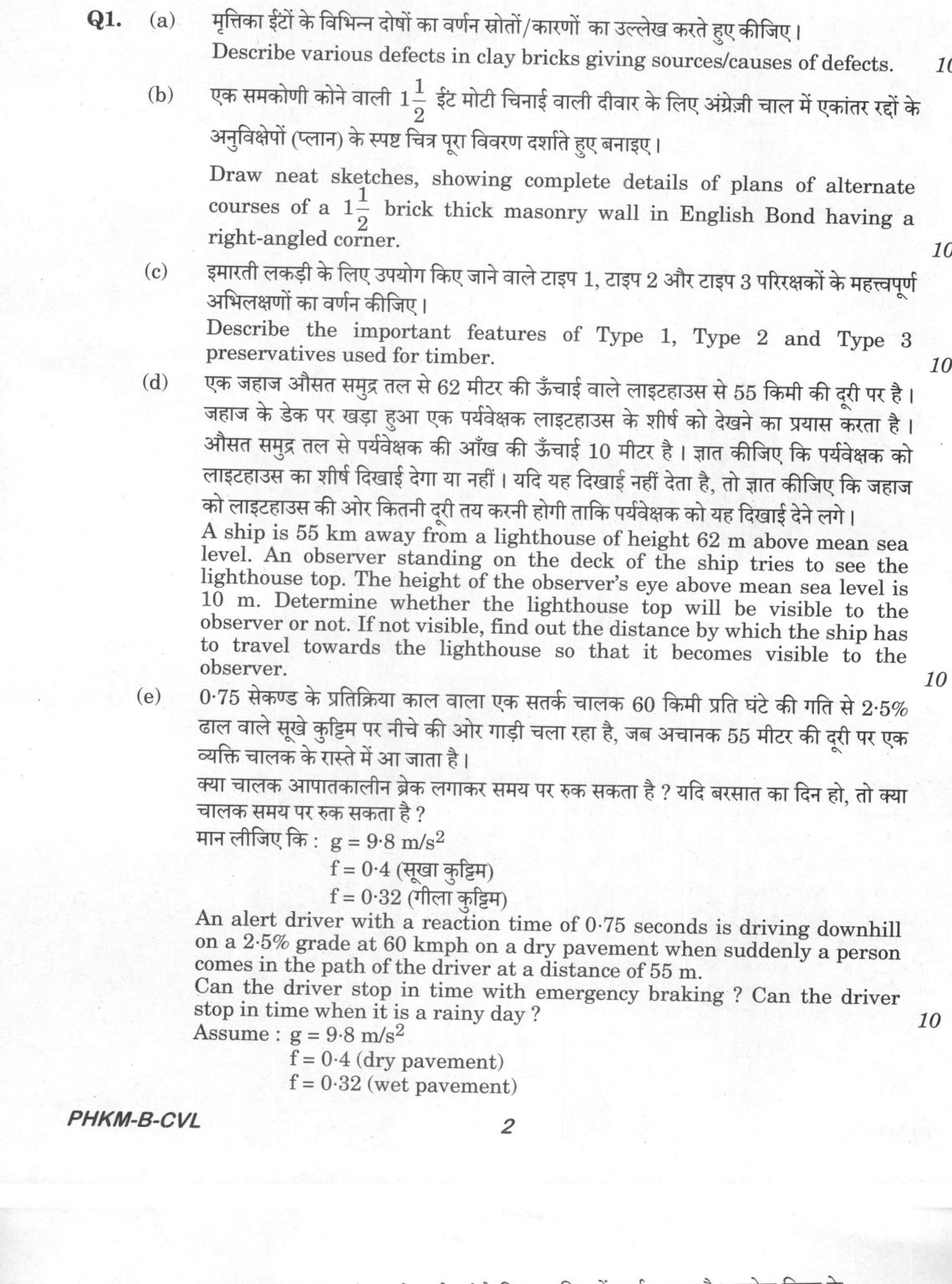
(a) Describe various defects in clay bricks giving sources/causes of defects. 10 marks (b) Draw neat sketches, showing complete…
Describe various defects in clay bricks giving sources/causes of defects. 10 marks
Draw neat sketches, showing complete details of plans of alternate courses of a 1½ brick thick masonry wall in English Bond having a right-angled corner. 10 marks
Describe the important features of Type 1, Type 2 and Type 3 preservatives used for timber. 10 marks
A ship is 55 km away from a lighthouse of height 62 m above mean sea level. An observer standing on the deck of the ship tries to see the lighthouse top. The height of the observer's eye above mean sea level is 10 m. Determine whether the lighthouse top will be visible to the observer or not. If not visible, find out the distance by which the ship has to travel towards the lighthouse so that it becomes visible to the observer. 10 marks
An alert driver with a reaction time of 0·75 seconds is driving downhill on a 2·5% grade at 60 kmph on a dry pavement when suddenly a person comes in the path of the driver at a distance of 55 m. Can the driver stop in time with emergency braking? Can the driver stop in time when it is a rainy day? Assume: g = 9·8 m/s², f = 0·4 (dry pavement), f = 0·32 (wet pavement) 10 marks
हिंदी में प्रश्न पढ़ें
मृत्तिका ईंटों के विभिन्न दोषों का वर्णन स्रोतों/कारणों का उल्लेख करते हुए कीजिए। 10
एक समकोणी कोने वाली 1½ ईंट मोटी चिनाई वाली दीवार के लिए अंग्रेजी चाल में एकान्तर रद्दों के अनुविख्षेपों (प्लान) के स्पष्ट चित्र पूरा विवरण दर्शाते हुए बनाइए। 10
इमारती लकड़ी के लिए उपयोग किए जाने वाले टाइप 1, टाइप 2 और टाइप 3 परिरक्षकों के महत्त्वपूर्ण अभिलक्षणों का वर्णन कीजिए। 10
एक जहाज औसत समुद्र तल से 62 मीटर की ऊँचाई वाले लाइटहाउस से 55 किमी की दूरी पर है। जहाज के डेक पर खड़ा हुआ एक पर्यवेक्षक लाइटहाउस के शीर्ष को देखने का प्रयास करता है। औसत समुद्र तल से पर्यवेक्षक की आँख की ऊँचाई 10 मीटर है। ज्ञात कीजिए कि पर्यवेक्षक को लाइटहाउस का शीर्ष दिखाई देगा या नहीं। यदि यह दिखाई नहीं देता है, तो ज्ञात कीजिए कि जहाज को लाइटहाउस की ओर कितनी दूरी तय करनी होगी ताकि पर्यवेक्षक को यह दिखाई देने लगे। 10
0·75 सेकंड के प्रतिक्रिया काल वाला एक सतर्क चालक 60 किमी प्रति घंटे की गति से 2·5% ढाल वाले सूखे कुंडिम पर नीचे की ओर गाड़ी चला रहा है, जब अचानक 55 मीटर की दूरी पर एक व्यक्ति चालक के रास्ते में आ जाता है। क्या चालक आपातकालीन ब्रेक लगाकर समय पर रुक सकता है? यदि बरसात का दिन हो, तो क्या चालक समय पर रुक सकता है? मान लीजिए कि: g = 9·8 m/s², f = 0·4 (सूखा कुंडिम), f = 0·32 (गीला कुंडिम) 10 marks
Model answer
Written by UPSC Answer Check against this question's marking rubric, to the expected length. UPSC does not publish answers for Mains — this is one way to score well, not an official key.
The five parts require material checks and geometric calculations.
(a) Brick defects. The common defects in clay bricks and their sources are: efflorescence, caused by soluble salts in the clay, water or lime migrating to the surface and crystallising; bloating, caused by over-firing or rapid heating which expands impurities or steam; laminations, caused by air pockets trapped during pugging, insufficient wedging, or organic matter in the clay; cracks, caused by uneven drying, rapid drying, shrinkage, poor curing, or thermal shock; warping, caused by improper stacking, uneven support, differential drying, or poor curing; black core, caused by under-firing, insufficient oxidation in the kiln, or impurities in the clay; spalling, caused by poor curing, frost action, or rapid heating; honeycombing, caused by poor clay, insufficient wedging, or excess sand; bulging, caused by over-firing or impurities in the clay; and glazing, caused by over-firing or fluxing impurities. These defects reduce strength, durability and appearance.
(b) English bond, 1½ brick wall. A 1½ brick wall is 13½ inch (345 mm) thick. In English bond, alternate courses of headers and stretchers are laid, giving a quarter-brick lap. For the plan of the header course, draw the two wall arms at a right angle using the standard brick 9 x 4.5 x 3 in and 10 mm mortar joints. The outer wythe consists of headers, i.e. brick ends exposed on the face; each header is 4.5 in wide on the face and 9 in deep across the wall. The inner wythe consists of stretchers, i.e. long faces parallel to the wall; each stretcher is 9 in long and 4.5 in wide. At the external corner, place a quoin header so that the header course is continuous; at the internal corner, place a queen closer to break the inner stretcher course. For the plan of the next stretcher course, the outer wythe consists of stretchers and the inner wythe consists of headers. At the external corner, a queen closer is used to break the outer stretcher course; at the internal corner, a quoin header is used. The vertical joints in the two courses are staggered, so no vertical joint is continuous from one course to the next. The two plans should be drawn one above the other, with the header course and the stretcher course clearly labelled. The lap is obtained because the header-course joints fall midway between the stretcher-course joints. The sketches should show the 13½ inch thickness, the two wythes, the header/stretcher arrangement, and the corner closers.
(c) Timber preservatives. Type 1 preservatives are tar-oil creosote and coal-tar based; they are highly toxic, dark brown, water resistant, and used for heavy timber, poles, sleepers, and ground-contact members by pressure treatment. They are not recommended for residential construction because of odour and toxicity. Type 2 preservatives are water-borne inorganic salts, especially CCA (chromated copper arsenate) and CCB; they are less toxic than creosote but still hazardous, give a green or brown stain, are used for general construction, outdoor timber, and pressure-treated for good retention. They should not be used where leaching into soil or water is likely. Type 3 preservatives are organic-solvent types, such as pentachlorophenol (penta); they are used for temporary or light-duty protection, indoor timber, and are applied by pressure, dipping, or brushing; they are toxic, less durable, and may darken or stain. They are not suitable for heavy ground contact. IS 401, the code of practice for preservative treatment of timber, classifies these types and prescribes retention, application methods, and toxicity considerations.
(d) Visibility. The dip of horizon is found from the right triangle formed by the eye, the horizon, and the Earth's centre. For height h above sea level and R = 6370 km, the geometrical distance is d = √(2Rh) (with h in km); with the usual refraction correction the working formula is d = 3.857√h km, h in metres. The line of sight just touches the Earth's surface at the horizon; if the sum of the two horizon distances is less than the separation, the top is hidden by the curvature of the Earth. For the lighthouse, h = 62 m, so dL = 3.857√62 = 30.4 km. For the observer, h = 10 m, so do = 3.857√10 = 12.2 km. The maximum distance at which the lighthouse top can be seen is dL + do = 42.6 km. Since the ship is 55 km away, the lighthouse top is not visible. The ship must travel 55 - 42.6 = 12.4 km towards the lighthouse.
(e) Stopping sight distance. The stopping sight distance is the sum of the distance travelled during reaction and the braking distance. On a downgrade, the grade reduces the effective friction, so f - S is used. The calculation assumes a level obstacle and that the driver applies brakes immediately after the reaction time. The speed is 60 km/h = 16.67 m/s. The reaction distance is vt = 16.67 x 0.75 = 12.5 m. For dry pavement, f = 0.4 and S = 0.025, so SSD = 12.5 + (16.67²)/(2 x 9.8 x (0.4 - 0.025)) = 12.5 + 277.8/7.35 = 12.5 + 37.8 = 50.3 m. Since 50.3 m is less than the available 55 m, the driver can stop in time on dry pavement, with about 4.7 m margin. For wet pavement, f = 0.32, so SSD = 12.5 + 277.8/(19.6 x 0.295) = 12.5 + 48.0 = 60.5 m. Since 60.5 m is greater than 55 m, the driver cannot stop in time on a rainy day; the available distance is short by about 5.5 m.
Thus, the lighthouse top becomes visible only after the ship has closed about 12.4 km, and the driver can stop safely only on dry pavement; on wet pavement the required SSD exceeds the available 55 m. These results show that material quality, correct bond, line-of-sight distance, and stopping sight distance are practical controls in construction and highway safety.
What "Describe" is asking you to do
Give a full, ordered account of the thing named — its parts, stages or mechanism — in the sequence in which it actually exists or occurs. Most describe questions come from the science optionals, where the marks sit in correct technical detail and, where the stem says so, a labelled diagram.
Structure that answers it
One-line identification of the subject → the parts or stages in their real order, each with its defining detail → labelled diagram where the subject is structural → closing line on function or significance
Where marks are lost
Loose general prose where the examiner is ticking named parts, correct terminology and their sequence; and in the General Studies papers, turning to evaluation before the description is finished.
How this answer will be evaluated
Approach
(a) describe: define > structure or process in order > labelled diagram > significance | (b) describe: define > structure or process in order > labelled diagram > significance | (c) describe: define > structure or process in order > labelled diagram > significance | (d) calculate: given > formula > substitution > result with units > interpretation | (e) calculate: given > formula > substitution > result with units > interpretation Full marks: All parts answered with correct formulas, clear sketches, and proper units. No calculation errors.
Key points expected
- Identify at least 4-5 distinct defects (e.g., warping, cracks, bulging)
- Link each defect to a specific cause (e.g., uneven drying, impurities)
- Mention defects related to over/under firing
- Mention defects related to moulding or handling
- Show 1.5 brick thickness (3 bricks wide)
- Show English Bond pattern (alternating headers and stretchers)
- Show right-angled corner with proper lap
- Label 'Header' and 'Stretcher' clearly
Evaluation rubric
Each sub-part is marked on its own, against the marks and word limit printed on the paper.
- (a) List various defects in clay bricks and identify the specific source or cause for each. 10 marks
describe— define → structure or process in order → labelled diagram → significance
Must cover
- Identify at least 4-5 distinct defects (e.g., warping, cracks, bulging)
- Link each defect to a specific cause (e.g., uneven drying, impurities)
- Mention defects related to over/under firing
- Mention defects related to moulding or handling
Loses marks
- Listing defects without causes
- Vague causes like 'bad quality'
Earns more
- Mention 'shrinkage' as a cause for cracks
- Mention 'iron pyrites' as a cause for bulging
- Mention 'uneven burning' as a cause for warping
Extra mark
- Reference IS 1077 for brick classification
- (b) Draw neat sketches of plans for alternate courses of a 1.5 brick thick wall in English Bond with a right-angled corner. 10 marks
describe— define → structure or process in order → labelled diagram → significance
Must cover
- Show 1.5 brick thickness (3 bricks wide)
- Show English Bond pattern (alternating headers and stretchers)
- Show right-angled corner with proper lap
- Label 'Header' and 'Stretcher' clearly
Loses marks
- Drawing only one course
- Incorrect bond pattern (e.g., running bond)
Earns more
- Show 1/4 brick lap at corners
- Show 1/2 brick lap between courses
- Neat, to-scale sketch
Extra mark
- Show a 3D isometric view of the corner
- (c) Describe the important features of Type 1, Type 2, and Type 3 preservatives used for timber. 10 marks
describe— define → structure or process in order → labelled diagram → significance
Must cover
- Define Type 1 (non-toxic, water-soluble)
- Define Type 2 (toxic, water-soluble)
- Define Type 3 (non-toxic, oil-soluble)
- Give one example for each type
Loses marks
- Confusing Type 1 and Type 2
- Failing to mention solubility (water vs oil)
Earns more
- Mention 'Borax' for Type 1
- Mention 'Copper Sulphate' for Type 2
- Mention 'Creosote' for Type 3
- Mention 'Penetrating power' as a feature
Extra mark
- Mention 'IS 399' for timber preservatives
- (d) Determine if a lighthouse is visible from a ship and calculate the required distance to travel if not visible. 10 marks
calculate— given → formula → substitution → result with units → interpretation
Must cover
- Use formula D = 2.08√h (or similar standard formula)
- Calculate distance to horizon for lighthouse (h=62m)
- Calculate distance to horizon for observer (h=10m)
- Compare sum of distances with given 55 km
Loses marks
- Using wrong formula for distance to horizon
- Failing to convert units (m to km)
Earns more
- Show calculation for D_lighthouse
- Show calculation for D_observer
- Calculate required distance to travel
Extra mark
- Mention 'dip of horizon' correction
- (e) Calculate stopping sight distance for dry and wet pavement and determine if the driver can stop in time. 10 marks
calculate— given → formula → substitution → result with units → interpretation
Must cover
- Use SSD formula: SSD = 0.278vt + v²/(2gf ± 2gG)
- Calculate SSD for dry pavement (f=0.4, G=2.5%)
- Calculate SSD for wet pavement (f=0.32, G=2.5%)
- Compare calculated SSD with given 55 m
Loses marks
- Ignoring the grade (G) in the formula
- Using wrong value for g (9.8 m/s²)
Earns more
- Show calculation for reaction distance
- Show calculation for braking distance
- State clearly if driver can stop or not
Extra mark
- Mention 'IS 734' for highway design
Practice this exact question
Write your answer and it is marked point by point against the model answer above — what you covered, what you missed, what you got wrong.
Evaluate my answer →More from Civil Engineering 2024 Paper II
- Q1 (a) Describe various defects in clay bricks giving sources/causes of defects. 10 marks (b…
- Q2 (a) The network for a construction project is shown in the figure given below. The three…
- Q3 (a) (i) Explain spot speed, running speed, space-mean speed, time-mean speed and average…
- Q4 (a) The network of a certain project is shown in the figure given below with the estimate…