Paper II — Q6
(a) Explain an aquifer. Deduce the expression for discharge (Q) through a well in an unconfined aquifer taking usual symbols. If…
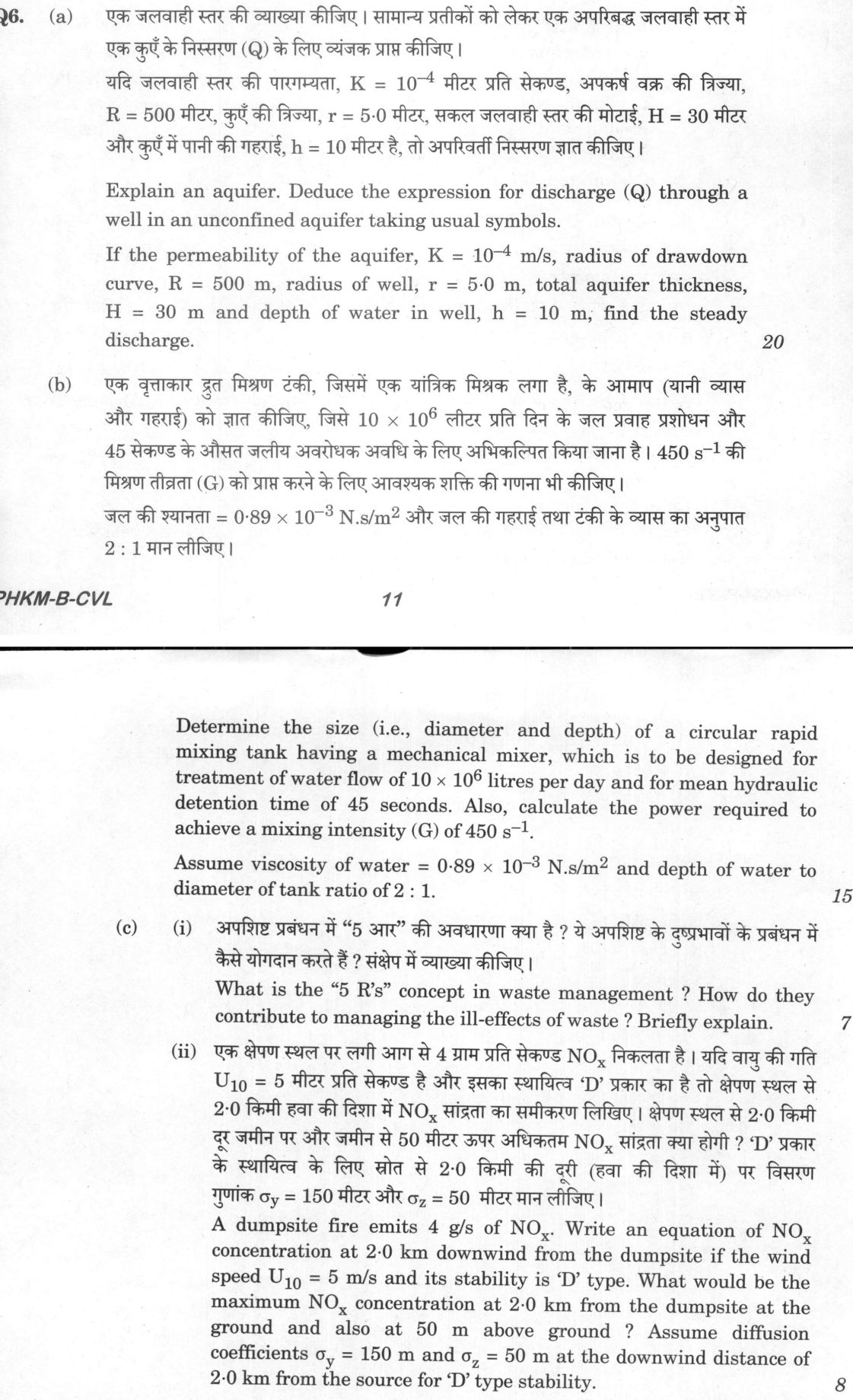
Explain an aquifer. Deduce the expression for discharge (Q) through a well in an unconfined aquifer taking usual symbols. If the permeability of the aquifer, K = 10⁻⁴ m/s, radius of drawdown curve, R = 500 m, radius of well, r = 5·0 m, total aquifer thickness, H = 30 m and depth of water in well, h = 10 m; find the steady discharge. 20 marks
Determine the size (i.e., diameter and depth) of a circular rapid mixing tank having a mechanical mixer, which is to be designed for treatment of water flow of 10 × 10⁶ litres per day and for mean hydraulic detention time of 45 seconds. Also, calculate the power required to achieve a mixing intensity (G) of 450 s⁻¹. Assume viscosity of water = 0·89 × 10⁻³ N.s/m² and depth of water to diameter of tank ratio of 2 : 1. 15 marks
What is the "5 R's" concept in waste management ? How do they contribute to managing the ill-effects of waste ? Briefly explain. 7 marks
A dumpsite fire emits 4 g/s of NOₓ. Write an equation of NOₓ concentration at 2·0 km downwind from the dumpsite if the wind speed U₁₀ = 5 m/s and its stability is 'D' type. What would be the maximum NOₓ concentration at 2·0 km from the dumpsite at the ground and also at 50 m above ground ? Assume diffusion coefficients σᵧ = 150 m and σᵤ = 50 m at the downwind distance of 2·0 km from the source for 'D' type stability. 8 marks
हिंदी में प्रश्न पढ़ें
एक जलवाही स्तर की व्याख्या कीजिए। सामान्य प्रतीकों को लेकर एक अपरिबद्ध जलवाही स्तर में एक कुएँ के निस्सरण (Q) के लिए व्यंजक प्राप्त कीजिए। यदि जलवाही स्तर की पारगम्यता, K = 10⁻⁴ मीटर प्रति सेकंड, अपकर्ष वक्र की त्रिज्या, R = 500 मीटर, कुएँ की त्रिज्या, r = 5·0 मीटर, सकल जलवाही स्तर की मोटाई, H = 30 मीटर और कुएँ में पानी की गहराई, h = 10 मीटर है, तो अपरिवर्ती निस्सरण ज्ञात कीजिए। (20 अंक)
एक वृत्ताकर द्रुत मिश्रण टंकी, जिसमें एक यांत्रिक मिश्रक लगा है, के आमाप (यानी व्यास और गहराई) को ज्ञात कीजिए, जिसे 10 × 10⁶ लीटर प्रति दिन के जल प्रवाह प्रशोधन और 45 सेकंड के औसत जलीय अवरोधक अवधि के लिए अभिकल्पित किया जाना है। 450 s⁻¹ की मिश्रण तीव्रता (G) को प्राप्त करने के लिए आवश्यक शक्ति की गणना भी कीजिए। जल की श्यानता = 0·89 × 10⁻³ N.s/m² और जल की गहराई तथा टंकी के व्यास का अनुपात 2 : 1 मान लीजिए। (15 अंक)
अपशिष्ट प्रबंधन में "5 आर" की अवधारणा क्या है ? ये अपशिष्ट के दुष्प्रभावों के प्रबंधन में कैसे योगदान करते हैं ? संक्षेप में व्याख्या कीजिए। (7 अंक)
एक क्षेपण स्थल पर लगी आग से 4 ग्राम प्रति सेकंड NOₓ निकलता है। यदि वायु की गति U₁₀ = 5 मीटर प्रति सेकंड है और इसका स्थायित्व 'D' प्रकार का है तो क्षेपण स्थल से 2·0 किमी हवा की दिशा में NOₓ सांद्रता का समीकरण लिखिए। क्षेपण स्थल से 2·0 किमी दूर जमीन पर और जमीन से 50 मीटर ऊपर अधिकतम NOₓ सांद्रता क्या होगी ? 'D' प्रकार के स्थायित्व के लिए स्रोत से 2·0 किमी की दूरी (हवा की दिशा में) पर विसरण गुणांक σᵧ = 150 मीटर और σᵤ = 50 मीटर मान लीजिए। (8 अंक)
Model answer
Written by UPSC Answer Check against this question's marking rubric, to the expected length. UPSC does not publish answers for Mains — this is one way to score well, not an official key.
(a) An aquifer is a saturated, permeable geological formation that can store and transmit water in usable quantities. In an unconfined aquifer, the upper boundary is the water table at atmospheric pressure.
Using Dupuit’s theory for steady radial flow to a fully penetrating well: at radius r, water-table height is z, and Darcy velocity is v = K(dz/dr). The cylindrical flow area is A = 2πrz. Hence
Q = A v = 2πrz K(dz/dr)
So, Q(dr/r) = 2πK z dz.
Integrating from the well face (r, h) to the drawdown-curve limit (R, H):
Q ∫ᵣᴿ dr/r = 2πK ∫ₕᴴ z dz
Q ln(R/r) = πK(H² − h²)
Q = πK(H² − h²)/ln(R/r)
This is valid for steady, homogeneous, isotropic unconfined aquifer flow under Dupuit assumptions.
Given K = 10⁻⁴ m/s, R = 500 m, r = 5.0 m, H = 30 m, h = 10 m:
Q = π × 10⁻⁴ × (30² − 10²)/ln(500/5.0)
= π × 10⁻⁴ × 800/ln 100
= 0.08π/ln 100 m³/s
Q = 0.0546 m³/s = 54.6 L/s
(b) Flow = 10 × 10⁶ L/day = 10⁷ L/day = 10⁴ m³/day.
Q = 10⁴/86400 = 0.11574 m³/s.
Detention time t = 45 s.
Tank volume V = Q t = 0.11574 × 45 = 5.208 m³.
Let diameter be D and water depth be H = 2D. For a circular tank:
V = (πD²/4)H = (πD²/4)(2D) = πD³/2
So D³ = 2V/π = 2 × 5.208/π = 3.3157 m³.
D = (3.3157)¹ᐟ³ = 1.491 m.
H = 2D = 2.982 m.
Diameter ≈ 1.49 m; water depth ≈ 2.98 m. A freeboard of about 0.3–0.5 m may be added.
Power for mechanical mixing:
P = μ V G²
= 0.89 × 10⁻³ × 5.208 × 450²
= 0.89 × 10⁻³ × 5.208 × 202500
= 938.67 W
P ≈ 0.939 kW
(c)(i) The “5 R’s” concept in waste management stands for Refuse, Reduce, Reuse, Recycle, and Recover.
- Refuse: avoid unnecessary materials, especially non-biodegradable and non-recyclable packaging.
- Reduce: minimise waste generation by efficient consumption and production.
- Reuse: use products repeatedly, repair them, and avoid single-use items.
- Recycle: convert waste materials into new useful products.
- Recover: recover energy or material from residual waste, such as composting, biogas, or waste-to-energy.
They reduce waste volume reaching landfills, save raw materials and energy, lower greenhouse gases, leachate, air pollution, and public-health risks, and promote a circular economy.
(c)(ii) For a continuous ground-level point source, the Gaussian plume equation is
C(x,y,z) = Q/(πUσᵧσz) exp(−y²/(2σᵧ²)) exp(−z²/(2σz²))
Here Q = 4 g/s, U = 5 m/s, σᵧ = 150 m, and taking the given σᵤ as the vertical coefficient σz = 50 m.
At x = 2.0 km:
C = 4/(π × 5 × 150 × 50) exp(−y²/(2 × 150²)) exp(−z²/(2 × 50²))
= 3.395 × 10⁻⁵ exp(−y²/45000) exp(−z²/5000) g/m³
= 33.95 exp(−y²/45000) exp(−z²/5000) μg/m³
Maximum at ground at 2.0 km: y = 0, z = 0.
Cmax,ground = 33.95 μg/m³
At 50 m above ground: y = 0, z = 50 m.
C = 33.95 exp(−50²/(2 × 50²))
= 33.95 exp(−0.5)
= 33.95 × 0.6065
C50m = 20.59 μg/m³
Assumptions: steady wind, flat terrain, no chemical reaction or deposition, and perfect ground reflection.
What "Derive" is asking you to do
Reach the stated expression from a starting relation, justifying every step. The destination is printed in the question, so only the route earns marks, and the assumptions you work under are part of that route.
Structure that answers it
Assumptions and notation defined → starting relation or governing equation → each step with its justification → the required expression → limiting case or boundary check
Where marks are lost
Writing the standard result first and fitting three lines to it, which an examiner reads at a glance. Marks also go on assumptions left unstated — lossless medium, small amplitude, errors independent with zero mean — and on symbols used before they are defined, even when the question says usual notations.
How this answer will be evaluated
Approach
Framework: null. (a) derive: given > assumptions > stepwise derivation > result > check | (b) calculate: given > formula > substitution > result with units > interpretation | (c(i)) explain: definition/context > points in order > small example > short close | (c(ii)) calculate: given > formula > substitution > result with units > interpretation Full marks: Complete derivations with all steps, correct calculations, proper units, and clear presentation.
Key points expected
- Define aquifer and state Dupit-Forchheimer assumptions
- Derive Q = (πK/ln(R/r))(H² - h²)
- Substitute K, R, r, H, h with units
- Calculate final Q in m³/s
- Calculate tank volume from flow and detention time
- Determine diameter and depth using 2:1 ratio
- Apply P = μG²V for power calculation
- State final dimensions and power in kW
Evaluation rubric
Each sub-part is marked on its own, against the marks and word limit printed on the paper.
- (a) Derive discharge expression for unconfined aquifer and calculate steady discharge. 20 marks
derive— given → assumptions → stepwise derivation → result → check
Must cover
- Define aquifer and state Dupit-Forchheimer assumptions
- Derive Q = (πK/ln(R/r))(H² - h²)
- Substitute K, R, r, H, h with units
- Calculate final Q in m³/s
Loses marks
- Using confined aquifer formula (Thiem)
- Omitting units in substitution steps
Earns more
- Sketch of drawdown curve
- Explicit statement of steady-state condition
Extra mark
- Mention of Theis equation for transient flow
- (b) Determine tank dimensions and power required for rapid mixing. 15 marks
calculate— given → formula → substitution → result with units → interpretation
Must cover
- Calculate tank volume from flow and detention time
- Determine diameter and depth using 2:1 ratio
- Apply P = μG²V for power calculation
- State final dimensions and power in kW
Loses marks
- Incorrect volume calculation
- Omitting viscosity in power formula
Earns more
- Check of tank aspect ratio
- Unit conversion for flow rate
Extra mark
- Mention of impeller type selection
- (c(i)) Explain the 5 R's concept in waste management. 7 marks
explain— definition/context → points in order → small example → short close
Must cover
- List all 5 R's (Reduce, Reuse, Recycle, Recover, Responsible)
- Briefly define each R
- Explain contribution to waste management
- Mention hierarchy of waste management
Loses marks
- Missing any of the 5 R's
- Vague definitions without examples
Earns more
- Example of each R in practice
- Link to circular economy
Extra mark
- Reference to specific waste management policy
- (c(ii)) Calculate NOx concentration at 2.0 km downwind for D stability. 8 marks
calculate— given → formula → substitution → result with units → interpretation
Must cover
- Write Gaussian plume equation for ground-level source
- Substitute Q, U, σy, σz, x values
- Calculate concentration at ground level (z=0)
- Calculate concentration at 50 m height
Loses marks
- Incorrect plume equation
- Omitting reflection term for ground-level source
Earns more
- State assumptions of Gaussian plume model
- Check for maximum concentration condition
Extra mark
- Mention of stability class D characteristics
Practice this exact question
Write your answer and it is marked point by point against the model answer above — what you covered, what you missed, what you got wrong.
Evaluate my answer →More from Civil Engineering 2024 Paper II
- Q3 (a) (i) Explain spot speed, running speed, space-mean speed, time-mean speed and average…
- Q4 (a) The network of a certain project is shown in the figure given below with the estimate…
- Q5 (a) What is a flood hydrograph ? The monthly discharge (Q) data of a river at a gauging s…
- Q6 (a) Explain an aquifer. Deduce the expression for discharge (Q) through a well in an unco…
- Q7 (a) A sewer having a 60 cm diameter (D) is required to flow at 0·4 depth (i.e., a proport…
- Q8 (a) (i) What is Lacey's Silt Factor? What is its value for standard silt? Design an earth…