Paper II — Q4
(a) The network of a certain project is shown in the figure given below with the estimated time duration (in days) of various…
The network of a certain project is shown in the figure given below with the estimated time duration (in days) of various activities. Determine the following : Earliest event time
Latest event time
Earliest start and finish time of each activity
Latest start and finish time of each activity
Total float of each activity
Critical path of the network (Assume the scheduled completion time of the project equal to the earliest event time of the last event) 20 marks
Prepare a detailed analysis of rate (₹ per sq. m) for a 25 mm thick cement concrete (1 : 2 : 4) floor with cement finishing coat. 15 marks
Sketch a typical diamond crossing and label all its components. Design a diamond crossing between two B.G. tracks crossing each other at an angle of 1 in 8·5. 15 marks
हिंदी में प्रश्न पढ़ें
नीचे दिए गए चित्र में एक निश्चित परियोजना का जाल (नेटवर्क) विभिन्न क्रियाओं की आकलित समयावधि (दिनों में) के साथ दर्शाया गया है। निम्नलिखित को ज्ञात कीजिए : यथाशीघ्र घटना काल
यथाविलम्बित घटना काल
प्रत्येक क्रिया का यथाशीघ्र प्रवर्तन काल एवं यथाशीघ्र समाप्ति काल
प्रत्येक क्रिया का यथाविलम्बित प्रवर्तन काल एवं यथाविलम्बित समाप्ति काल
प्रत्येक क्रिया का कुल प्लव (फ्लोट)
जाल का क्रांतिक पथ (परियोजना का निर्धारित समाप्ति काल अंतिम घटना के यथाशीघ्र घटना काल के बराबर मान लीजिए) 20 marks
सीमेंट के आखिरी लेप के साथ बनाए गए एक 25 मिमी मोटे सीमेंट कंक्रीट (1 : 2 : 4) फर्श के लिए विस्तृत विश्लेषण दर (₹ प्रति वर्ग मीटर) तैयार कीजिए। 15
एक प्राकृतिक समचतुर्भुज (डायमंड) क्रॉसिंग का चित्र बनाइए और उसके सभी घटकों को नामांकित कीजिए। यदि दो बड़ी लाइन (बी.जी.) रेलपथ एक-दूसरे को 8·5 में 1 के कोण पर क्रॉस करते हैं, तो उनके बीच एक समचतुर्भुज (डायमंड) क्रॉसिंग का अभिकल्पन कीजिए। 15
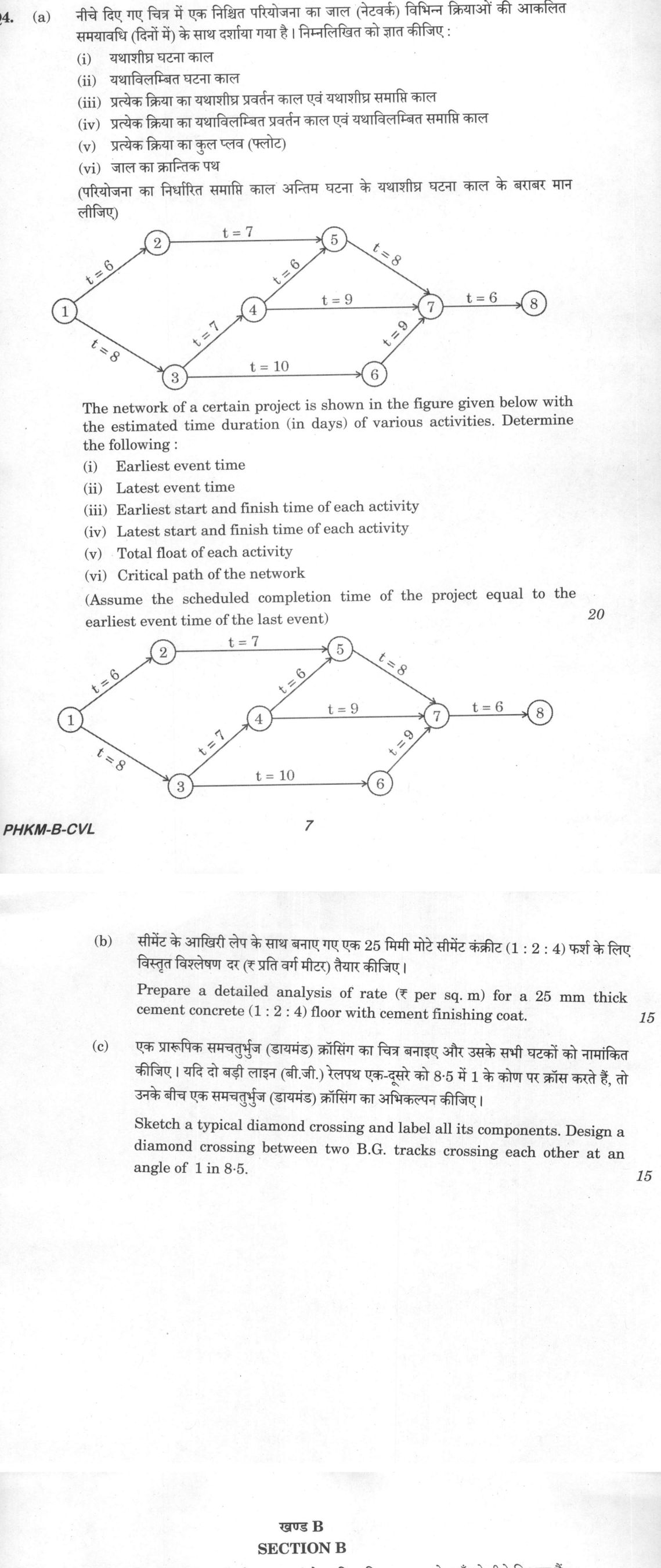
The figure this question refers to, in words
The question paper is a scan and the diagram did not survive as text. This is the figure as read from the original page — every component, value and label — so the question can be worked from the text below.
(a) A project network diagram with 8 numbered event nodes (circles 1 through 8) and directed activity arrows labeled with time durations t in days:
- Arrow from Node 1 to Node 2: t = 6
- Arrow from Node 1 to Node 3: t = 8
- Arrow from Node 2 to Node 5: t = 7
- Arrow from Node 3 to Node 4: t = 7
- Arrow from Node 3 to Node 6: t = 10
- Arrow from Node 4 to Node 5: t = 6
- Arrow from Node 4 to Node 7: t = 9
- Arrow from Node 5 to Node 7: t = 8
- Arrow from Node 6 to Node 7: t = 9
- Arrow from Node 7 to Node 8: t = 6
Model answer
Written by UPSC Answer Check against this question's marking rubric, to the expected length. UPSC does not publish answers for Mains — this is one way to score well, not an official key.
(a)(i) Earliest event times (forward pass): E1 = 0 E2 = 0 + 6 = 6 days E3 = 0 + 8 = 8 days E4 = 8 + 7 = 15 days E5 = max(6 + 7, 15 + 6) = max(13, 21) = 21 days E6 = 8 + 10 = 18 days E7 = max(15 + 9, 21 + 8, 18 + 9) = max(24, 29, 27) = 29 days E8 = 29 + 6 = 35 days Project duration = 35 days.
(a)(ii) Latest event times (backward pass), with L8 = E8 = 35 days: L7 = 35 − 6 = 29 days L6 = 29 − 9 = 20 days L5 = 29 − 8 = 21 days L4 = min(21 − 6, 29 − 9) = min(15, 20) = 15 days L3 = min(15 − 7, 20 − 10) = min(8, 10) = 8 days L2 = 21 − 7 = 14 days L1 = min(14 − 6, 8 − 8) = min(8, 0) = 0 day.
(a)(iii) Earliest start time EST = E_i and earliest finish time EFT = E_i + d: 1–2: EST = 0, EFT = 6 days 1–3: EST = 0, EFT = 8 days 2–5: EST = 6, EFT = 13 days 3–4: EST = 8, EFT = 15 days 3–6: EST = 8, EFT = 18 days 4–5: EST = 15, EFT = 21 days 4–7: EST = 15, EFT = 24 days 5–7: EST = 21, EFT = 29 days 6–7: EST = 18, EFT = 27 days 7–8: EST = 29, EFT = 35 days.
(a)(iv) Latest start time LST = L_j − d and latest finish time LFT = L_j: 1–2: LST = 8, LFT = 14 days 1–3: LST = 0, LFT = 8 days 2–5: LST = 14, LFT = 21 days 3–4: LST = 8, LFT = 15 days 3–6: LST = 10, LFT = 20 days 4–5: LST = 15, LFT = 21 days 4–7: LST = 20, LFT = 29 days 5–7: LST = 21, LFT = 29 days 6–7: LST = 20, LFT = 29 days 7–8: LST = 29, LFT = 35 days.
(a)(v) Total float TF = LST − EST = L_j − E_i − d: 1–2: 8 days 1–3: 0 day 2–5: 8 days 3–4: 0 day 3–6: 2 days 4–5: 0 day 4–7: 5 days 5–7: 0 day 6–7: 2 days 7–8: 0 day.
(a)(vi) Activities with zero total float form the critical path: 1–3–4–5–7–8, duration = 8 + 7 + 6 + 8 + 6 = 35 days. Hence scheduled completion time = 35 days.
(b) Assumed rates: cement ₹400/bag of 50 kg, sand ₹1600/m³, 12.5 mm coarse aggregate ₹1500/m³, mason ₹800/day, bhisti ₹650/day, coolie ₹550/day. Finishing coat assumed 6 mm thick cement mortar 1:3. For 1 m² floor: Cement concrete volume = 0.025 m³. Dry volume = 1.54 × 0.025 = 0.0385 m³. For 1:2:4, sum = 7. Cement = (1/7) × 0.0385 = 0.0055 m³ = 0.0055 × 1440 = 7.92 kg = 0.158 bag. Sand = (2/7) × 0.0385 = 0.0110 m³. Coarse aggregate = (4/7) × 0.0385 = 0.0220 m³. Finishing coat: wet volume = 0.006 m³. Dry volume = 1.33 × 0.006 = 0.00798 m³. Cement = (1/4) × 0.00798 = 0.001995 m³ = 2.873 kg = 0.0575 bag. Sand = (3/4) × 0.00798 = 0.005985 m³. Total cement = 0.2155 bag ≈ 0.22 bag. Total sand = 0.0170 m³. Aggregate = 0.0220 m³. Material cost: cement 0.22 × 400 = ₹88.00; sand 0.017 × 1600 = ₹27.20; aggregate 0.022 × 1500 = ₹33.00; water/curing/misc = ₹8.00. Total materials = ₹156.20. Labour: mason 0.05 day × 800 = ₹40.00; coolie/beldar 0.15 day × 550 = ₹82.50; bhisti 0.025 day × 650 = ₹16.25. Total labour = ₹138.75. Subtotal = 156.20 + 138.75 = ₹294.95. Tools and plant @2% = ₹5.90. Overhead and contractor profit @10% = ₹30.09. Total rate = 294.95 + 5.90 + 30.09 = ₹330.94 ≈ ₹331 per m², excluding GST. Validity: if finishing coat thickness or mix changes, adjust cement and sand proportionately.
(c) Typical diamond crossing: two straight tracks cross at a small angle. The four rail intersections form two acute crossings and two obtuse crossings. Sleepers are laid perpendicular to the bisector of the crossing angle and are common to both tracks. Labels: acute crossing/V-crossing, obtuse crossing, wing rail, check rail, point rail, splice rail, nose, common sleepers, distance blocks, gauge tie plates, ballast. The acute crossings lie at the ends of the long diagonal; the obtuse crossings lie on the short diagonal.
Design data: B.G. gauge G = 1.676 m. Crossing angle = 1 in 8.5, so cot α = 8.5. α = tan⁻¹(1/8.5) = 6°42′35″ ≈ 6.71°. Obtuse crossing angle = 180° − α = 173°17′25″. Half angle α/2 = 3°21′17″. Length of diamond L = G cot(α/2) = 1.676 × cot(3°21′17″). cot(3°21′17″) ≈ 17.06, so L = 1.676 × 17.06 = 28.60 m. Short diagonal between obtuse crossings = G sec(α/2) = 1.676 × 1.0017 = 1.68 m. Longest sleeper at acute crossing = 2G sec(α/2) = 2 × 1.676 × 1.0017 = 3.36 m. Assume sleeper spacing = 0.60 m. Number of sleepers = L/0.60 + 1 = 28.60/0.60 + 1 ≈ 49. Thus the diamond crossing requires two acute crossings, two obtuse crossings, common sleepers up to 3.36 m long, and about 49 sleepers at 0.60 m spacing.
What "Solve" is asking you to do
Choose the method, then carry it through to a final answer. Identifying what kind of problem this is and why that method applies is the first thing marked; a correct figure arrived at invisibly earns almost nothing.
Structure that answers it
Given data and what is required → method chosen, with the reason it applies → set-up (equation, circuit, free body, trial balance) → working, step by step → answer with units and any condition of validity
Where marks are lost
Doing the middle steps mentally and writing only the result. In mathematics papers, a further loss comes from giving a decimal where the exact value in surds or fractions was wanted, or from skipping the justification a part explicitly asks for.
How this answer will be evaluated
Approach
Framework: CPM (Critical Path Method). (a) calculate: given > formula > substitution > result with units > interpretation | (b) calculate: given > formula > substitution > result with units > interpretation | (c) describe: define > structure or process in order > labelled diagram > significance Full marks: Complete CPM calculations with correct critical path; detailed rate analysis with all components; accurate diamond crossing sketch with correct angle calculation.
Key points expected
- Calculate Earliest Event Time (EET) for all nodes
- Calculate Latest Event Time (LET) for all nodes
- Compute Total Float for each activity
- Identify the Critical Path with zero float
- Calculate material quantities (Cement, Sand, Aggregate) for 1:2:4 mix
- Include quantity for cement finishing coat
- List labor requirements with rates
- Calculate total cost per square meter
Evaluation rubric
Each sub-part is marked on its own, against the marks and word limit printed on the paper.
- (a) Determine CPM parameters (EET, LET, ES, EF, LS, LF, Float) and identify the critical path. 20 marks
calculate— given → formula → substitution → result with units → interpretation
Must cover
- Calculate Earliest Event Time (EET) for all nodes
- Calculate Latest Event Time (LET) for all nodes
- Compute Total Float for each activity
- Identify the Critical Path with zero float
Loses marks
- Arithmetic errors in time calculations
- Failure to identify the correct critical path
- Missing units (days) in final results
Earns more
- Correct calculation of Earliest Start/Finish times
- Correct calculation of Latest Start/Finish times
- Clear tabular presentation of activity parameters
- Explicit statement of project duration
Extra mark
- Neatly drawn network diagram with EET/LET labelled on nodes
- Highlighting of critical activities on the diagram
- (b) Prepare a detailed rate analysis for 25mm cement concrete floor with finishing coat. 15 marks
calculate— given → formula → substitution → result with units → interpretation
Must cover
- Calculate material quantities (Cement, Sand, Aggregate) for 1:2:4 mix
- Include quantity for cement finishing coat
- List labor requirements with rates
- Calculate total cost per square meter
Loses marks
- Omission of cement finishing coat cost
- Incorrect mix ratio calculation (1:2:4)
- Failure to state units (per sq. m)
Earns more
- Inclusion of contractor's profit and overheads
- Correct application of wastage factors
- Clear breakdown of material vs labor costs
- Use of standard IS code mix proportions
Extra mark
- Reference to specific IS code for concrete mix
- Inclusion of tool and plant charges if applicable
- (c) Sketch a diamond crossing and design one for B.G. tracks at 1 in 8.5 angle. 15 marks
describe— define → structure or process in order → labelled diagram → significance
Must cover
- Sketch a typical diamond crossing with labelled components
- Calculate crossing angle from 1 in 8.5 gradient
- Determine length of crossing components
- Provide design details for B.G. tracks
Loses marks
- Missing labels on the sketch
- Incorrect calculation of crossing angle
- Failure to specify track gauge (B.G.)
Earns more
- Correct identification of frog, check rails, and flangeways
- Accurate calculation of crossing angle (approx 6.69 degrees)
- Proper dimensioning of the diamond crossing
- Clear distinction between main and crossing tracks
Extra mark
- Reference to IS code for diamond crossing design
- Inclusion of standard gauge dimensions (1435mm)
Practice this exact question
Write your answer and it is marked point by point against the model answer above — what you covered, what you missed, what you got wrong.
Evaluate my answer →More from Civil Engineering 2024 Paper II
- Q1 (a) Describe various defects in clay bricks giving sources/causes of defects. 10 marks (b…
- Q2 (a) The network for a construction project is shown in the figure given below. The three…
- Q3 (a) (i) Explain spot speed, running speed, space-mean speed, time-mean speed and average…
- Q4 (a) The network of a certain project is shown in the figure given below with the estimate…
- Q5 (a) What is a flood hydrograph ? The monthly discharge (Q) data of a river at a gauging s…
- Q6 (a) Explain an aquifer. Deduce the expression for discharge (Q) through a well in an unco…
- Q7 (a) A sewer having a 60 cm diameter (D) is required to flow at 0·4 depth (i.e., a proport…