Paper II — Q5
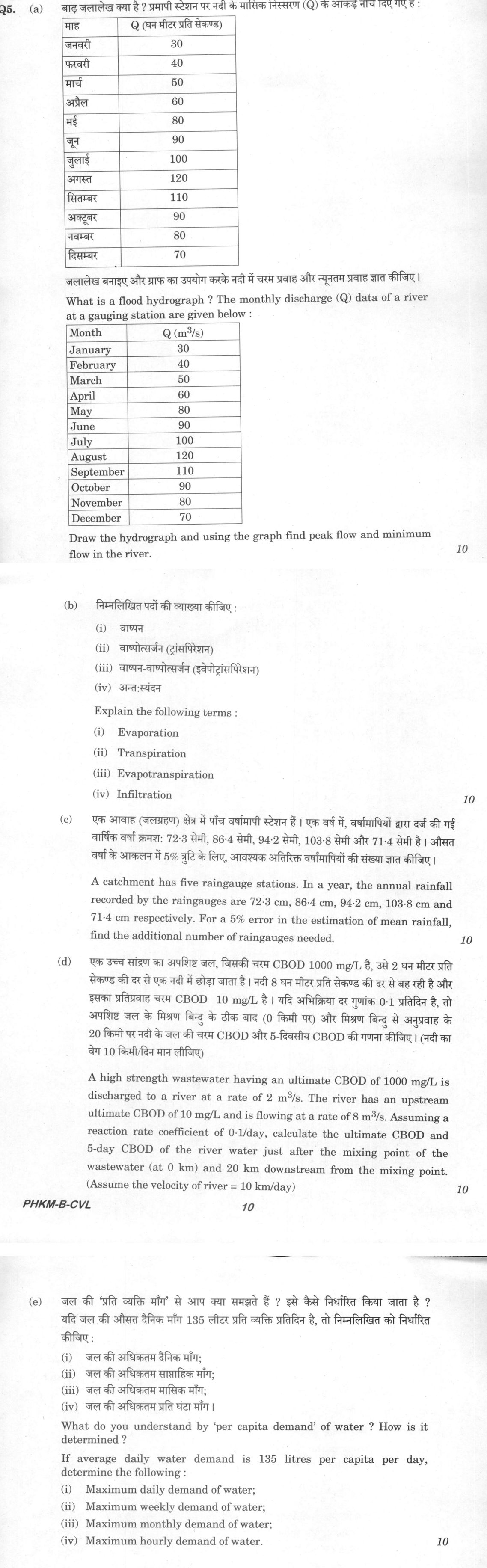
(a) What is a flood hydrograph ? The monthly discharge (Q) data of a river at a gauging station are given below : | Month | Q…
What is a flood hydrograph ? The monthly discharge (Q) data of a river at a gauging station are given below :
| Month | Q (m³/s) |
|---|---|
| January | 30 |
| February | 40 |
| March | 50 |
| April | 60 |
| May | 80 |
| June | 90 |
| July | 100 |
| August | 120 |
| September | 110 |
| October | 90 |
| November | 80 |
| December | 70 |
Draw the hydrograph and using the graph find peak flow and minimum flow in the river. 10 marks
Explain the following terms : Evaporation
Transpiration
Evapotranspiration
Infiltration 10 marks
A catchment has five raingauge stations. In a year, the annual rainfall recorded by the raingauges are 72·3 cm, 86·4 cm, 94·2 cm, 103·8 cm and 71·4 cm respectively. For a 5% error in the estimation of mean rainfall, find the additional number of raingauges needed. 10 marks
A high strength wastewater having an ultimate CBOD of 1000 mg/L is discharged to a river at a rate of 2 m³/s. The river has an upstream ultimate CBOD of 10 mg/L and is flowing at a rate of 8 m³/s. Assuming a reaction rate coefficient of 0·1/day, calculate the ultimate CBOD and 5-day CBOD of the river water just after the mixing point of the wastewater (at 0 km) and 20 km downstream from the mixing point. (Assume the velocity of river = 10 km/day) 10 marks
What do you understand by 'per capita demand' of water ? How is it determined ? If average daily water demand is 135 litres per capita per day, determine the following : Maximum daily demand of water;
Maximum weekly demand of water;
Maximum monthly demand of water;
Maximum hourly demand of water. 10 marks
हिंदी में प्रश्न पढ़ें
बाढ़ जलालेख क्या है ? प्रमापी स्टेशन पर नदी के मासिक निस्सरण (Q) के आँकड़े नीचे दिए गए हैं :
| माह | Q (घन मीटर प्रति सेकंड) |
|---|---|
| जनवरी | 30 |
| फरवरी | 40 |
| मार्च | 50 |
| अप्रैल | 60 |
| मई | 80 |
| जून | 90 |
| जुलाई | 100 |
| अगस्त | 120 |
| सितम्बर | 110 |
| अक्टूबर | 90 |
| नवम्बर | 80 |
| दिसम्बर | 70 |
जलालेख बनाइए और ग्राफ का उपयोग करके नदी में चरम प्रवाह और न्यूनतम प्रवाह ज्ञात कीजिए। (10 अंक)
निम्नलिखित पदों की व्याख्या कीजिए : वाष्पन
वाष्पोत्सर्जन (ट्रांस्पिरेशन)
वाष्पन-वाष्पोत्सर्जन (इवैपोट्रांस्पिरेशन)
अन्तःस्रंवन (10 अंक)
एक आवाह (जलप्रण) क्षेत्र में पाँच वर्षामापी स्टेशन हैं । एक वर्ष में, वर्षामापियों द्वारा दर्ज की गई वार्षिक वर्षा क्रमशः: 72·3 सेमी, 86·4 सेमी, 94·2 सेमी, 103·8 सेमी और 71·4 सेमी है । औसत वर्षा के आकलन में 5% त्रुटि के लिए, आवश्यक अतिरिक्त वर्षामापियों की संख्या ज्ञात कीजिए । (10 अंक)
एक उच्च सांद्रण का अपशिष्ट जल, जिसकी चरम CBOD 1000 mg/L है, उसे 2 घन मीटर प्रति सेकंड की दर से एक नदी में छोड़ा जाता है । नदी 8 घन मीटर प्रति सेकंड की दर से बह रही है और इसका प्रतिप्रवाह चरम CBOD 10 mg/L है । यदि अभिक्रिया दर गुणांक 0·1 प्रतिदिन है, तो अपशिष्ट जल के मिश्रण बिंदु के ठीक बाद (0 किमी पर) और मिश्रण बिंदु से अनुप्रवाह के 20 किमी पर नदी के जल की चरम CBOD और 5-दिवसीय CBOD की गणना कीजिए । (नदी का वेग 10 किमी/दिन मान लीजिए) (10 अंक)
जल की 'प्रति व्यक्ति माँग' से आप क्या समझते हैं ? इसे कैसे निर्धारित किया जाता है ? यदि जल की औसत दैनिक माँग 135 लीटर प्रति व्यक्ति प्रतिदिन है, तो निम्नलिखित को निर्धारित कीजिए : जल की अधिकतम दैनिक माँग;
जल की अधिकतम साप्ताहिक माँग;
जल की अधिकतम मासिक माँग;
जल की अधिकतम प्रति घंटा माँग। (10 अंक)
The figure this question refers to, in words
The question paper is a scan and the diagram did not survive as text. This is the figure as read from the original page — every component, value and label — so the question can be worked from the text below.
(a) Table with two columns: Month | Q (m3/s) January | 30 February | 40 March | 50 April | 60 May | 80 June | 90 July | 100 August | 120 September | 110 October | 90 November | 80 December | 70
Model answer
Written by UPSC Answer Check against this question's marking rubric, to the expected length. UPSC does not publish answers for Mains — this is one way to score well, not an official key.
(a) A flood hydrograph is a graphical plot of discharge (or stage) of a river at a gauging station against time during a flood event. It generally shows the rising limb, crest/peak, and recession limb. The given monthly data give an annual flow hydrograph rather than a single-storm flood hydrograph, but the same plotting method applies.
Plot months January to December on the x-axis and discharge Q in m³/s on the y-axis. The points to be joined by straight lines are:
- Jan: 30 m³/s
- Feb: 40 m³/s
- Mar: 50 m³/s
- Apr: 60 m³/s
- May: 80 m³/s
- Jun: 90 m³/s
- Jul: 100 m³/s
- Aug: 120 m³/s
- Sep: 110 m³/s
- Oct: 90 m³/s
- Nov: 80 m³/s
- Dec: 70 m³/s
Joining these points gives the required hydrograph. From the graph, the highest ordinate occurs in August and the lowest in January.
Peak flow = 120 m³/s (August) Minimum flow = 30 m³/s (January)
(b)(i) Evaporation is the process by which water changes from liquid state to vapour state from free water surfaces, soil surfaces, or wet surfaces. It depends on vapour-pressure deficit, temperature, wind speed, relative humidity, solar radiation, and atmospheric pressure. It is expressed as depth of water lost per unit time, usually mm/day. For evaporation to continue, both energy and available water must be present.
(b)(ii) Transpiration is the loss of water vapour from living plant tissues, mainly through stomata in leaves. Water absorbed by roots moves through the plant and escapes as vapour. It depends on plant type, stomatal opening, soil moisture, temperature, wind, and humidity. It is essentially evaporation from plant surfaces, but it is biologically controlled.
(b)(iii) Evapotranspiration is the combined loss of water to the atmosphere by evaporation from water and soil surfaces and by transpiration from vegetation. Potential evapotranspiration (PET) is the maximum possible loss when water supply is not limiting. Actual evapotranspiration (AET) is the actual loss under existing soil-moisture conditions. It is important in irrigation planning, water-balance studies, and catchment yield estimation.
(b)(iv) Infiltration is the process by which water enters the soil surface from rainfall or irrigation. The maximum rate at which soil can absorb water is called infiltration capacity. It depends on soil texture, structure, initial moisture content, vegetation, compaction, and rainfall intensity. Infiltration rate generally decreases with time and is often modelled by Horton’s equation: f = f_c + (f_0 − f_c)e^(−kt). Water in excess of infiltration capacity becomes surface runoff.
(c) The mean rainfall is first found using the arithmetic-mean method. Sum of rainfall = 72.3 + 86.4 + 94.2 + 103.8 + 71.4 = 428.1 cm Mean x̄ = 428.1/5 = 85.62 cm
For the required number of raingauges, the coefficient of variation method is used: N = (Cv/ε)² where Cv = coefficient of variation in percent and ε = permissible percentage error = 5%.
Deviations and squares:
- 72.3 − 85.62 = −13.32; square = 177.4224
- 86.4 − 85.62 = 0.78; square = 0.6084
- 94.2 − 85.62 = 8.58; square = 73.6164
- 103.8 − 85.62 = 18.18; square = 330.5124
- 71.4 − 85.62 = −14.22; square = 202.2084
Σ(x − x̄)² = 784.368 cm² Sample standard deviation s = √[784.368/(5 − 1)] = √196.092 = 14.003 cm Cv = (s/x̄) × 100 = (14.003/85.62) × 100 = 16.355%
Required total number of raingauges: N = (16.355/5)² = (3.271)² = 10.70 ≈ 11 Existing raingauges = 5 Additional raingauges needed = 11 − 5 = 6
Additional number of raingauges needed = 6
(d) At the mixing point, use the mass-balance principle for ultimate CBOD. River flow Q_r = 8 m³/s, upstream ultimate CBOD L_r = 10 mg/L Wastewater flow Q_w = 2 m³/s, ultimate CBOD L_w = 1000 mg/L Mixed flow Q_m = 8 + 2 = 10 m³/s
Ultimate CBOD just after mixing, L_0: L_0 = (Q_r L_r + Q_w L_w)/Q_m L_0 = (8 × 10 + 2 × 1000)/10 L_0 = (80 + 2000)/10 = 2080/10 = 208 mg/L
For first-order CBOD decay, k = 0.1/day. 5-day CBOD at 0 km: CBOD₅ = L_0(1 − e^(−k × 5)) = 208(1 − e^(−0.5)) = 208(1 − 0.60653) = 208 × 0.39347 = 81.84 mg/L
At 20 km downstream, travel time t = distance/velocity = 20/10 = 2 days. Remaining ultimate CBOD: L_20 = L_0 e^(−k t) = 208 e^(−0.1 × 2) = 208 e^(−0.2) = 208 × 0.81873 = 170.30 mg/L
5-day CBOD at 20 km: CBOD₅,20 = L_20(1 − e^(−0.5)) = 170.30 × 0.39347 = 67.01 mg/L
At 0 km: ultimate CBOD = 208 mg/L; 5-day CBOD = 81.84 mg/L At 20 km: ultimate CBOD = 170.30 mg/L; 5-day CBOD = 67.01 mg/L The calculation assumes complete mixing at the outfall, plug flow downstream, first-order decay with base e, and no additional pollution load between the two sections.
(e) Per capita demand is the average quantity of water required per person per day for domestic, commercial, industrial, public, and firefighting uses, including losses and waste. It is usually expressed as litres per capita per day (Lpcd). It is determined by dividing the total annual water consumption of a town by its population and by 365 days. It can also be estimated as the sum of domestic, commercial, industrial, public, fire, and unaccounted-for demands. It varies with climate, standard of living, habits, cost of water, pressure in the distribution system, and efficiency of water management.
Given average daily demand = 135 Lpcd.
(e)(i) Maximum daily demand Using 1.8 times the average daily demand: = 1.8 × 135 = 243 Lpcd
(e)(ii) Maximum weekly demand Using 1.48 times the average daily demand: = 1.48 × 135 = 199.8 Lpcd ≈ 200 Lpcd
(e)(iii) Maximum monthly demand Using 1.28 times the average daily demand: = 1.28 × 135 = 172.8 Lpcd ≈ 173 Lpcd
(e)(iv) Maximum hourly demand Average hourly demand on the maximum day = maximum daily demand/24 = 243/24 = 10.125 L per capita per hour. Maximum hourly demand = 1.5 × 10.125 = 15.19 L per capita per hour This is equivalent to 15.19 × 24 = 364.5 Lpcd if expressed as a daily volume.
What "Solve" is asking you to do
Choose the method, then carry it through to a final answer. Identifying what kind of problem this is and why that method applies is the first thing marked; a correct figure arrived at invisibly earns almost nothing.
Structure that answers it
Given data and what is required → method chosen, with the reason it applies → set-up (equation, circuit, free body, trial balance) → working, step by step → answer with units and any condition of validity
Where marks are lost
Doing the middle steps mentally and writing only the result. In mathematics papers, a further loss comes from giving a decimal where the exact value in surds or fractions was wanted, or from skipping the justification a part explicitly asks for.
How this answer will be evaluated
Approach
(a) describe: define > structure or process in order > labelled diagram > significance | (b) explain: definition/context > points in order > small example > short close | (c) calculate: given > formula > substitution > result with units > interpretation | (d) calculate: given > formula > substitution > result with units > interpretation | (e) calculate: given > formula > substitution > result with units > interpretation Full marks: All parts answered with correct calculations, clear definitions, and proper units.
Key points expected
- Define flood hydrograph as discharge-time plot
- Plot monthly discharge data on graph
- Identify peak flow as 120 m³/s
- Identify minimum flow as 30 m³/s
- Define evaporation as water loss from surfaces
- Define transpiration as water loss from plants
- Define evapotranspiration as combined loss
- Define infiltration as water entering soil
Evaluation rubric
Each sub-part is marked on its own, against the marks and word limit printed on the paper.
- (a) Define flood hydrograph and identify peak/minimum flow from the provided data. 10 marks
describe— define → structure or process in order → labelled diagram → significance
Must cover
- Define flood hydrograph as discharge-time plot
- Plot monthly discharge data on graph
- Identify peak flow as 120 m³/s
- Identify minimum flow as 30 m³/s
Loses marks
- Missing definition of flood hydrograph
- Failing to plot the data graphically
Earns more
- Label axes with units (m³/s, Month)
- Mark peak and minimum points on graph
Extra mark
- Mention rising and falling limbs of hydrograph
- (b) Define evaporation, transpiration, evapotranspiration, and infiltration. 10 marks
explain— definition/context → points in order → small example → short close
Must cover
- Define evaporation as water loss from surfaces
- Define transpiration as water loss from plants
- Define evapotranspiration as combined loss
- Define infiltration as water entering soil
Loses marks
- Confusing evaporation with transpiration
- Vague or incomplete definitions
Earns more
- Mention factors affecting each process
- Distinguish between evaporation and transpiration
Extra mark
- Provide a simple diagram of the water cycle
- (c) Calculate the additional number of raingauges needed for 5% error. 10 marks
calculate— given → formula → substitution → result with units → interpretation
Must cover
- Calculate mean rainfall from 5 stations
- Calculate standard deviation of rainfall
- Apply formula N = (Cv/e)²
- Subtract existing 5 stations from N
Loses marks
- Incorrect calculation of mean or standard deviation
- Failing to subtract the existing number of stations
Earns more
- Show step-by-step calculation of mean and SD
- State the formula used clearly
Extra mark
- Mention the significance of the coefficient of variation
- (d) Calculate ultimate and 5-day CBOD at mixing point and 20 km downstream. 10 marks
calculate— given → formula → substitution → result with units → interpretation
Must cover
- Calculate mixed ultimate CBOD at 0 km
- Calculate 5-day CBOD at 0 km
- Calculate ultimate CBOD at 20 km
- Calculate 5-day CBOD at 20 km
Loses marks
- Incorrect application of the mixing formula
- Failing to account for the reaction rate coefficient
Earns more
- Show the mixing formula for CBOD
- Use the decay formula for 5-day CBOD
Extra mark
- Mention the reaction rate coefficient used
- (e) Define per capita demand and calculate maximum daily, weekly, monthly, and hourly demands. 10 marks
calculate— given → formula → substitution → result with units → interpretation
Must cover
- Define per capita demand of water
- Calculate maximum daily demand
- Calculate maximum weekly demand
- Calculate maximum monthly and hourly demands
Loses marks
- Incorrect application of peak factors
- Failing to define per capita demand
Earns more
- Show the calculation for each demand type
- State the peak factors used
Extra mark
- Mention the standard peak factors used in water supply design
Practice this exact question
Write your answer and it is marked point by point against the model answer above — what you covered, what you missed, what you got wrong.
Evaluate my answer →More from Civil Engineering 2024 Paper II
- Q2 (a) The network for a construction project is shown in the figure given below. The three…
- Q3 (a) (i) Explain spot speed, running speed, space-mean speed, time-mean speed and average…
- Q4 (a) The network of a certain project is shown in the figure given below with the estimate…
- Q5 (a) What is a flood hydrograph ? The monthly discharge (Q) data of a river at a gauging s…
- Q6 (a) Explain an aquifer. Deduce the expression for discharge (Q) through a well in an unco…
- Q7 (a) A sewer having a 60 cm diameter (D) is required to flow at 0·4 depth (i.e., a proport…
- Q8 (a) (i) What is Lacey's Silt Factor? What is its value for standard silt? Design an earth…