Paper II — Q7
(a) A sewer having a 60 cm diameter (D) is required to flow at 0·4 depth (i.e., a proportional depth d/D = 0·4) on a grade…
A sewer having a 60 cm diameter (D) is required to flow at 0·4 depth (i.e., a proportional depth d/D = 0·4) on a grade ensuring a degree of self-cleansing equivalent to that obtained at full depth at a velocity of 80 cm/s. Determine the required grade, associated velocities and discharges at full depth and 0·4 depth. The value of Manning's rugosity coefficient (N) = 0·015 may be taken same at all depths of flow. 20 marks
Explain the following: (i) Aquitard (ii) Specific retention (iii) Storage coefficient (iv) Coefficient of permeability (v) Darcy's Law 15 marks
For the gravity dam shown in the following figure, determine I. Factor of safety against sliding II. Factor of safety against overturning. Take the following data: μ = 0·70, γc = 24 kN/m³, γw = 10 kN/m³, q = 1400 kN/m² (ii) Explain duty and delta. What is the discharge capacity required of the outlet to irrigate 2200 ha of sugarcane having a Kor depth of 17 cm and a Kor period of 30 days? 15 marks
हिंदी में प्रश्न पढ़ें
60 सेमी व्यास (D) वाले सीवर को 0·4 गहराई (यानी आनुपातिक गहराई d/D = 0·4) पर एक प्रवणता पर इस तरह से प्रवाहित होना है कि 80 सेमी प्रति सेकंड के वेग पर पूर्ण गहराई पर प्राप्त के तुल्य स्वतः-अपमार्जन की कोटि को सुनिश्चित किया जा सके। पूर्ण गहराई और 0·4 गहराई पर आवश्यक प्रवणता, संबंधित वेगों और निस्सरणों को निर्धारित कीजिए। मैनिंग रूक्षता गुणांक (N) = 0·015 का मान प्रवाह की सभी गहराइयों पर समान लिया जा सकता है। (20 अंक)
निम्नलिखित की व्याख्या कीजिए: (i) क्षावी जलरोधी स्तर (जलरोधक) (ii) विशिष्ट धारण (iii) संग्रह गुणांक (iv) पारगम्यता गुणांक (v) डार्सी का नियम (15 अंक)
निम्नलिखित चित्र में दर्शाए गए भाराक्षित बांध के लिए, ज्ञात कीजिए: I. सर्पण के विरुद्ध सुरक्षा गुणांक II. अपवर्तन के विरुद्ध सुरक्षा गुणांक। निम्नलिखित आँकड़ों का उपयोग कीजिए: μ = 0·70, γc = 24 किलो न्यूटन प्रति घन मीटर, γw = 10 किलो न्यूटन प्रति घन मीटर, q = 1400 किलो न्यूटन प्रति वर्ग मीटर (ii) कर्ति (ड्यूटी) और डेल्टा की व्याख्या कीजिए। 17 सेमी कोर गहराई और 30 दिनों की कोर अवधि वाले 2200 हेक्टेयर गन्ने की सिंचाई के लिए निगम (आउटलेट) की आवश्यक निस्सरण क्षमता क्या है? (15 अंक)
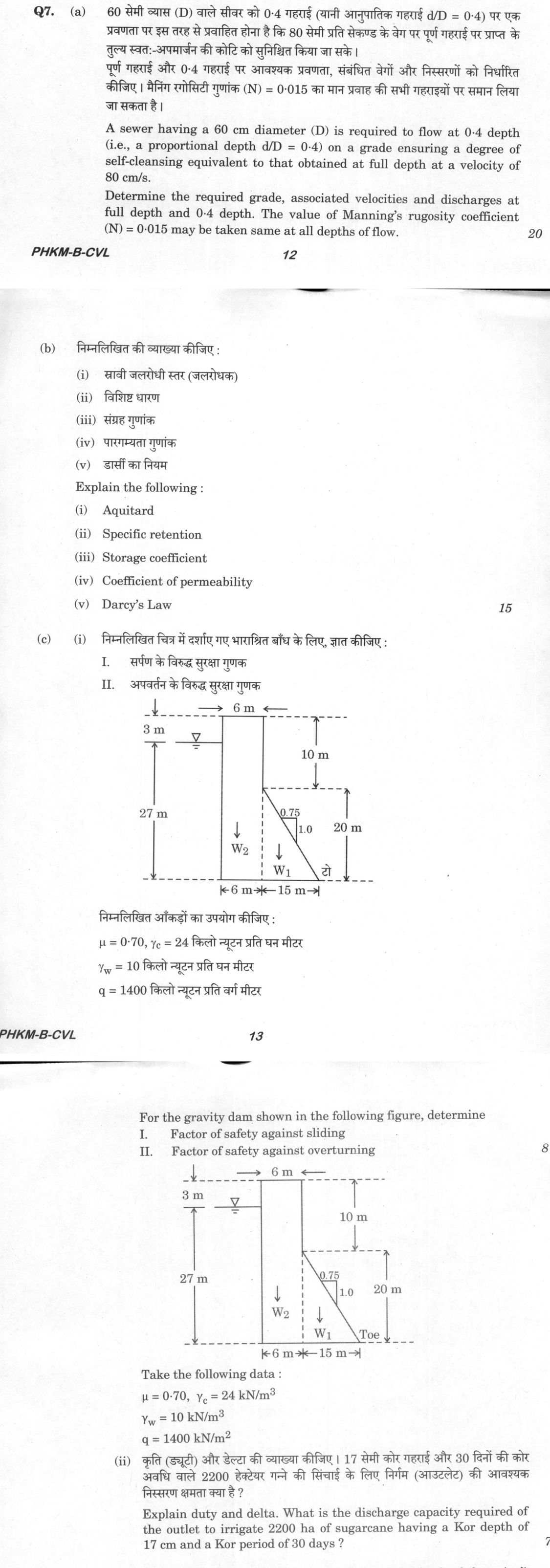
The figure this question refers to, in words
The question paper is a scan and the diagram did not survive as text. This is the figure as read from the original page — every component, value and label — so the question can be worked from the text below.
(c) A cross-sectional diagram of a gravity dam. The dam has a vertical upstream face and a sloped downstream face. The total height of the dam is 27 m. The top of the dam has a width of 6 m. The base of the dam consists of a vertical section of 6 m width and a sloped section extending 15 m horizontally to the toe. The downstream face slopes from the top of the 6 m vertical section down to the toe over a vertical drop of 20 m. The slope of the downstream face is indicated by a triangle with a vertical side of 1.0 and a horizontal side of 0.75. The water level is shown 3 m below the top of the dam. The weight of the dam is divided into two parts: W2 (the rectangular part) and W1 (the triangular part). The toe of the dam is labeled 'Toe'.
What "Calculate" is asking you to do
Apply the standard formula or schedule to data the question has already supplied — a table of readings, cost records, a balance sheet — and produce the number. The method is rarely in doubt; the marks sit in the named intermediate quantities, each of which has to appear as a labelled line.
Structure that answers it
Data as given → formula or standard treatment, named → substitution → each intermediate, labelled → result with units
Where marks are lost
Omitting an intermediate the marking scheme pays for separately, or rounding at an intermediate line so the final figure drifts. In commerce and accountancy, any figure in a statement that no numbered working note supports is treated as unearned.
How this answer will be evaluated
Approach
(a) calculate: given > formula > substitution > result with units > interpretation | (b) explain: definition/context > points in order > small example > short close | (c(i)) calculate: given > formula > substitution > result with units > interpretation | (c(ii)) calculate: given > formula > substitution > result with units > interpretation Full marks: Complete working with all steps, units, and checks; neat diagrams; code references
Key points expected
- State Manning's equation and given parameters
- Calculate hydraulic radius and wetted perimeter
- Determine required grade for 80 cm/s velocity
- Compute discharge at full and 0.4 depth
- Define aquitard with permeability range
- Explain specific retention concept
- State storage coefficient definition
- Describe Darcy's Law with equation
Evaluation rubric
Each sub-part is marked on its own, against the marks and word limit printed on the paper.
- (a) Determine grade, velocity, and discharge at full and 0.4 depth. 20 marks
calculate— given → formula → substitution → result with units → interpretation
Must cover
- State Manning's equation and given parameters
- Calculate hydraulic radius and wetted perimeter
- Determine required grade for 80 cm/s velocity
- Compute discharge at full and 0.4 depth
Loses marks
- Missing hydraulic radius calculation
- No unit consistency check
- Grade calculation without velocity verification
Earns more
- Show proportional depth relationships
- Verify self-cleansing velocity condition
- Include unit conversions explicitly
- Present results in tabular form
Extra mark
- Reference IS 732 sewer design code
- Include neat cross-sectional sketch
- (b) Define and explain five hydrogeological terms. 15 marks
explain— definition/context → points in order → small example → short close
Must cover
- Define aquitard with permeability range
- Explain specific retention concept
- State storage coefficient definition
- Describe Darcy's Law with equation
Loses marks
- Confusing aquitard with aquiclude
- Missing units in definitions
- No distinction between terms
Earns more
- Provide numerical examples for each
- Distinguish aquitard from aquifer
- Show Darcy's Law derivation
- Include units for all coefficients
Extra mark
- Reference standard hydrogeology textbook
- Include flow diagram for Darcy's Law
- (c(i)) Determine FOS against sliding and overturning for gravity dam.
calculate— given → formula → substitution → result with units → interpretation
Must cover
- Compute sliding FOS using μ and forces
- Calculate overturning FOS with moments
- Identify all vertical and horizontal forces
- Apply given γc, γw, and q values
Loses marks
- Missing water pressure calculation
- No moment arm identification
- FOS without force resolution
Earns more
- Draw free body diagram
- Show moment arm calculations
- Verify against IS 11223 limits
- Include water pressure distribution
Extra mark
- Reference IS 11223 dam design code
- Include labelled dam cross-section
- (c(ii)) Explain duty/delta and calculate outlet discharge capacity.
calculate— given → formula → substitution → result with units → interpretation
Must cover
- Define duty and delta concepts
- State duty-delta relationship formula
- Calculate duty from Kor depth/period
- Compute required discharge in cumecs
Loses marks
- Missing unit conversions
- No duty-delta relationship stated
- Discharge without area conversion
Earns more
- Show unit conversions (ha to m²)
- Include delta calculation steps
- Verify discharge against standard values
- Present formula derivation
Extra mark
- Reference irrigation engineering code
- Include field layout sketch
Model answer coming soon
Every evaluation on this site is marked against a verified model answer. This question's answer is still being written; evaluation opens the moment it lands.
More from Civil Engineering 2024 Paper II
- Q4 (a) The network of a certain project is shown in the figure given below with the estimate…
- Q5 (a) What is a flood hydrograph ? The monthly discharge (Q) data of a river at a gauging s…
- Q6 (a) Explain an aquifer. Deduce the expression for discharge (Q) through a well in an unco…
- Q7 (a) A sewer having a 60 cm diameter (D) is required to flow at 0·4 depth (i.e., a proport…
- Q8 (a) (i) What is Lacey's Silt Factor? What is its value for standard silt? Design an earth…