Paper II — Q3
(a) (i) Explain spot speed, running speed, space-mean speed, time-mean speed and average speed. 10 (ii) The consolidated data…
Explain spot speed, running speed, space-mean speed, time-mean speed and average speed. 10 marks
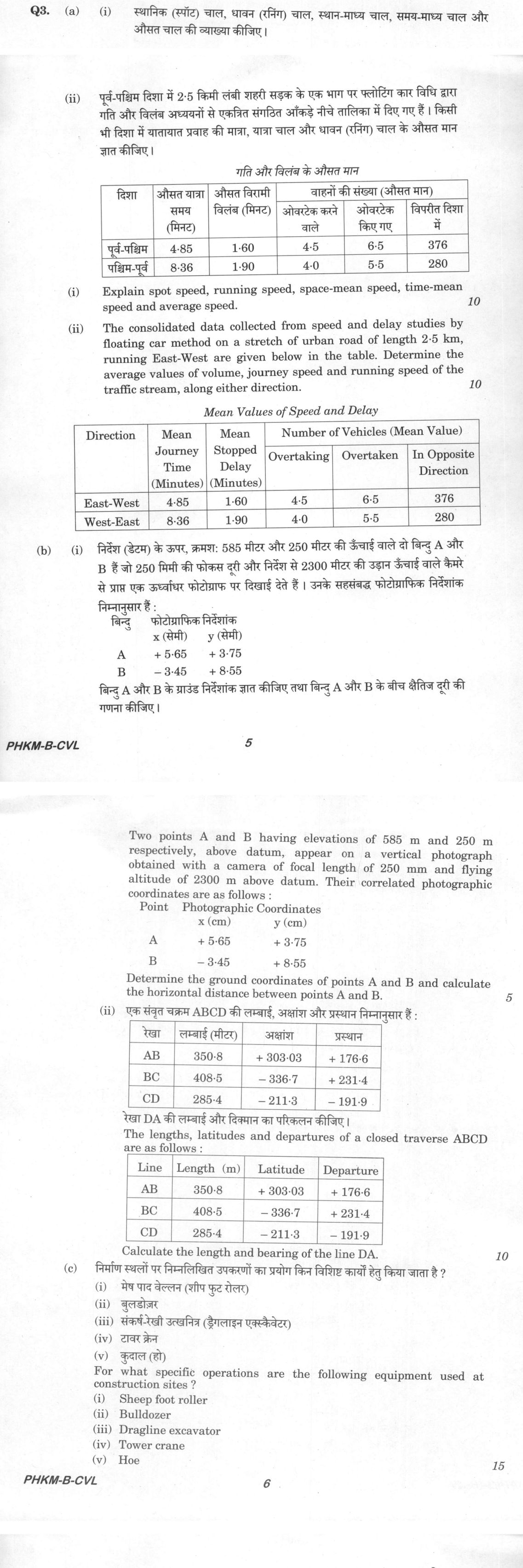
The consolidated data collected from speed and delay studies by floating car method on a stretch of urban road of length 2·5 km, running East-West are given below in the table. Determine the average values of volume, journey speed and running speed of the traffic stream, along either direction. 10 marks
Mean Values of Speed and Delay
| Direction | Mean Journey Time (Minutes) | Mean Stopped Delay (Minutes) | Number of Vehicles (Mean Value) | ||
|---|---|---|---|---|---|
| Overtaking | Overtaken | In Opposite Direction | |||
| East-West | 4·85 | 1·60 | 4·5 | 6·5 | 376 |
| West-East | 8·36 | 1·90 | 4·0 | 5·5 | 280 |
Two points A and B having elevations of 585 m and 250 m respectively, above datum, appear on a vertical photograph obtained with a camera of focal length of 250 mm and flying altitude of 2300 m above datum. Their correlated photographic coordinates are as follows :
Point Photographic Coordinates x (cm) y (cm) A + 5·65 + 3·75 B – 3·45 + 8·55
Determine the ground coordinates of points A and B and calculate the horizontal distance between points A and B. 5 marks
The lengths, latitudes and departures of a closed traverse ABCD are as follows :
| Line | Length (m) | Latitude | Departure |
|---|---|---|---|
| AB | 350·8 | + 303·03 | + 176·6 |
| BC | 408·5 | – 336·7 | + 231·4 |
| CD | 285·4 | – 211·3 | – 191·9 |
Calculate the length and bearing of the line DA. 10 marks
For what specific operations are the following equipment used at construction sites ? Sheep foot roller
Bulldozer
Dragline excavator
Tower crane
Hoe 15
हिंदी में प्रश्न पढ़ें
स्थानिक (स्पॉट) चाल, धावन (रनिंग) चाल, स्थान-माध्य चाल, समय-माध्य चाल और औसत चाल की व्याख्या कीजिए। 10
पूर्व-पश्चिम दिशा में 2·5 किमी लंबी शाहरी सड़क के एक भाग पर फ्लोटिंग कार विधि द्वारा गति और विलंब अध्ययनों से एकत्रित संगठित आँकड़े नीचे तालिका में दिए गए हैं। किसी भी दिशा में यातायात प्रवाह की मात्रा, यात्रा चाल और धावन (रनिंग) चाल के औसत मान ज्ञात कीजिए।
गति और विलंब के औसत मान
| दिशा | औसत यात्रा समय (मिनट) | औसत विरामी विलंब (मिनट) | वाहनों की संख्या (औसत मान) | ||
|---|---|---|---|---|---|
| ओवरटेक करने वाले | ओवरटेक किए गए | विपरीत दिशा में | |||
| पूर्व-पश्चिम | 4·85 | 1·60 | 4·5 | 6·5 | 376 |
| पश्चिम-पूर्व | 8·36 | 1·90 | 4·0 | 5·5 | 280 |
निर्देश (डेटम) के ऊपर, क्रमशः 585 मीटर और 250 मीटर की ऊँचाई वाले दो बिंदु A और B हैं जो 250 मिमी की फोकस दूरी और निर्देश से 2300 मीटर की उड़ान ऊँचाई वाले कैमरे से प्राप्त एक ऊर्ध्वाधर फोटोग्राफ पर दिखाई देते हैं। उनके सहसंबद्ध फोटोग्राफिक निर्देशांक निम्नानुसार हैं :
| बिंदु | फोटोग्राफिक निर्देशांक | |
|---|---|---|
| x (सेमी) | y (सेमी) | |
| A | + 5·65 | + 3·75 |
| B | − 3·45 | + 8·55 |
बिंदु A और B के ग्राउंड निर्देशांक ज्ञात कीजिए तथा बिंदु A और B के बीच क्षैतिज दूरी की गणना कीजिए। 5
एक संयुक्त चक्रम ABCD की लम्बाई, अक्षांश और प्रस्थान निम्नानुसार हैं :
| रेखा | लम्बाई (मीटर) | अक्षांश | प्रस्थान |
|---|---|---|---|
| AB | 350·8 | + 303·03 | + 176·6 |
| BC | 408·5 | – 336·7 | + 231·4 |
| CD | 285·4 | – 211·3 | – 191·9 |
रेखा DA की लम्बाई और दिक्मान का परिकलन कीजिए। 10
निर्माण स्थलों पर निम्नलिखित उपकरणों का प्रयोग किन विशिष्ट कार्यों हेतु किया जाता है ? मेष पाद वेल्लन (शीप फुट रोलर)
बुलडोजर
संकर्ष-रेखी उत्खनित्र (ड्रैगलाइन एक्सकेवेटर)
टावर क्रेन
कुदाल (हो) 15 marks
The figure this question refers to, in words
The question paper is a scan and the diagram did not survive as text. This is the figure as read from the original page — every component, value and label — so the question can be worked from the text below.
(a) Table titled 'Mean Values of Speed and Delay'. Columns: Direction, Mean Journey Time (Minutes), Mean Stopped Delay (Minutes), Number of Vehicles (Mean Value) [sub-columns: Overtaking, Overtaken, In Opposite Direction]. Row 1: East-West, 4.85, 1.60, 4.5, 6.5, 376. Row 2: West-East, 8.36, 1.90, 4.0, 5.5, 280.
(b) Table of Traverse Data. Columns: Line, Length (m), Latitude, Departure. Row 1: AB, 350.8, + 303.03, + 176.6. Row 2: BC, 408.5, - 336.7, + 231.4. Row 3: CD, 285.4, - 211.3, - 191.9.
Model answer
Written by UPSC Answer Check against this question's marking rubric, to the expected length. UPSC does not publish answers for Mains — this is one way to score well, not an official key.
Speed definitions. Spot speed is the instantaneous speed of a single vehicle at a point, measured by radar or pneumatic tube. Running speed is the speed of the stream excluding stops, v_r = L/(t_j - t_s), where L is length, t_j journey time and t_s stopped delay. Space-mean speed is the total distance travelled by all vehicles divided by total time taken by all vehicles; for a fixed length it is the harmonic mean, v_s = n/Σ(1/v_i). Time-mean speed is the arithmetic mean of spot speeds, v_t = Σv_i/n. Average speed (journey speed) is total distance divided by total time including delays, v_j = L/t_j; it is lower than running speed because stops are included. Stops reduce journey/average speed but not running speed, and time-mean speed can overestimate space-mean speed.
Floating-car calculations. For the 2.5 km stretch, use Wardrop’s formula with O = vehicles overtaking the test car, P = vehicles overtaken by it, and M = opposite-direction count in the opposite run. The 376 and 280 values are opposite-direction run counts, not hourly volumes; Wardrop’s formula converts them to veh/h. For east-west flow, O−P = 4.5−6.5 = −2.0, M = 280, and t = 4.85+8.36 = 13.21 min. Thus q_EW = (−2.0+280)/13.21 = 21.05 veh/min = 1263 veh/h. For west-east flow, O−P = 4.0−5.5 = −1.5, M = 376, so q_WE = (−1.5+376)/13.21 = 28.35 veh/min = 1701 veh/h. The negative net values show the test car overtook more than it was overtaken. The adjusted journey time is T = t − (O−P)/q. For EW, T = 4.85 − (−2.0/21.05) = 4.945 min, giving journey speed 2.5×60/4.945 = 30.3 km/h and running speed 2.5×60/(4.945−1.60) = 44.8 km/h. For WE, T = 8.36 − (−1.5/28.35) = 8.413 min, giving journey speed 17.8 km/h and running speed 2.5×60/(8.413−1.90) = 23.0 km/h.
Photogrammetry and traverse. For a vertical photo, X = x(H−h)/f and Y = y(H−h)/f, with f = 25 cm; the coordinates are measured from the principal point in the photo’s x-y system. For A, H−h = 1715 m, so X_A = 5.65×1715/25 = 387.6 m, Y_A = 3.75×1715/25 = 257.3 m. For B, H−h = 2050 m, so X_B = −3.45×2050/25 = −282.9 m, Y_B = 8.55×2050/25 = 701.1 m. The horizontal distance is √[(387.6+282.9)^2+(257.3−701.1)^2] = 804.1 m. For the closed traverse, ΣLat = 0 and ΣDep = 0. Known latitudes sum to 303.03−336.7−211.3 = −244.97 m, so Lat_DA = +244.97 m. Known departures sum to 176.6+231.4−191.9 = +216.1 m, so Dep_DA = −216.1 m. Length DA = √(244.97^2+216.1^2) = 326.7 m. Since latitude is north and departure west, bearing is N arctan(216.1/244.97) W = N 41°25′ W.
Construction equipment. The sheep foot roller is used for compacting cohesive, high-plasticity soils, especially clay cores in Indian earth-dam and canal embankments, because its feet knead and interlock the soil. The bulldozer is used for short-haul earthmoving, site clearing, grading, pushing loose soil and backfilling around foundations; in Indian road and site preparation it is common. The dragline excavator is used for underwater excavation, canal and river-bed work, and digging below machine level, because it pulls the bucket toward the machine and can work in wet ground. The tower crane is used for vertical material handling in Indian high-rise and urban building construction, lifting steel, concrete, formwork and finishes to height. The hoe/backhoe is used for trenching, foundation excavation and loading, with a strong pulling action that draws the bucket and material toward the machine. Thus the speed, photogrammetric, traverse and equipment requirements are met by IRC:106-1990 speed-study practice, IS 14802 photogrammetric relations, and standard site operations.
What "Explain" is asking you to do
Make the working of something clear — what sets it off, what follows from what, and what it produces. Explain is the Commission's mechanism word: it dominates the technical papers and the “explain why” stems, where the marks sit in the causal chain and not in the label.
Structure that answers it
State what it is → the initiating condition → the chain of cause, step by step → an instance where it plays out → what the chain produces
Where marks are lost
Describing what something looks like instead of why it works that way. Naming the stages without linking them reads as description too.
How this answer will be evaluated
Approach
Framework: UPSC Civil Engineering Paper 2 (Transport, Surveying, Construction). (a(i)) explain: definition/context > points in order > small example > short close | (a(ii)) calculate: given > formula > substitution > result with units > interpretation | (b(i)) calculate: given > formula > substitution > result with units > interpretation | (b(ii)) calculate: given > formula > substitution > result with units > interpretation | (c) describe: define > structure or process in order > labelled diagram > significance Full marks: All parts answered with correct calculations, clear explanations, and no errors.
Key points expected
- Define spot speed as instantaneous speed at a point
- Define running speed as distance over moving time
- Define space-mean speed as distance over journey time
- Distinguish time-mean speed from space-mean speed
- Calculate total volume for East-West and West-East
- Compute journey speed using total distance and journey time
- Compute running speed using distance and moving time
- Show all calculations with units
Evaluation rubric
Each sub-part is marked on its own, against the marks and word limit printed on the paper.
- (a(i)) Definitions and distinctions of five speed parameters. 10 marks
explain— definition/context → points in order → small example → short close
Must cover
- Define spot speed as instantaneous speed at a point
- Define running speed as distance over moving time
- Define space-mean speed as distance over journey time
- Distinguish time-mean speed from space-mean speed
Loses marks
- Confusing running speed with space-mean speed
- Failing to distinguish time-mean from space-mean
Earns more
- Mention relationship between time-mean and space-mean
- Provide formula for each speed type
Extra mark
- Include a simple diagram illustrating spot vs running speed
- (a(ii)) Compute volume, journey speed, and running speed for both directions. 10 marks
calculate— given → formula → substitution → result with units → interpretation
Must cover
- Calculate total volume for East-West and West-East
- Compute journey speed using total distance and journey time
- Compute running speed using distance and moving time
- Show all calculations with units
Loses marks
- Omitting units in final answers
- Incorrect calculation of moving time
Earns more
- Present results in a clear table format
- State assumptions about road length and direction
Extra mark
- Include a brief interpretation of the results
- (b(i)) Determine ground coordinates and horizontal distance between points A and B. 5 marks
calculate— given → formula → substitution → result with units → interpretation
Must cover
- Use photographic coordinates to find ground coordinates
- Apply scale factor based on focal length and altitude
- Calculate horizontal distance using ground coordinates
- Show all steps with units
Loses marks
- Incorrect application of scale factor
- Failing to convert units consistently
Earns more
- State the formula for scale factor
- Include a sketch of the coordinate system
Extra mark
- Mention the significance of the horizontal distance
- (b(ii)) Determine length and bearing of line DA in a closed traverse. 10 marks
calculate— given → formula → substitution → result with units → interpretation
Must cover
- Sum latitudes and departures to find closure error
- Apply corrections to latitudes and departures
- Calculate length of DA using corrected values
- Determine bearing of DA from corrected coordinates
Loses marks
- Incorrect calculation of closure error
- Failing to apply corrections before final calculation
Earns more
- Show the traverse table with corrections
- State the method used for corrections
Extra mark
- Include a diagram of the traverse
- (c) Describe specific operations for five construction equipment items. 15 marks
describe— define → structure or process in order → labelled diagram → significance
Must cover
- Describe operation of sheep foot roller
- Describe operation of bulldozer
- Describe operation of dragline excavator
- Describe operation of tower crane and hoe
Loses marks
- Confusing the functions of different equipment
- Failing to describe specific operations
Earns more
- Include a brief description of each equipment's function
- Mention typical applications for each
Extra mark
- Include a simple diagram of each equipment
Practice this exact question
Write your answer and it is marked point by point against the model answer above — what you covered, what you missed, what you got wrong.
Evaluate my answer →More from Civil Engineering 2024 Paper II
- Q1 (a) Describe various defects in clay bricks giving sources/causes of defects. 10 marks (b…
- Q2 (a) The network for a construction project is shown in the figure given below. The three…
- Q3 (a) (i) Explain spot speed, running speed, space-mean speed, time-mean speed and average…
- Q4 (a) The network of a certain project is shown in the figure given below with the estimate…
- Q5 (a) What is a flood hydrograph ? The monthly discharge (Q) data of a river at a gauging s…
- Q6 (a) Explain an aquifer. Deduce the expression for discharge (Q) through a well in an unco…