GS Paper I — Q11
The political and administrative reorganization of states and territories has been a continuous ongoing process since the…
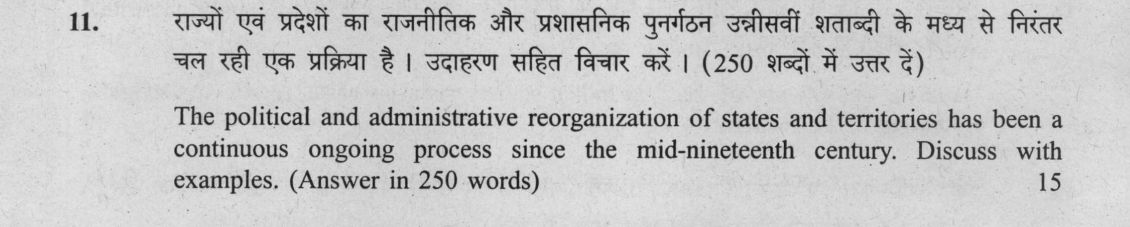
The political and administrative reorganization of states and territories has been a continuous ongoing process since the mid-nineteenth century. Discuss with examples. (Answer in 250 words) 15 marks
हिंदी में प्रश्न पढ़ें
राज्यों एवं प्रदेशों का राजनीतिक और प्रशासनिक पुनर्गठन उन्नीसवीं शताब्दी के मध्य से निरंतर चल रही एक प्रक्रिया है । उदाहरण सहित विचार करें । (250 शब्दों में उत्तर दें)
Model answer
Written by UPSC Answer Check against this question's marking rubric, to the 250-word length. UPSC does not publish answers for Mains — this is one way to score well, not an official key.
State reorganisation in India has been continuous since the mid-nineteenth century, reflecting colonial administration, linguistic identity, governance efficiency and federal balance. Provinces of British India were repeatedly redrawn from the 1850s onward: Bengal was partitioned in 1905 and the partition annulled in 1911, leading to Bihar and Orissa as a separate province in 1912; Sindh was separated in 1936 and Burma in 1937. After Independence, the integration of princely states created a patchwork of units, prompting the Dhar Commission (1948) and JVP Committee (1949). The latter recommended linguistic basis, which became the dominant principle, though not absolute.
The States Reorganisation Act, 1956, was the watershed: it created 14 states and 6 Union Territories, largely along linguistic lines, while retaining administrative flexibility. Thereafter, reorganisation continued. Bombay was split into Maharashtra and Gujarat in 1960. Punjab was reorganised in 1966, with Haryana carved out and parts transferred to Himachal Pradesh, which became a full state in 1971. In the Northeast, Nagaland (1963), Manipur (1972), Meghalaya (1972), Tripura (1972), Mizoram (1987) and Arunachal Pradesh (1987) emerged. In 2000, Jharkhand, Uttarakhand and Chhattisgarh were created; Telangana in 2014 and Jammu and Kashmir’s reorganisation into J&K and Ladakh in 2019 extended the process.
Administratively, Union Territories, autonomous districts and recent district reorganisation show that reorganisation is ongoing. Overall, it has strengthened representation and local governance, but also demands careful balancing of identity, development and federal stability.
What "Discuss" is asking you to do
Lay the issue out from more than one side — how it arose, what is claimed for it, what is held against it, and where it now stands. UPSC attaches discuss to broad topics with several live dimensions, so coverage of the dimensions earns more than the strength of your opinion.
Structure that answers it
Set the issue up → the case as it is made → the case against → the dimension both sides leave out → where the balance now lies
Where marks are lost
Listing facts with no thread between them, or arguing one side throughout and calling it a discussion.
How this answer will be evaluated
Approach
Framework: GS1 Political Science / Indian Polity. discuss: intro > 3-4 dimensions > example > balanced close Full marks: Comprehensive timeline from 1858 to 2014, clear distinction between linguistic and administrative criteria, strong examples.
Key points expected
- Mention mid-19th century context (e.g., 1858 Act, 1861 Act)
- Explain the 1956 States Reorganisation Act (linguistic basis)
- Cite post-1956 examples (e.g., Telangana, J&K, UTs)
- Discuss the shift from linguistic to administrative/size criteria
Evaluation rubric
Each sub-part is marked on its own, against the marks and word limit printed on the paper.
- The answer Analyze the continuous process of state reorganization from mid-19th century to present with examples. 15 marks · 250 words
discuss— intro → 3-4 dimensions → example → balanced close
Must cover
- Mention mid-19th century context (e.g., 1858 Act, 1861 Act)
- Explain the 1956 States Reorganisation Act (linguistic basis)
- Cite post-1956 examples (e.g., Telangana, J&K, UTs)
- Discuss the shift from linguistic to administrative/size criteria
Loses marks
- Focusing only on the 1956 Act without historical context
- Listing states without explaining the 'why' or 'how' of reorganization
- Ignoring the 'continuous process' aspect (treating it as a one-time event)
Earns more
- Reference to Sarkaria Commission or Punchhi Commission
- Mention of the 7th Schedule (State List) implications
- Discussion of the 'one size fits all' vs 'federalism' debate
- Reference to the 1953 States Reorganisation Commission
Extra mark
- Timeline of key reorganization acts (1858, 1956, 2014)
- Specific mention of the 1956 Act's 'linguistic principle' vs 'economic principle'
Practice this exact question
Write your answer and it is marked point by point against the model answer above — what you covered, what you missed, what you got wrong.
Evaluate my answer →More from General Studies 2022 GS Paper I
- Q8 Explore and evaluate the impact of 'Work From Home' on family relationships. (Answer in 1…
- Q9 How is the growth of Tier 2 cities related to the rise of a new middle class with an emph…
- Q10 Given the diversities among tribal communities in India, in which specific contexts shoul…
- Q11 The political and administrative reorganization of states and territories has been a cont…
- Q12 Discuss the main contributions of Gupta period and Chola period to Indian heritage and cu…
- Q13 Discuss the significance of the lion and bull figures in Indian mythology, art and archit…
- Q14 What are the forces that influence ocean currents ? Describe their role in fishing indust…