GS Paper I — Q2
Why did the armies of the British East India Company – mostly comprising of Indian soldiers – win consistently against the more…
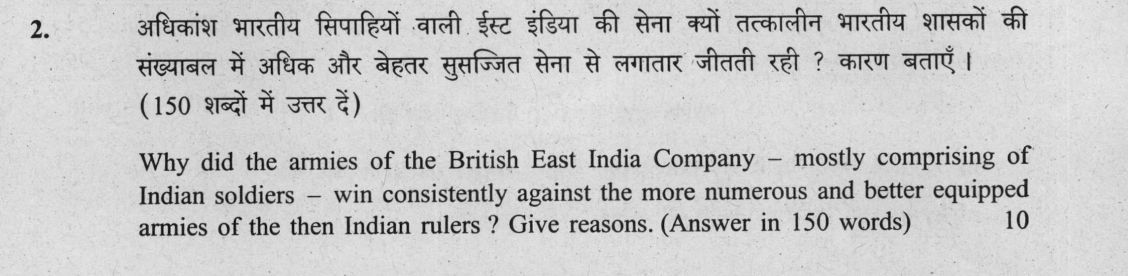
Why did the armies of the British East India Company – mostly comprising of Indian soldiers – win consistently against the more numerous and better equipped armies of the then Indian rulers ? Give reasons. (Answer in 150 words) 10 marks
हिंदी में प्रश्न पढ़ें
अधिकांश भारतीय सिपाहियों वाली ईस्ट इंडिया की सेना क्यों तत्कालीन भारतीय शासकों की संख्याबल में अधिक और बेहतर सुसज्जित सेना से लगातार जीतती रही ? कारण बताएं। (150 शब्दों में उत्तर दें)
Model answer
Written by UPSC Answer Check against this question's marking rubric, to the 150-word length. UPSC does not publish answers for Mains — this is one way to score well, not an official key.
The Company’s armies won not because Indian sepoys were inherently superior, but because they were embedded in a disciplined, well-funded and politically flexible war machine. Sepoys received regular drill, linear tactics and coordinated flintlock musketry and artillery, unlike feudal levies dependent on personal loyalty; at Plassey and Buxar this discipline, combined with artillery and political defections, proved decisive. Bengal revenue after 1757 financed sustained campaigns, while naval support helped cut supply lines in riverine and coastal operations. Regular pay and bhatta as a field/service allowance, with more predictable and partly merit-based advancement among sepoys—though higher command remained European—gave greater stability than larger, irregularly paid regional armies. Divide-and-rule diplomacy exploited post-Aurangzeb Mughal fragmentation, subsidiary alliances and rivalries among Indian states. Finally, regimental identity and religious accommodation preserved caste practices, fostering long-term sepoy loyalty. Thus, overall institutional regularity, economic power and political manipulation, not mere numbers, explained the Company’s consistent battlefield victories.
What "Explain" is asking you to do
Make the working of something clear — what sets it off, what follows from what, and what it produces. Explain is the Commission's mechanism word: it dominates the technical papers and the “explain why” stems, where the marks sit in the causal chain and not in the label.
Structure that answers it
State what it is → the initiating condition → the chain of cause, step by step → an instance where it plays out → what the chain produces
Where marks are lost
Describing what something looks like instead of why it works that way. Naming the stages without linking them reads as description too.
How this answer will be evaluated
Approach
Framework: GS1 History: British objective, Indian response, synthesis. explain: definition/context > points in order > small example > short close Full marks: Identifies 3-4 structural/systemic reasons with specific examples
Key points expected
- Professional training and discipline of Company forces
- Superior artillery and logistics management
- Unified command structure vs fragmented Indian armies
- Financial stability and regular pay for soldiers
Evaluation rubric
Each sub-part is marked on its own, against the marks and word limit printed on the paper.
- The answer Analytical reasons for Company's military superiority over Indian rulers 10 marks · 150 words
explain— definition/context → points in order → small example → short close
Must cover
- Professional training and discipline of Company forces
- Superior artillery and logistics management
- Unified command structure vs fragmented Indian armies
- Financial stability and regular pay for soldiers
Loses marks
- Narrating chronology of battles without analysis
- Attributing victory solely to 'British bravery'
- Ignoring the role of Indian soldiers in the Company army
Earns more
- Use of Indian sepoys as a cost-effective tool
- Technological edge in firearms and fortification
- Strategic use of diplomacy and divide-and-rule
Extra mark
- Reference to specific battles (e.g., Plassey, Buxar)
- Mention of specific administrative reforms (e.g., Permanent Settlement)
Practice this exact question
Write your answer and it is marked point by point against the model answer above — what you covered, what you missed, what you got wrong.
Evaluate my answer →More from General Studies 2022 GS Paper I
- Q1 How will you explain that medieval Indian temple sculptures represent the social life of…
- Q2 Why did the armies of the British East India Company – mostly comprising of Indian soldie…
- Q3 Why was there a sudden spurt in famines in colonial India since the mid-eighteenth centur…
- Q4 Describe the characteristics and types of primary rocks. (Answer in 150 words) 10
- Q5 Discuss the meaning of colour-coded weather warnings for cyclone prone areas given by Ind…