GS Paper I — Q20
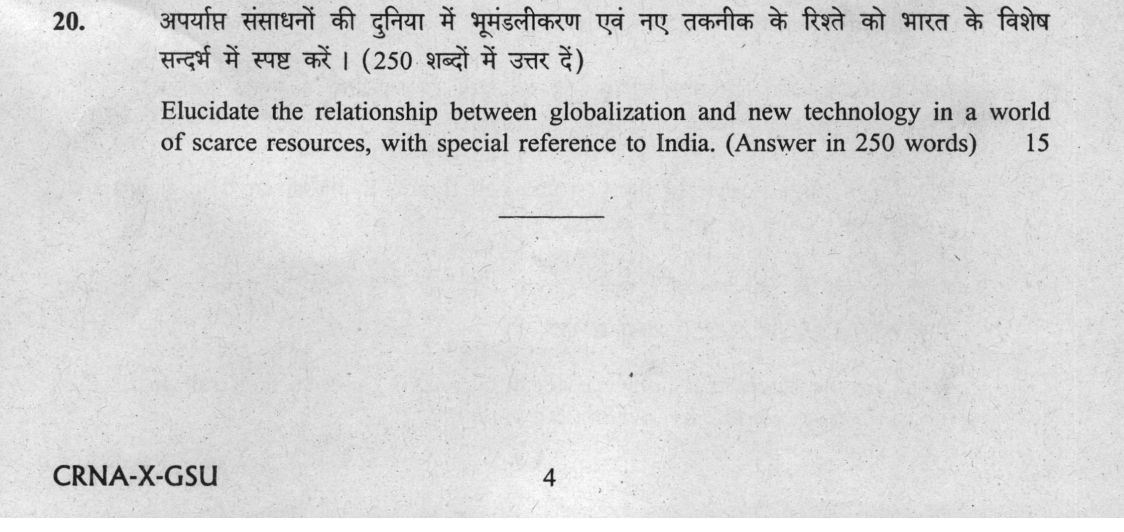
Elucidate the relationship between globalization and new technology in a world of scarce resources, with special reference to…
Elucidate the relationship between globalization and new technology in a world of scarce resources, with special reference to India. (Answer in 250 words) 15 marks
हिंदी में प्रश्न पढ़ें
अपर्याप्त संसाधनों की दुनिया में भूमंडलीकरण एवं नए तकनीक के रिश्ते को भारत के विशेष संदर्भ में स्पष्ट करें। (250 शब्दों में उत्तर दें)
Model answer
Written by UPSC Answer Check against this question's marking rubric, to the 250-word length. UPSC does not publish answers for Mains — this is one way to score well, not an official key.
Globalization and new technology are mutually reinforcing: digital, biotech and green technologies shrink distance by lowering transaction costs, enabling real-time trade, services, data flows and global value chains (GVCs). In a world of scarce resources, this nexus can expand access to capital, markets and knowledge, but it also concentrates benefits where connectivity, energy and skills exist.
The relationship is bidirectional. Globalization exposes resource-constrained economies to competition, forcing faster adoption of efficient technologies and innovation. Scarcity is both a constraint and a driver: digital divide and unreliable energy limit participation, yet water, land and energy stress encourage frugal innovation, circular-economy models and resource-saving processes.
India illustrates this. Its IT revolution integrated it into global services and software GVCs; the JAM trinity (Jan Dhan, Aadhaar, mobile) extended financial inclusion and reduced transaction costs; renewable energy transitions—solar, wind, green hydrogen—seek to reduce fossil-fuel dependence. Yet India remains vulnerable to dependence on imported critical minerals, including rare-earth minerals, lithium and cobalt, for EVs, batteries and electronics, exposing supply-chain risks.
Asymmetries persist. Global IP regimes and technology-transfer barriers can limit India’s movement up GVCs, while its services-led integration can improve bargaining power.
Thus technology-enabled globalization can aggravate or alleviate scarcity depending on access; it does not automatically reduce it. For developing economies, and India especially, the way forward is inclusive digital access, energy security, domestic innovation, circular resource use and cooperative global governance, turning technological globalization into sustainable development.
What "Elucidate" is asking you to do
Make a stated proposition plain and then prove it with instances. Elucidate stems almost always carry a claim or a named concept, and very often the words “with examples” or “with suitable diagrams” — the illustration is part of the directive, not decoration.
Structure that answers it
Plain-language statement of what the proposition means → the part that is obscure, resolved → first illustration → second illustration → why the proposition holds
Where marks are lost
Adding terminology; elucidate rewards removing it. The commoner loss is a clean explanation with no example, when the stem asked for examples.
How this answer will be evaluated
Approach
Framework: GS1 Paper 1. explain: definition/context > points in order > small example > short close Full marks: Clear, specific, and well-structured answer with strong Indian examples.
Key points expected
- Define the 'scarce resources' context (energy, water, land).
- Explain how technology acts as a multiplier for global integration.
- Provide specific Indian examples (e.g., IT, renewable energy, digital economy).
- Analyze the impact of global tech flows on India's resource management.
Evaluation rubric
Each sub-part is marked on its own, against the marks and word limit printed on the paper.
- The answer Explain the interplay of globalization and technology in resource-scarce contexts, focusing on India. 15 marks · 250 words
explain— definition/context → points in order → small example → short close
Must cover
- Define the 'scarce resources' context (energy, water, land).
- Explain how technology acts as a multiplier for global integration.
- Provide specific Indian examples (e.g., IT, renewable energy, digital economy).
- Analyze the impact of global tech flows on India's resource management.
Loses marks
- Generic discussion of globalization without specific resource focus.
- Ignoring the 'new technology' aspect.
- Failing to provide specific Indian examples.
Earns more
- Mention specific Indian initiatives (e.g., Digital India, Make in India).
- Discuss the 'Jal Jeevan Mission' or 'National Solar Mission'.
- Reference the 'Startup India' initiative.
- Mention the 'Atmanirbhar Bharat' campaign.
Extra mark
- Cite a specific statistic on India's renewable energy capacity.
- Mention a specific global tech company's investment in India.
Practice this exact question
Write your answer and it is marked point by point against the model answer above — what you covered, what you missed, what you got wrong.
Evaluate my answer →More from General Studies 2022 GS Paper I
- Q17 Troposphere is a very significant atmospheric layer that determines weather processes. Ho…
- Q18 Analyse the salience of 'sect' in Indian society vis-a-vis caste, region and religion. (A…
- Q19 Are tolerance, assimilation and pluralism the key elements in the making of an Indian for…
- Q20 Elucidate the relationship between globalization and new technology in a world of scarce…