GS Paper I — Q7
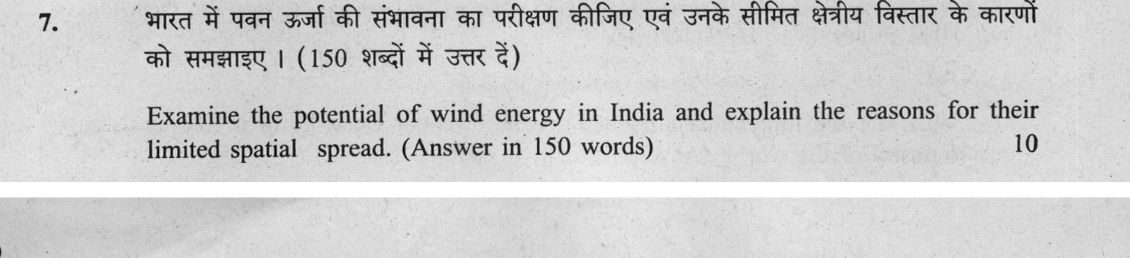
Examine the potential of wind energy in India and explain the reasons for their limited spatial spread. (Answer in 150 words) 10
हिंदी में प्रश्न पढ़ें
भारत में पवन ऊर्जा की संभावना का परीक्षण कीजिए एवं उनके सीमित क्षेत्रीय विस्तार के कारणों को समझाइए। (150 शब्दों में उत्तर दें)
Model answer
Written by UPSC Answer Check against this question's marking rubric, to the 150-word length. UPSC does not publish answers for Mains — this is one way to score well, not an official key.
India ranks fourth globally in wind power with ~45 GW installed capacity, against an estimated potential of 302 GW at 100m and 695 GW at 120m hub heights (NIWE). This resource is primarily concentrated along the monsoon-driven corridors of the Western Ghats, coastal plains, and arid zones of Tamil Nadu, Gujarat, Maharashtra, Rajasthan, and Karnataka.
Reasons for Limited Spatial Spread
Geographical and Technical Limits: Commercially viable wind speeds are confined to just 8–10 peninsular and western states. Low Capacity Utilization Factors (25–30%) and severe seasonal intermittency require dedicated storage and grid balancing, discouraging non-coastal adoption.
Infrastructure and Land Bottlenecks: High upfront capital costs, acute land acquisition conflicts, and inadequate evacuation infrastructure in remote wind corridors stall projects.
Policy and Structural Lags: Slow repowering of ageing, low-capacity turbines (notably in Tamil Nadu), delayed wind-solar hybrid integration, and unexploited offshore potential in Gujarat and Tamil Nadu have restricted spatial diversification.
Unlocking nationwide potential necessitates dedicated Green Energy Corridors, expedited offshore wind deployment, and streamlined repowering policies.
What "Examine" is asking you to do
Test the proposition the question puts to you and return a finding on how far it holds. Examine stems carry a claim, or ask whether something has happened, and expect evidence weighed both ways before the extent is stated — often with remedial measures attached.
Structure that answers it
Restate the claim as the question frames it → evidence that supports it → evidence that undercuts it → the conditions under which it holds → verdict on how far it stands
Where marks are lost
Stopping at description. An examination has to reach a finding, and “examine with justification” means the extent must be stated, not implied.
How this answer will be evaluated
Approach
Framework: Geography: explain the mechanism, then location follows. examine: intro > how/why with reasoning > evidence > conclusion Full marks: Mechanism clearly linked to location with specific examples and a map.
Key points expected
- Identify key wind-rich zones (coastal, western, peninsular)
- Explain the meteorological mechanism (monsoon, pressure gradients)
- Link physical geography to the limited spatial spread
- Provide a balanced conclusion on the potential
Evaluation rubric
Each sub-part is marked on its own, against the marks and word limit printed on the paper.
- The answer Assess wind energy potential and explain the physical reasons for its limited spatial spread. 10 marks · 150 words
examine— intro → how/why with reasoning → evidence → conclusion
Must cover
- Identify key wind-rich zones (coastal, western, peninsular)
- Explain the meteorological mechanism (monsoon, pressure gradients)
- Link physical geography to the limited spatial spread
- Provide a balanced conclusion on the potential
Loses marks
- Narrating chronology of wind energy development
- Listing locations without explaining the 'why'
- Emotive words on energy security
Earns more
- Mention specific states (Tamil Nadu, Gujarat, Rajasthan)
- Reference the 'wind corridor' concept
- Distinguish between coastal and inland wind patterns
- Mention seasonal variability of wind speed
Extra mark
- 30-second sketch map of wind corridors
- One robust statistic on installed capacity
Practice this exact question
Write your answer and it is marked point by point against the model answer above — what you covered, what you missed, what you got wrong.
Evaluate my answer →More from General Studies 2022 GS Paper I
- Q4 Describe the characteristics and types of primary rocks. (Answer in 150 words) 10
- Q5 Discuss the meaning of colour-coded weather warnings for cyclone prone areas given by Ind…
- Q6 Discuss the natural resource potentials of 'Deccan Trap'. (Answer in 150 words) 10
- Q7 Examine the potential of wind energy in India and explain the reasons for their limited s…
- Q8 Explore and evaluate the impact of 'Work From Home' on family relationships. (Answer in 1…
- Q9 How is the growth of Tier 2 cities related to the rise of a new middle class with an emph…
- Q10 Given the diversities among tribal communities in India, in which specific contexts shoul…