GS Paper III — Q15
The adoption of electric vehicles is rapidly growing worldwide. How do electric vehicles contribute to reducing carbon emissions…
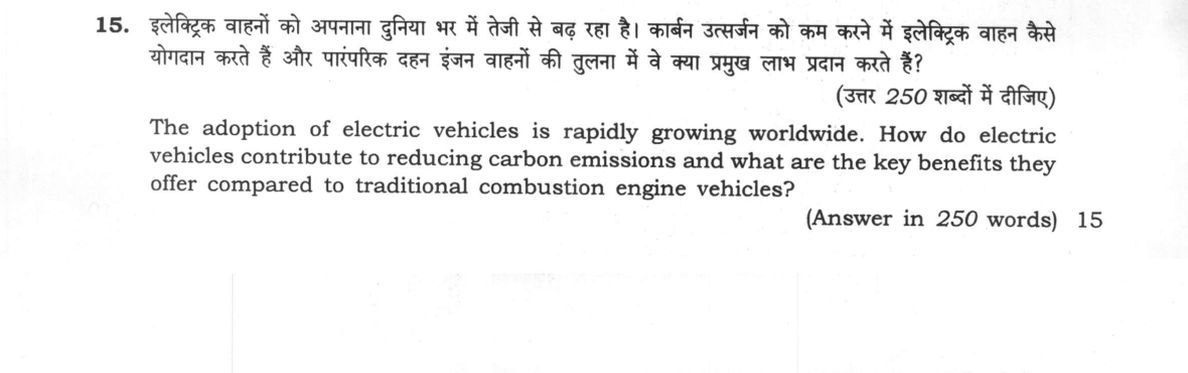
The adoption of electric vehicles is rapidly growing worldwide. How do electric vehicles contribute to reducing carbon emissions and what are the key benefits they offer compared to traditional combustion engine vehicles? (Answer in 250 words) 15 marks
हिंदी में प्रश्न पढ़ें
इलेक्ट्रिक वाहनों को अपनाना दुनिया भर में तेजी से बढ़ रहा है। कार्बन उत्सर्जन को कम करने में इलेक्ट्रिक वाहन कैसे योगदान करते हैं और पारंपरिक दहन इंजन वाहनों की तुलना में वे क्या प्रमुख लाभ प्रदान करते हैं? (उत्तर 250 शब्दों में दीजिए)
Model answer
Written by UPSC Answer Check against this question's marking rubric, to the 250-word length. UPSC does not publish answers for Mains — this is one way to score well, not an official key.
The global transition to Electric Vehicles (EVs) is a cornerstone of transport decarbonisation. EVs reduce emissions fundamentally by replacing internal combustion with electrochemical energy conversion.
Mechanisms of Emission Reduction Unlike Internal Combustion Engine (ICE) vehicles that combust fossil fuels to release greenhouse gases, particulate matter (PM2.5), and NOx, battery EVs produce zero tailpipe emissions. This directly curbs urban air toxicity in severely polluted cities like Delhi.
On a well-to-wheel basis, EVs exhibit superior energy efficiency, converting approximately 70–90% of electrical energy into mechanical drive, compared to only 20–30% thermal efficiency in ICE powertrains. Lifecycle carbon analysis reveals that while upstream battery manufacturing is carbon-intensive, the operational phase amortises this deficit rapidly. However, the net carbon reduction is heavily contingent on the power generation mix; in coal-dominated electricity grids like India's, high fossil reliance limits the absolute lifecycle benefits unless paired with aggressive renewable capacity additions.
Comparative Benefits over ICE Vehicles Beyond tailpipe elimination, EVs offer critical structural advantages: Economic and Energy Security: By displacing petroleum demand, EVs curb fiscal vulnerability to volatile global crude markets and drastically lower crude import dependency. Grid Modernisation: Through bi-directional Vehicle-to-Grid (V2G) technology, EV fleets can act as distributed energy storage systems, supplying power back during peak demand and smoothing renewable intermittency.
The Indian Context and Way Forward India is driving this shift through the FAME-II scheme, the Production Linked Incentive (PLI) for Advanced Chemistry Cell (ACC) batteries, and the national target of 30% EV market penetration by 2030. To fully realise these benefits, EV adoption must be simultaneously synchronised with grid decarbonisation and circular battery recycling frameworks.
What "Explain" is asking you to do
Make the working of something clear — what sets it off, what follows from what, and what it produces. Explain is the Commission's mechanism word: it dominates the technical papers and the “explain why” stems, where the marks sit in the causal chain and not in the label.
Structure that answers it
State what it is → the initiating condition → the chain of cause, step by step → an instance where it plays out → what the chain produces
Where marks are lost
Describing what something looks like instead of why it works that way. Naming the stages without linking them reads as description too.
How this answer will be evaluated
Approach
Framework: GS3 Environment: threat, causes, impact, mitigation. explain: definition/context > points in order > small example > short close Full marks: Clear technical distinction between tailpipe and lifecycle emissions; strong comparative analysis.
Key points expected
- Zero tailpipe emissions mechanism
- Comparison of energy efficiency (EV vs ICE)
- Reduction in local air pollutants
- Lower operational and maintenance costs
Evaluation rubric
Each sub-part is marked on its own, against the marks and word limit printed on the paper.
- The answer Explain the mechanism of carbon reduction and list key benefits over ICE vehicles. 15 marks · 250 words
explain— definition/context → points in order → small example → short close
Must cover
- Zero tailpipe emissions mechanism
- Comparison of energy efficiency (EV vs ICE)
- Reduction in local air pollutants
- Lower operational and maintenance costs
Loses marks
- Ignoring the 'comparison' aspect of the question
- Vague claims without technical reasoning
- Focusing only on policy, not technology
Earns more
- Mention of grid decarbonization (renewables)
- Noise pollution reduction
- Energy security (reduced oil import)
- Lifecycle analysis (battery manufacturing)
Extra mark
- Specific scheme (e.g., FAME II) with budget
- Simple flowchart of energy source to wheel
Practice this exact question
Write your answer and it is marked point by point against the model answer above — what you covered, what you missed, what you got wrong.
Evaluate my answer →More from General Studies 2023 GS Paper III
- Q12 Distinguish between 'care economy' and 'monetized economy'. How can care economy be broug…
- Q13 Explain the changes in cropping pattern in India in the context of changes in consumption…
- Q14 What are the direct and indirect subsidies provided to farm sector in India? Discuss the…
- Q15 The adoption of electric vehicles is rapidly growing worldwide. How do electric vehicles…
- Q16 What is the main task of India's third moon mission which could not be achieved in its ea…
- Q17 Comment on the National Wetland Conservation Programme initiated by the Government of Ind…
- Q18 The Intergovernmental Panel on Climate Change (IPCC) has predicted a global sea level ris…