GS Paper III — Q16
What is the main task of India's third moon mission which could not be achieved in its earlier mission? List the countries that…
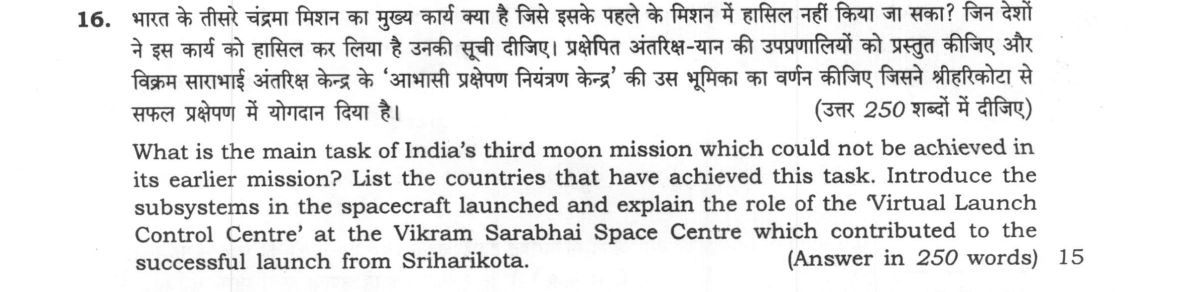
What is the main task of India's third moon mission which could not be achieved in its earlier mission? List the countries that have achieved this task. Introduce the subsystems in the spacecraft launched and explain the role of the 'Virtual Launch Control Centre' at the Vikram Sarabhai Space Centre which contributed to the successful launch from Sriharikota. (Answer in 250 words) 15 marks
हिंदी में प्रश्न पढ़ें
भारत के तीसरे चंद्रमा मिशन का मुख्य कार्य क्या है जिसे इसके पहले के मिशन में हासिल नहीं किया जा सका? जिन देशों ने इस कार्य को हासिल कर लिया है उनकी सूची दीजिए। प्रक्षेपित अंतरिक्ष-यान की उपप्रणालियों को प्रस्तुत कीजिए और विक्रम साराभाई अंतरिक्ष केंद्र के 'आभासी प्रक्षेपण नियंत्रण केंद्र' की उस भूमिका का वर्णन कीजिए जिसने श्रीहरिकोटा से सफल प्रक्षेपण में योगदान दिया है। (उत्तर 250 शब्दों में दीजिए)
Model answer
Written by UPSC Answer Check against this question's marking rubric, to the 250-word length. UPSC does not publish answers for Mains — this is one way to score well, not an official key.
The primary objective of Chandrayaan-3 was demonstrating a safe and soft landing on the lunar surface, specifically near the unexplored lunar South Pole. This task could not be achieved during Chandrayaan-2 in 2019 due to software glitches and velocity-braking anomalies during the final descent phase, resulting in the hard crash of the Vikram lander.
Countries Achieving Soft Landing India became the fourth nation in history to soft-land on the Moon, joining the former USSR, the United States, and China, followed recently by Japan (SLIM mission in 2024). India is the first to land in the lunar south polar region.
Subsystems of the Spacecraft Launched aboard the LVM3-M4 vehicle—powered by S200 solid boosters, an L110 liquid core, and a C25 cryogenic upper stage—the spacecraft comprised three integrated subsystems:
- Propulsion Module: Transported the lander-rover composite from injection orbit to a 100-km circular lunar orbit while operating the SHAPE payload.
- Lander Module (Vikram): Engineered with reinforced legs, enhanced fuel reserves, and advanced navigation instruments including the Laser Doppler Velocimeter (LDV), Lander Horizontal Velocity Camera (LHVC), and autonomous hazard detection and avoidance systems.
- Rover (Pragyan): A six-wheeled vehicle deployed from the lander, carrying the LIBS and APXS payloads for in-situ elemental analysis of lunar regolith.
Role of the Virtual Launch Control Centre (VLCC) Situated at the Vikram Sarabhai Space Centre (VSSC), Thiruvananthapuram, the VLCC provided crucial remote support to the primary Launch Control Centre at Sriharikota. It acquired real-time telemetry streams, performing automated health checks and vehicle dynamics validation during the LVM3 countdown and ascent. By enabling parallel monitoring, simulated trajectory tracking, and automated anomaly-detection algorithms, the VLCC provided mission critical redundancy, ensuring precise vehicle stage separations and accurate orbital insertion.
Chandrayaan-3’s success underscores India’s maturing space ecosystem, proving end-to-end indigenous capability in complex, deep-space exploration.
What "Explain" is asking you to do
Make the working of something clear — what sets it off, what follows from what, and what it produces. Explain is the Commission's mechanism word: it dominates the technical papers and the “explain why” stems, where the marks sit in the causal chain and not in the label.
Structure that answers it
State what it is → the initiating condition → the chain of cause, step by step → an instance where it plays out → what the chain produces
Where marks are lost
Describing what something looks like instead of why it works that way. Naming the stages without linking them reads as description too.
How this answer will be evaluated
Approach
Framework: GS3 Technology: why it matters, use, benefit, risk, policy. explain: definition/context > points in order > small example > short close Full marks: Precisely identifies the south pole landing, lists all 4 nations, details GNC/Propulsion subsystems, and clearly articulates the VLCC's specific pre-launch function.
Key points expected
- Identify soft landing on lunar south pole as the main task
- List USA, USSR, China, and Japan as countries that achieved this
- Introduce subsystems: Propulsion, Guidance, Navigation, and Control (GNC)
- Explain role of Virtual Launch Control Centre (VLCC) at VSSC
Evaluation rubric
Each sub-part is marked on its own, against the marks and word limit printed on the paper.
- The answer Identify the specific objective of Chandrayaan-3, list successful nations, describe spacecraft subsystems, and explain the role of the Virtual Launch Control Centre. · 250 words
explain— definition/context → points in order → small example → short close
Must cover
- Identify soft landing on lunar south pole as the main task
- List USA, USSR, China, and Japan as countries that achieved this
- Introduce subsystems: Propulsion, Guidance, Navigation, and Control (GNC)
- Explain role of Virtual Launch Control Centre (VLCC) at VSSC
Loses marks
- Confusing Chandrayaan-1/2 objectives with Chandrayaan-3
- Listing countries that only orbited the moon but did not land
- Vague description of subsystems without naming GNC or Propulsion
Earns more
- Mention specific role of VLCC in pre-launch checks
- Distinguish between Chandrayaan-2 failure and Chandrayaan-3 success
- Mention the launch vehicle (LVM3) and its role
- Reference the specific date of launch (July 2023)
Extra mark
- Mention the specific landing site (Shiv Shakti Point)
- Reference the specific payload (Vikram lander, Pragyan rover)
Practice this exact question
Write your answer and it is marked point by point against the model answer above — what you covered, what you missed, what you got wrong.
Evaluate my answer →More from General Studies 2023 GS Paper III
- Q13 Explain the changes in cropping pattern in India in the context of changes in consumption…
- Q14 What are the direct and indirect subsidies provided to farm sector in India? Discuss the…
- Q15 The adoption of electric vehicles is rapidly growing worldwide. How do electric vehicles…
- Q16 What is the main task of India's third moon mission which could not be achieved in its ea…
- Q17 Comment on the National Wetland Conservation Programme initiated by the Government of Ind…
- Q18 The Intergovernmental Panel on Climate Change (IPCC) has predicted a global sea level ris…
- Q19 What are the internal security challenges being faced by India? Give out the role of Cent…